
AI for Interview Transcripts Explained: Complete Guide

Over 80 percent of organizations now rely on AI-powered tools to handle interview transcripts. As digital conversations surge in workplaces and research, the demand for fast, accurate, and insightful transcription has never been higher. Understanding how artificial intelligence transforms raw audio into structured, meaningful content opens up new possibilities for efficiency and clarity in every conversation.
Table of Contents
- Defining AI for Interview Transcripts
- How Real-Time AI Processing Works
- Key Features and Capabilities Overview
- Data Privacy, Security, and Compliance
- Pros, Limitations, and Common Pitfalls
Key Takeaways
| Point | Details |
|---|---|
| Advanced Transcription Technologies | AI for interview transcripts utilizes Automatic Speech Recognition and Natural Language Processing to enhance accuracy and efficiency in converting speech to text. |
| Real-Time Processing Benefits | Real-time AI systems provide instant transcription and contextual analysis, making interviews more dynamic and responsive. |
| Privacy and Security Measures | Strong data protection practices, including encryption and anonymization, are crucial for maintaining user trust in AI transcription technologies. |
| Pros and Limitations | While offering efficiency and reduced bias, AI transcription systems may misinterpret nuances and are dependent on high-quality training data. |
Defining AI for Interview Transcripts
AI for interview transcripts represents an advanced technological approach that transforms how conversations are captured, analyzed, and understood. At its core, this innovative technology uses artificial intelligence to automatically convert spoken language during interviews into accurate, structured written text while providing contextual insights.
According to research from the arXiv Interview AI-ssistant system, AI transcription goes beyond simple text conversion. This technology exemplifies real-time human-AI collaboration, focusing on assisting interviewers during both preparation and execution phases. The system can intelligently parse complex conversational nuances, identifying key themes, emotional undertones, and critical information that might be missed during manual transcription.
The technological capabilities of AI interview transcription include several powerful features:
- Automatic Speech Recognition (ASR): Converts spoken words into text with high accuracy
- Natural Language Processing (NLP): Understands context, sentiment, and semantic meaning
- Real-time Transcription: Provides immediate text conversion during live interviews
- Multilingual Support: Can transcribe and translate across different languages
- Intelligent Summarization: Generates concise summaries of interview content
Research from MimiTalk further highlights the transformative potential of this technology, introducing a dual-agent AI framework designed to enhance qualitative research by automating conversational data collection. This approach significantly improves the efficiency and scalability of interview transcription processes, reducing human error and saving substantial time for researchers and professionals across various industries.

How Real-Time AI Processing Works
Real-time AI processing in interview transcription represents a sophisticated technological marvel that enables instant analysis and conversion of spoken communication. This dynamic process involves multiple complex layers of computational intelligence working simultaneously to transform raw audio input into meaningful, structured data.
According to research from the Interview AI-ssistant system, real-time AI processing demonstrates remarkable capabilities in live interview scenarios. The system provides immediate assistance to interviewers through advanced technologies like real-time transcription and adaptive question generation. By leveraging sophisticated algorithms, these AI systems can instantaneously process speech, recognize linguistic patterns, and generate contextually relevant responses.
The core components of real-time AI processing include:
- Speech Recognition: Converts audio input into text with high precision
- Natural Language Understanding: Interprets semantic meaning and context
- Contextual Analysis: Identifies emotional tone and underlying communication nuances
- Instantaneous Response Generation: Creates relevant follow-up questions or insights
- Machine Learning Adaptation: Continuously improves processing accuracy
Additional research from SimInterview further illustrates the potential of real-time AI processing by showcasing multilingual interview simulations. These advanced systems utilize large language models to dynamically adapt interview scenarios, processing responses instantaneously across different linguistic contexts.
This breakthrough technology demonstrates how AI can transform traditional interview methodologies, making communication more efficient, accurate, and adaptive.
Key Features and Capabilities Overview
AI interview transcription technology represents a sophisticated suite of advanced capabilities designed to revolutionize how professional conversations are captured, analyzed, and understood. These intelligent systems go far beyond simple audio-to-text conversion, offering comprehensive solutions that transform the entire interview experience.
Research from MimiTalk highlights an innovative approach to conversational data collection, featuring a dual-model system with a supervisor model for strategic oversight and a conversational model for dynamic question generation. This sophisticated framework enables more nuanced, ethical, and scalable interview processing across various professional contexts.
The key capabilities of AI interview transcription technology include:
- Multilingual Processing: Transcription and translation across multiple languages
- Semantic Understanding: Deep comprehension of context and underlying communication nuances
- Emotion Detection: Analyzing speaker sentiment and emotional tone
- Adaptive Questioning: Generating contextually relevant follow-up queries
- Comprehensive Data Extraction: Identifying key insights, themes, and critical information
Further insights from SimInterview demonstrate the technology’s remarkable adaptability, showcasing personalized interview experiences that can dynamically adjust scenarios to match individual resumes and specific job requirements. These advanced systems represent a paradigm shift in how professional interactions are documented, analyzed, and understood, offering unprecedented precision and depth of insight.
Data Privacy, Security, and Compliance
Data privacy and security represent critical considerations in the rapidly evolving landscape of AI interview transcription technologies. As these systems handle sensitive personal and professional information, robust protective mechanisms are essential to maintain user trust and meet stringent regulatory requirements.
Research from SimInterview highlights a sophisticated approach to addressing privacy concerns through a contestable AI design. This innovative framework emphasizes key principles such as explainability, bias detection, and maintaining a human-in-the-loop process. By prioritizing transparency and accountability, these systems aim to meet emerging regulatory expectations and protect individual data rights.
The core privacy and security strategies implemented in advanced AI interview transcription technologies include:
- Encryption: Protecting data during transmission and storage
- Anonymization: Removing personally identifiable information
- Access Controls: Implementing strict user authentication protocols
- Audit Trails: Tracking and logging all data interactions
- Consent Management: Ensuring explicit user permissions for data usage
Additional insights from the Interview AI-ssistant research underscore the importance of developing human-AI collaborative interfaces that prioritize data protection in qualitative research tools. These systems are designed to balance technological innovation with rigorous privacy safeguards, ensuring that sensitive interview data remains confidential and secure throughout the entire processing lifecycle.
Pros, Limitations, and Common Pitfalls
AI interview transcription technologies present a complex landscape of transformative potential and inherent challenges. While these innovative systems offer unprecedented capabilities, they also require nuanced understanding and strategic implementation to maximize their effectiveness and mitigate potential drawbacks.
Research from MimiTalk reveals critical insights into the psychological dynamics of AI-driven interviews. The studies indicate that these technologies can significantly reduce interview anxiety for candidates, enabling more comfortable and authentic interactions. However, the research also highlights a crucial limitation: AI systems may struggle to capture the subtle cultural and emotional nuances that human interviewers naturally perceive.
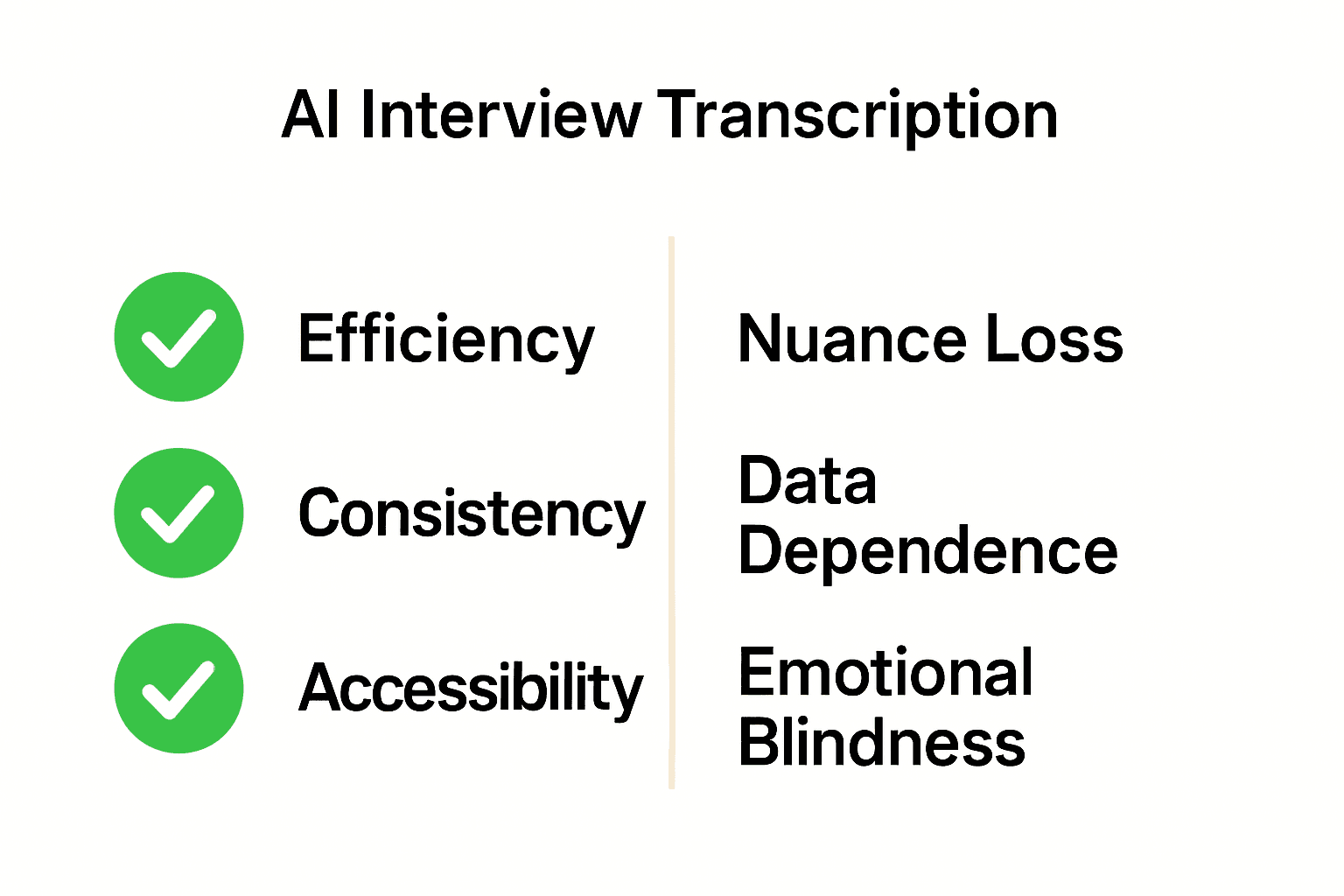
The comprehensive pros and limitations of AI interview transcription technologies include:
Pros:
- Efficiency: Rapid processing and analysis of interview data
- Consistency: Standardized evaluation criteria
- Accessibility: Support for multiple languages and remote interviewing
- Reduced Bias: More objective assessment mechanisms
- Cost-Effectiveness: Lower operational expenses
Limitations:
- Potential misinterpretation of contextual communication
- Limited emotional intelligence
- Challenges with highly complex or nuanced conversations
- Dependency on quality of underlying training data
- Potential privacy and ethical concerns
Further insights from SimInterview emphasize the technology’s experimental nature, noting variations in performance across different resume types and the significant influence of cultural norms on questioning strategies. These findings underscore the importance of continuous refinement and human oversight in AI-driven interview technologies.
Transform Your Interview Experience with Real-Time AI Assistance
Navigating the challenges of interview transcription is no small task. The article highlights how capturing detailed conversations and analyzing emotional nuances demand advanced AI-powered solutions like automatic speech recognition and natural language processing. If you want to reduce anxiety and improve accuracy by having an AI that listens and responds instantly, you need a tool built to support this complex process.

Discover how Parakeet AI, a real-time AI job interview assistant, can effectively convert spoken questions into smart, tailored answers right as your interview unfolds. This technology not only saves you time but also offers consistent, context-aware support to help you stay confident and prepared. Take control of your next interview and experience the future of intelligent transcription today by visiting Parakeet AI and start turning conversations into success.
Frequently Asked Questions
What is AI for interview transcripts?
AI for interview transcripts is a technology that uses artificial intelligence to automatically convert spoken language during interviews into accurate, structured written text, providing contextual insights beyond simple text conversion.
How does real-time AI processing enhance interview transcription?
Real-time AI processing enhances interview transcription by enabling immediate text conversion, recognizing speech patterns, understanding context, and generating relevant follow-up questions during live interviews.
What are some key features of AI interview transcription technology?
Key features of AI interview transcription technology include automatic speech recognition, natural language processing, multilingual support, intelligent summarization, and emotion detection.
How does AI address privacy and security concerns in interview transcription?
AI addresses privacy and security concerns by implementing strategies such as encryption, anonymization, access controls, audit trails, and consent management to protect sensitive data during the transcription process.