
Behavioral Interview Tips: Complete Guide to Success

Most job interviews fail to predict real workplace success, yet behavioral interviews have changed the game by focusing on how candidates actually respond to challenges. Employers use this approach because evidence shows that past actions are the best indicators of future performance. If you are preparing for your next big interview, understanding the principles behind behavioral interviews gives you the edge to turn your experience into powerful proof of your skills.
Table of Contents
- Behavioral Interviews Defined And Core Principles
- Common Questions And Response Frameworks
- Key Behaviors And Competency Areas Assessed
- Practical Example Answers And Real-World Scenarios
- Mistakes To Avoid In Behavioral Interviews
Key Takeaways
| Point | Details |
|---|---|
| Behavioral Interviews | These interviews focus on past behavior to predict future performance, emphasizing concrete examples rather than hypothetical scenarios. |
| STAR Method | This structured response framework (Situation, Task, Action, Result) helps candidates deliver clear and compelling narratives. |
| Core Competencies | Common areas assessed include adaptability, leadership, problem-solving, communication, teamwork, and initiative. |
| Preparation Tips | Candidates should prepare diverse storytelling banks, focusing on authenticity and quantifiable results to avoid common pitfalls. |
Behavioral Interviews Defined And Core Principles
Behavioral interviews represent a sophisticated approach to candidate assessment that goes far beyond traditional questioning techniques. According to Kansas State University, these interviews are grounded in a fundamental psychological premise: past behavior predicts future performance. By using carefully structured questions, employers aim to understand how candidates have previously navigated professional challenges.
The core philosophy of behavioral interviewing centers on extracting detailed, concrete examples of a candidate’s real-world experience. Instead of hypothetical scenarios, interviewers seek specific stories that reveal an individual’s problem-solving skills, emotional intelligence, and professional capabilities. For example, rather than asking “How would you handle conflict?”, a behavioral interviewer might request, “Tell me about a time when you successfully resolved a disagreement with a colleague.”
Key characteristics of behavioral interviews include:
- Deep exploration of past experiences
- Focus on specific, verifiable situations
- Emphasis on demonstrated skills over theoretical knowledge
- Reduction of interviewer bias through structured questioning
These interviews provide significant advantages for employers. By Kansas State University, the technique “helps predict employee’s performance and reduces subjectivity when making a selection.” This approach transforms the interview from a mere conversation into a strategic assessment tool that offers genuine insights into a candidate’s potential.
For job seekers, understanding behavioral interview principles means preparing comprehensive, authentic narratives that showcase professional growth, adaptability, and problem-solving skills. The more precisely you can articulate past achievements, the more effectively you’ll demonstrate your value to potential employers.
For more insights on crafting compelling interview responses, check out our guide on understanding how to answer interview questions.
Common Questions And Response Frameworks
Behavioral interviews are characterized by their unique approach to uncovering a candidate’s professional capabilities through targeted questioning. The core strategy involves asking questions that require candidates to provide specific, detailed stories from their past work experiences. This method moves beyond generic responses to reveal true problem-solving skills and professional behaviors.
Response Frameworks are critical tools for navigating behavioral interview questions effectively. The most widely recognized approach is the STAR method (Situation, Task, Action, Result), which provides a structured way to craft compelling narratives:
- Situation: Briefly describe the context of the specific scenario
- Task: Explain your specific responsibility in that situation
- Action: Detail the precise steps you took to address the challenge
- Result: Share the outcomes, emphasizing positive impacts and lessons learned
Common behavioral interview questions typically explore several key areas:
- Leadership and team collaboration
- Problem-solving and critical thinking
- Conflict resolution
- Adaptability and learning agility
- Handling professional challenges
- Demonstrating initiative and innovation
When preparing responses, candidates should focus on selecting stories that highlight transferable skills and demonstrate professional growth. The goal is not just to answer the question, but to showcase your ability to think strategically, work effectively, and learn from experiences.

For a comprehensive collection of potential interview questions to practice with, explore our top common interview questions and answers for 2025. Practicing with diverse scenarios will help you develop the confidence and clarity needed to excel in behavioral interviews.
Key Behaviors And Competency Areas Assessed
Behavioral interviews are designed to probe deep into a candidate’s professional capabilities by examining specific competency areas that predict future job performance. As noted by West Texas A&M University, these interviews focus on uncovering how candidates have navigated complex professional challenges, revealing their adaptability, problem-solving skills, and emotional intelligence.
Core Competency Areas typically assessed during behavioral interviews include:
- Adaptability: Ability to embrace change and learn quickly
- Leadership: Capacity to guide, motivate, and inspire teams
- Problem-Solving: Skill in analyzing challenges and developing effective solutions
- Communication: Proficiency in clear, effective interpersonal interactions
- Teamwork: Capability to collaborate and work effectively with diverse groups
- Initiative: Demonstrated proactivity and self-motivation
Interviewers seek concrete evidence of these competencies through targeted questioning. University of Pennsylvania Career Services highlights that more employers are using behavioral questions as predictive tools, asking candidates to “recount a specific example of a past experience” that illuminates their professional capabilities.
Typical behavioral questions probe critical scenarios such as handling unprecedented challenges, managing change, and demonstrating professional growth. For instance, an interviewer might ask you to describe a time when you were assigned a task outside your job description, or how you adapted to a significant workplace change. These questions are designed to move beyond surface-level responses, requiring candidates to provide detailed narratives that showcase their professional maturity, strategic thinking, and ability to learn and grow.
Preparing for these assessments requires deep self-reflection and the ability to articulate your experiences compellingly.
The key is to select stories that not only answer the question but also highlight your unique strengths and professional potential.
Practical Example Answers And Real-World Scenarios
Crafting compelling behavioral interview responses requires strategic storytelling and thoughtful preparation. University of the Pacific emphasizes that successful interviews depend on constructing STAR stories that authentically demonstrate professional capabilities. These narratives should seamlessly integrate a specific Situation, clear Task, decisive Action, and meaningful Result.
Effective STAR story components include:
- Situation: Brief, clear context highlighting professional challenge
- Task: Your specific responsibility or objective
- Action: Precise steps taken to address the challenge
- Result: Concrete outcomes, quantifiable achievements, and personal learnings
Real-world scenario examples might include:
- Leadership Challenge: Describe how you successfully led a team project with competing priorities
- Problem-Solving: Explain a complex workplace issue you resolved through strategic thinking
- Conflict Resolution: Share an instance where you mediated a challenging team disagreement
- Adaptability: Illustrate how you quickly learned a new skill or technology
As Yale’s Office of Career Strategy suggests, your answers should be concise yet engaging, focusing on what you learned and how experiences have shaped your professional growth. The goal is to create a “bank of stories” that can be subtly modified to address various interview questions.
For additional practice and insight into crafting exceptional interview responses, explore our mock interview questions and answers to ace your interview. Preparing a diverse range of stories will help you approach behavioral interviews with confidence and clarity.
Mistakes To Avoid In Behavioral Interviews
Behavioral interviews require nuanced preparation and strategic storytelling. Yale’s Office of Career Services emphasizes that most interviews rely on behavioral questioning techniques designed to uncover candidates’ past accomplishments as predictors of future performance. Understanding common pitfalls can significantly improve your interview effectiveness.
Critical Mistakes to Sidestep:
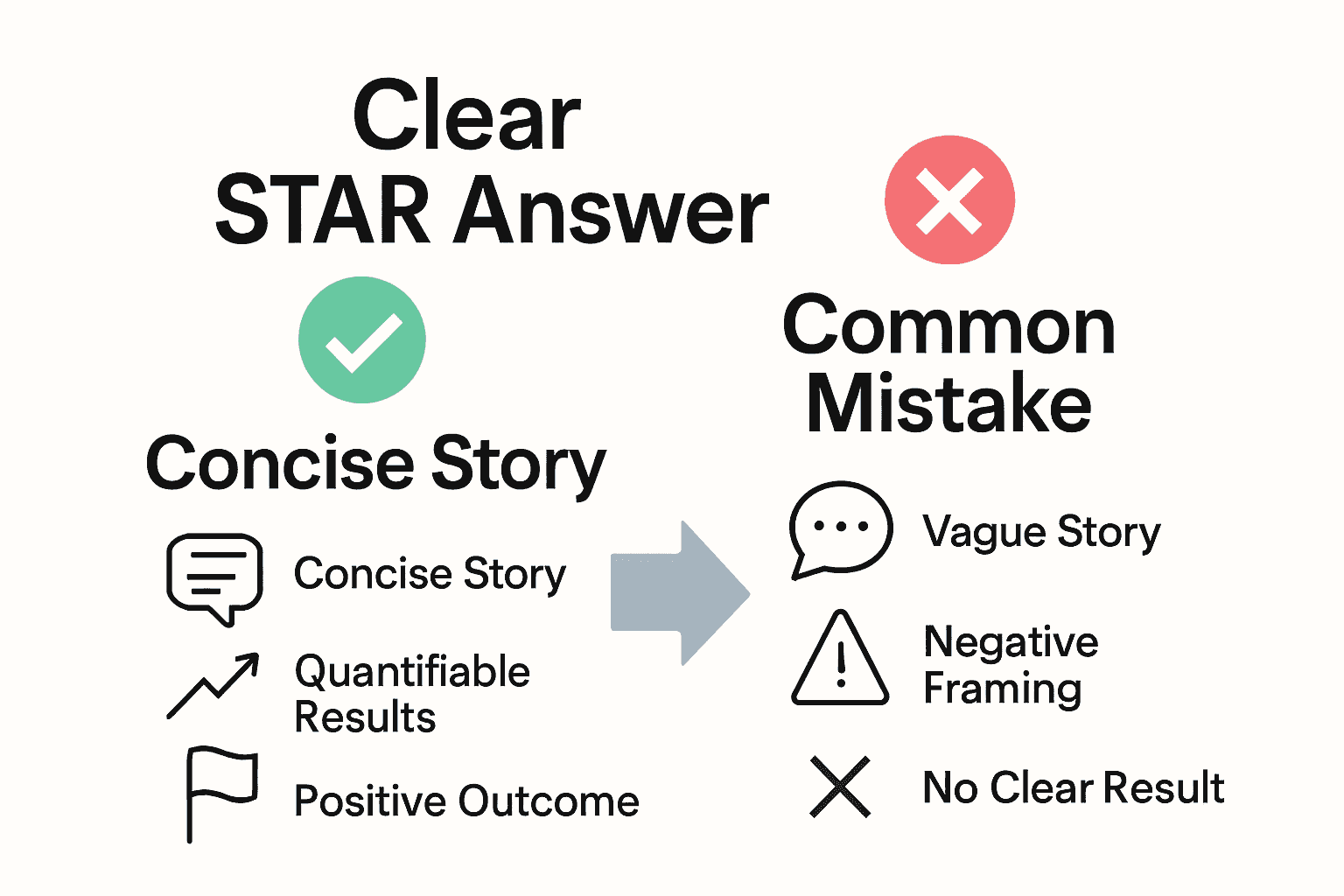
- Vague Storytelling: Providing generic, unstructured responses without specific details
- Fabricating Experiences: Inventing stories instead of drawing from authentic professional moments
- Negative Framing: Focusing on problems without highlighting personal growth or solutions
- Rambling Narratives: Losing interviewer’s attention through overly lengthy explanations
- Lack of Quantifiable Results: Failing to demonstrate concrete, measurable outcomes
Potential red flags that can undermine your behavioral interview performance include:
- Not preparing a diverse story bank that addresses multiple competency areas
- Overlooking the importance of reflection and learning in your narratives
- Neglecting to practice concise, engaging storytelling techniques
- Avoiding responsibility or blaming others in challenging scenarios
Successful candidates approach behavioral interviews as opportunities to showcase their professional journey.
This means crafting stories that are honest, structured, and demonstrate personal and professional development. The goal is not just answering questions, but telling a compelling narrative that reveals your unique professional capabilities.
To develop your interview storytelling skills and avoid common pitfalls, check out our guide on how to answer interview questions confidently. Preparation and strategic self-presentation are your most powerful interview tools.
Master Behavioral Interviews with Real-Time AI Support
Nailing behavioral interviews means mastering storytelling with the STAR method and confidently sharing real, detailed experiences. Yet many candidates struggle with recalling the right examples under pressure or crafting responses that truly showcase adaptability, leadership, and problem-solving. If you want to stop feeling anxious and start delivering answers that stand out, you need a smart way to practice and get instant, tailored feedback.

Take control of your interview success today with Parakeet AI, a real-time AI job interview assistant that listens and provides accurate answers for every question. Whether you need help structuring your STAR stories or want to refine your storytelling to avoid common pitfalls, Parakeet AI is here to guide you step-by-step. Don’t miss the chance to transform nervousness into confidence by exploring our resources like mock interview questions and answers to ace your interview and learn how to answer interview questions confidently.
Visit Parakeet AI right now to practice smarter, prepare deeper, and show your best self in every behavioral interview.
Frequently Asked Questions
What are behavioral interviews?
Behavioral interviews are a candidate assessment technique that focuses on how past behavior predicts future performance. Interviewers ask structured questions to explore specific experiences and skills rather than relying on hypothetical scenarios.
How do I prepare for a behavioral interview?
To prepare for a behavioral interview, use the STAR method (Situation, Task, Action, Result) to craft detailed stories from your past experiences. Focus on selecting narratives that demonstrate key competencies like leadership, problem-solving, and adaptability.
What common questions might I encounter in a behavioral interview?
Typical behavioral interview questions explore areas such as conflict resolution, teamwork, adaptability, and problem-solving. Examples include “Tell me about a time you resolved a disagreement with a colleague” or “Describe a challenge you faced and how you overcame it.”
What mistakes should I avoid during a behavioral interview?
Key mistakes to avoid include providing vague responses, fabricating experiences, focusing only on problems without solutions, rambling through answers, and failing to showcase quantifiable results or lessons learned. Preparation and structured storytelling are essential for success.