
Common Interview Formats: What Jobseekers Should Know

Most American employers rely on at least four distinct interview formats during the hiring process, shaping how candidates are evaluated from the first conversation to the final offer. Understanding these formats matters because each one measures different strengths, from technical skills to problem solving and cultural fit. With over 80% of large American companies using multiple interview types for a single role, knowing what to expect can make a critical difference in your job search preparation and performance.
Table of Contents
- Defining Common Interview Formats And Their Purpose
- Key Types Of Interview Formats Explained
- How Interview Formats Shape The Hiring Process
- Pros, Cons, And Common Pitfalls
- Choosing The Right Interview Format For Success
Key Takeaways
| Point | Details |
|---|---|
| Understanding Interview Formats | Different interview formats serve unique purposes and help employers evaluate candidates comprehensively. Familiarizing oneself with these formats enhances candidate preparedness. |
| Importance of Behavioral and Technical Interviews | Behavioral interviews reveal past performance, while technical interviews assess specific skills. Both formats provide critical insights into future job performance. |
| Need for Versatile Preparation | Job candidates should adapt their preparation strategies to align with industry-specific interview expectations, enhancing their competitiveness. |
| Awareness of Interview Pitfalls | Recognizing common pitfalls, such as unconscious bias and over-reliance on certain formats, allows both employers and candidates to navigate interviews more effectively. |
Defining Common Interview Formats And Their Purpose
Employers use several strategic interview formats to assess job candidates effectively, each designed with unique objectives and evaluation techniques. Understanding these different interview styles helps jobseekers prepare more comprehensively and demonstrate their capabilities across multiple assessment frameworks. Modern recruitment practices recognize that no single interview type provides a complete picture of a candidate’s potential.
According to Boston University’s employment research, four primary interview formats dominate professional hiring processes: screening interviews, behavioral interviews, technical interviews, and case interviews. Screening interviews serve as initial candidate filters, typically conducted by human resources professionals or recruiters to verify basic qualifications and eliminate candidates who do not meet minimum requirements. These brief conversations help organizations efficiently manage large applicant pools by quickly identifying promising candidates.
Behavioral and technical interviews represent more specialized assessment methods. Behavioral interviews focus on past performance, asking candidates to describe specific work experiences that demonstrate critical skills like problem-solving, teamwork, and adaptability. Interviewers use these conversations to predict future job performance by examining how candidates have handled professional challenges. Technical interviews, common in fields like technology, engineering, and science, evaluate candidates’ specific professional competencies through targeted questions, practical assignments, or skill demonstrations.
Group and panel interview formats add additional complexity to candidate evaluation. Panel interviews involve multiple interviewers simultaneously assessing a candidate, providing a comprehensive perspective on the applicant’s communication skills, confidence, and ability to manage high-pressure situations. These structured conversations allow organizations to gather diverse perspectives and reduce individual interviewer bias, ensuring a more holistic candidate assessment.
Key Types Of Interview Formats Explained
Professional job interviews encompass diverse formats, each designed to extract specific insights about a candidate’s capabilities, personality, and potential fit within an organization. Understanding these interview types allows jobseekers to prepare strategically and present themselves more effectively across different assessment frameworks. Modern employers recognize the value of using multiple interview approaches to gain a comprehensive evaluation.
Chronological interviews represent a traditional format where interviewers systematically explore a candidate’s professional history, asking detailed questions about previous roles, responsibilities, and career progression. These interviews typically follow a linear timeline, enabling recruiters to understand an applicant’s professional development, skill acquisition, and career trajectory. Candidates should prepare to discuss their work experiences coherently, highlighting achievements and demonstrating how past experiences align with the potential new role.

More specialized interview formats include case interviews, group interviews, and portfolio-based interviews. Case interviews, predominantly used in consulting and strategic roles, challenge candidates to solve complex business problems in real-time, assessing analytical thinking and problem-solving skills. Group interviews evaluate interpersonal dynamics by observing how candidates interact, communicate, and collaborate with potential colleagues. Portfolio-based interviews, common in creative industries like design, marketing, and media, require candidates to showcase their previous work, demonstrating practical skills and professional accomplishments.
Technical and behavioral interview formats provide deeper insights into a candidate’s professional competencies. Technical interviews, prevalent in technology, engineering, and scientific fields, test specific professional skills through targeted questions, practical assignments, or skill demonstrations. Behavioral interviews explore past performance by asking candidates to describe specific work experiences that reveal critical skills like adaptability, leadership, and conflict resolution. These interview styles help employers predict future job performance by understanding how candidates have navigated professional challenges.
How Interview Formats Shape The Hiring Process
The strategic selection of interview formats plays a critical role in transforming recruitment from a simple screening process to a sophisticated talent acquisition methodology. Different interview approaches serve as precision tools that help organizations evaluate candidates beyond traditional resume assessments, providing nuanced insights into professional capabilities, cultural fit, and potential long-term performance. This multifaceted approach allows employers to construct a comprehensive understanding of a candidate’s professional potential.
Organizations strategically design interview formats to address specific evaluation objectives, with each format targeting distinct aspects of candidate assessment. Understanding the interview assessment workflow reveals how employers systematically deconstruct candidate potential through carefully structured interactions. Screening interviews quickly filter candidates based on basic qualifications, while behavioral interviews explore past performance patterns. Technical interviews assess specialized skills, and case interviews evaluate analytical thinking and problem-solving capabilities.
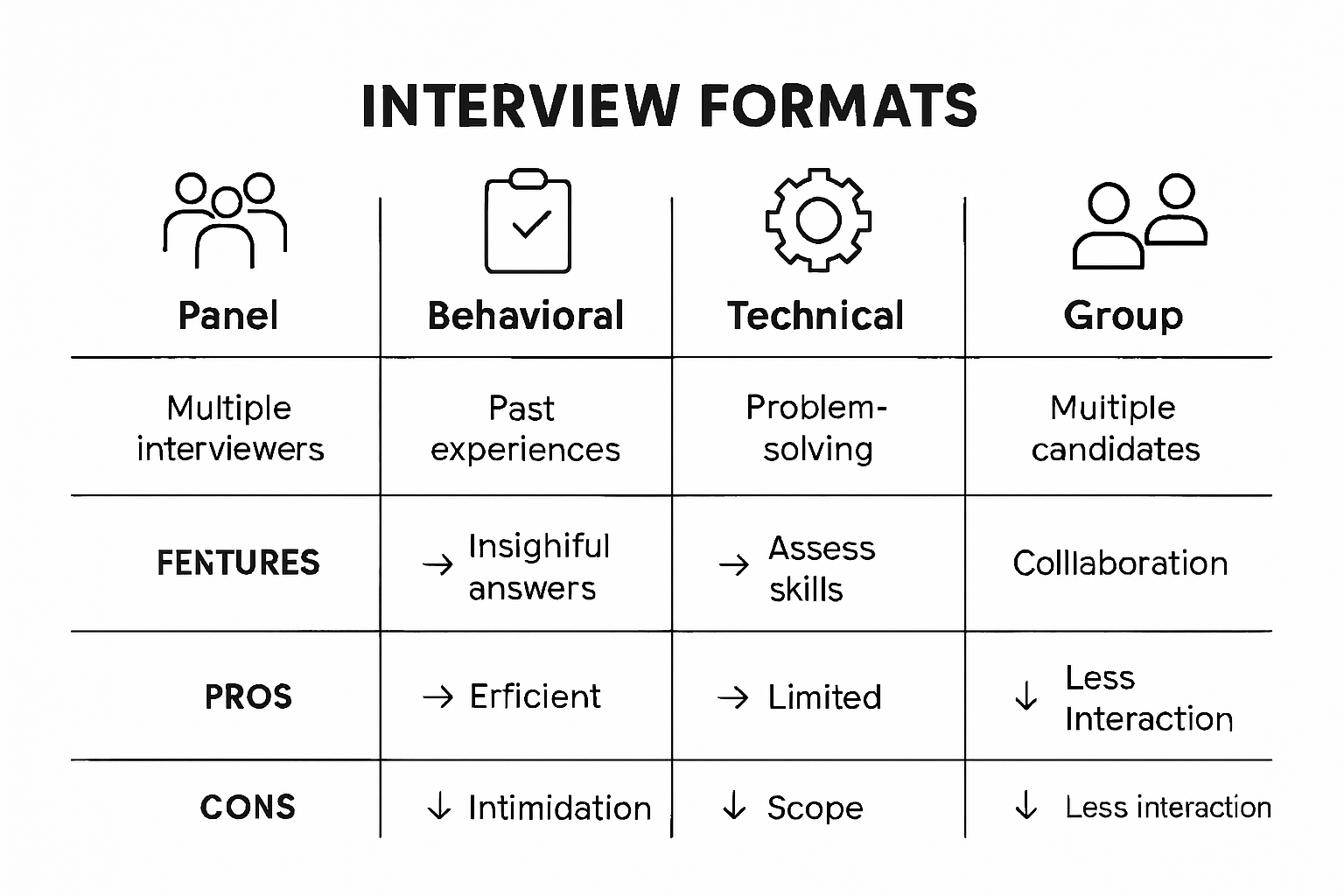
The complexity of modern hiring processes demands a holistic approach that goes beyond traditional linear assessment methods. Organizational matching has become increasingly sophisticated, with interview formats designed to evaluate not just professional competencies but also soft skills, emotional intelligence, and cultural alignment. Group interviews, for instance, allow employers to observe interpersonal dynamics, communication skills, and collaborative potential in real-time. Portfolio-based interviews in creative fields enable candidates to demonstrate tangible skills and professional achievements, providing a more comprehensive view of their capabilities.
Technological advancements and evolving workplace dynamics continue to reshape interview formats, introducing innovative assessment techniques. Virtual interviewing platforms, behavioral assessment tools, and AI-driven screening processes are transforming traditional recruitment paradigms. These technological interventions enable more objective, data-driven candidate evaluations, reducing unconscious bias and providing deeper insights into candidate potential. As workplace requirements become more complex, interview formats will likely continue to evolve, becoming more sophisticated, personalized, and aligned with specific organizational needs.
Pros, Cons, And Common Pitfalls
Interview formats represent powerful evaluation tools, but they are not without inherent limitations and potential challenges that both employers and candidates must navigate carefully. Understanding these nuanced dynamics helps professionals approach interviews more strategically, minimizing potential miscommunications and maximizing opportunities for meaningful professional assessment. Each interview format carries unique strengths and potential drawbacks that can significantly impact hiring outcomes.
Behavioral interviews, while providing deep insights into past performance, can inadvertently introduce several assessment challenges. What is Virtual Interviewing? highlights how technological adaptations are transforming traditional interview approaches, revealing both opportunities and potential pitfalls. Candidates might struggle to articulate complex past experiences effectively, while interviewers could misinterpret responses or place excessive weight on isolated anecdotes. The retrospective nature of these interviews can sometimes fail to predict future job performance accurately, creating a potential mismatch between perceived and actual capabilities.
Technical and case interviews present their own set of complex assessment challenges. These formats demand candidates demonstrate immediate problem-solving skills under significant pressure, which might not always translate to real-world job performance. Contextual limitations become apparent when interviews rely too heavily on theoretical scenarios disconnected from actual workplace dynamics. High-performing professionals might struggle with artificial interview constraints, while candidates skilled at interview performances might not necessarily excel in practical work environments. This disconnect underscores the importance of using multiple assessment methods to develop a comprehensive candidate profile.
Common interview pitfalls include unconscious bias, over-reliance on specific interview formats, and inadequate preparation from both interviewer and candidate perspectives. Employers must design interview processes that balance systematic evaluation with genuine human connection, avoiding excessive standardization that might overlook unique candidate potential. Candidates, meanwhile, should approach interviews as collaborative conversations, demonstrating adaptability, self-awareness, and genuine professional passion. By recognizing and mitigating these potential limitations, organizations can develop more nuanced, effective hiring strategies that identify truly exceptional talent.
Choosing The Right Interview Format For Success
Selecting the optimal interview format requires strategic self-assessment, industry awareness, and a nuanced understanding of professional presentation techniques. Job candidates must approach interview preparation as a targeted mission, recognizing that different roles and organizational cultures demand unique communication and evaluation approaches. The ability to adapt and excel across multiple interview formats can significantly enhance a candidate’s competitive advantage in the job market.
Job interview tips for success emphasize the importance of matching interview preparation strategies to specific industry expectations. Professional versatility becomes crucial when navigating diverse interview formats, from technical screenings in technology sectors to behavioral assessments in service-oriented industries. Candidates should develop a flexible skill set that allows them to demonstrate technical competence, interpersonal skills, and problem-solving capabilities across different evaluation frameworks.
Industry-specific considerations play a pivotal role in interview format selection and preparation. Creative fields like design and marketing often utilize portfolio-based interviews that prioritize tangible work samples, while technical disciplines like engineering and computer science rely heavily on case interviews and practical skill demonstrations. Candidates must research industry-specific interview norms, understanding the unique assessment priorities of their target professional domains. This targeted approach enables more authentic, compelling professional presentations that align with organizational expectations.
Successful interview navigation requires a holistic approach that balances thorough preparation with genuine professional authenticity. Candidates should develop comprehensive interview toolkits that include adaptable storytelling techniques, concise communication skills, and the ability to articulate professional experiences across various formats. By cultivating strategic flexibility, professionals can transform interview experiences from potential challenges into opportunities for meaningful career advancement, demonstrating not just their technical capabilities but their capacity for nuanced professional communication.
Master Every Interview Format With Confidence
Navigating the complex world of interviews can be overwhelming. This article highlights common challenges such as adapting to behavioral, technical, and case interview styles while avoiding pitfalls like miscommunication and pressure. Whether you must demonstrate technical expertise or showcase past experiences, preparation and adaptability are key.
Take control of your interview journey today with Parakeet AI, a real-time AI job interview assistant that listens and helps you respond to every question effectively. Don’t let unfamiliar interview formats or nerves hold you back. Visit Parakeet AI now and transform your preparation with smart, instant support tailored to any interview style. Learn more about how to choose the right interview format and enhance your performance through strategic practice at Parakeet AI. Start turning interview uncertainty into opportunity right now.
Frequently Asked Questions
What are the primary types of interview formats used in hiring processes?
Employers typically use four primary interview formats: screening interviews, behavioral interviews, technical interviews, and case interviews. Each format serves a unique purpose in assessing candidates’ qualifications and potential fit for the role.
How do behavioral interviews differ from technical interviews?
Behavioral interviews focus on past work experiences that demonstrate critical skills like problem-solving and teamwork, while technical interviews specifically assess candidates’ professional competencies through targeted questions and practical assignments.
What should candidates expect during a panel interview?
In a panel interview, multiple interviewers evaluate a candidate simultaneously. This format allows for diverse perspectives on the candidate’s communication skills, confidence, and ability to handle pressure.
How can jobseekers prepare for different interview formats?
Jobseekers should conduct research on the specific interview formats common in their target industries, develop adaptable communication techniques, and practice articulating their experiences across various assessment frameworks to prepare effectively.