
How to Structure Interview Responses for Success

Feeling anxious about job interviews is common, especially for recent graduates or professionals starting fresh in a new industry. Interviews today are more than a test of knowledge—they require you to interpret questions, showcase your professional qualities, and deliver responses that stand out in a competitive market. Structured guidance, combined with AI technology, gives you the tools to transform uncertainty into confidence, helping you craft answers that directly reveal your strengths and fit for any role.
Table of Contents
- Step 1: Assess The Interview Question Carefully
- Step 2: Select A Clear Response Framework
- Step 3: Personalize Your Answer With Ai
- Step 4: Organize Key Points Logically
- Step 5: Review And Refine Your Response
Quick Summary
| Key Point | Explanation |
|---|---|
| 1. Analyze Interview Questions Thoroughly | Break down each question to understand its true intent and tailor your responses accordingly. |
| 2. Implement a Structured Response Framework | Use methods like STAR or CAR to organize your answers, ensuring clarity and effectiveness in your storytelling. |
| 3. Personalize Responses With AI Tools | Leverage AI to generate tailored responses that suit specific job requirements while maintaining personal authenticity. |
| 4. Organize Your Thoughts Logically | Structure your interview narratives logically, connecting experiences to demonstrate problem-solving abilities clearly. |
| 5. Continuously Review and Refine | Practice and seek feedback to polish your answers, ensuring relevance and clarity in all your interview responses. |
Step 1: Assess the Interview Question Carefully
Interviews require more than just answering questions - they demand strategic understanding. Your goal in this initial step is to decode the underlying intent behind each interview question, ensuring your response precisely matches what the interviewer seeks.
To effectively assess an interview question, you’ll want to break down its core components and understand its deeper purpose. Understanding the nuances of interview questions helps you craft targeted, authentic responses. Here are key strategies to dissect interview questions:
- Listen carefully to the entire question before responding
- Identify the specific skills or attributes the question is exploring
- Analyze the question’s structure and keywords
- Consider the broader context of the role and company
By recognizing the type of question - whether behavioral, situational, technical, or cultural fit - you can structure your answer strategically. Some questions aim to evaluate your problem-solving skills, while others assess your adaptability or teamwork capabilities.
Pay close attention to the language used. Words like “describe,” “explain,” or “tell me about” signal different response expectations. A request to “describe a challenge” requires a narrative approach, while “explain your strategy” demands a more analytical breakdown.
The key is not just answering the question, but revealing the professional qualities that make you an ideal candidate.
Professional Tip: Practice actively listening and pause briefly before responding to ensure you’ve fully understood the interviewer’s question and can provide a precise, targeted answer.
Step 2: Select a Clear Response Framework
Every successful interview response requires a strategic structure that transforms your experiences into compelling narratives. Your mission in this step is to select a robust response framework that allows you to communicate your skills and achievements with clarity and precision.
Professional answer frameworks provide a systematic approach to crafting memorable responses. These structured methods help you avoid rambling and ensure you highlight your most relevant professional qualities. Key response frameworks include:
- STAR Method (Situation, Task, Action, Result)
- CAR Approach (Context, Action, Result)
- PAR Template (Problem, Action, Result)
- SOIL Framework (Situation, Obstacle, Impact, Learning)
Each framework offers a unique way to organize your professional stories, transforming potentially generic answers into powerful, evidence-based demonstrations of your capabilities. The key is selecting a framework that naturally fits the question type and allows you to showcase your strengths.

When choosing a framework, consider the specific interview context. Behavioral questions often work best with the STAR method, while problem-solving scenarios might shine using the CAR approach. Practice translating your experiences into these structured formats to build confidence and precision.
Here’s a quick comparison of popular interview response frameworks and how they fit different question types:
| Framework | Best For | Key Advantage |
|---|---|---|
| STAR | Behavioral questions | Emphasizes complete story arc |
| CAR | Problem-solving scenarios | Streamlines action-result focus |
| PAR | Technical interviews | Highlights specific problem resolution |
| SOIL | Growth and learning questions | Showcases personal development and insights |
The right framework turns your professional experiences from simple statements into compelling, memorable stories.
Professional Tip: Prepare 3-5 versatile stories in advance that can be adapted to multiple frameworks, ensuring you’re ready for various interview question styles.
Step 3: Personalize Your Answer With AI
Artificial intelligence has transformed interview preparation, offering unprecedented opportunities to craft tailored, compelling responses that showcase your unique professional profile. Your objective in this step is to leverage AI technologies to enhance the authenticity and precision of your interview answers.
AI-powered interview answer generators now provide sophisticated tools for creating personalized responses that align perfectly with specific job requirements. These advanced systems analyze your resume, professional background, and target role to produce nuanced, context-specific answers that highlight your most relevant skills and experiences.
Key strategies for using AI to personalize your interview responses include:
- Input detailed professional history and achievements
- Specify target job role and industry
- Customize response tone and complexity
- Integrate specific technical skills and soft skills
- Refine generated answers with your personal touch
When utilizing AI tools, remember that the generated content serves as a sophisticated template. Your personal narrative, authentic delivery, and genuine experiences remain the most critical components. AI helps structure and polish your responses, but cannot replace the unique perspective you bring to an interview.
This table summarizes the role of AI in personalizing interview responses versus traditional preparation:
| Aspect | AI Tools | Traditional Preparation |
|---|---|---|
| Customization | Tailored to job/role | Depends on self-assessment |
| Speed | Rapid draft creation | Manual, often slower |
| Depth of Insights | Leverages data analysis | Based on personal reflection |
| Need for Human Input | Requires review and personalization | 100% crafted by individual |
Artificial intelligence is a powerful ally in interview preparation, but your individual story remains the true differentiator.
Professional Tip: Always review and personalize AI-generated content, ensuring it authentically represents your professional journey and communicates your unique value proposition.
Step 4: Organize Key Points Logically
Successful interview responses require more than just good content - they demand strategic mental organization that allows you to communicate your professional narrative with crystal clarity. Your goal is to transform your experiences into a compelling, easy-to-follow storyline that captures the interviewer’s attention and demonstrates your problem-solving capabilities.
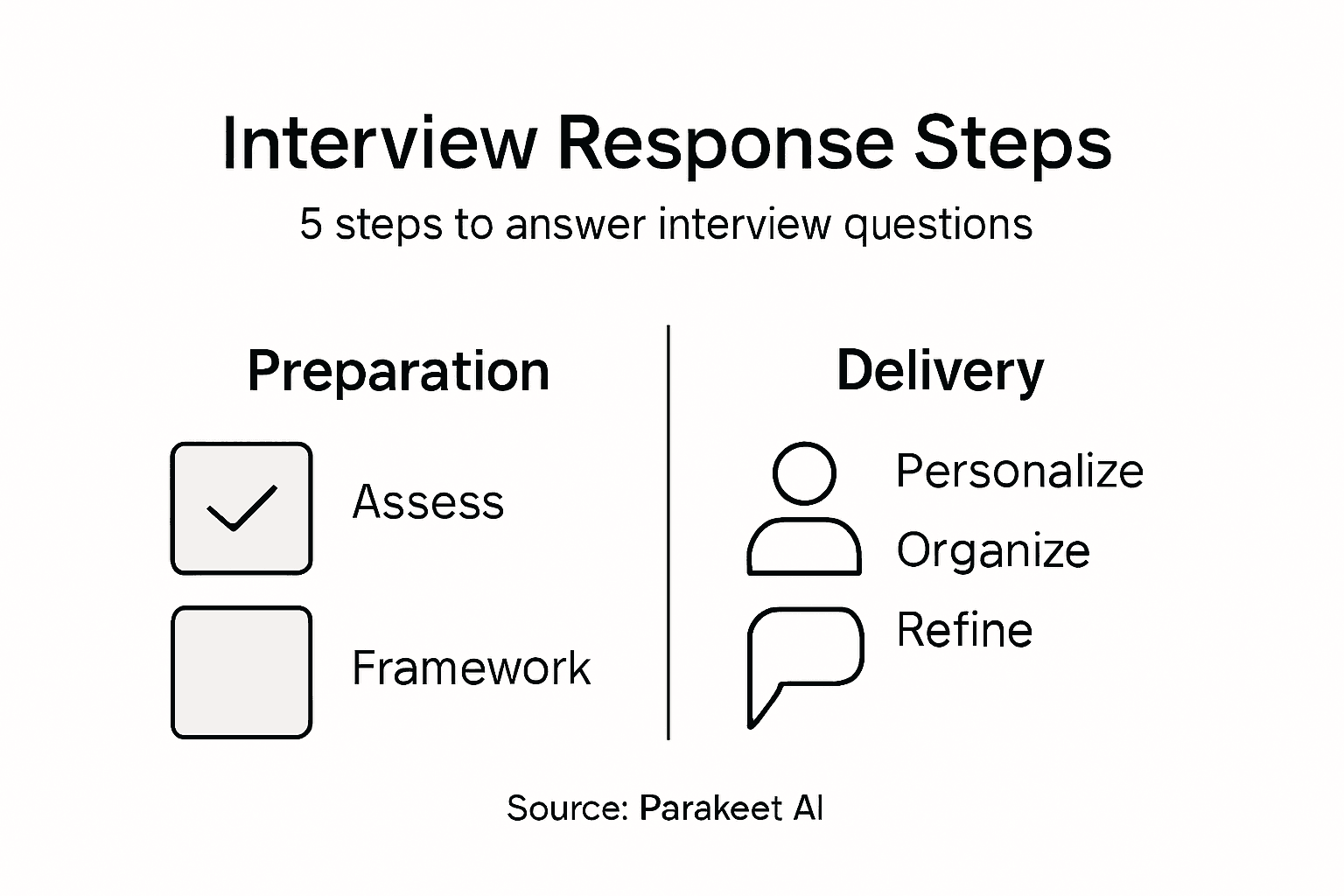
Structured answer templates provide a powerful framework for arranging your thoughts effectively under interview pressure. These methodical approaches help you avoid rambling and ensure you highlight the most relevant details in a logical sequence.
Key strategies for organizing your interview responses include:
- Start with context and background
- Clearly state the specific challenge or problem
- Describe your specific actions and approach
- Highlight measurable results and outcomes
- Connect your experience to the role’s requirements
Think of your response like a well-crafted story. Each point should flow naturally into the next, creating a narrative arc that shows your professional growth, critical thinking, and ability to navigate complex situations. The most memorable responses feel conversational yet structured, revealing your personality while maintaining professional polish.
Your interview answer is a journey - guide the listener through your professional experiences with intention and clarity.
Professional Tip: Practice your response out loud, timing yourself and ensuring each key point connects seamlessly to create a cohesive professional narrative.
Step 5: Review and Refine Your Response
Crafting an exceptional interview response is an iterative process that demands continuous self-evaluation and improvement. Your goal is to transform your initial draft into a polished, compelling narrative that showcases your professional capabilities with precision and authenticity.
Iterative practice and feedback are critical to developing responses that resonate with interviewers. This strategic refinement process helps you identify and eliminate weaknesses, ensuring your answers are sharp, relevant, and impactful.
Key strategies for reviewing and refining your interview responses include:
- Record yourself practicing the response
- Listen critically for unnecessary words or rambling
- Time your response to ensure conciseness
- Seek feedback from trusted colleagues or mentors
- Align your answer with the specific job requirements
- Eliminate jargon and overly complex language
Think of your interview response as a living document. Each practice session is an opportunity to smooth rough edges, clarify your message, and build confidence. The most effective responses feel natural, not rehearsed - they should sound like a genuine conversation while maintaining a clear, structured narrative.
Refinement is the difference between a good answer and an unforgettable professional story.
Professional Tip: Create a personal evaluation checklist that helps you objectively assess your responses, focusing on clarity, relevance, and emotional connection.
Master Your Interview Responses with Real-Time AI Guidance
Struggling to craft well-structured answers that truly resonate with interviewers is a common challenge highlighted in “How to Structure Interview Responses for Success.” From decoding complex questions to organizing your thoughts using frameworks like STAR and CAR, the process can feel overwhelming. You want clear, personalized support that not only helps you understand the question but also guides you to deliver concise and impactful answers every time.
Parakeet AI offers exactly that solution. Our real-time AI job interview assistant listens carefully as you answer, providing instant, tailored responses that align perfectly with the strategies discussed in the article. Whether you need help breaking down tough behavioral questions or want to apply a proven response framework in the moment, Parakeet AI ensures you always communicate your professional story with confidence and precision.
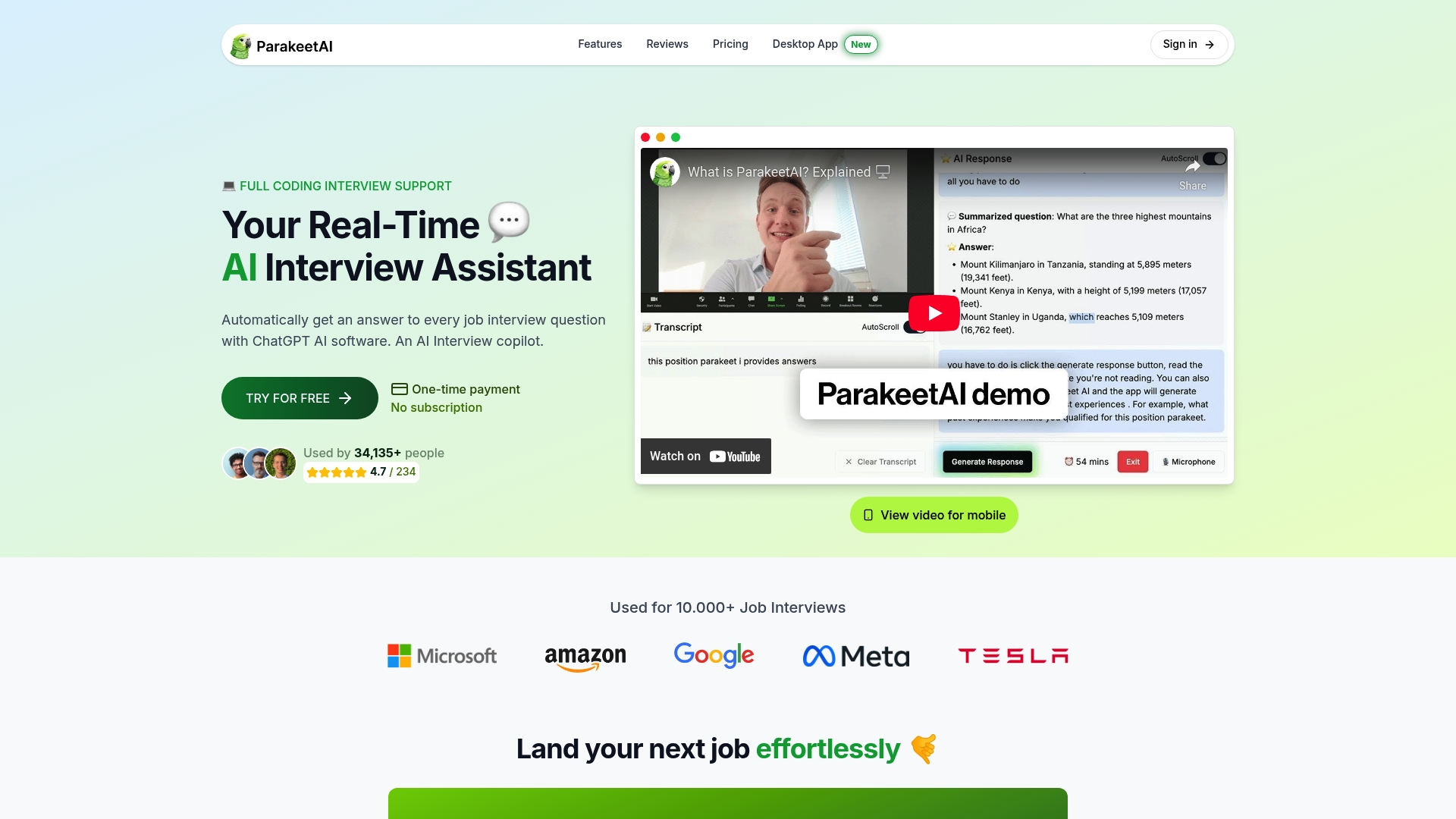
Take control of your interview performance now by experiencing the power of Parakeet AI. Visit our landing page and discover how easy it is to transform uncertainty into success. Don’t wait to impress your next interviewer with answers structured for maximum impact.
Frequently Asked Questions
How can I effectively assess an interview question?
To effectively assess an interview question, listen carefully and make sure you understand its core components. Break down the question’s intent by identifying specific skills or attributes it explores, and consider the broader context of the role to tailor your response.
What are some recommended response frameworks for interview answers?
Popular response frameworks include the STAR Method (Situation, Task, Action, Result) and the CAR Approach (Context, Action, Result). Choose a framework that fits the question type to help streamline your narrative and highlight your professional qualities clearly.
How can I use artificial intelligence to enhance my interview responses?
Leverage artificial intelligence tools by inputting your detailed professional history and specifying the target job role. Use AI-generated responses as templates, but remember to personalize them with your unique experiences and insights.
What steps should I take to organize my key points logically for an interview response?
Start by outlining the context and background, then clearly state the specific challenge you faced. Follow with your specific actions, measurable results, and connect your experiences to the role’s requirements for maximum clarity and impact.
How can I review and refine my interview responses effectively?
Record yourself practicing your responses and listen critically to identify areas for improvement. Time your answers to ensure conciseness, seek feedback from trusted colleagues, and refine your message to align closely with the job requirements.