
7 Must-Ask Interview Questions to Ask Interviewee for Startups

Over 60 percent of American startups now rely on AI tools to make smarter hiring decisions. Yet many HR professionals still struggle to find interview strategies that truly reveal top talent. With rising competition and shifting candidate expectations, crafting dynamic interview questions matters more than ever. This guide highlights actionable methods that help HR teams and hiring managers at tech startups worldwide assess problem-solving, technical skills, adaptability, and cultural fit using proven, AI-powered techniques.
Table of Contents
- Assess Problem-Solving With Scenario-Based Questions
- Evaluate Technical Skills Through Real-World Examples
- Probe Cultural Fit With Team Interaction Queries
- Understand Motivation Using Career Goal Questions
- Test Adaptability With Change Management Scenarios
- Gauge Communication Skills Through Role-Play Questions
- Uncover Learning Ability With Skill Development Queries
Quick Summary
| Takeaway | Explanation |
|---|---|
| 1. Use Scenario-Based Questions | Implement scenario-based questions to reveal candidates’ real-world problem-solving skills, critical thinking, and emotional intelligence. |
| 2. Assess Technical Skills with Real Scenarios | Design technical assessments that simulate actual workplace challenges to evaluate how candidates apply their skills in practical situations. |
| 3. Explore Cultural Fit | Ask questions that gauge candidates’ alignment with company values and their potential to contribute positively to team dynamics. |
| 4. Test Adaptability with Change Scenarios | Create realistic scenarios that assess candidates’ responses to change, revealing their resilience and problem-solving abilities during uncertainty. |
| 5. Evaluate Learning Ability | Use skill development questions to understand candidates’ growth mindset, intellectual curiosity, and capacity for rapid knowledge acquisition. |
1. Assess Problem-Solving with Scenario-Based Questions
Startup interviews demand more than traditional question-and-answer formats. Scenario-based questions represent a powerful technique for uncovering a candidate’s true problem-solving potential.
These strategic questions go beyond surface-level responses by placing candidates in hypothetical workplace situations that reveal their critical thinking, emotional intelligence, and decision-making skills. By presenting real-world challenges, you can observe how candidates approach complex problems, analyze potential solutions, and demonstrate accountability.
Effective scenario-based questions should simulate authentic startup environments where quick thinking, creativity, and adaptability are essential. For instance, you might ask a candidate how they would handle a sudden product launch delay, a team conflict, or an unexpected budget constraint. The goal is not just hearing their answer but understanding their reasoning process, communication style, and strategic approach.
When crafting these questions, focus on scenarios directly relevant to your startup’s specific challenges. A software engineering candidate might receive a technical problem-solving scenario, while a marketing role could involve strategic brand positioning challenges. The key is creating scenarios that mirror your actual work environment.
Key Elements of Effective Scenario-Based Questions:
- Realistic workplace situations
- Clear problem statement
- Open-ended response opportunities
- Potential for multiple solution approaches
- Insights into candidate’s thought process
Best Practices for Implementation:
- Provide enough context for candidates to understand the scenario
- Allow candidates time to think and structure their response
- Listen for logical reasoning, not just the final solution
- Observe communication skills and emotional intelligence
Pro tip: Create a standardized scoring rubric for evaluating scenario responses to ensure consistent and objective candidate assessment.
2. Evaluate Technical Skills Through Real-World Examples
Startup technical interviews demand more than theoretical knowledge and impressive resumes. Technical skills evaluation requires a strategic approach that goes beyond standard questioning techniques.
To truly understand a candidate’s capabilities, startups must design interview processes that simulate authentic workplace challenges. This means creating scenarios that reveal not just what candidates know, but how they apply their knowledge in practical situations.
Real-world technical skill assessment involves multiple layers of examination. Begin with structured technical questions that probe the depth of a candidate’s expertise in specific domains. These questions should be carefully crafted to explore problem-solving approaches, technical reasoning, and practical application of skills.
Key Components of Technical Skills Evaluation:
- Coding challenges that mirror actual project requirements
- System design discussions revealing architectural thinking
- Problem-solving exercises testing adaptability
- Practical demonstrations of technical proficiency
- Collaborative tasks showing teamwork and communication
Successful startup interviews move beyond simple question and answer formats. They create immersive experiences where candidates can demonstrate their technical capabilities through hands-on exercises, live coding sessions, and complex scenario analyses.
Best Practices for Technical Skill Assessment:
- Design challenges relevant to your specific technological ecosystem
- Allow candidates to explain their thought process
- Observe not just the solution, but the approach to problem-solving
- Create a supportive environment that reduces interview anxiety
- Focus on learning potential, not just current knowledge
Pro tip: Develop a standardized evaluation rubric that objectively scores technical skills across multiple dimensions, ensuring consistent and fair candidate assessment.
3. Probe Cultural Fit with Team Interaction Queries
Startup success hinges on more than individual technical skills. Cultural fit assessment represents a critical component of modern hiring strategies that go beyond traditional interview techniques.
Understanding a candidate’s ability to integrate seamlessly into your startup’s unique environment requires nuanced and strategic interaction queries. These questions aim to uncover deeper insights about a candidate’s values, collaboration style, communication approach, and potential team dynamics.
Effective cultural fit queries explore how candidates handle workplace challenges, interact with diverse team members, and align with organizational values. The goal is not to find carbon copy employees but to identify individuals who can enhance your team’s collective capabilities while bringing unique perspectives.
Key Dimensions of Cultural Fit Exploration:
- Communication style and transparency
- Adaptability in dynamic environments
- Approach to collaboration and teamwork
- Alignment with organizational values
- Emotional intelligence and interpersonal skills
Recommended Interaction Query Strategies:
- Ask scenario-based questions revealing problem-solving approaches
- Explore past team experiences and collaboration challenges
- Understand candidate’s perspective on workplace diversity
- Assess alignment with startup’s mission and vision
- Evaluate potential cultural contributions
Best Practices for Cultural Fit Assessment:
- Create a conversational interview environment
- Use open-ended questions encouraging detailed responses
- Listen actively to understand underlying motivations
- Look for genuine enthusiasm and cultural resonance
- Avoid leading or biased questioning techniques
Pro tip: Design cultural fit questions that reveal candidate’s authentic self by focusing on storytelling and real world experiences rather than hypothetical scenarios.
4. Understand Motivation Using Career Goal Questions
Startup hiring is not about finding employees but discovering passionate collaborators who align with your organizational vision. Career goal exploration represents a nuanced strategy for uncovering a candidate’s deeper professional motivations.
Motivation is the invisible fuel that drives individual and organizational performance. By asking strategic career goal questions, startup leaders can peek beyond resume credentials and understand what truly inspires a candidate to excel.
The most effective motivation questions go far beyond surface level inquiries. They invite candidates to articulate their professional journey, revealing personal aspirations, growth mindset, and potential long term alignment with your startup’s mission.
Key Components of Motivation Assessment:
- Personal career trajectory
- Professional development goals
- Alignment with startup vision
- Long term career aspirations
- Intrinsic motivational drivers
Strategic Motivation Question Approaches:
- Explore past achievements and learning experiences
- Understand candidate’s definition of professional success
- Evaluate passion for continuous learning
- Assess potential for internal growth
- Determine cultural and professional compatibility
Interview Question Techniques:
- Ask open ended questions encouraging narrative responses
- Listen for enthusiasm and authentic passion
- Notice consistency between stated goals and past experiences
- Observe communication style and self awareness
- Look for growth oriented mindset
Pro tip: Create a structured scoring system that objectively evaluates candidate motivation across multiple dimensions, allowing for more comprehensive and fair assessment.
5. Test Adaptability with Change Management Scenarios
In the fast paced world of startups, adaptability is not just a skill its a survival mechanism. Adaptability interview scenarios represent a critical assessment tool for identifying candidates who can thrive amid constant change.
Change is the only constant in startup environments. Effective interviews must go beyond traditional questioning techniques to uncover a candidate’s true capacity for navigating unpredictable professional landscapes. These scenarios reveal how potential team members respond to unexpected challenges, shift priorities, and maintain productivity during organizational transitions.
Adaptability assessment requires creating realistic scenarios that mirror actual workplace complexities. By presenting candidates with nuanced change management challenges, startup leaders can observe critical behavioral indicators such as resilience, problem solving capacity, emotional intelligence, and strategic thinking.
Key Adaptability Assessment Dimensions:
- Emotional response to unexpected changes
- Speed of learning and skill acquisition
- Capacity to reframe challenges as opportunities
- Communication during transitional periods
- Proactive problem solving approach
Strategic Scenario Design Principles:
- Create multi layered workplace scenarios
- Allow candidates to explain decision making process
- Evaluate both strategic thinking and emotional intelligence
- Look for constructive approaches to uncertainty
- Assess ability to maintain team morale during transitions
Effective Scenario Construction Techniques:
- Use realistic startup specific challenges
- Design scenarios with multiple potential solutions
- Observe candidates communication and reasoning
- Evaluate adaptability across different complexity levels
- Provide space for creative problem solving
Pro tip: Develop a standardized rubric for scoring candidate responses that objectively measures adaptability across multiple professional and emotional competencies.
6. Gauge Communication Skills Through Role-Play Questions
Startup success depends on crystal clear communication, and traditional interview techniques often fall short of revealing true interpersonal capabilities. Role play communication assessments represent a powerful method for uncovering a candidate’s authentic communication potential.
Role play questions transform interviews from passive question answer interactions into dynamic scenarios that test real world communication skills. By creating immersive scenarios that mirror actual workplace challenges, startup leaders can observe how candidates communicate under pressure, demonstrate empathy, and navigate complex interpersonal dynamics.
Effective role play assessments go beyond surface level communication evaluations. They provide a window into a candidate’s ability to think on their feet, adapt communication styles, and solve problems collaboratively while maintaining professional composure.
Key Communication Skill Dimensions:
- Verbal clarity and articulation
- Active listening capabilities
- Emotional intelligence
- Conflict resolution approaches
- Nonverbal communication cues
Strategic Role Play Design Principles:
- Create realistic startup specific scenarios
- Design multi layered communication challenges
- Allow candidates to demonstrate problem solving skills
- Observe both verbal and nonverbal communication
- Evaluate adaptability and professional tone
Role Play Scenario Construction Techniques:
- Simulate client interactions
- Test team collaboration scenarios
- Explore conflict management approaches
- Assess presentation and persuasion skills
- Reveal authentic communication style
Pro tip: Develop a comprehensive scoring rubric that objectively evaluates communication skills across multiple dimensions, ensuring a holistic and fair assessment of candidate interaction capabilities.
7. Uncover Learning Ability with Skill Development Queries
In the rapidly evolving startup ecosystem, an employee’s capacity to learn quickly becomes more valuable than their current skill set. Soft skill interview questions provide a strategic pathway to assessing a candidate’s fundamental learning potential.
Learning ability represents the hidden superpower that separates good employees from exceptional team members. By crafting targeted skill development queries, startup leaders can peek into a candidate’s intellectual curiosity, growth mindset, and capacity for rapid knowledge acquisition.
Effective learning ability assessments move beyond traditional questioning techniques. They explore not just what skills a candidate currently possesses, but how they approach learning, adapt to new challenges, and transform feedback into actionable personal development strategies.
Key Dimensions of Learning Potential:
- Intellectual curiosity
- Ability to acquire new skills rapidly
- Openness to constructive feedback
- Commitment to continuous improvement
- Adaptability in complex learning environments
Strategic Query Design Principles:
- Ask about personal learning experiences
- Explore methods of skill acquisition
- Understand approaches to overcoming knowledge gaps
- Evaluate self reflection capabilities
- Assess motivation for professional growth
Learning Ability Evaluation Techniques:
- Use scenario based learning challenges
- Request examples of skill transformation
- Explore passion for knowledge expansion
- Understand learning from failure experiences
- Assess metacognitive skills
Pro tip: Create a structured evaluation framework that scores candidates on multiple learning potential indicators, ensuring a comprehensive and objective assessment of their intellectual adaptability.
Below is a comprehensive table summarizing the strategies and best practices for conducting effective startup interviews, as discussed throughout the article.
| Assessment Area | Key Strategies | Expected Outcomes |
|---|---|---|
| Problem-Solving Scenarios | Use realistic, relevant challenges to assess thought process and decision-making. | Insights into critical thinking, creativity, and accountability. |
| Technical Skills Assessment | Incorporate real-world coding challenges and technical discussions. | Evaluation of practical expertise, adaptability, and problem-solving capabilities. |
| Cultural Fit Exploration | Design queries addressing values, teamwork, and adaptability. | Identification of candidates who align with organizational values and contribute positively to team dynamics. |
| Motivation Assessment | Focus on understanding a candidate’s career goals and growth aspirations. | Determining long-term alignment with startup’s mission and intrinsic drivers. |
| Adaptability Scenarios | Present complex change management challenges. | Observing resilience, emotional intelligence, and adaptability under dynamic conditions. |
| Communication Skills Role-Play | Simulate realistic workplace interactions to gauge interpersonal effectiveness. | Unveiling communication styles, active listening, and collaborative potential. |
| Learning Ability Queries | Evaluate intellectual curiosity and approach to acquiring new skills quickly. | Recognizing growth mindset and preparedness for continuous professional development. |
Unlock Efficient Startup Hiring with AI-Powered Interview Support
Startups face unique challenges when it comes to hiring the right talent who excel in problem-solving, adaptability, and cultural fit as highlighted in the article “7 Must-Ask Interview Questions to Ask Interviewee for Startups.” Navigating scenarios like assessing motivation or communication skills during interviews can be overwhelming and time-consuming without the right tools. Parakeet AI transforms this process by providing a real-time AI job interview assistant that listens carefully and instantly offers smart, relevant answers to improve your assessment accuracy.
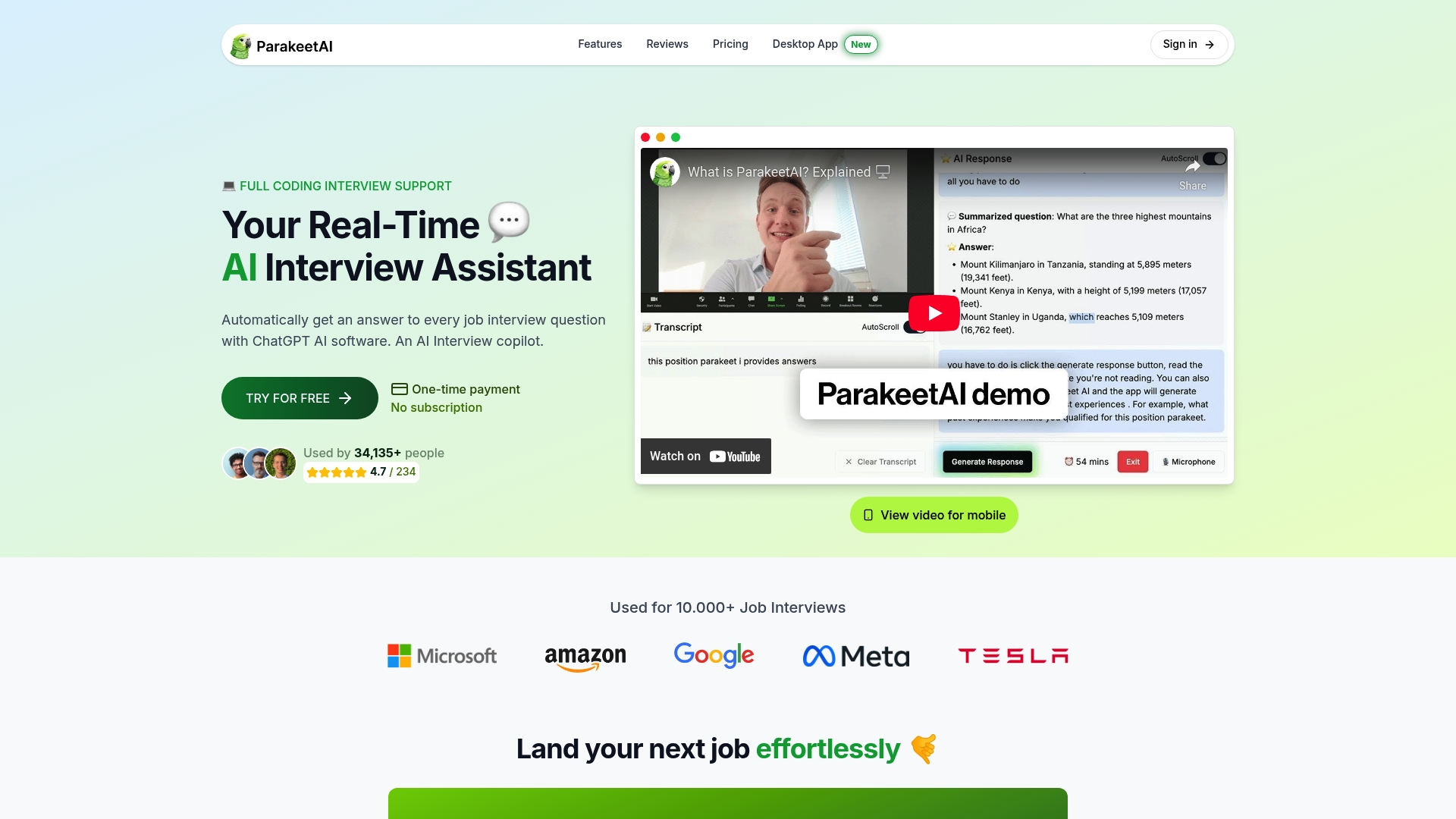
Empower your hiring team today with Parakeet AI to experience seamless interview guidance tailored to startup needs. Whether you want to test adaptability with change management scenarios or probe cultural fit through team queries, our solution supports you every step of the way. Don’t wait to elevate your interview process into a clear, confident, and efficient experience. Visit Parakeet AI main page and start transforming your startup hiring now.
Frequently Asked Questions
What are some effective scenario-based questions to ask during startup interviews?
By asking candidates how they would handle real-world scenarios, such as a sudden product launch delay or a budget constraint, you can gauge their problem-solving and critical-thinking skills. Create questions that are relevant to your startup’s unique challenges to ensure clarity and context.
How can I evaluate a candidate’s technical skills during an interview?
Design technical questions that mimic actual project challenges, such as coding tasks or system design discussions. Allow candidates to explain their thought processes as they tackle these tasks to assess their practical application of skills and understanding of complex problems.
What strategies can I use to assess cultural fit in startup candidates?
Utilize interaction queries that gauge a candidate’s communication style, collaboration approach, and alignment with your company’s values. Focus on their past team experiences and how they handle workplace challenges to determine potential fit.
How should I explore a candidate’s career motivations during the interview?
Ask open-ended questions about their career goals and aspirations to understand what drives them professionally. Look for genuine passion and alignment with your startup’s mission to identify candidates who will be committed collaborators.
What role do adaptability questions play in the interview process?
Adaptability questions help you assess how candidates handle change and unexpected challenges. Present realistic scenarios that reflect your startup’s fast-paced environment to observe qualities like resilience and proactive problem-solving.
What techniques can I use to assess a candidate’s communication skills during an interview?
Implement role-play scenarios that mimic real interactions, such as client negotiations or team conflicts. Observe how candidates express themselves, listen actively, and manage complex interpersonal dynamics to gauge their overall communication effectiveness.