
Job Interview Questions and Answers PDF: Confidence for Success

Meeting with potential employers can feel like a test where every answer counts, especially for recent graduates and those entering the workforce for the first time. Understanding the different types of interview questions, such as behavioral and situational, gives you an edge as you prepare to showcase your strengths. This practical guide offers structured examples and proven strategies designed to help you respond confidently and make a lasting impression at your next interview.
Table of Contents
- Job Interview Questions And Answers Defined
- Key Types Of Job Interview Questions
- How Ai-Powered Interview Tools Work
- Effective Sample Answers For Common Questions
- Preparing, Practicing, And Avoiding Mistakes
Key Takeaways
| Point | Details |
|---|---|
| Interview Questions are Strategic | They help evaluate a candidate’s skills, experience, and fit within an organization through various types of questions. |
| Utilize the STAR Method | Candidates should structure responses using Situation, Task, Action, and Result to showcase their strengths effectively. |
| Prepare with AI Tools | AI-powered interview platforms provide data-driven feedback and simulate realistic experiences to improve candidate performance. |
| Avoid Common Mistakes | Effective interview preparation includes thorough research, practice, and self-assessment to ensure clear communication and confidence. |
Job Interview Questions and Answers Defined
Job interview questions are strategic tools designed to evaluate a candidate’s skills, experience, and potential fit within an organization. Structured interviews represent a systematic approach to understanding a candidate’s professional capabilities through carefully crafted inquiries.
These questions typically fall into several key categories that help employers assess a candidate’s potential:
- Behavioral Questions: Explore past performance and predict future actions
- Situational Questions: Present hypothetical work scenarios to test problem-solving skills
- Technical Questions: Evaluate specific job-related knowledge and competencies
- Personal Background Questions: Understand candidate’s professional journey and motivations
The primary objective of job interview questions is to move beyond a candidate’s resume and gain deeper insights into their professional capabilities. Effective interview questions are designed to reveal not just what skills a person possesses, but how they apply those skills in real-world contexts.
Interviewers strategically craft questions to understand a candidate’s:
- Technical proficiency
- Communication skills
- Problem-solving approach
- Cultural fit within the organization
- Career aspirations and professional goals
Pro tip: Practice answering interview questions out loud to build confidence and refine your communication style.

Key Types of Job Interview Questions
Job interviews employ various question types designed to comprehensively assess a candidate’s professional capabilities. Structured interview approaches reveal critical insights into a candidate’s potential performance and organizational fit.
The primary categories of interview questions include:
- Behavioral Questions: Examine past experiences and actions
- Situational Questions: Test problem-solving skills through hypothetical scenarios
- Technical Questions: Evaluate job-specific knowledge and competencies
- Background Questions: Understand professional history and motivations
Each interview question type serves a distinct purpose in evaluating candidate potential. Behavioral questions focus on past performance, asking candidates to describe specific instances where they demonstrated key skills or overcame professional challenges. These questions operate on the premise that past behavior predicts future performance.
Situational questions present hypothetical work scenarios, challenging candidates to demonstrate critical thinking and adaptability. Interviewers use these questions to assess:
- Decision-making skills
- Problem-solving approaches
- Ethical reasoning
- Interpersonal communication
- Stress management capabilities
Effective interview questions reveal more than just surface-level qualifications - they uncover a candidate’s true professional potential.
Pro tip: Prepare specific, concrete examples for behavioral questions that highlight your unique professional strengths and achievements.
How AI-Powered Interview Tools Work
AI-powered interview tools are revolutionizing job preparation through advanced technological capabilities. AI interview platforms integrate sophisticated technologies like natural language processing and computer vision to simulate realistic interview experiences.
These intelligent systems typically incorporate multiple sophisticated features:
- Language Analysis: Evaluate verbal responses for clarity and relevance
- Sentiment Detection: Assess emotional tone and confidence levels
- Performance Tracking: Monitor and compare interview performance metrics
- Adaptive Questioning: Generate dynamic questions based on previous responses
Artificial Intelligence transforms interview preparation by providing personalized, data-driven feedback. The tools analyze multiple dimensions of communication, including:
- Verbal content quality
- Speaking pace and rhythm
- Facial expressions
- Body language indicators
- Contextual understanding of responses
AI interview technologies offer unprecedented insights into candidate communication skills, going far beyond traditional mock interview methods.
The most advanced platforms leverage machine learning algorithms to continuously improve their question generation and evaluation capabilities. These systems can identify subtle communication patterns, providing nuanced feedback that helps candidates refine their interview techniques.
Here’s a comparison of traditional interview methods versus AI-powered interview tools:
| Aspect | Traditional Interviews | AI-Powered Tools |
|---|---|---|
| Question Consistency | Varies by interviewer | Standardized across sessions |
| Feedback Type | Often subjective | Data-driven and detailed |
| Assessment Scope | Relies on interviewer perception | Analyzes verbal and non-verbal cues |
| Preparation Support | Limited to live practice | Allows unlimited self-paced practice |
Pro tip: Practice with multiple AI interview tools to experience diverse questioning styles and receive comprehensive performance feedback.
Effective Sample Answers for Common Questions
Crafting compelling interview responses requires strategic preparation and authentic storytelling. Sample interview answers help candidates structure their responses to highlight their unique professional strengths effectively.
Common interview questions typically fall into several key categories that demand specific response strategies:
- Personal Background Questions: Require concise professional narratives
- Strength and Weakness Inquiries: Need balanced, growth-oriented perspectives
- Behavioral Questions: Demand specific, structured example demonstrations
- Career Motivation Questions: Require alignment with company goals
Effective interview responses follow a structured approach, often utilizing the STAR method (Situation, Task, Action, Result) to provide clear, compelling narratives. This framework helps candidates transform potentially generic answers into memorable, impactful stories that showcase their professional capabilities.
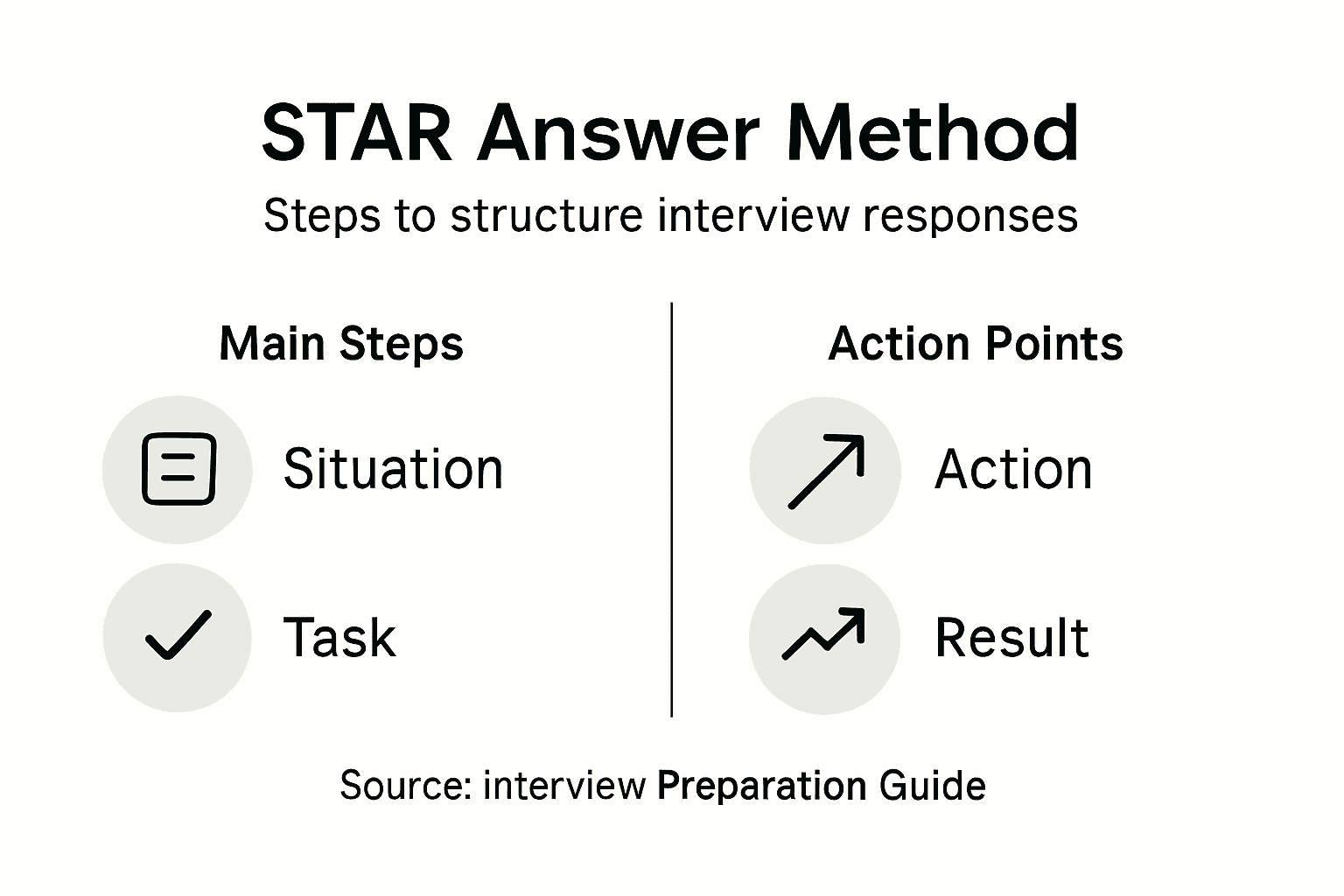
Below is a summary of common interview questions and the STAR method response approach:
| Question Type | STAR Component Focus | Best Practice Tip |
|---|---|---|
| Behavioral | Situation & Result | Highlight measurable outcomes |
| Strengths/Weaknesses | Task & Action | Show growth and learning |
| Career Motivation | Action & Result | Align with company values |
When addressing common interview questions, candidates should focus on key communication principles:
- Be specific and concrete
- Use quantifiable achievements
- Connect personal experiences to job requirements
- Demonstrate professional growth
- Maintain positive, solution-oriented language
The most memorable interview answers reveal not just what you’ve done, but how you think and approach challenges.
Pro tip: Practice your answers out loud, recording yourself to identify areas for improvement and build genuine confidence.
Preparing, Practicing, and Avoiding Mistakes
Successful interview preparation requires a strategic, multifaceted approach. Job interview preparation demands systematic planning to minimize potential mistakes and maximize confidence.
Key preparation strategies encompass multiple critical dimensions:
- Research: Thoroughly investigate the company and position
- Practice: Conduct multiple mock interviews
- Self-Assessment: Identify and address potential weaknesses
- Logistical Planning: Manage practical interview details
Interview preparation is not just about memorizing answers, but developing a comprehensive understanding of your professional narrative. Candidates must be prepared to articulate their experiences, skills, and motivations with clarity and authenticity.
Common interview preparation mistakes to avoid include:
- Arriving unprepared or late
- Lacking specific examples of achievements
- Displaying negative attitudes about previous employers
- Failing to ask thoughtful questions
- Overlooking non-verbal communication signals
Effective interview preparation transforms uncertainty into confident performance.
Pro tip: Record your mock interviews and critically analyze your verbal and non-verbal communication to identify improvement areas.
Prepare Confidently with AI Assistance for Your Job Interviews
The article highlights the challenge many candidates face when answering complex job interview questions and the importance of practicing behavioral and situational responses effectively. Key pain points like building confidence, mastering the STAR method, and avoiding common preparation mistakes are obstacles that often hold job seekers back. Now you can overcome these hurdles with a solution that understands your needs. Parakeet AI is a real-time job interview assistant that listens carefully to your answers and instantly offers tailored suggestions for every question using advanced AI. This opportunity to practice dynamically helps you improve your communication, demonstrate your unique strengths, and boost your confidence like never before.
Experience a new level of preparation that integrates concepts such as structured interviews and effective sample answers directly into your practice sessions. Say goodbye to uncertainty and unlock your true potential today.
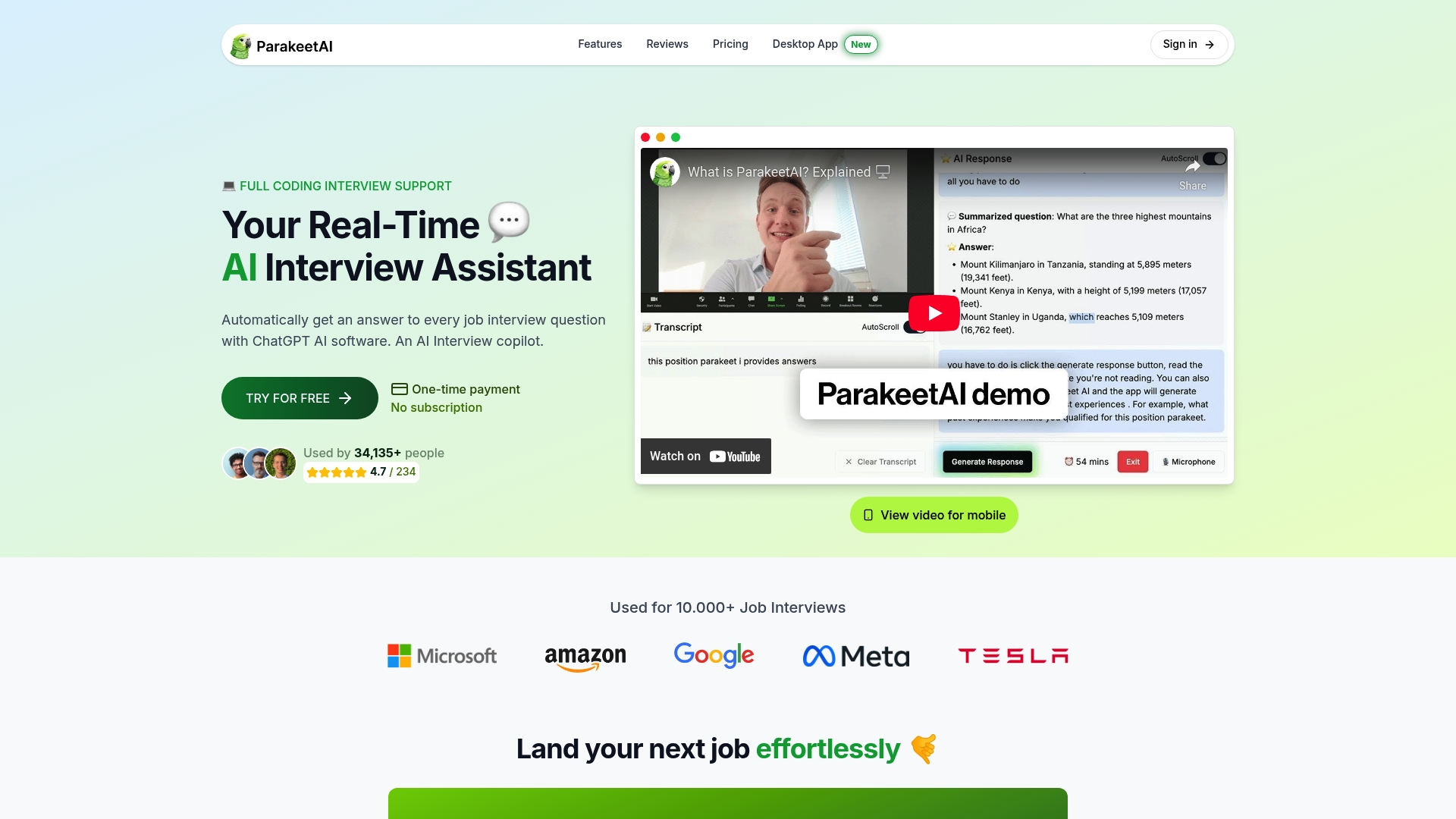
Are you ready to transform your interview preparation by practicing with an AI-powered tool that adapts to your responses in real time? Visit Parakeet AI now and take the first step toward interview confidence and success. For more insights on preparing effectively, check out Job Interview Questions and Answers PDF and start practicing smarter today.
Frequently Asked Questions
What are the types of job interview questions?
Job interview questions typically fall into categories such as behavioral questions, situational questions, technical questions, and personal background questions. Each category serves a distinct purpose in assessing a candidate’s skills and fit within an organization.
How can I prepare for behavioral interview questions?
To prepare for behavioral interview questions, use the STAR method (Situation, Task, Action, Result) to structure your responses. Be specific, provide concrete examples, and focus on measurable results to demonstrate your capabilities effectively.
What are some common mistakes to avoid during interviews?
Common interview mistakes include arriving late, lacking specific examples of achievements, displaying negative attitudes about previous employers, failing to ask questions, and overlooking non-verbal communication cues. Avoiding these pitfalls can enhance your performance.
How do AI-powered interview tools enhance interview preparation?
AI-powered interview tools analyze various communication dimensions, such as verbal content, speaking pace, and body language, providing personalized feedback. These insights help candidates refine their answers and enhance their interview techniques, making preparation more effective.