
Post-Interview Analysis: Turning Feedback Into Results

Most advice about post-interview analysis leaves American professionals more confused than confident. The reality is that more than 60 percent of candidates misunderstand how to turn interview feedback into real progress. Mastering this process matters because it can transform one missed opportunity into many future wins. This guide cuts through the noise, explaining what truly works so you can boost your interview skills and stand out with every application.
Table of Contents
- Post-Interview Analysis Explained And Debunked
- Main Types And Approaches To Analysis
- How Automated And Manual Analysis Differ
- Typical Process For Conducting Analysis
- Common Mistakes In Post-Interview Analysis
Key Takeaways
| Point | Details |
|---|---|
| Effective Analysis Transforms Experience | Post-interview analysis shifts focus from pass-or-fail assessments to continuous personal development opportunities. |
| Integration of Techniques Enhances Insights | Combining automated tools with human evaluation fosters a robust understanding of performance nuances. |
| Avoid Common Pitfalls for Accurate Evaluation | Being aware of biases and ensuring comprehensive documentation is crucial for meaningful assessments. |
| Structured Methodology Maximizes Learning | Following a systematic process for analysis can significantly improve both evaluation and candidate growth. |
Post-Interview Analysis Explained and Debunked
Post-interview analysis represents a critical yet often misunderstood process of extracting meaningful insights from job interview interactions. By systematically reviewing interview conversations, candidates can transform feedback into strategic personal development opportunities. Unlike traditional evaluation methods, modern approaches like postqualitative inquiry challenge standard assessment techniques by encouraging a more nuanced understanding of interview dynamics.
The core of effective post-interview analysis involves multiple strategic steps. First, candidates must objectively review their performance, identifying specific moments where communication could have been stronger or where technical responses might have been incomplete. Performance review becomes a reflective exercise focused not on criticism, but on constructive improvement. Candidates should pay attention to verbal communication, body language, problem-solving approach, and alignment with the role’s core requirements.
Statistical approaches like post hoc analysis can provide additional rigor to interview evaluation. These techniques help candidates systematically break down interview interactions, examining communication patterns, response quality, and potential areas of strength or improvement. However, it’s crucial to approach such analysis with caution, avoiding over-interpretation or reading too deeply into individual interaction moments.
Successful post-interview analysis ultimately transforms a single interaction into a powerful learning experience. By treating each interview as an opportunity for growth rather than a pass-or-fail event, professionals can continuously refine their communication skills, technical expertise, and professional presentation. The goal isn’t just to dissect past performance, but to build a strategic framework for future interview success.
Main Types and Approaches to Analysis
Post-interview analysis encompasses several sophisticated methodologies designed to extract meaningful insights from professional interactions. Behavior coding represents one advanced approach, systematically evaluating communication patterns and interaction quality by categorizing specific verbal and non-verbal behaviors during interview exchanges.
Another critical analytical technique is qualitative research methods, with process tracing emerging as a particularly powerful approach. This method allows candidates to develop nuanced understanding by examining diagnostic evidence and exploring complex causal relationships within their interview performance. Researchers and job seekers can use process tracing to break down intricate communication moments, identifying subtle patterns that traditional assessment techniques might overlook.
Typical approaches to post-interview analysis can be categorized into several key frameworks:
- Objective Performance Assessment: Quantitative evaluation of response accuracy, technical knowledge, and communication clarity
- Behavioral Pattern Analysis: Examining body language, tone, and non-verbal communication signals
- Narrative Reconstruction: Reconstructing the interview conversation to identify strengths, weaknesses, and potential improvement areas
- Comparative Benchmarking: Measuring individual performance against industry standards and role-specific expectations
Successful post-interview analysis requires a balanced approach that combines emotional intelligence with rigorous analytical techniques. By integrating multiple evaluation methods, professionals can transform interview experiences into powerful learning opportunities, continuously refining their communication skills and professional presentation strategies.
How Automated and Manual Analysis Differ
The landscape of interview performance evaluation is dramatically transforming with technological advancements, creating a stark contrast between traditional manual approaches and cutting-edge automated analysis techniques. Multimodal behavioral analytics have revolutionized the assessment process, enabling sophisticated evaluation of candidate interactions that go far beyond human capability to track and interpret nuanced communication signals.

Manual analysis traditionally relies on human evaluators making subjective assessments based on personal experience and intuition. In contrast, automated systems leverage advanced computational techniques to provide objective, data-driven insights. Topic modeling techniques now enable automated systems to extract complex thematic structures from interview transcripts, processing information with unprecedented speed and precision that manual methods cannot match.
Key differences between automated and manual analysis include:
- Objectivity: Automated systems eliminate human bias
- Speed: Machine analysis processes information exponentially faster
- Depth of Analysis: AI can track microscopic communication patterns invisible to human observers
- Scalability: Automated tools can simultaneously analyze multiple interviews
- Consistency: Machine learning models provide uniform evaluation standards
While automated analysis offers remarkable technological advantages, the most effective approach often combines machine insights with human interpretation. Professionals can leverage automated tools to identify subtle performance patterns, then apply personal context and emotional intelligence to develop truly comprehensive interview feedback strategies.
Typical Process for Conducting Analysis
Post-interview analysis follows a structured methodology designed to extract meaningful insights from professional interactions. Behavior coding provides a systematic framework for evaluating interview performance by assigning standardized codes to observable communication behaviors, enabling a comprehensive and objective assessment approach.
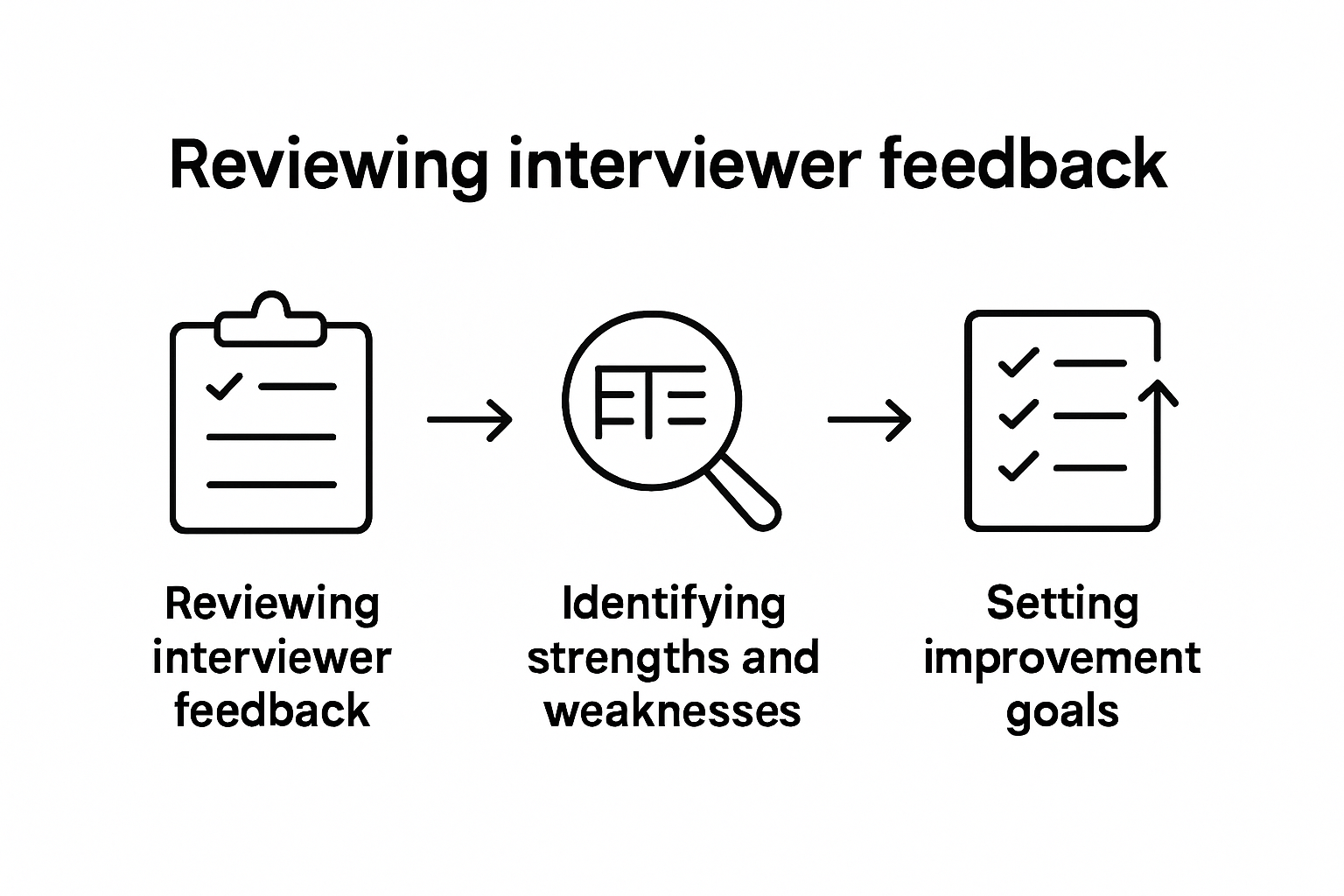
The analytical process typically involves multiple strategic stages. Process tracing techniques offer sophisticated methods for examining causal relationships and diagnostic evidence within interview interactions. Professionals can break down this complex evaluation into a sequential approach that maximizes insight generation and performance understanding.
A comprehensive post-interview analysis typically follows these key steps:
- Initial Recording and Transcription
- Capture full interview audio or video
- Create verbatim transcript of the conversation
- Behavioral Pattern Identification
- Analyze verbal communication quality
- Assess non-verbal communication signals
- Evaluate response structure and clarity
- Quantitative Performance Scoring
- Rate technical knowledge accuracy
- Measure communication effectiveness
- Compare against role-specific benchmarks
- Qualitative Insight Generation
- Identify strengths and potential improvement areas
- Develop personalized feedback recommendations
- Strategic Reflection and Action Planning
- Create targeted skill development strategy
- Set specific communication improvement goals
Successful post-interview analysis transforms a single interaction into a powerful learning opportunity. By integrating systematic evaluation techniques with personal reflection, professionals can continuously refine their interview performance and career development strategies.
Common Mistakes in Post-Interview Analysis
Post-interview analysis is a nuanced process fraught with potential pitfalls that can undermine the entire evaluation. Making snap judgments represents one of the most critical errors professionals encounter, where initial impressions can dramatically skew objective performance assessment and lead to fundamentally biased conclusions.
Professionals frequently stumble into systematic errors that compromise the integrity of their analysis. Interview preparation and data organization are foundational elements often overlooked, resulting in incomplete or misleading evaluations. Rushed or poorly structured analysis can transform a potentially insightful review into a superficial and ineffective exercise.
Key mistakes in post-interview analysis include:
- Emotional Bias: Allowing personal feelings to influence objective assessment
- Incomplete Documentation: Failing to capture comprehensive interaction details
- Narrow Perspective: Focusing on limited aspects of candidate performance
- Inconsistent Evaluation Criteria: Using subjective or changing assessment standards
- Confirmation Bias: Seeking information that confirms preexisting assumptions
- Neglecting Contextual Factors: Ignoring broader situational elements affecting performance
Successful post-interview analysis demands a disciplined, systematic approach that balances objective measurement with nuanced human insight. By recognizing and actively mitigating these common mistakes, professionals can develop more accurate, fair, and meaningful performance evaluations that genuinely support professional development and recruitment effectiveness.
Unlock Real Growth Through Smarter Post-Interview Analysis
Navigating the complex process of post-interview analysis is challenging. You want to avoid emotional bias, incomplete documentation, and confirmation bias while accurately decoding your interview performance. Concepts like behavior coding and process tracing can seem overwhelming when you try to self-assess. What if you could gain objective, detailed, and instant insights into your interview interactions without the guesswork? That is exactly the problem that Parakeet AI solves by providing a real-time AI job interview assistant that listens and analyzes your interview as it happens. This technology transforms your feedback into actionable results with clarity and precision.

Stop letting post-interview reflection become a source of frustration or self-doubt. Use Parakeet AI to harness advanced automated analysis that captures verbal and non-verbal cues, rates communication effectiveness, and helps you develop strategic improvement plans. Visit our landing page now to start turning every interview into an opportunity for growth. The sooner you act, the faster you can refine your skills and confidently face your next job interview.
Frequently Asked Questions
What is post-interview analysis?
Post-interview analysis is the systematic review of job interview performance aimed at extracting insights to improve future interview skills and communication.
How can I conduct an effective post-interview analysis?
To conduct an effective post-interview analysis, record the interview, assess verbal and non-verbal communication, utilize quantitative scoring, and identify areas for improvement while developing an action plan.
What are common mistakes to avoid in post-interview analysis?
Common mistakes include relying on emotional bias, providing incomplete documentation, focusing narrowly on specific aspects of performance, and neglecting broader contextual factors affecting the interview.
How can automated analysis enhance post-interview evaluation?
Automated analysis enhances post-interview evaluation by providing objective and data-driven insights, tracking nuanced communication patterns, and offering a faster, scalable, and consistent method for assessing interview interactions.