
7 Essential Types of Interview Assessments for Hiring Success

Deciding who is truly ready for your next open job can be overwhelming with so many applications and limited time for review. Finding candidates who have both the skills and the right mindset is a persistent challenge for employers across industries. The right assessment tools can help you make smarter and fairer hiring decisions. You’ll discover methods backed by research that increase interview reliability, minimize bias, and provide concrete evidence of job readiness. Get ready to learn practical strategies that dig deeper than resumes and help you confidently choose the best fit for your team.
Table of Contents
- 1. Structured Behavioral Assessments For Consistent Evaluation
- 2. Technical Skill Tests To Measure Job Readiness
- 3. Situational Judgment Assessments For Real-World Problem Solving
- 4. Cognitive Ability Assessments For Predicting Performance
- 5. Personality Assessments For Team Fit
- 6. AI-Driven Video Interview Scoring For Objective Analysis
- 7. Role-Play And Simulation Assessments For Practical Insights
Quick Summary
| Takeaway | Explanation |
|---|---|
| 1. Use Structured Behavioral Assessments | Implement standardized questions to enhance reliability and fairness in hiring decisions. |
| 2. Incorporate Technical Skill Tests | Evaluate candidates through practical challenges to assess true job readiness beyond resumes. |
| 3. Leverage Situational Judgment Assessments | Simulate real-life scenarios to gauge decision-making and problem-solving skills under pressure. |
| 4. Employ Cognitive Ability Assessments | Measure fundamental cognitive skills to predict job performance and success effectively. |
| 5. Integrate AI-Driven Video Interview Scoring | Combine technology analysis with human insights for objective candidate evaluation and improved outcomes. |
1. Structured Behavioral Assessments for Consistent Evaluation
Structured behavioral assessments represent a powerful approach to candidate evaluation that transforms traditional interview processes. By implementing a standardized method of questioning, organizations can dramatically improve the reliability and fairness of their hiring decisions.
These assessments focus on gathering specific, verifiable information about a candidate’s past job-related behaviors through systematic interview techniques. The core principle is simple: how someone has performed in previous professional scenarios provides the most accurate predictor of their future workplace performance.
Key characteristics of structured behavioral assessments include:
- Predetermined, job-specific questions
- Consistent evaluation criteria for all candidates
- Emphasis on observable, measurable behaviors
- Reduction of personal bias in hiring decisions
- Enhanced predictive validity of candidate selection
Systematic behavioral assessments increase interview reliability by providing standardized conditions that allow for more objective candidate comparisons.
The methodology involves creating a detailed interview protocol that maps specific job competencies to carefully crafted behavioral questions. Interviewers are trained to ask identical questions to all candidates and rate responses using predefined scoring rubrics. This approach transforms subjective interviews into data-driven evaluation processes.
Companies implementing structured behavioral assessments can expect significant improvements in hiring outcomes. Research indicates these methods can increase selection accuracy by up to 65% compared to traditional unstructured interviews.
Pro tip: Develop a comprehensive behavioral interview guide with 5-7 core competency-based questions that directly relate to critical job performance indicators.
2. Technical Skill Tests to Measure Job Readiness
Technical skill tests represent a critical tool for evaluating a candidate’s true job preparedness beyond traditional resume screening. These comprehensive assessments provide employers with concrete evidence of a candidate’s actual technical competencies and potential workplace performance.
Understanding technical skill assessment frameworks reveals a multidimensional approach to evaluating job readiness. These tests go far beyond simple multiple-choice exams and integrate cognitive, practical, and interpersonal skill evaluations.
Key components of effective technical skill tests include:
- Practical coding challenges
- Real-world problem-solving scenarios
- Simulated workplace task demonstrations
- Technical knowledge examinations
- Soft skill and communication assessments
Technical skill tests provide employers with a comprehensive view of a candidate’s true job readiness and potential performance.
The most sophisticated technical skill tests are designed to mirror actual workplace challenges. They evaluate not just technical knowledge but also critical thinking, adaptability, and the ability to apply skills in dynamic environments. This holistic approach helps organizations identify candidates who can truly excel in complex professional settings.
Employers can significantly improve hiring accuracy by implementing standardized technical skill assessments. Research suggests these evaluations can increase candidate selection precision by up to 40% compared to traditional interview methods.
Pro tip: Design technical skill tests that simulate real-world project scenarios and include both technical problem-solving and collaborative elements to gain a comprehensive candidate evaluation.
3. Situational Judgment Assessments for Real-World Problem Solving
Situational judgment assessments represent a sophisticated approach to evaluating a candidate’s decision-making skills in complex workplace scenarios. These innovative evaluations go beyond traditional interview techniques by presenting realistic professional challenges that reveal a candidate’s true problem-solving capabilities.
Research into situational judgment test methodologies demonstrates their effectiveness in predicting workplace performance. By simulating authentic work environments, these assessments provide deep insights into how candidates might respond to critical professional situations.
Key components of effective situational judgment assessments include:
- Realistic workplace scenario descriptions
- Multiple response options reflecting different decision-making approaches
- Scenarios that test interpersonal skills
- Challenges requiring ethical and strategic thinking
- Situations that evaluate adaptability and problem-solving
Situational judgment tests reveal a candidate’s cognitive processes and decision-making capabilities under realistic professional conditions.
The assessment design involves complex cognitive stages that mirror actual workplace decision-making. Candidates must first comprehend the scenario, analyze potential consequences, and select the most appropriate response. This multilayered approach provides a nuanced view of a candidate’s professional judgment.
Organizations using strategic situational judgment assessments can reduce hiring risks and identify candidates with superior problem-solving skills. Studies indicate these evaluations can improve candidate selection accuracy by up to 50% compared to traditional interview methods.
Pro tip: Create situational judgment scenarios that reflect your specific workplace challenges and include both technical and interpersonal problem-solving elements to gain comprehensive candidate insights.
4. Cognitive Ability Assessments for Predicting Performance
Cognitive ability assessments offer a sophisticated approach to understanding a candidate’s potential performance beyond traditional evaluation methods. These powerful tools provide deep insights into an individual’s mental capabilities and problem-solving potential.
Modern cognitive assessment methodologies integrate advanced psychometric techniques to measure critical mental skills. By evaluating specific cognitive constructs, organizations can more accurately predict job performance and candidate success.
Key components of comprehensive cognitive ability assessments include:
- Memory processing capabilities
- Abstract reasoning skills
- Information processing speed
- Complex problem-solving aptitude
- Critical thinking potential
Cognitive ability tests reveal the underlying mental skills that drive exceptional workplace performance.
Research demonstrates that these assessments provide significant predictive validity for job performance. They go beyond surface-level evaluations by measuring fundamental cognitive capabilities that translate directly into workplace effectiveness.
Organizations implementing cognitive ability assessments can expect more nuanced candidate selection processes. Studies indicate these evaluations can improve hiring accuracy by up to 45% compared to traditional interview techniques.
Pro tip: Design cognitive assessments that balance standardized measurement with context-specific challenges to gain the most comprehensive view of a candidate’s mental capabilities.
5. Personality Assessments for Team Fit
Personality assessments provide critical insights into how candidates will interact within team environments and contribute to organizational culture. These sophisticated evaluations go beyond traditional hiring metrics to understand the human dynamics that drive workplace success.
Research into personality trait correlations reveals the profound impact of individual characteristics on team performance. By systematically analyzing personality dimensions, organizations can predict potential collaboration styles and team synergies.
Key aspects of effective personality assessments include:
- Measuring core personality traits
- Evaluating interpersonal communication styles
- Assessing potential team compatibility
- Understanding individual work preferences
- Identifying potential collaboration challenges
Personality assessments help organizations build cohesive teams by understanding the unique psychological makeup of potential employees.
The most advanced personality assessments leverage scientific frameworks like the Big Five personality model. This approach provides nuanced insights into traits such as conscientiousness, agreeableness, openness, extraversion, and emotional stability.
Companies implementing comprehensive personality assessments can improve team dynamics and reduce potential workplace conflicts. Studies suggest these evaluations can enhance team performance by up to 35% through more strategic talent placement.
Pro tip: Design personality assessments that balance quantitative measurements with qualitative insights to capture the full complexity of individual work styles and team potential.
6. AI-Driven Video Interview Scoring for Objective Analysis
AI-driven video interview scoring represents a revolutionary approach to candidate evaluation that transforms traditional hiring practices. This cutting-edge technology leverages advanced machine learning techniques to provide unprecedented insights into candidate performance.
Research demonstrates sophisticated AI interview analysis can dramatically improve the objectivity and accuracy of candidate assessments. By analyzing verbal and non-verbal communication signals, these systems offer a more comprehensive evaluation than human-only interviews.
Key capabilities of AI-driven video interview scoring include:
- Natural language processing of verbal responses
- Computer vision analysis of body language
- Voice tone and emotional intelligence tracking
- Consistent and unbiased candidate evaluation
- Quantitative scoring of interview performance
AI-powered video interview scoring provides data-driven insights that transform subjective hiring decisions into objective, measurable assessments.
The technology goes beyond traditional metrics by capturing nuanced communication signals. Artificial intelligence can detect subtle indicators of candidate confidence, communication skills, and potential cultural fit that might escape human perception.
Organizations implementing AI-driven video interview scoring can expect significant improvements in hiring outcomes. Studies indicate these technologies can enhance candidate selection accuracy by up to 40% compared to traditional interview methods.
Pro tip: Combine AI video interview scoring with human expertise to create a comprehensive evaluation strategy that balances technological insights with human judgment.
7. Role-Play and Simulation Assessments for Practical Insights
Role-play and simulation assessments represent a dynamic approach to evaluating candidate performance by immersing them in realistic workplace scenarios. These powerful evaluation techniques go beyond traditional interviews by creating interactive environments that reveal true professional capabilities.
Examining simulation-based assessment strategies reveals their transformative potential in understanding candidate behavior. By constructing scenarios that mirror actual workplace challenges, organizations can observe how candidates think and perform under pressure.
Key elements of effective role-play assessments include:
- Carefully designed realistic workplace scenarios
- Multiple interaction points to test adaptability
- Opportunities for problem-solving demonstration
- Structured observation and evaluation protocols
- Comprehensive performance feedback mechanisms
Role-play simulations transform candidate evaluation from passive questioning to active performance demonstration.
These assessments provide deep behavioral insights that traditional interviews cannot capture. Candidates are placed in dynamic situations that require them to demonstrate critical thinking, communication skills, and professional judgment in real-time.
Research indicates that organizations using role-play assessments can improve candidate selection accuracy by up to 55%. By creating controlled yet authentic environments, employers gain unprecedented visibility into a candidate’s true potential.
Pro tip: Design role-play scenarios that specifically reflect your organization’s unique challenges and culture to gain the most meaningful candidate insights.
Below is a comprehensive table summarizing the candidate assessment strategies discussed throughout the article.
| Assessment Type | Key Features | Benefits |
|---|---|---|
| Structured Behavioral Assessments | Standardized questioning, focus on past job-related behaviors. | Improved reliability and fairness, reduced bias, enhanced predictive validity. |
| Technical Skill Tests | Evaluations of practical skills, real-world problem-solving, and knowledge. | Concrete evidence of capabilities, holistic view of job preparedness. |
| Situational Judgment Assessments | Realistic workplace scenarios requiring ethical thinking and adaptability. | Insights into decision-making and problem-solving under authentic conditions. |
| Cognitive Ability Assessments | Measurements of memory, reasoning, and critical thinking. | Accurate prediction of job performance and mental capabilities. |
| Personality Assessments | Evaluation of teamwork traits and interpersonal styles. | Enhanced team compatibility and improved workplace dynamics. |
| AI-Driven Video Interview Scoring | Analysis of verbal cues and body language using machine learning. | Consistent and unbiased candidate evaluations, objective insights. |
| Role-Play and Simulation Assessments | Interactive scenarios mimicking workplace challenges. | Demonstration of practical skills and professional behavior under pressure. |
Revolutionize Your Hiring with Real-Time AI Interview Assistance
Hiring teams face the challenge of applying structured behavioral assessments, situational judgment tests, and technical skill evaluations while maintaining fairness and accuracy. These crucial evaluations demand consistency, unbiased scoring, and deep insights into candidate capabilities. Yet, the pressure to assess every aspect during an interview can feel overwhelming and prone to human error. Imagine having a tool that actively listens and delivers accurate, AI-driven answers in real time, helping you navigate complex interview scenarios with ease.
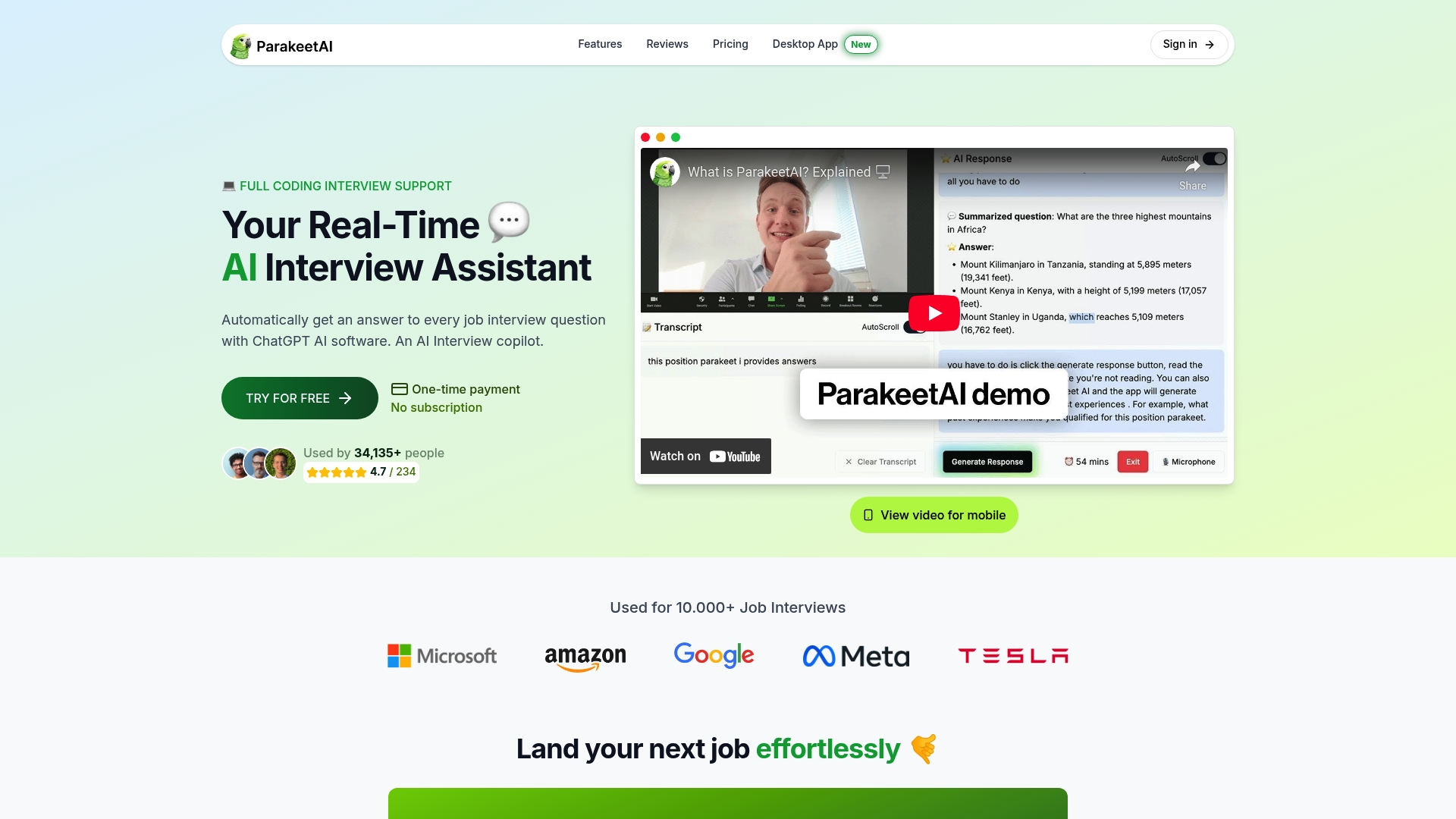
Boost your hiring success today by integrating a real-time AI job interview assistant capable of enhancing your evaluation process. At Parakeet AI, we empower recruiters to conduct more precise and objective interviews that align perfectly with the key assessment types outlined in the article. Don’t wait to improve your selection accuracy and reduce hiring risks. Discover how our AI-driven interview solution at https://parakeet-ai.com can transform your candidate evaluations and lead you to smarter hiring decisions.
Frequently Asked Questions
What are structured behavioral assessments and how do they improve hiring outcomes?
Structured behavioral assessments are standardized methods for evaluating candidates based on their past job-related behaviors. To implement this, develop a detailed interview protocol that outlines specific questions for key competencies within your organization, aiming to enhance your hiring accuracy dramatically.
How do technical skill tests evaluate a candidate’s job readiness?
Technical skill tests measure a candidate’s actual competencies through practical challenges and problem-solving scenarios. To enhance your selection process, design assessments that simulate real-world tasks relevant to the position, potentially increasing hiring precision by up to 40%.
What role do situational judgment assessments play in candidate evaluation?
Situational judgment assessments present candidates with realistic workplace scenarios to test their decision-making skills. Create scenarios that reflect your organization’s challenges, enabling you to evaluate candidates’ cognitive processes and improve selection accuracy by up to 50%.
How can cognitive ability assessments predict job performance?
Cognitive ability assessments measure mental skills such as problem-solving and critical thinking to predict a candidate’s workplace performance. Set up assessments that incorporate contextual challenges to provide a comprehensive view of a candidate’s cognitive potential, aiming to improve your hiring accuracy by up to 45%.
Why are personality assessments important for team dynamics?
Personality assessments help identify how candidates will fit into team environments by analyzing individual traits that influence collaboration. Consider implementing assessments based on the Big Five personality model to better understand candidates’ working styles and enhance team performance by up to 35%.
What benefits do AI-driven video interview scoring offer?
AI-driven video interview scoring uses machine learning to analyze candidates’ verbal and non-verbal cues during interviews, leading to more objective evaluations. Integrate AI scoring with human insights to maximize hiring precision and potentially improve your selection accuracy by up to 40%.