
Benefits of Mock Interviews: Building Tech Career Confidence

Nearly half of American hiring managers report that strong interview skills are the deciding factor in tech job offers. For job seekers around the world, especially recent graduates, mastering the interview can feel daunting. Understanding how mock interviews and modern AI-driven practice sessions work is the key to transforming nerves into confidence, helping every candidate showcase their unique value whether they are aiming to impress an American employer or launching a global tech career.
Table of Contents
- Mock Interviews Defined And Core Concepts
- Types Of Mock Interviews For Tech Roles
- How Real-Time AI Interview Assistants Work
- Personalized Feedback And Skill Improvement
- Reducing Interview Anxiety And Building Confidence
- Common Pitfalls And Effective Preparation Strategies
Key Takeaways
| Point | Details |
|---|---|
| Importance of Mock Interviews | Mock interviews provide job seekers with a realistic practice environment, enhancing communication and technical skills. |
| Diverse Formats Available | Options like live interactions, recorded responses, and AI simulations cater to different preparation needs and goals. |
| Personalized Feedback | AI-driven platforms offer targeted insights and track progress over time, fostering continuous improvement. |
| Addressing Interview Anxiety | Engaging in mock interviews helps candidates build confidence and manage stress effectively in real interview scenarios. |
Mock Interviews Defined and Core Concepts
In the competitive world of professional development, mock interviews represent strategic training simulations designed to help job seekers prepare for real-world employment conversations. These practice interview scenarios are carefully structured verbal interactions where candidates rehearse responding to potential questions, allowing them to refine communication skills and build professional confidence.
Unlike standard role-playing exercises, mock interviews serve a sophisticated purpose in career preparation. Participants engage in simulated conversations that closely mirror actual job interview environments, with trained professionals or experienced peers acting as interviewers. The goal extends beyond simple practice - these interactions help candidates develop nuanced communication strategies, understand industry-specific questioning techniques, and learn to present their professional narratives effectively.
Mock interviews offer multifaceted benefits for tech professionals. They provide a safe environment to practice technical responses, assess personal communication patterns, and identify areas requiring improvement. By systematically practicing interview skills, candidates can transform potential nervousness into genuine self-assurance, ultimately increasing their chances of successful job placement.
Pro tip: Practice mock interviews with professionals in your specific tech domain to gain the most targeted and relevant feedback about your interview performance.
Types of Mock Interviews for Tech Roles
In the rapidly evolving tech industry, interview preparation strategies have become increasingly diverse and sophisticated. Tech professionals now have access to multiple mock interview formats designed to simulate real-world hiring scenarios, each offering unique advantages for skill development and professional confidence building.
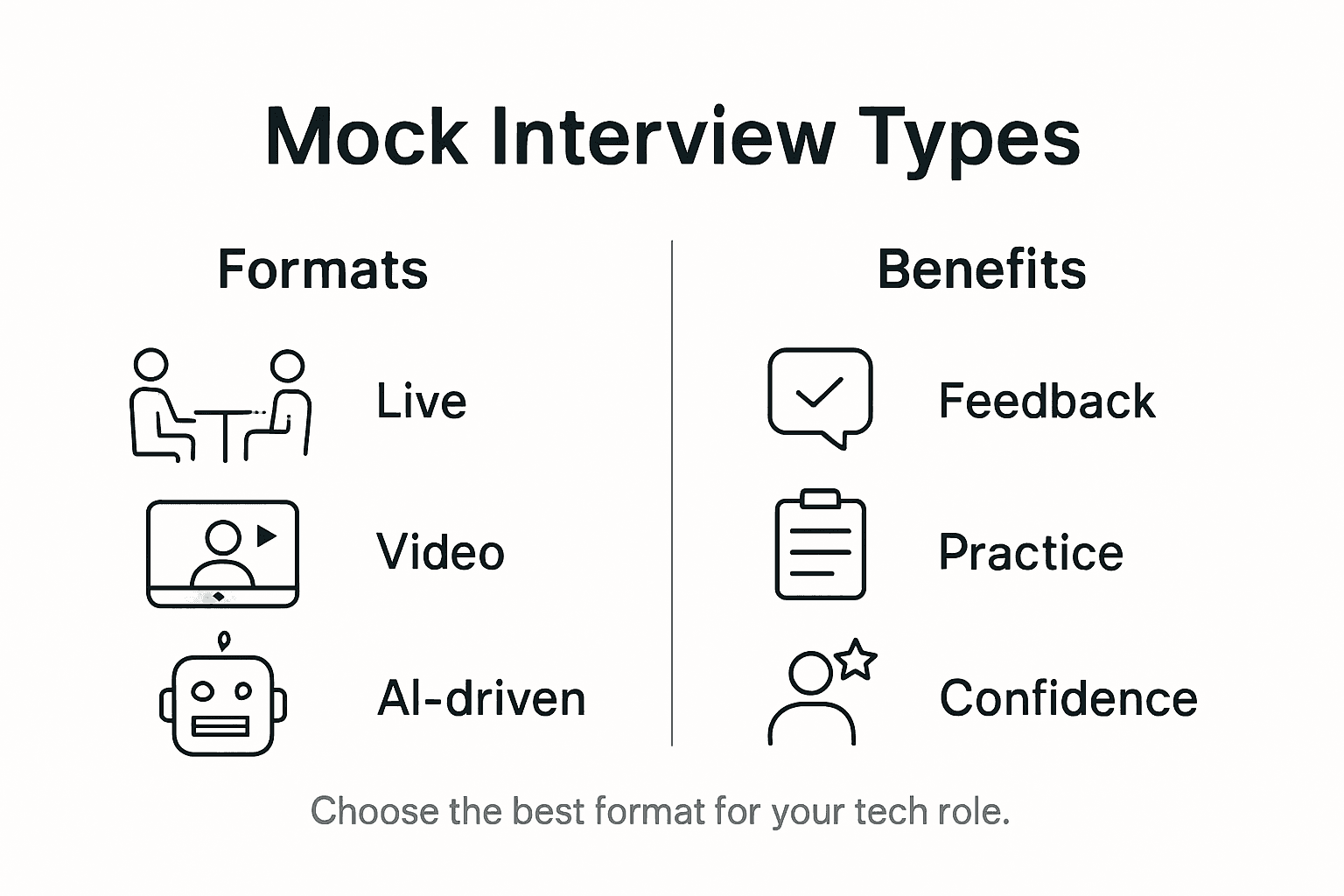
The most prominent types of mock interviews in tech include live interactive interviews, recorded video responses, and AI-driven simulations. Live interactive interviews typically involve direct engagement with experienced tech recruiters or industry professionals who provide immediate feedback. Recorded video responses allow candidates to review their performance, analyze body language, and refine communication techniques. Virtual mock interviews have particularly gained prominence, offering flexible preparation options that adapt to changing professional landscapes.
Tech-specific mock interviews often focus on specialized domains like software engineering, data science, cybersecurity, and product management. These targeted simulations include technical problem-solving sessions, coding challenges, system design discussions, and behavioral assessments. By replicating authentic interview environments, candidates can develop domain-specific communication skills, technical articulation, and strategic thinking required for competitive tech roles.
Pro tip: Select mock interview formats that closely match your target tech role and practice with professionals who have current industry experience.
Here’s a quick comparison of mock interview formats for tech roles:
| Format Type | Key Features | Ideal For | Feedback Method |
|---|---|---|---|
| Live Interactive | Real-time interaction, tailored questions | Candidates seeking personalized feedback | Verbal, immediate response |
| Recorded Video Response | Self-review, flexible timing | Analysis of body language and clarity | Self-evaluation, peer review |
| AI-Driven Simulations | Adaptive scenarios, instant analytics | Practicing industry-standard questions | Automated, data-driven |
How Real-Time AI Interview Assistants Work
Real-time AI interview assistants represent a groundbreaking technological approach to professional skill development, leveraging advanced machine learning and natural language processing technologies. These sophisticated systems create immersive, interactive environments that simulate authentic interview experiences with unprecedented precision and personalization.
The core functionality of AI interview assistants revolves around multimodal interaction and intelligent response analysis. Machine learning algorithms continuously process verbal and non-verbal communication cues, evaluating candidates’ technical knowledge, communication skills, and problem-solving approaches. Advanced AI systems generate dynamic interview scenarios that adapt in real-time, presenting candidates with increasingly complex challenges that mirror actual technical interview environments.
These intelligent platforms go beyond traditional mock interview tools by providing instantaneous, nuanced feedback. They can analyze speech patterns, technical accuracy, response structure, and even subtle communication elements like confidence and clarity. By generating interviewer personas that reflect industry-standard expectations, AI assistants help tech professionals develop comprehensive interview skills that extend far beyond simple question-and-answer preparation.
Pro tip: Practice with multiple AI interview scenarios to expose yourself to diverse questioning styles and technical challenges.
This table summarizes ways AI interview assistants enhance skill development:
| Functionality | Impact on Candidate Skills | Advantage for Tech Roles |
|---|---|---|
| Real-time scenario adaptation | Tests diverse problem-solving approaches | Matches dynamic job requirements |
| Speech & Response Analysis | Improves technical articulation | Highlights communication strengths |
| Instant, Data-Based Feedback | Reveals improvement areas | Enables targeted skill building |
Personalized Feedback and Skill Improvement
Virtual mock interviews have revolutionized professional skill development, offering unprecedented opportunities for targeted performance enhancement. These advanced training tools provide candidates with comprehensive, nuanced insights into their interview capabilities, allowing for systematic and strategic improvement across multiple dimensions of professional communication.
The power of personalized feedback lies in its ability to deconstruct complex communication patterns. Artificial intelligence technologies enable granular analysis of interview performances, evaluating everything from verbal articulation to nonverbal communication signals. AI-driven assessment platforms offer objective, data-informed evaluations of candidate skills, breaking down interview interactions into measurable components such as language precision, response structure, technical knowledge depth, and overall communication effectiveness.
Tech professionals benefit from these detailed insights by receiving targeted recommendations for improvement. Unlike traditional feedback methods, AI-powered systems can track progress over multiple practice sessions, identifying subtle shifts in communication strategy, technical fluency, and confidence. The iterative nature of these platforms transforms interview preparation from a static exercise into a dynamic, personalized learning experience that adapts to individual strengths and developmental needs.
Pro tip: Record and review multiple mock interview sessions to identify consistent patterns in your communication style and track your incremental skill improvements.
Reducing Interview Anxiety and Building Confidence
Mock interviews serve as powerful psychological training tools for managing professional stress, offering candidates a strategic approach to confronting interview-related anxiety. By creating controlled, low-stakes environments that simulate actual hiring conversations, these practice sessions help tech professionals systematically deconstruct and overcome their performance fears.
Psychological preparation plays a critical role in interview success. AI-driven mock interviews provide realistic practice opportunities that gradually build mental resilience, allowing candidates to develop coping mechanisms for high-pressure communication scenarios. These simulated experiences help professionals reframe anxiety as a manageable challenge rather than an insurmountable barrier, transforming nervous energy into focused, confident engagement.

The neuroscience of skill acquisition reveals that repeated exposure reduces fear responses. Tech professionals who consistently engage in mock interviews learn to normalize the interview experience, developing muscle memory for communication strategies and emotional regulation. As candidates become more familiar with typical interview dynamics, their physiological stress responses diminish, replaced by a sense of genuine preparedness and self-assurance that translates directly into improved real-world performance.
Pro tip: Practice deep breathing techniques and visualization exercises immediately before mock interviews to train your nervous system to remain calm under pressure.
Common Pitfalls and Effective Preparation Strategies
Interview preparation demands a strategic and comprehensive approach that goes beyond simple question rehearsal. Tech professionals must recognize and systematically address potential performance barriers, understanding that successful interviewing requires deliberate skill development across multiple dimensions of professional communication.
Common pitfalls in tech interview preparation often stem from narrow, reactive approaches. Preparation gaps typically include insufficient technical practice, underdeveloped communication skills, and limited exposure to industry-specific interview dynamics. Rigorous preparation involves analyzing personal performance weaknesses and developing targeted improvement strategies, which means conducting multiple mock interviews, soliciting diverse feedback, and meticulously refining both technical knowledge and interpersonal presentation skills.
Effective preparation transcends traditional rehearsal techniques. Successful candidates develop a holistic approach that integrates technical proficiency, communication clarity, and psychological readiness. This involves creating comprehensive practice scenarios that mirror real-world technical interviews, systematically challenging personal comfort zones, and building adaptive communication strategies that demonstrate both technical competence and professional adaptability.
Pro tip: Record and critically analyze your mock interview performances, paying special attention to your technical explanation clarity, problem-solving articulation, and nonverbal communication signals.
Elevate Your Tech Interview Confidence with Real-Time AI Support
The journey to mastering tech interviews can feel overwhelming as you strive to overcome interview anxiety and develop sharp communication and problem-solving skills. This article highlights how mock interviews build essential confidence and reduce stress by offering realistic practice and personalized feedback. If you want to transform nervousness into genuine self-assurance and practice effectively, leveraging real-time AI assistance can be the game changer you need.
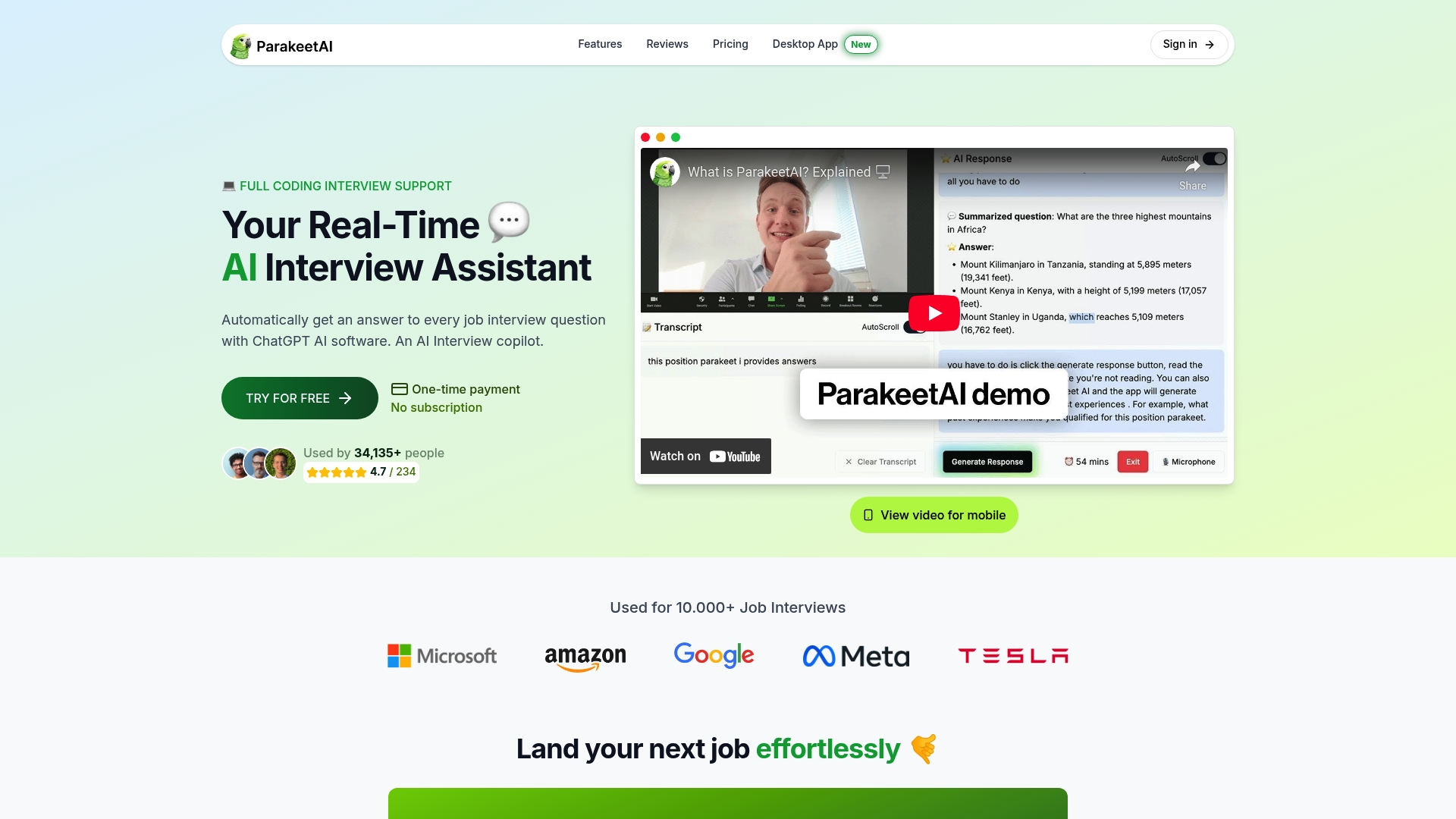
At Parakeet AI, our cutting-edge AI job interview assistant listens carefully to every question you face and automatically provides thoughtful, instant answers tailored to your unique interview scenario. This technology is designed to simulate authentic interview experiences and guide you through diverse technical challenges while tracking your progress — all to build unstoppable confidence and sharpen your skills.
Discover how AI-powered mock interview solutions align perfectly with the article’s insights by providing dynamic feedback and personalized skill improvement. Stop letting interview nerves hold you back and start practicing smarter today.
Experience the future of interview preparation now and take the next step toward landing your dream tech role.
Frequently Asked Questions
What are mock interviews, and how do they benefit tech professionals?
Mock interviews are practice simulations designed to help job seekers prepare for real job interviews. They allow tech professionals to refine their communication skills, practice technical responses, and build confidence in a realistic environment.
How can mock interviews help reduce interview anxiety?
Mock interviews create a controlled, low-stakes environment that mimics actual interview scenarios, helping candidates confront their performance fears and develop coping strategies. By normalizing the interview experience, candidates can transform anxiety into self-assurance.
What types of mock interviews are available for tech roles?
Common types of mock interviews include live interactive interviews, recorded video responses, and AI-driven simulations. Each format offers unique benefits, such as personalized feedback, self-review opportunities, or adaptive challenges to match industry expectations.
How does personalized feedback from mock interviews enhance skill development?
Personalized feedback provides candidates with detailed insights into their performance, including areas of strength and opportunities for improvement. This targeted analysis helps tech professionals refine their communication strategies and technical skills over multiple practice sessions.