
Interview Assessment Test Sample: Boost Your Success

Preparing for a tech interview can feel challenging when every company seems to use a different evaluation method. With employers increasingly relying on structured interview assessments to measure skills, even the most qualified candidates can feel uncertain about what to expect. This guide sheds light on the main types of interview tests, what each method reveals about your abilities, and why practicing with AI-powered tools can give you a clear edge over traditional preparation approaches.
Table of Contents
- Interview Assessment Test Sample Explained
- Main Types of Interview Assessment Tests
- How Tech Interview Assessments Work
- Typical Questions and Answer Frameworks
- Optimizing Practice With AI Interview Tools
- Common Pitfalls and How to Avoid Them
Key Takeaways
| Point | Details |
|---|---|
| Structured Assessments Enhance Hiring | Implementing interview assessment tests provides objective, data-driven insights into candidate suitability. |
| Various Test Formats Offer Unique Insights | Different types of assessments, like psychometric and technical tests, reveal diverse skills and compatibility. |
| AI Tools Optimize Preparation | AI interview platforms provide instant feedback and personalized practice, enhancing communication skills. |
| Avoid Common Pitfalls for Success | Over-rehearsing and lack of research can undermine performance; focus on authentic storytelling and preparation. |
Interview Assessment Test Sample Explained
An interview assessment test helps employers systematically evaluate a job candidate’s skills, capabilities, and potential workplace fit. These screening tools go far beyond traditional interviews by providing structured, measurable insights into a candidate’s professional attributes. Recruitment screening processes can include multiple evaluation methods designed to comprehensively assess an applicant’s strengths.
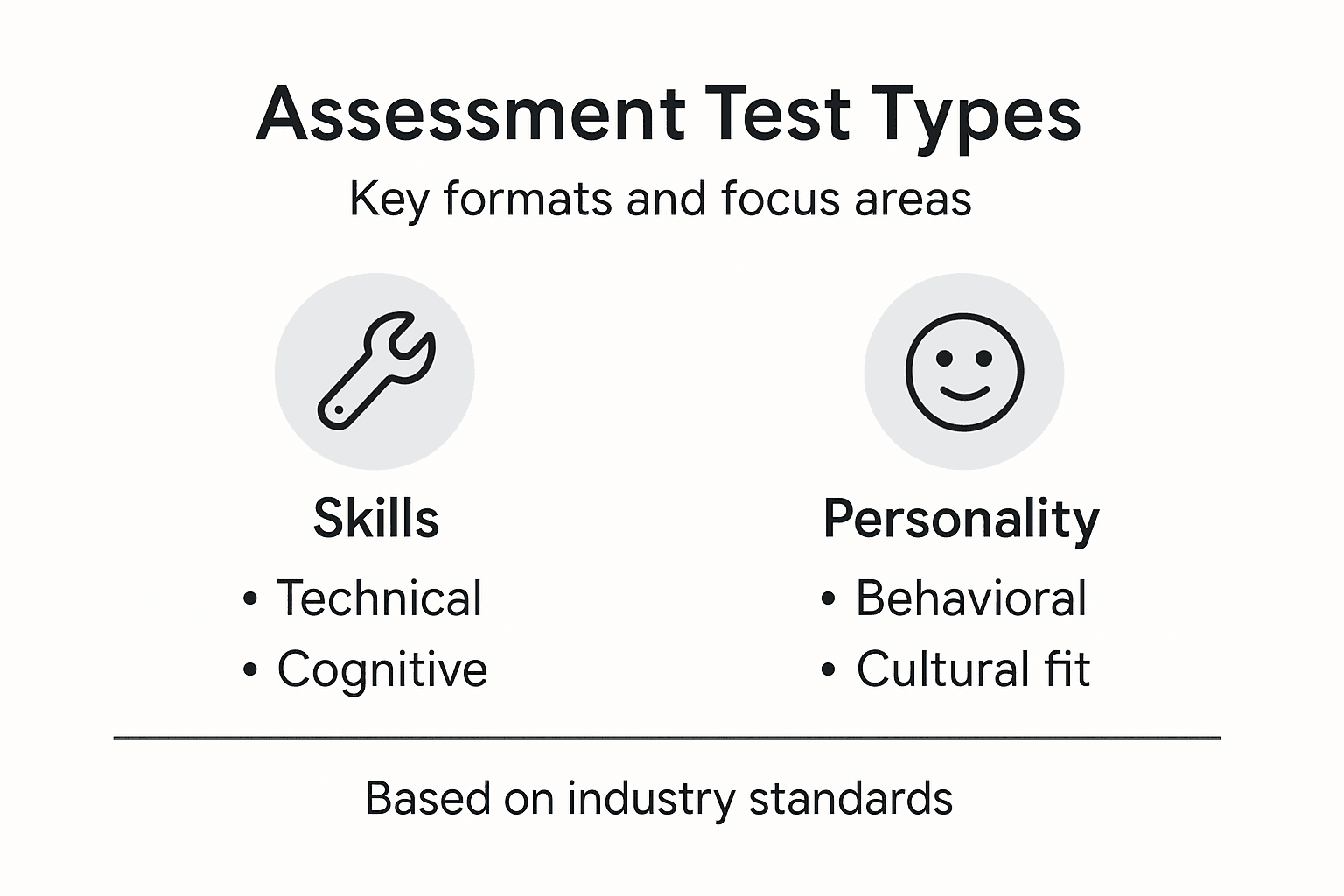
Typically, interview assessment tests encompass several distinct evaluation categories:
- Aptitude Tests: Measure cognitive abilities and problem-solving skills
- Personality Assessments: Evaluate behavioral traits and cultural compatibility
- Cognitive Ability Evaluations: Analyze critical thinking and reasoning capabilities
- Technical Skills Assessments: Gauge specific professional competencies
These assessments serve multiple strategic purposes for organizations. By implementing standardized evaluation methods, companies can:
- Reduce subjective hiring biases
- Identify candidates with highest potential performance
- Match candidate characteristics with organizational requirements
- Predict long-term job success more accurately
Most assessment tests are designed to provide objective data that complements traditional interview techniques. They typically involve online tests, video interviews, or in-person evaluations that systematically measure a candidate’s professional capabilities.
Interview assessment tests transform hiring from a gut-feeling process to a data-driven selection strategy.
Pro tip: Prepare thoroughly by practicing different assessment test formats and understanding the specific skills each test evaluates.
Main Types of Interview Assessment Tests
Modern employers utilize a wide range of interview assessment tests to evaluate candidates comprehensively. Interview assessment techniques have evolved beyond traditional question-and-answer formats to include multiple sophisticated evaluation methods that provide deeper insights into a candidate’s potential.
The most common types of interview assessment tests include:
- Psychometric Tests: Measure personality traits, cognitive abilities, and behavioral characteristics
- Technical Skills Assessments: Evaluate job-specific technical knowledge and competencies
- Presentation Exercises: Test communication, analytical, and creative problem-solving skills
- Role-Play Scenarios: Assess decision-making, interpersonal skills, and professional interaction
- In-Tray/Online Simulations: Demonstrate organizational and prioritization capabilities
Different assessment formats offer unique advantages for employers:
- Telephone interviews provide initial screening
- Video interviews allow flexible candidate evaluation
- Assessment centers offer comprehensive multi-method evaluations
- Group exercises test teamwork and collaborative skills
These assessment methods help organizations predict job performance more accurately by examining candidates’ skills beyond traditional resume reviews and interviews.

Here’s a comparison of interview assessment test formats and what they reveal about candidates:
| Assessment Format | Key Skills Assessed | Unique Insight Provided |
|---|---|---|
| Psychometric Tests | Personality & cognitive ability | Cultural fit and learning approach |
| Technical Exercises | Job-specific technical competencies | Real-world problem-solving capacity |
| Presentation Exercises | Communication & analytical thinking | Clarity under pressure |
| Group Assessments | Teamwork & collaboration | Interaction in group dynamics |
Interview assessment tests transform recruitment from subjective selection to data-driven talent acquisition.
Pro tip: Research the specific assessment formats used in your industry and practice relevant skills to improve your performance across different evaluation methods.
How Tech Interview Assessments Work
Tech interview assessments are sophisticated evaluation tools designed to measure a candidate’s technical skills and problem-solving capabilities. Technical assessment strategies have evolved to provide comprehensive insights into a candidate’s professional potential beyond traditional resume screening.
The core components of technical interview assessments typically include:
- Coding Challenges: Evaluate programming skills and algorithmic thinking
- System Design Questions: Test architectural and design problem-solving abilities
- Live Coding Sessions: Assess real-time technical implementation skills
- Project-Based Assessments: Demonstrate practical application of technical knowledge
- Domain-Specific Technical Tests: Measure expertise in specific technological domains
Employers utilize these assessments to evaluate candidates through multiple approaches:
- Standardized role-based technical tests
- Real-world scenario simulations
- Problem-solving skill evaluations
- Practical skill demonstrations
Technical assessment tests help companies efficiently verify candidate capabilities by providing objective measurements of technical proficiency across various skill levels and technological domains.
Technical interviews transform candidate evaluation from subjective impressions to measurable, skill-based assessments.
Pro tip: Practice coding challenges, simulate real-world problem-solving scenarios, and develop a comprehensive portfolio that demonstrates your technical versatility.
Typical Questions and Answer Frameworks
Successful interview preparation involves developing strategic response frameworks that demonstrate your skills, experience, and professional potential. Academic interview questions require carefully structured answers that highlight your unique capabilities and alignment with organizational goals.
Typical interview questions can be categorized into several key types:
- Background Questions: Explore your professional history and career trajectory
- Behavioral Questions: Assess past performance through specific scenario examples
- Technical Competency Questions: Evaluate specific skills relevant to the role
- Problem-Solving Questions: Test critical thinking and analytical capabilities
- Motivational Questions: Understand your career objectives and professional drive
Effective answer frameworks typically follow structured approaches:
- Provide context for your response
- Describe specific actions you took
- Highlight positive outcomes and learnings
- Connect the experience to the current opportunity
The key to compelling interview responses is demonstrating not just what you’ve done, but how your experiences translate into value for the prospective employer. Strong candidates craft narratives that showcase adaptability, continuous learning, and strategic thinking.
Successful interviews are less about perfect answers and more about authentic, well-structured storytelling.
Pro tip: Develop a versatile portfolio of personal stories that can be adapted to different interview questions, focusing on demonstrating your problem-solving skills and professional growth.
Optimizing Practice with AI Interview Tools
Technology has revolutionized interview preparation through advanced AI-powered training platforms that provide personalized, data-driven coaching experiences. AI interview simulation tools leverage sophisticated natural language processing to transform how candidates prepare for critical professional assessments.
Key capabilities of AI interview tools include:
- Speech Pattern Analysis: Evaluate communication clarity and confidence
- Real-Time Feedback: Provide instant insights on response quality
- Adaptive Question Generation: Create customized practice scenarios
- Non-Verbal Cue Tracking: Assess body language and emotional intelligence
- Performance Benchmarking: Compare skills against industry standards
These intelligent platforms offer multiple strategic advantages for job seekers:
- Reduce interview anxiety through repeated simulations
- Identify and improve communication weaknesses
- Develop more compelling, structured responses
- Practice across diverse interview scenarios
AI tools go beyond traditional preparation methods by offering objective, measurable insights that help candidates refine their professional presentation and communication strategies.
To help you prepare, here’s a summary of how AI-powered interview tools outperform traditional methods:
| Preparation Method | Feedback Style | Skills Improved | Personalization Level |
|---|---|---|---|
| Traditional Practice | Manual, delayed | General speaking confidence | Low, one-size-fits-all |
| AI Interview Platforms | Instant, data-driven | Targeted communication weaknesses | High, adaptive to user |
AI interview tools transform random practice into targeted, scientifically informed skill development.
Pro tip: Regularly use AI interview tools, treating each session as a genuine interview and carefully analyzing the detailed feedback to incrementally improve your performance.
Common Pitfalls and How to Avoid Them
Interviews are complex interactions where subtle mistakes can significantly impact candidate evaluation and overall performance. Interviewer evaluation challenges reveal numerous psychological and communication barriers that can derail successful job prospects.
Common interview pitfalls candidates frequently encounter include:
- Over-Rehearsing: Sounding robotic and inauthentic
- Lack of Specific Examples: Unable to substantiate claims with concrete experiences
- Negative Language: Using pessimistic or defensive communication styles
- Insufficient Research: Demonstrating minimal understanding of the company
- Poor Non-Verbal Communication: Weak eye contact, nervous body language
Strategies to mitigate these potential interview challenges:
- Practice storytelling, not scripted responses
- Prepare detailed, measurable professional narratives
- Maintain positive, solution-oriented communication
- Conduct comprehensive company and role research
- Develop confident, professional body language
Successful candidates recognize that interviews are collaborative conversations designed to assess mutual fit, not interrogations to be nervously survived.
Interviews are opportunities for professional dialogue, not high-stakes performance tests.
Pro tip: Record yourself practicing interview responses to objectively assess your communication style, tone, and non-verbal cues.
Master Your Interview Assessment Tests with Real-Time AI Support
The article highlights key challenges in interview assessment tests such as managing behavioral questions, tackling technical exercises, and preparing for various evaluation formats. Many candidates struggle with providing authentic, well-structured answers and overcoming nervousness during interviews. These pain points often lead to missed opportunities despite strong qualifications. With terms like psychometric tests, technical assessments, and AI interview simulation tools mentioned, it is clear that a strategic and adaptive preparation method can make all the difference.
Boost your confidence and sharpen your responses with a real-time AI job interview assistant that listens and provides tailored answers instantly. This innovative technology bridges the gap between theoretical preparation and actual interview execution by helping you practice and improve communication, problem-solving, and storytelling skills directly aligned with the demands of modern recruitment processes. Visit Parakeet AI and experience the future of interview coaching today.
Looking to turn every interview challenge into your advantage Try our AI-driven platform now Real-Time AI Job Interview Assistant
Interview Assessment Test Sample: Boost Your Success offers the perfect opportunity to elevate your interview skills to the next level. Take control and prepare smarter not harder.
Frequently Asked Questions
What is an interview assessment test?
An interview assessment test is a tool used by employers to evaluate a candidate’s skills, capabilities, and fit for the workplace systematically. It provides structured insights that go beyond traditional interviews.
What types of assessments are commonly included in interview assessment tests?
Common types of assessments include aptitude tests, personality assessments, technical skills evaluations, cognitive ability evaluations, and role-play scenarios, each measuring different attributes of a candidate.
How can I prepare for an interview assessment test?
To prepare effectively, practice different assessment formats, understand the specific skills being evaluated, and develop a versatile portfolio of experiences to share during the interview.
What are the benefits of using interview assessment tests for employers?
Interview assessment tests help reduce subjective biases, identify high-potential candidates, match candidate characteristics with job requirements, and predict long-term job success more accurately.