
Interview Automation: Transforming Global Job Search

Most American job seekers now encounter artificial intelligence during interview preparation, and nearly 60 percent say it reduces their anxiety and improves their performance. From London to Toronto, technology is transforming how professionals approach the hiring process across global industries. This introduction reveals how interview automation is redefining candidate experiences, highlights the most impactful AI features, and uncovers what job seekers need to know to confidently navigate modern, digitally enhanced interviews.
Table of Contents
- Interview Automation Defined and Debunked
- Key Types of Automated Interview Tools
- How Real-Time Ai Interview Assistants Work
- Essential Features and Candidate Experience
- Risks, Ethics, and Legal Implications
- How Interview Automation Compares to Traditional Methods
Key Takeaways
| Point | Details |
|---|---|
| Interview Automation Enhances Preparation | AI-driven platforms streamline interview prep by providing real-time feedback and personalized insights, helping job seekers refine their communication skills. |
| Technological Advantages Over Traditional Methods | Automated tools offer consistent, data-driven assessments that reduce biases and provide scalability in candidate evaluations, unlike traditional interviews. |
| Collaboration with Human Skills is Key | Effective job seekers use AI technologies as collaborative partners, integrating them into their overall interview strategies rather than relying solely on them. |
| Ethical Considerations are Essential | Organizations must ensure transparency and data protection in AI interview processes to maintain fairness and uphold individual rights during recruitment. |
Interview Automation Defined and Debunked
Interview automation represents a cutting-edge technological approach transforming how job seekers prepare for and navigate professional interviews. At its core, this innovation leverages artificial intelligence to streamline, simulate, and optimize the interview experience, removing traditional barriers and inefficiencies.
The landscape of interview automation encompasses several critical components. AI-driven interview platforms can analyze interview data with advanced algorithmic processing, reducing human bias and identifying nuanced communication patterns. These systems go beyond simple question-and-answer simulations, providing real-time feedback, sentiment analysis, and personalized performance insights.
Key features of interview automation technologies typically include dynamic question generation, adaptive learning algorithms, and comprehensive performance tracking. By simulating realistic interview scenarios, these tools help job seekers develop confidence, refine communication strategies, and understand potential areas of improvement. AI scheduling technologies further eliminate traditional coordination challenges, enabling more efficient and flexible interview preparation processes.
Understanding interview automation requires recognizing both its transformative potential and current limitations. While these technologies offer unprecedented support, they cannot completely replace human judgment or the fundamental interpersonal dynamics of interviews. Successful job seekers will view AI tools as collaborative partners in their professional development journey.
Pro Tip: Integrate AI interview preparation tools systematically into your job search strategy, treating them as supplements to—not replacements for—genuine human communication skills.
Key Types of Automated Interview Tools
Automated interview tools have emerged as sophisticated technological solutions designed to transform the job search and interview preparation landscape. These innovative platforms leverage advanced artificial intelligence and machine learning algorithms to provide job seekers with comprehensive support throughout their professional journey.
Comprehensive interview preparation platforms offer a range of functionalities, including advanced interview recording and transcription capabilities. These tools typically provide features such as video analysis, speech pattern recognition, and detailed performance feedback. Job seekers can record mock interviews, receive instant insights into their communication style, and identify areas for improvement in real-time.
The most advanced automated interview tools are distinguished by their multifaceted approach. They encompass several critical components: dynamic question generators, AI-powered performance analytics, and personalized coaching modules. Multilingual interview support platforms enable candidates to practice interviews in multiple languages, with sophisticated speaker identification and timestamping features that provide nuanced performance evaluation.
Beyond individual preparation tools, some automated interview platforms offer integrated solutions for employers and recruitment teams. These systems can streamline candidate screening, provide objective assessment metrics, and reduce unconscious bias in the initial interview stages. By combining technological precision with adaptive learning algorithms, these tools are reshaping traditional hiring processes and creating more equitable opportunities for job seekers worldwide.
Pro Tip: Select automated interview tools that offer comprehensive feedback mechanisms and align closely with your specific industry and career development goals.
How Real-Time AI Interview Assistants Work
Real-time AI interview assistants represent a groundbreaking technological advancement that transforms the traditional interview preparation and execution process. These sophisticated systems leverage advanced machine learning algorithms and natural language processing to provide instantaneous, intelligent support throughout the interview experience.

At the core of these AI assistants is their ability to analyze and respond to complex interview dynamics in real-time. By processing live conversational data, these intelligent systems can generate context-aware responses, suggest optimal communication strategies, and provide immediate feedback on verbal and non-verbal communication cues. Cognitive augmentation becomes a key feature, allowing job seekers to receive nuanced guidance that adapts dynamically to the specific conversational context of each interview.
The technological architecture of real-time AI interview assistants typically involves multiple interconnected components. Natural language understanding engines parse interview questions and candidate responses, while machine learning models continuously refine their comprehension and recommendation capabilities. These systems can detect subtle communication patterns, emotional tones, and potential areas of improvement, offering candidates granular insights into their interview performance that were previously unavailable through traditional preparation methods.
Beyond individual interview preparation, these AI assistants are reshaping the entire recruitment ecosystem. They provide objective, data-driven insights that help reduce unconscious bias, enable more comprehensive candidate assessment, and create a more equitable interview experience. By combining technological precision with adaptive learning capabilities, real-time AI interview assistants are not just tools but intelligent partners in professional communication and career development.
Pro Tip: Practice regularly with AI interview assistants to develop muscle memory for effective communication and gain increasingly sophisticated performance insights.
Essential Features and Candidate Experience
Automated interview technologies are revolutionizing the candidate experience by providing sophisticated, intelligent platforms that transform traditional recruitment processes. These advanced systems go far beyond simple screening mechanisms, offering comprehensive support that addresses both technological efficiency and human-centered interaction.
Automated interview platforms enhance candidate evaluation through intelligent screening and personalized feedback mechanisms. Intelligent screening tools can rapidly analyze candidate profiles, generate standardized interview questions, and provide unbiased assessments that level the playing field for job seekers. These systems create immersive practice environments that help candidates build confidence, identify skill gaps, and develop more effective communication strategies before critical professional interactions.
The most advanced interview automation technologies incorporate multiple sophisticated features designed to optimize the candidate experience. Dynamic question generation adapts to individual candidate backgrounds, while sentiment analysis technologies provide nuanced insights into communication styles and emotional intelligence. Advanced interview platforms offer seamless scheduling, automatic transcription, and comprehensive data reporting that transform the traditional interview preparation process into a more transparent, supportive experience.
Critically, these technologies are not about replacing human interaction but enhancing it. By reducing administrative burdens and unconscious biases, AI-driven interview platforms create more equitable, efficient recruitment ecosystems. They provide candidates with unprecedented opportunities to understand their strengths, refine their communication skills, and approach interviews with greater self-awareness and strategic preparation.
Here’s an overview of how interview automation features positively impact candidates:
| Feature | Candidate Benefit | Business Impact |
|---|---|---|
| Dynamic Question Generation | Personalized interview practice | Efficient candidate screening |
| AI Feedback and Analytics | Immediate skill improvement | Data-driven hiring decisions |
| Automated Scheduling | Flexible preparation times | Reduced administrative burden |
| Sentiment and Speech Analysis | Awareness of communication tone | Objective assessment tools |
Pro Tip: Approach AI interview tools as collaborative partners, using their insights to continuously refine your communication skills and professional presentation.
Risks, Ethics, and Legal Implications
Interview automation technologies bring profound ethical considerations that extend far beyond their technological capabilities. As artificial intelligence becomes increasingly integrated into recruitment processes, organizations and job seekers must navigate complex ethical landscapes that balance technological innovation with fundamental human rights and professional integrity.
Ethical implementation of AI interview technologies demands rigorous transparency and awareness of potential systemic biases. Algorithmic accountability requires continuous scrutiny to prevent discriminatory practices that might inadvertently perpetuate existing social inequalities. The opacity of AI decision-making processes creates significant challenges, necessitating robust mechanisms that ensure fair, unbiased candidate assessments while protecting individual privacy and maintaining professional dignity.
Participant consent and data protection emerge as critical ethical considerations in automated interview platforms. Maintaining confidentiality, ensuring voluntary participation, and protecting sensitive personal information become paramount concerns. Ethical guidelines must evolve to address the unique challenges presented by AI-driven interview technologies, establishing clear protocols that safeguard candidate rights and prevent potential misuse of personal data.
The legal implications of interview automation are complex and rapidly evolving. Organizations must proactively develop comprehensive policies that address potential algorithmic discrimination, data privacy regulations, and the ethical boundaries of AI-assisted recruitment. This requires collaboration between technology developers, legal experts, and human resources professionals to create frameworks that balance technological efficiency with fundamental principles of fairness and respect.
Pro Tip: Regularly audit and review your AI interview tools to ensure they align with current ethical standards and legal requirements.
How Interview Automation Compares to Traditional Methods
The landscape of professional recruitment is undergoing a profound transformation, with interview automation technologies challenging long-established traditional interviewing paradigms. These emerging technologies represent more than just a technological upgrade – they signal a fundamental reimagining of how talent assessment and candidate evaluation can be conducted.
AI-driven interview platforms demonstrate comparable data quality to human-conducted interviews, while offering significant advantages in efficiency and scalability. Technological precision enables these systems to remove geographical constraints, reduce administrative overhead, and provide more consistent candidate assessments. Unlike traditional methods that rely heavily on individual interviewer interpretation, automated interview technologies can standardize evaluation criteria, reducing potential human biases and creating more objective selection processes.
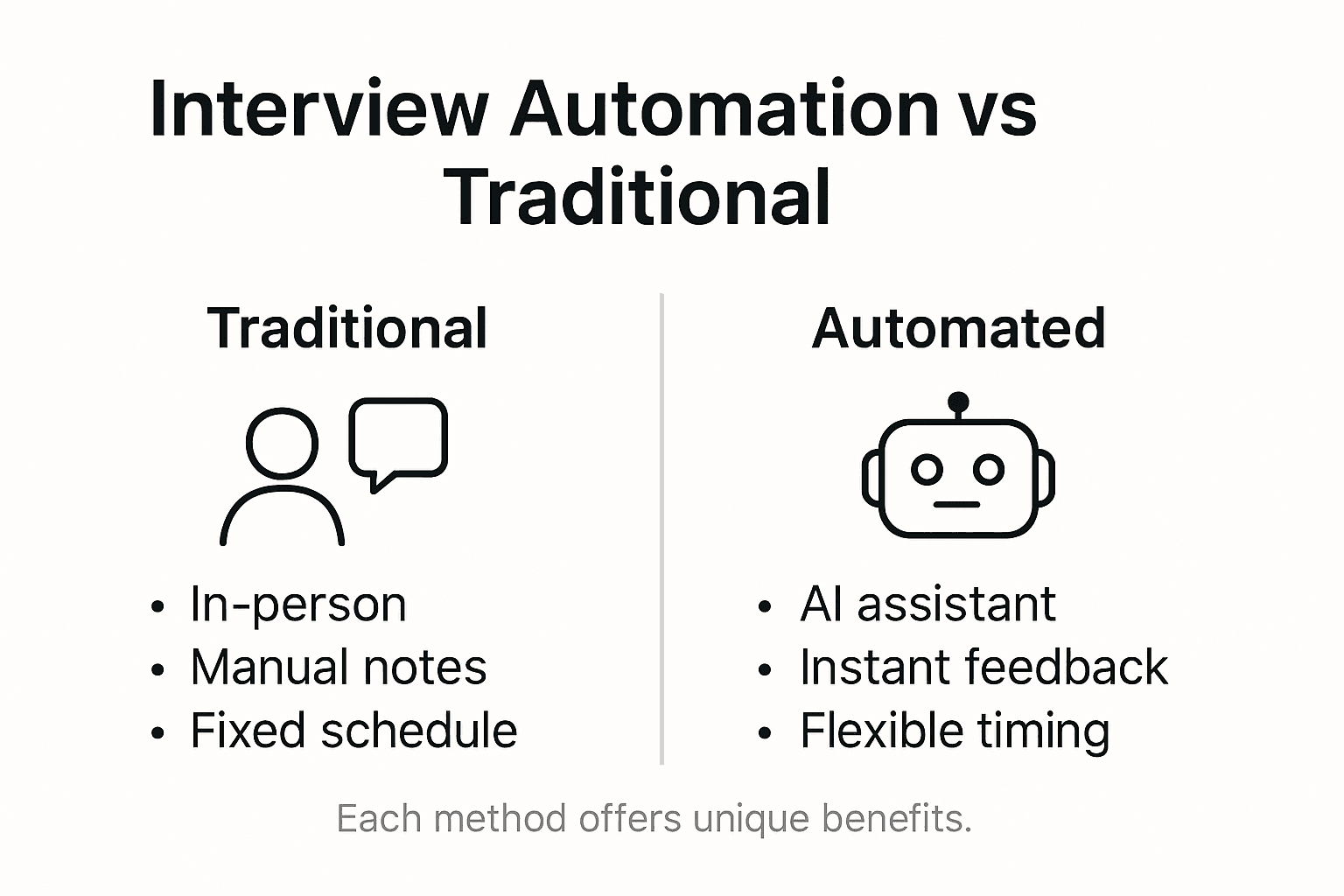
Key differences between traditional and automated interview methods emerge across several critical dimensions. Traditional interviews depend on interpersonal dynamics, subjective impressions, and the interviewer’s individual communication skills. In contrast, AI-powered interview platforms integrate advanced multimodal data processing, analyzing not just verbal responses but also non-verbal communication signals, tone variations, and contextual nuances. This comprehensive approach allows for a more holistic candidate assessment that goes beyond the limitations of conventional face-to-face interactions.
To clarify the differences between traditional and automated interview methods, here is a side-by-side comparison:
| Dimension | Traditional Interviews | Automated Interview Platforms |
|---|---|---|
| Evaluation Consistency | Varies by interviewer | Standardized algorithms |
| Bias Mitigation | Highly variable | Reduced through AI screening |
| Scalability | Limited by resources | High; supports global access |
| Communication Analysis | Subjective impressions | Verbal & non-verbal data processing |
| Feedback Speed | Delayed, post-interview | Instant, real-time insights |
While automated interview technologies offer remarkable benefits, they are not intended to completely replace human judgment but to complement and enhance existing recruitment strategies. The most effective approaches will likely involve a hybrid model that combines technological efficiency with human emotional intelligence. By leveraging AI tools as collaborative partners in the recruitment process, organizations can create more dynamic, inclusive, and insightful candidate evaluation methods.
Pro Tip: Approach AI interview tools as collaborative technologies that augment – rather than replace – human decision-making capabilities.
Elevate Your Interview Success with Real-Time AI Assistance
The article highlights key challenges in navigating today’s competitive job market through interview automation. Common pain points include overcoming communication barriers, managing real-time pressure, and receiving instant, actionable feedback to refine your performance. Concepts like real-time AI interview assistants and dynamic question generation show how technology can transform interview preparation but also reveal the need for personalized, adaptive support during actual interviews.
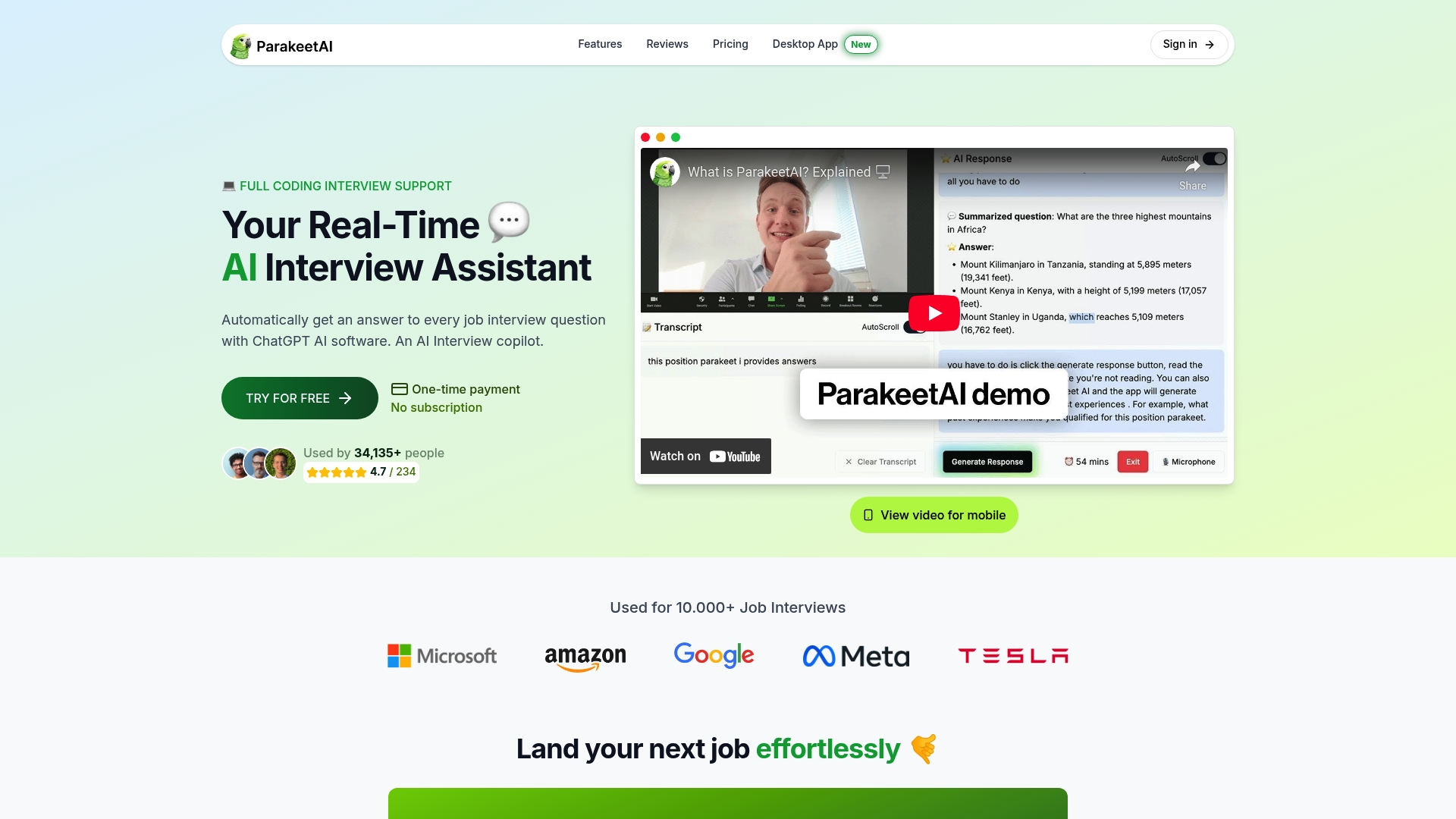
That is where Parakeet comes in. Our real-time AI job interview assistant listens attentively and provides automatic responses to every question using advanced AI, helping you master your communication and build confidence with each interaction. This means you can practice with a tool that understands the nuances of your speech and offers insights that turn stress into strength. Explore the future of interview preparation by visiting Parakeet AI and discover how automated assistance complements your natural skills without replacing human connection.
Transform challenges into opportunities. Start your journey today with Parakeet, a powerful ally designed to help you perform at your best every time.
Frequently Asked Questions
What is interview automation?
Interview automation refers to the use of artificial intelligence and technology to streamline the interview process for job seekers, providing tools for practice, feedback, and scheduling.
How do AI-driven interview platforms improve candidate preparation?
AI-driven interview platforms offer personalized feedback, simulate real-life interview scenarios, and provide insights into communication skills, helping candidates to refine their strategies and build confidence.
What are the benefits of using real-time AI interview assistants?
Real-time AI interview assistants enhance the interview process by providing immediate feedback on communication styles, suggesting strategies in real-time, and helping candidates adjust their performance dynamically during practice sessions.
Are automated interview tools biased?
While automated interview tools strive to reduce human bias through standardized algorithms, it’s essential for organizations to regularly audit these systems to ensure they remain fair and uphold ethical standards.