
Master product manager interview questions and answers 2026

Many aspiring product managers believe technical skills dominate interviews, but that’s only part of the picture. In reality, product manager interviews test a broad skill set spanning product sense, execution, leadership, strategic thinking, and behavioral competencies. Knowing common questions and how to answer them strategically dramatically improves your chances of landing the role. This comprehensive guide covers key question categories, expert frameworks, detailed model answers, and actionable preparation tips to help you succeed in your 2026 product manager interviews.
Table of Contents
- Understanding Core Product Manager Interview Question Categories
- Crafting Effective Answers With Structured Frameworks
- Top 10 Product Manager Interview Questions And Detailed Model Answers
- Common Mistakes To Avoid And Final Interview Preparation Advice
- Boost Your Interview Success With Parakeet AI
- Frequently Asked Questions
Key takeaways
| Point | Details |
|---|---|
| Question categories | Interviewers assess product sense, execution, leadership, strategy, and behavioral skills to evaluate your complete PM capabilities. |
| Structured frameworks | Using frameworks like STAR and CIRCLES creates clear, compelling answers that demonstrate impact and problem-solving ability. |
| Real examples matter | Incorporating specific scenarios with quantifiable metrics shows concrete value and strengthens your credibility. |
| Practice improves performance | Consistent preparation with mock interviews and feedback refinement builds confidence and interview readiness. |
Understanding core product manager interview question categories
Successful product manager interviews typically cover five distinct categories, each designed to test different crucial competencies. Understanding these categories helps you prepare targeted answers that showcase your complete skill set.
Product sense questions evaluate your ability to understand user needs, identify problems, and design solutions. Interviewers want to see how you think about products, prioritize features, and balance user value with business goals. Execution questions focus on your ability to deliver results, manage timelines, and work cross-functionally to ship products successfully.
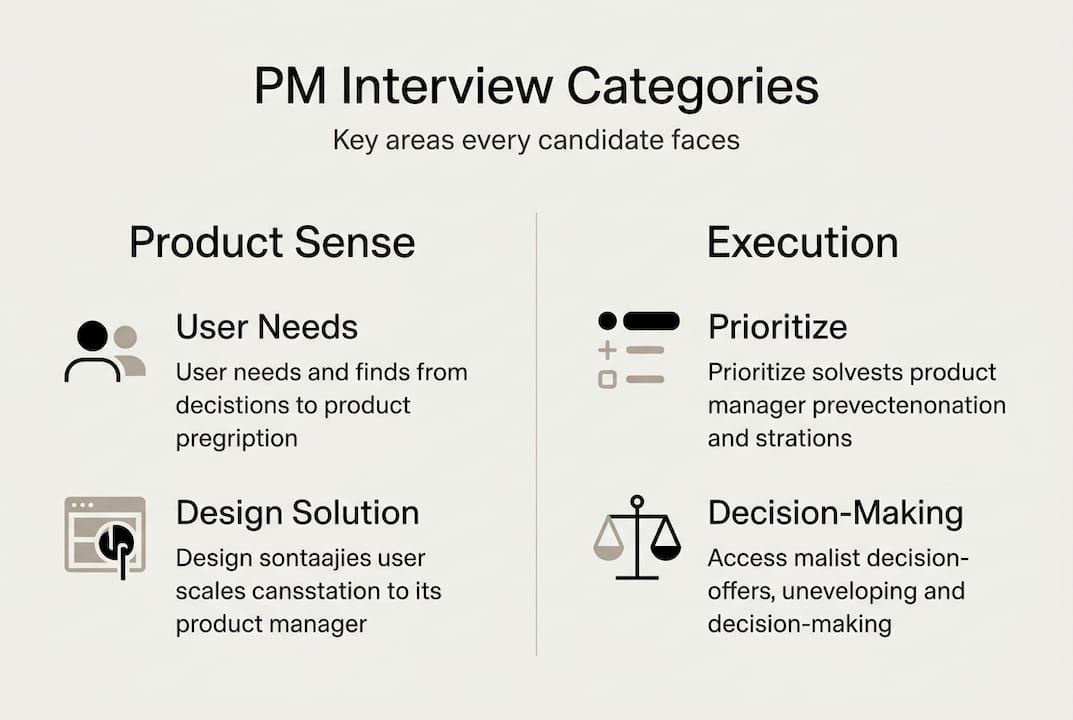
Leadership questions assess how you influence teams, resolve conflicts, and drive decisions without direct authority. Strategic thinking questions test your vision for products, market understanding, and ability to make trade-offs aligned with company objectives. Behavioral questions reveal your collaboration style, adaptability, and problem-solving approach in real situations.
Here are example question types under each category:
- Product sense: How would you improve our flagship product? Design a feature for elderly users. What metrics would you track for success?
- Execution: How do you prioritize a backlog with competing stakeholders? Describe launching a product under tight deadlines.
- Leadership: Tell me about resolving a conflict between engineering and design. How do you motivate teams during setbacks?
- Strategic thinking: Where should our product be in three years? How would you enter a new market segment?
- Behavioral: Describe a time you failed and what you learned. How do you handle disagreement with your manager?
Interviewers seek answers demonstrating user empathy, data-driven thinking, clear communication, and the ability to balance multiple constraints. Preparing for these program manager interview questions ensures you cover the full spectrum of competencies hiring managers evaluate. Each category reveals different aspects of your potential effectiveness as a product manager, so comprehensive preparation across all areas maximizes your interview success.
Crafting effective answers with structured frameworks
Raw knowledge alone won’t win interviews. You need to organize your thoughts clearly and deliver answers that resonate. Structured responses with frameworks like STAR improve clarity and impact, helping interviewers follow your logic and see your value immediately.
The STAR framework (Situation, Task, Action, Result) works brilliantly for behavioral and execution questions. Start by setting context with the situation, explain the specific task or challenge you faced, describe the actions you took with clear reasoning, and conclude with quantifiable results that show impact. This structure keeps answers focused and demonstrates your ability to drive outcomes.

For product sense questions, the CIRCLES framework provides excellent scaffolding. Comprehend the situation by clarifying the question and constraints. Identify the customer and their needs. Report customer pain points and priorities. Cut through prioritization by choosing which problems to solve. List solutions and evaluate trade-offs. Evaluate trade-offs between solutions. Summarize your recommendation with clear reasoning.
Follow these steps to structure compelling answers:
- Listen carefully and clarify any ambiguities before answering to ensure you address the actual question.
- Take 15 to 30 seconds to organize your thoughts using an appropriate framework.
- State your approach upfront so the interviewer understands your structure.
- Walk through each framework component methodically without rushing.
- Use specific examples from your experience rather than hypothetical scenarios.
- Quantify impact with metrics whenever possible to demonstrate tangible results.
- Conclude by connecting your answer back to the role or company context.
Pro Tip: Research the company’s values and recent product launches before your interview, then tailor your framework answers to reference these specifics naturally. This shows genuine interest and helps interviewers visualize you in the role.
Common pitfalls destroy otherwise solid answers. Avoid rambling without structure, as this signals unclear thinking. Never give answers lacking concrete metrics or results, since product management demands data-driven decisions. Don’t ignore the business context or user needs when explaining your reasoning. Skip jargon that obscures rather than clarifies your points. These best interview answer techniques separate strong candidates from those who struggle to articulate their value. Practice applying frameworks until they feel natural, allowing you to focus on content rather than structure during actual interviews. Tools like Uman’s interview prep platform can help you refine your framework application through realistic practice sessions.
Top 10 product manager interview questions and detailed model answers
Seeing effective answers in action clarifies what interviewers seek and gives you templates to adapt. Practicing model answers increases confidence and readiness, helping you perform under pressure during actual interviews.
| Question | Intent | Model Answer Approach | | — | — | | How would you prioritize features for our mobile app? | Tests prioritization framework and user focus | Use a scoring matrix (user value, business impact, effort) and explain trade-offs with specific examples from the app. | | Tell me about a time you launched a product that failed | Assesses learning from failure and resilience | Apply STAR: describe context, your role, what went wrong, specific lessons learned, and how you applied them successfully later. | | Design a product for restaurant owners | Evaluates product sense and user empathy | Use CIRCLES: identify owner pain points (inventory, staffing, margins), prioritize based on impact, propose solution with clear value proposition. | | How do you work with difficult stakeholders? | Tests leadership and influence skills | Share specific example using STAR showing empathy, finding common ground, and achieving alignment through data and communication. | | What metrics would you track for a social media feature? | Assesses analytical thinking and goal alignment | Define success (engagement, retention, revenue), propose leading and lagging indicators, explain why each metric matters for decisions. | | Where do you see our product in three years? | Tests strategic vision and market understanding | Research competitors and trends, articulate clear vision aligned with company mission, explain key milestones and assumptions. | | How do you decide what not to build? | Evaluates trade-off thinking and focus | Explain opportunity cost framework, share example of saying no to good ideas for great ones, quantify impact of focus. | | Describe your product development process | Tests execution methodology and collaboration | Walk through discovery, definition, development, delivery phases with specific tools and collaboration approaches you’ve used successfully. | | How would you improve user onboarding for our product? | Assesses user experience thinking and data use | Analyze current funnel with hypothetical drop-off points, propose experiments with success metrics, explain prioritization rationale. | | Tell me about influencing a decision without authority | Tests leadership and persuasion skills | Use STAR with focus on building relationships, using data to support position, and creating win-win outcomes for stakeholders. |
Customize these answers to your personal experience with these tips:
- Replace generic examples with specific projects you’ve led or contributed to significantly.
- Add quantifiable metrics from your work (user growth percentages, revenue impact, efficiency gains).
- Reference technologies, methodologies, or tools you’ve actually used rather than theoretical knowledge.
- Adjust complexity based on the role level (associate PM versus senior PM requires different depth).
Pro Tip: When answering any question, explicitly mention cross-functional collaboration and quantify your impact with specific numbers. Saying “increased user engagement” is weak compared to “increased daily active users by 23% through personalized notifications, working closely with engineering and data science teams.”
The nuances matter tremendously. Strong answers balance user needs with business constraints, show you can make tough trade-offs, and demonstrate you learn from both successes and failures. Weak answers stay too abstract, lack specific examples, or ignore important dimensions like technical feasibility or business viability. Study these patterns and adapt them to showcase your unique experiences and strengths as a product manager. Review software engineering manager interview questions for additional perspective on technical collaboration questions you might encounter.
Common mistakes to avoid and final interview preparation advice
Even well-prepared candidates stumble on preventable errors that undermine their chances. Understanding these pitfalls helps you avoid them and present your strongest self.
Common mistakes that hurt candidates include:
- Giving vague answers without specific examples or concrete details that prove your claims.
- Ignoring metrics and quantifiable results, making it impossible to assess your actual impact.
- Poor storytelling that jumps around chronologically or lacks clear structure and flow.
- Failing to ask clarifying questions, leading to answers that miss the interviewer’s actual intent.
- Not researching the company’s products, competitors, or recent news before the interview.
- Talking too much about “we” without clarifying your specific role and contributions to outcomes.
- Neglecting to prepare questions for the interviewer, signaling lack of genuine interest.
- Focusing only on successes without showing vulnerability, learning, or growth from challenges.
“The difference between good and great product manager candidates often comes down to preparation quality. Those who practice extensively with realistic scenarios, seek feedback, and iterate on their answers consistently outperform equally talented peers who rely on raw ability alone.”
Thorough company research separates engaged candidates from generic applicants. Study the product deeply by using it extensively and identifying improvement opportunities. Read recent press releases, blog posts, and earnings calls to understand strategic priorities. Research competitors to show market awareness and strategic thinking. Understand the company culture through employee reviews and social media to assess fit and tailor your examples.
Many candidates fail by not doing enough company research and lacking clear product prioritization rationale. This preparation demonstrates genuine interest and helps you connect your experience to specific company needs during answers.
Your day-of interview readiness checklist should include:
- Review your prepared examples and frameworks one final time without cramming new material.
- Prepare thoughtful questions about the role, team dynamics, and product strategy to ask interviewers.
- Test your technology setup if interviewing remotely (camera, microphone, internet, backup plan).
- Dress appropriately for the company culture (research this beforehand if uncertain).
- Arrive or log in 10 minutes early to handle any unexpected issues calmly.
- Bring notebook and pen to take notes and show engagement during the conversation.
- Have your resume and any portfolio materials easily accessible for reference if needed.
Iterative practice based on feedback accelerates improvement dramatically. Record yourself answering questions and identify verbal tics or unclear explanations. Conduct mock interviews with peers or mentors who can provide honest critiques. Join product management communities where members practice together regularly. Each practice session should focus on specific weaknesses you’ve identified rather than general repetition. The Microsoft interview preparation guide offers additional strategies for structured practice that applies broadly across tech companies.
Boost your interview success with Parakeet AI
Preparing for product manager interviews requires consistent practice with realistic scenarios and immediate feedback. Parakeet AI offers a powerful solution by simulating actual interview conditions and providing real-time assistance during practice sessions. The platform listens to your responses and automatically generates helpful answers, allowing you to learn effective techniques while building confidence.
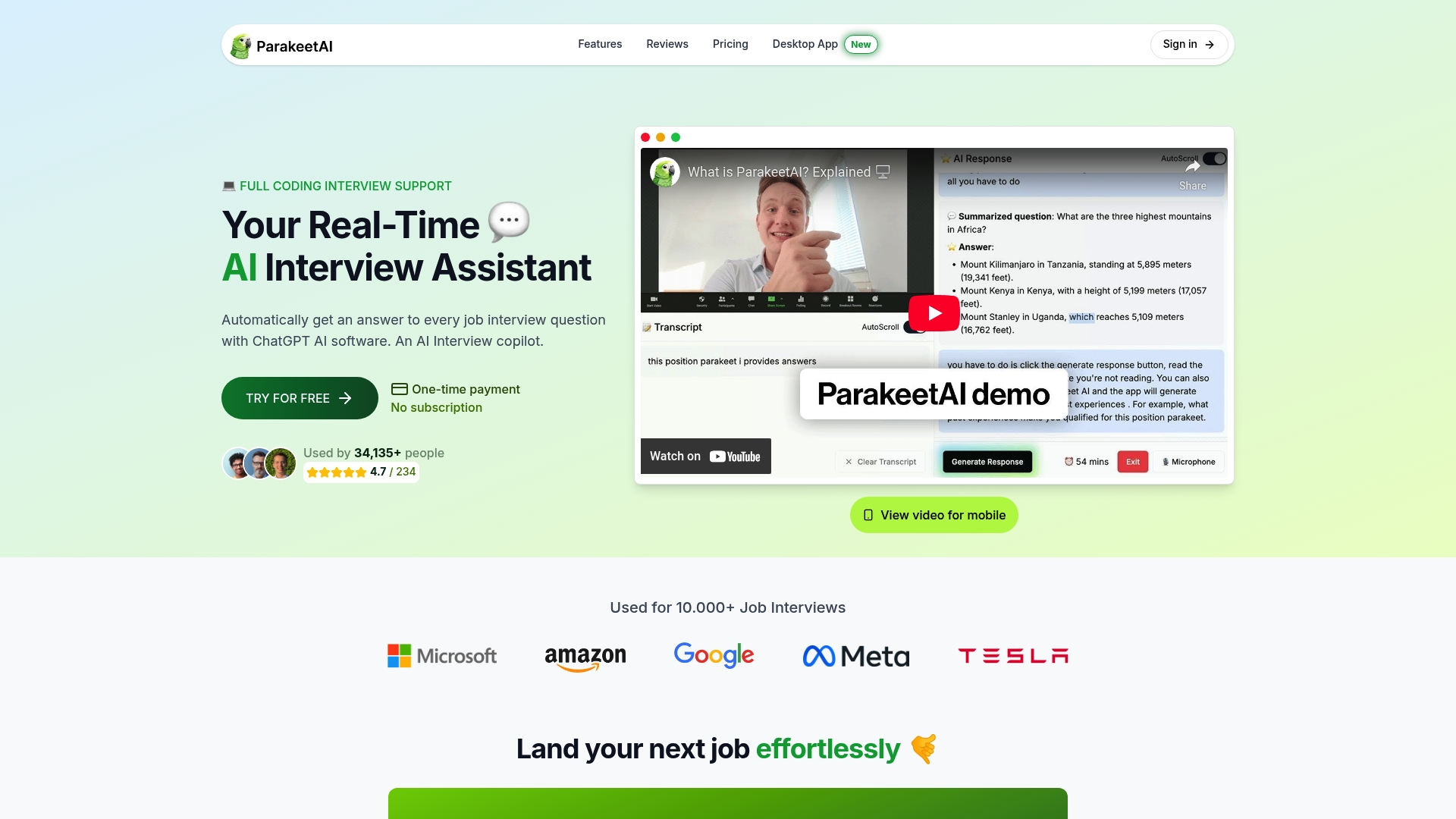
You can tailor practice sessions specifically to product manager roles, covering all question categories from product sense to behavioral scenarios. This targeted preparation helps you identify weak spots and refine your answers before facing actual interviewers.
Pro Tip: Use Parakeet AI to conduct multiple practice sessions focusing on your weakest question categories, then review the AI-generated answers to understand better response structures and content that resonates with interviewers.
As you head into 2026 interviews, leveraging tools like Parakeet AI alongside traditional preparation methods gives you a significant competitive advantage. The combination of framework knowledge, personal example preparation, and realistic practice creates the confidence and competence that hiring managers seek in strong product manager candidates.
Frequently asked questions
What types of questions should I expect in a product manager interview?
Product manager interviews include product sense, execution, leadership, strategy, and behavioral questions to assess diverse skills. Expect questions about prioritization, user empathy, cross-functional collaboration, and how you’ve handled past challenges. Strong answers demonstrate problem-solving ability, data-driven thinking, and alignment with company goals.
How can I make my product manager interview answers stand out?
Use structured frameworks like STAR, include quantifiable results showing your direct impact, and align answers with the company’s specific goals and values. Tell concise stories that highlight your collaboration skills and decision-making process. Effective interview answer techniques emphasize clarity, specificity, and demonstrating tangible outcomes rather than vague descriptions of responsibilities.
What is the best way to prepare for a product management interview?
Consistently practice answering diverse PM questions using proven frameworks, study the company’s products and competitors thoroughly, and conduct multiple mock interviews with feedback. Case interview preparation techniques help you develop structured thinking and clear communication. Review feedback after each practice session and refine your answers iteratively, focusing on weak areas until you feel confident across all question categories.
How important are behavioral questions in a product manager interview?
Behavioral questions assess crucial soft skills like collaboration, leadership, conflict resolution, and cultural fit that predict your success in the role. They provide insight into how you handle real-world challenges, work with diverse teams, and adapt to changing circumstances. Many program manager behavioral questions overlap with PM interviews, so prepare examples demonstrating emotional intelligence, resilience, and effective communication under pressure.