
Best Answers to Interview Questions for Tech Jobs

Job interviews can feel like a maze when every company asks different technical questions. For tech professionals with a few years of experience, knowing what interviewers expect is the first step toward better outcomes. This guide unpacks how to pinpoint key questions, analyze job requirements, and build responses that confidently showcase your strengths in any United States, Canadian, European, or global interview setting.
Table of Contents
- Step 1: Identify Key Tech Interview Questions
- Step 2: Analyze Job Requirements And Expectations
- Step 3: Craft Tailored Answers Using Proven Frameworks
- Step 4: Practice Delivering Answers With Real-Time AI
- Step 5: Review Feedback And Refine Responses
Quick Summary
| Key Point | Explanation |
|---|---|
| 1. Identify key tech interview questions | Research and understand crucial technical questions related to your specific role and technologies to anticipate what you will be asked in interviews. |
| 2. Analyze job requirements thoroughly | Break down job descriptions to map your skills to the position’s needs, enabling you to effectively demonstrate your qualifications during the interview. |
| 3. Utilize structured interview response frameworks | Apply proven frameworks like the STAR Method to organize and present your answers clearly, showcasing both your skills and thought processes. |
| 4. Practice with AI simulation tools | Use AI-powered platforms for mock interviews to refine delivery, manage anxiety, and gain feedback on your performance in a realistic environment. |
| 5. Review feedback for continuous improvement | Systematically analyze feedback on your interview responses to identify areas for enhancement, allowing for incremental improvement over time. |
Step 1: Identify key tech interview questions
Understanding the landscape of technical interview questions is crucial for tech job seekers. These questions are designed to assess your practical skills, problem-solving capabilities, and critical thinking across various technology domains.
To effectively identify key tech interview questions, you’ll want to focus on several strategic approaches. Technical interviews typically cover a range of topics specific to your role and industry:
- Programming language proficiency
- System design concepts
- Algorithmic problem-solving
- Tool and technology expertise
- Platform-specific knowledge
Research plays a pivotal role in your preparation. IT interview assessments often explore candidates’ adaptability across different operating systems and platforms like Windows, Linux, and macOS. This means you’ll need to develop a comprehensive understanding of multiple technical environments.
When preparing, start by thoroughly reviewing the job description. Pay close attention to required skills, preferred technologies, and specific role responsibilities. These details will help you anticipate the types of technical questions you’re likely to encounter during your interview.
Pro tip: Create a targeted study list based on the specific technologies and skills mentioned in the job posting.
Pro tip: Maintain an ongoing digital notebook of technical questions and your evolving answers to track your interview preparation progress.
Step 2: Analyze job requirements and expectations
Successfully navigating a tech job interview requires a strategic approach to understanding job expectations before you even step into the interview room. Analyzing job requirements is more than just reading a job description – it’s about deeply understanding the role’s nuanced expectations and aligning your skills accordingly.
To effectively analyze job requirements, break down your research into several key components:
- Review the job description thoroughly
- Identify specific technical skills required
- Map your experience to job responsibilities
- Research the company’s technological ecosystem
- Understand performance metrics and success indicators
Careful job requirement research involves examining both explicit and implicit expectations. This means looking beyond the listed technical skills to understand the underlying competencies the employer values. Pay attention to phrases like “strong problem-solving skills” or “collaborative team environment” which signal deeper cultural and professional expectations.
Technical interviews are not just about what you know, but how you apply your knowledge in complex scenarios.
When preparing, create a side-by-side comparison of the job requirements and your professional experience. Highlight areas where your skills directly match the job description and identify potential skill gaps you might need to address before the interview.

Pro tip: Create a digital skills matrix documenting how your professional experiences align with each job requirement, enabling quick and confident interview responses.
Step 3: Craft tailored answers using proven frameworks
Mastering the art of interview responses requires understanding effective answer strategies. Crafting tailored answers is about transforming your professional experiences into compelling narratives that directly speak to the employer’s needs.
Tech professionals can leverage several powerful response frameworks:
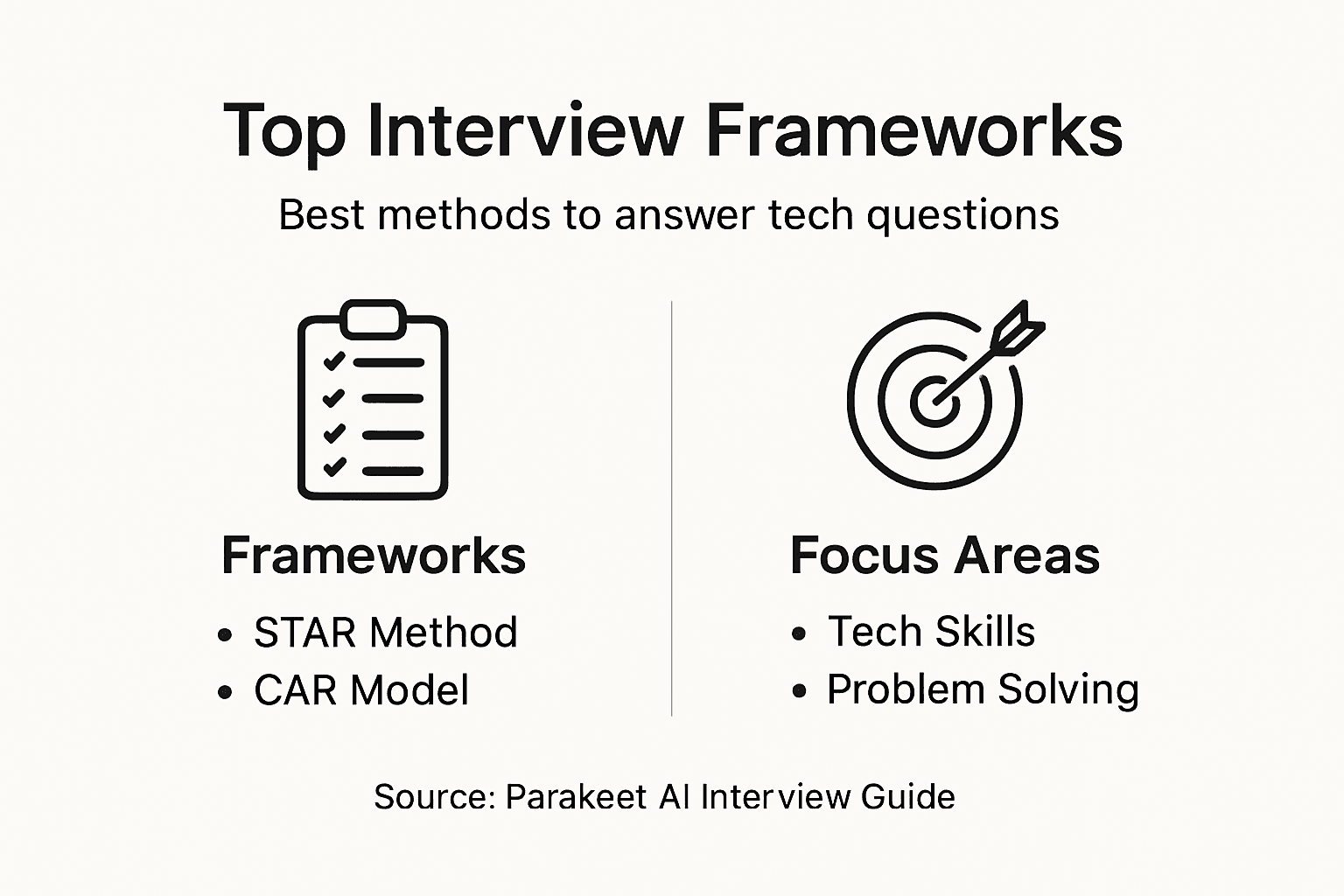
- STAR Method (Situation, Task, Action, Result)
- Present-Past-Future format
- Problem-Solution-Impact approach
- Specific-Example-Reflection technique
- Quantifiable-Outcome narrative structure
The interview response frameworks help you organize complex professional experiences into clear, digestible stories. Each framework offers a structured way to highlight your skills, demonstrating not just what you did, but how you think and solve problems.
Here’s how popular interview response frameworks compare:
| Framework | Focus Area | Best For |
|---|---|---|
| STAR Method | Situation, Task, Action, Result | Behavioral questions |
| Present-Past-Future Format | Career progression narrative | Vision and adaptability |
| Problem-Solution-Impact | Problem-solving and outcomes | Technical challenge stories |
| Specific-Example-Reflection | Personal growth and learning | Lessons learned and feedback |
| Quantifiable-Outcome | Measurable achievements | Showcasing impact with data |
Your goal is to transform your professional experiences into a narrative that shows your unique value proposition.
When selecting examples, prioritize stories that showcase your technical skills, problem-solving abilities, and alignment with the specific role’s requirements. Practice translating your experiences into these structured formats, ensuring each response is concise, relevant, and impactful.
Pro tip: Record yourself practicing interview answers to identify areas for improvement and refine your storytelling technique.
Step 4: Practice delivering answers with real-time AI
Leveraging tech interview simulation tools can transform your preparation strategy, providing an immersive environment to refine your communication skills and build confidence. Real-time AI practice offers an unprecedented opportunity to rehearse interview responses in a dynamic, interactive setting.
Effective AI-driven interview practice involves several key approaches:
- Use AI-powered mock interview platforms
- Record and analyze your verbal and non-verbal communication
- Simulate diverse interview scenarios
- Receive instant feedback on answer structure
- Practice handling unexpected questions
- Track improvement through performance metrics
The goal of real-time AI practice is not just memorizing answers, but developing a fluid, adaptive communication style that demonstrates your technical expertise and professional potential. Realistic simulation helps you manage interview anxiety, improve response clarity, and develop a natural conversational rhythm.
AI practice tools bridge the gap between preparation and actual interview performance.
Pay attention to nuanced feedback from AI systems, which can provide insights into your tone, language complexity, and content relevance that human coaches might miss. Focus on incrementally improving your responses, treating each practice session as an opportunity for strategic self-improvement.
Pro tip: Practice your interview responses during different times of day to understand how your energy and communication style might vary.
Below is a summary of useful digital tools and their impact on tech interview preparation:
| Tool Type | Main Function | Preparation Benefit |
|---|---|---|
| Mock Interview AI | Simulate interviews | Build confidence and adaptability |
| Digital Notebook | Track Q&A and progress | Organize learning and revisions |
| Skills Matrix Apps | Map skills to job requirements | Identify gaps and strengths |
| Feedback Journals | Review and analyze responses | Support continuous improvement |
Step 5: Review feedback and refine responses
Learning to analyze interview performance is a critical skill for tech professionals seeking to improve their communication and technical presentation abilities. Reviewing feedback systematically transforms good interview responses into exceptional ones by identifying subtle areas of improvement.
Your feedback review process should encompass multiple dimensions:
- Evaluate answer content accuracy
- Assess communication clarity
- Analyze non-verbal communication
- Identify potential knowledge gaps
- Examine response structure and flow
- Track repeated communication patterns
Candidates can leverage detailed critique to transform good answers into great ones by enhancing interview responses. This means going beyond surface-level corrections and deeply understanding how your communication style impacts an interviewer’s perception.
Effective feedback analysis is about continuous incremental improvement, not perfection.
Pay special attention to subtle cues in feedback that might reveal deeper communication challenges. Look for patterns in your responses that could indicate areas needing refinement, such as over-explaining technical concepts or failing to provide concrete examples.
Pro tip: Create a personal feedback journal documenting each practice interview’s insights to track your communication evolution systematically.
Accelerate Your Tech Interview Success with Real-Time AI Assistance
Facing tough technical questions and struggling to craft compelling answers is a common challenge highlighted in the article “Best Answers to Interview Questions for Tech Jobs.” With the pressure to deliver clear, structured responses using frameworks like STAR and the need to adapt to complex technical scenarios, many candidates feel overwhelmed and uncertain about their preparation. You want to move beyond generic answers and build confidence through tailored, practice-driven strategies.
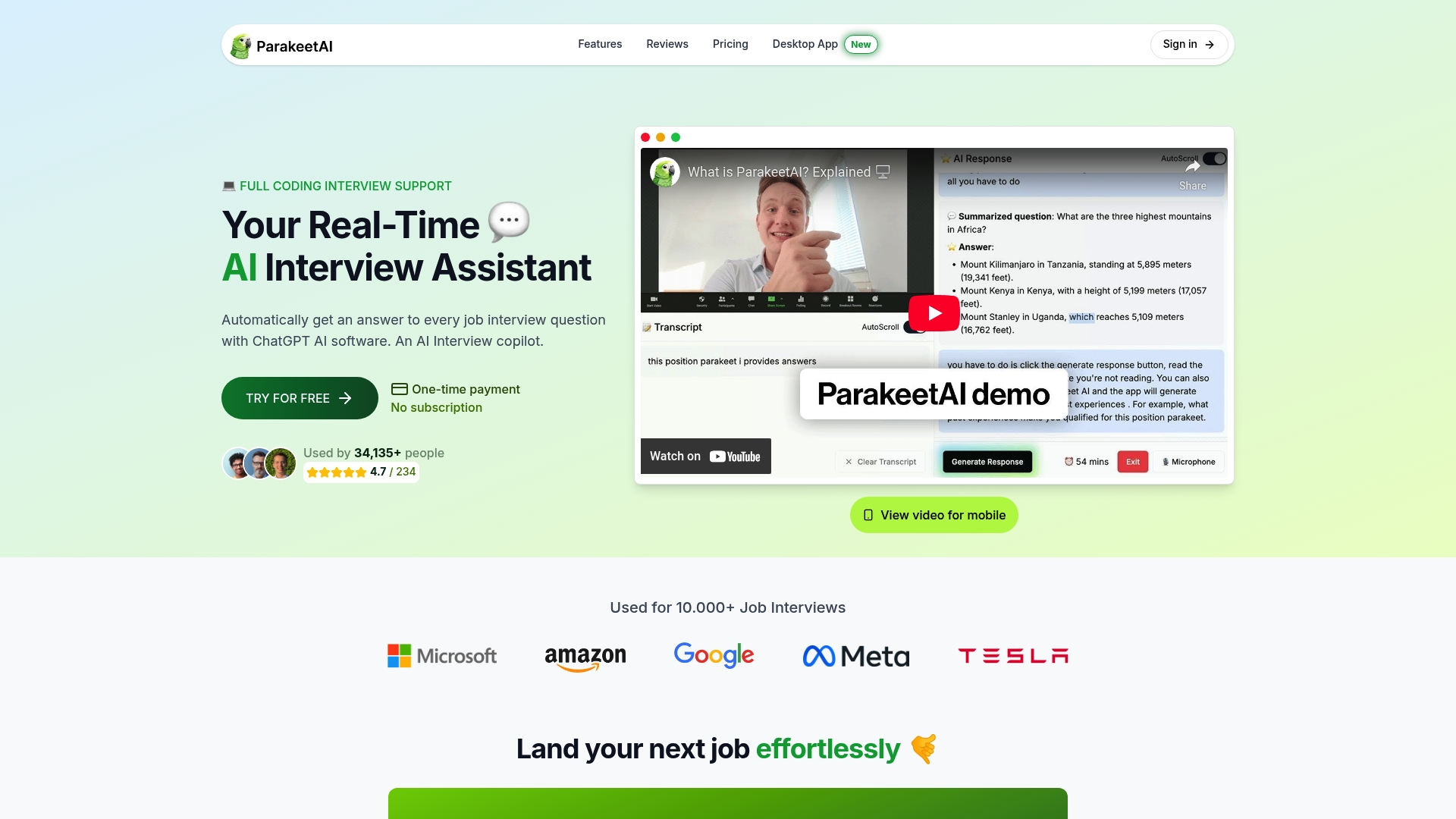
Elevate your preparation with Parakeet AI, a real-time AI job interview assistant that listens to your responses and instantly provides precise, customized answers to every question. Whether you need help refining your STAR method examples or practicing intricate system design explanations, Parakeet AI supports your journey by delivering instant feedback and dynamic answer suggestions. Don’t let anxiety or uncertainty hold you back. Experience unmatched interview readiness now by visiting Parakeet AI and start transforming your tech interview performance today.
Frequently Asked Questions
What are the most common technical interview questions for tech jobs?
These typically include questions on programming languages, algorithmic problem-solving, and system design concepts. Start by researching common questions for your specific role and industry to prepare effectively.
How can I tailor my answers to technical interview questions?
To tailor your answers, use frameworks like the STAR Method to structure your responses clearly. Focus on specific experiences that match the job requirements, illustrating your skills and problem-solving abilities with relevant examples.
What should I do to analyze job requirements before an interview?
Thoroughly review the job description and identify key technical skills and responsibilities. Map your experiences to these requirements, and note any skills gaps you may need to address before the interview.
How can I practice my interview responses effectively?
Utilize mock interviews or simulations to rehearse your answers in real-time scenarios. Record your practice sessions to evaluate your communication style and gather constructive feedback for improvement.
What types of feedback should I look for after practice interviews?
Focus on assessing content accuracy, clarity, and non-verbal communication. Analyzing feedback can help identify areas for improvement, such as succinctness in answers or the inclusion of concrete examples.