
Master Problem Solving for Interviews with AI Assistance

Facing your first AI-assisted interview can feel intimidating, especially for recent graduates hoping to stand out in competitive tech roles. The pressure to present your unique skills and problem-solving abilities goes beyond memorizing answers, as recruiters increasingly use sophisticated tools to assess both clarity and authenticity. This guide breaks down practical strategies, from building a focused toolkit to mastering structured thinking and using AI-powered feedback, helping you deliver responses that are both effective and true to your personal voice.
Table of Contents
- Step 1: Prepare Essential Tools for AI-Assisted Interviews
- Step 2: Analyze Typical Interview Questions Efficiently
- Step 3: Apply Structured Problem Solving Techniques
- Step 4: Leverage AI Suggestions for Optimal Responses
- Step 5: Verify Solution Quality and Improve Performance
Quick Summary
| Key Point | Explanation |
|---|---|
| 1. Use Focused Tools for Preparation | Identify essential tools that help record, analyze, and simulate interviews for effective practice and feedback. |
| 2. Analyze Common Interview Themes | Categorize interview questions to prepare versatile answers, focusing on core themes like motivation and problem-solving. |
| 3. Practice Structured Problem Solving | Use frameworks to clearly communicate your reasoning during problem-solving questions, helping interviewers follow your logic. |
| 4. Refine Responses with AI Feedback | Incorporate AI suggestions to enhance clarity and adapt answers for different interview contexts while maintaining authenticity. |
| 5. Continuously Evaluate and Improve | Establish response criteria, use feedback to identify weaknesses, and practice iteratively to enhance performance before interviews. |
Step 1: Prepare Essential Tools for AI-Assisted Interviews
Successfully tackling an interview with AI assistance starts with having the right toolkit in place. This isn’t about having dozens of apps or subscriptions. Instead, you need a focused set of tools that complement your preparation strategy and help you perform at your best when the interview begins. Think of this as building your preparation infrastructure, the foundation that lets you practice effectively, receive real-time feedback, and refine your responses before you’re in the hot seat with a recruiter.
Start by identifying what types of tools actually serve your needs. You’ll want something that records and transcribes your practice interviews so you can review exactly what you said, how you said it, and where you stumbled. Tools like AI-powered transcription services can transform your practice sessions into analyzable data, letting you spot patterns in your answers and catch filler words or awkward pauses you didn’t notice in the moment. Beyond transcription, you need an interview simulator or practice platform that mimics the actual interview experience. This could be a dedicated interview tool, a chatbot platform, or even a combination of resources. The goal is creating a space where you can practice without the pressure of a real job opportunity hanging in the balance.
Next, think about how AI can enhance your preparation without undermining your authenticity. Large language models can help you organize your thoughts, refine how you phrase your experiences, and practice articulating technical or complex concepts in clearer language. This is especially valuable if English isn’t your first language or if you’re interviewing for a specialized technical role where precision matters. However, don’t let AI write your answers for you. The risk here is real: recruiters can often sense when responses feel rehearsed or inauthentic, and over-relying on AI-generated language can actually work against you. Your goal is using these tools to enhance your natural communication style, not replace it. Practice reading AI suggestions out loud. Ask yourself whether the phrasing feels like something you’d actually say. If it doesn’t, adjust it. You want your interview answers to sound like you, just the best version of you.
Finally, set up your environment for consistent practice. You’ll need a quiet space where you can record yourself without background noise. Test your camera and microphone quality, because technical failures during practice mean you’ll catch them before they happen in a real interview. Have your resume, the job description, and any notes about the company easily accessible during your practice sessions. Some people use a second monitor or printed documents so they can reference information without it being obvious on camera. You might also want a simple note taking system to capture patterns you notice while reviewing your practice recordings. When you’re reviewing a practice session, make notes about which questions threw you off, which topics you explained unclearly, and which responses felt natural and confident. Use these observations to shape your next practice round.
Here’s a quick comparison of common AI-assisted interview tools and their primary functions:
| Tool Type | Main Benefit | Example Tools |
|---|---|---|
| Transcription & Recording | Review and analyze practice interviews | Sonix, Otter.ai |
| Interview Simulators | Mimic real interviews for practice | Pramp, InterviewBuddy |
| AI Writing Assistants | Refine answer phrasing, improve clarity | ChatGPT, Grammarly |
| Real-Time Feedback Apps | Identify filler words and pacing issues | Yoodli, Mocks.ai |
Pro tip: Create a simple spreadsheet tracking the 15 to 20 most common interview questions for your industry, then record yourself answering each one at least twice, spacing your practice sessions out over several days so you can apply lessons from earlier recordings to later attempts.
Step 2: Analyze Typical Interview Questions Efficiently
Now that your tools are in place, it’s time to understand what you’re actually being asked when interviewers pose their questions. Most interviewers ask far fewer unique questions than you might think. They’re looking for specific information about you, your fit with their organization, and your ability to handle the role. By analyzing the patterns beneath typical interview questions, you can prepare responses that address what they really want to know rather than just giving surface-level answers.

Start by categorizing interview questions into the themes that consistently appear across different positions and companies. Questions about your background, motivation, and career goals all explore whether you understand yourself and your professional direction. Questions about specific projects or accomplishments test your ability to articulate results and take ownership. Questions about handling conflict or failure reveal your problem-solving approach and resilience. When you understand that interview questions explore motivation, fit, and collaboration potential, you can see how seemingly different questions actually map onto the same underlying themes. A question about your greatest weakness and a question about a time you failed are both testing the same thing, just from different angles. Once you recognize these patterns, you only need to prepare core responses that you can adapt to multiple questions rather than memorizing dozens of separate answers.
Next, use your AI tools to practice mapping questions to themes and developing versatile responses. When you encounter a question you’re unsure about, ask an AI chatbot to break down what the interviewer is really trying to learn. For example, “Why do you want this job?” isn’t actually about your love for the company’s mission. It’s testing whether you’ve done your homework, whether your values align with the role, and whether you’re genuinely interested or just desperate for employment. Your response should address all three concerns through a single, authentic answer. Practice taking questions that seem unique and finding the underlying pattern they share with other questions you’ve prepared for. This approach saves tremendous time because you’re not creating 50 different responses. You’re creating 8 to 10 solid core responses that you can frame differently depending on what’s being asked.
Another efficient approach involves anticipating the questions that will definitely come up for your specific industry and role. These aren’t surprises. Whether you’re interviewing for a technical position, a leadership role, or an entry-level job, certain questions appear almost universally. Search for industry-specific interview guides or use your AI assistant to generate a list of common questions for your target role. Then prioritize ruthlessly. Focus on questions that genuinely make you nervous or uncertain. These are the areas where your preparation will pay the biggest dividend. Record yourself answering these questions, then review your recordings specifically looking for vagueness, rambling, or moments where you lose your train of thought. These reveal where you need deeper preparation.
Finally, understand that efficiency doesn’t mean giving robotic or overly rehearsed answers. The goal is knowing your material well enough that you can relax and have a natural conversation. When you’ve practiced enough, you stop thinking about what you’re going to say next and start focusing on actually connecting with the interviewer. That’s when your authentic personality shines through, which is what hiring managers actually want to see. They’re not looking for perfect responses. They’re looking for thoughtful, genuine people who can articulate their thinking clearly.
Pro tip: Record 30 second to one minute answers for your top 10 interview questions, then watch them back without sound to assess your body language, eye contact, and facial expressions, since AI-assisted practice often focuses on what you say rather than how you look saying it.
Step 3: Apply Structured Problem Solving Techniques
When you encounter a problem-solving question in an interview, you need a framework that keeps you organized and helps you think out loud in a way that impresses the interviewer. Unstructured thinking leads to rambling, backtracking, and leaving the interviewer uncertain about your actual reasoning. A structured approach demonstrates clear thinking, systematic analysis, and the ability to break complex problems into manageable pieces. This is exactly what hiring managers want to see, especially for roles that require logical problem-solving or technical thinking.
Start with understanding that structured interviews use standardized approaches with consistent sequences, and the same principle applies to your problem-solving responses. When you get a question like “How would you design a parking lot system?” or “Walk me through how you’d optimize our checkout process,” you’re not expected to have the perfect answer. You’re expected to think systematically and communicate your reasoning clearly. Begin by pausing and clarifying the problem. Ask questions. What’s the scope? Who are the users? What constraints do we have? This pause might feel uncomfortable, but it’s actually the most impressive thing you can do in that moment. It shows you don’t jump to conclusions. After clarifying, state your approach out loud. “I’m going to break this into three parts: first I’ll identify the core requirements, then I’ll sketch out a basic solution, and finally I’ll discuss potential improvements.” This verbal roadmap keeps both you and your interviewer on the same page.
Next, break down your solution into clear stages as you work through it. For a technical problem, this might mean starting with the simplest version first, then adding complexity. For a business problem, identify the stakeholders and constraints before proposing solutions. Use your AI tools to practice this structure repeatedly. Give your AI assistant a problem-solving question, record yourself answering it, then review your recording. Were you jumping around between ideas or following a logical progression? Did you explain your thinking as you went, or did you just announce conclusions? Were you asking clarifying questions at the start? These recordings reveal your actual problem-solving patterns in ways that just thinking through problems never will. Practice until the structured approach feels natural, not like you’re following a rigid formula.
One critical skill is knowing when to dive deep versus when to move forward. During an interview, you don’t have unlimited time. If you spend fifteen minutes designing one tiny component, you’ll never finish explaining your complete solution. Learn to say something like “For now I’ll assume this works this way, and we can refine it if needed.” This shows maturity and awareness of time constraints. Practice making these judgment calls during your preparation so you’re not figuring it out for the first time in an actual interview. As you work through your solution, vocalize your assumptions clearly. “I’m assuming we need to handle 10,000 users simultaneously because that’s typical for this scale of application.” This helps the interviewer understand your thinking and gives them an opportunity to correct you if your assumption is wrong.
Finally, always end with a reflection on what you’d do differently or what questions remain unanswered. This shows you’re thinking critically and understanding that most real problems don’t have perfect solutions. Say something like “In a real implementation, I’d want to validate these assumptions with actual data, and I’d expect to refine this approach based on what we learn.” This demonstrates maturity and intellectual honesty, which interviewers value far more than pretending you have all the answers.
Pro tip: Practice your structured problem-solving approach using the classic problem types from your industry (system design for software engineers, market analysis for business roles, clinical reasoning for healthcare positions), and time yourself to ensure you can fully explain your solution in 15 to 20 minutes.
Step 4: Leverage AI Suggestions for Optimal Responses
At this point, you’ve prepared your tools, analyzed typical questions, and practiced structured problem-solving. Now comes the part where AI truly shines: using it to refine your actual responses in real time. AI can catch things you miss about yourself. It notices when you’re being vague, when you’re using filler words excessively, or when your tone shifts from confident to uncertain. The key is learning how to interpret AI feedback without letting it override your authentic voice.
Start by feeding your prepared answers into AI tools and asking for specific feedback. Don’t ask for generic suggestions. Ask targeted questions. “Does this answer directly address what the interviewer asked, or am I going off on a tangent?” “Where in this response do I sound uncertain?” “What’s the strongest part of this answer and what part needs more work?” AI tools can provide real-time feedback on speech and tone, helping you refine your responses before you deliver them to an actual hiring manager. When AI suggests changes, try them out. Record yourself delivering the revised version and compare it to your original. Does the new version feel more natural, or does it feel forced? Sometimes AI suggestions are spot-on. Sometimes they make your answer sound generic or robotic. Your job is cherry-picking the valuable feedback and discarding the rest. For example, if AI suggests eliminating a pause where you breathe, ignore that. Natural pauses make you sound human and thoughtful. But if AI points out that you’re repeating the same phrase three times in one answer, that’s feedback worth acting on.
Next, use AI to help you develop different versions of the same answer for different contexts. The core message might stay the same, but the emphasis and examples can shift. Ask your AI assistant to suggest how you’d frame your answer if you were speaking to a technical interviewer versus a business stakeholder. Practice delivering both versions until you can naturally adjust on the fly based on your interviewer’s background and the company’s priorities. This is where AI-assisted practice becomes powerful. You’re not just memorizing one answer. You’re building flexibility into your responses.
Another critical application is using AI to catch gaps in your knowledge or thinking. When an interviewer asks a question and you freeze, that’s often because you actually don’t know what you think about the topic yet. Use your AI tools to explore the question from multiple angles before crafting your response. Ask it to explain different perspectives on a controversial topic in your field, or to break down the pros and cons of different approaches to a common problem. This exploration happens during your preparation, not during the interview. By the time you’re in the actual interview, you’ve already done this thinking work.
Finally, understand the limits of AI suggestions. An AI tool cannot judge cultural fit or pick up on subtle interpersonal dynamics. It won’t know whether a particular story or example lands better with one company versus another. AI is excellent at helping you be clear, concise, and confident. It’s terrible at helping you be authentically you. The goal is using AI to remove obstacles between your thinking and your words, not to replace your thinking entirely. When you incorporate AI feedback thoughtfully and selectively, your responses become sharper, your delivery becomes more polished, and your confidence genuinely increases because you know you’ve prepared thoroughly.
Pro tip: Record yourself giving an answer, have AI analyze it for tone and clarity, make one or two specific changes based on that feedback, then record the revised version and compare them side by side to see which feels more effective, rather than trying to implement all of AI’s suggestions at once.
Step 5: Verify Solution Quality and Improve Performance
You’ve practiced your responses, refined them with AI feedback, and built confidence in your problem-solving approach. Now you need to critically evaluate whether your solutions are actually good. This isn’t about achieving perfection. It’s about identifying weaknesses before you walk into an interview room and discovering them in real time. Verification means stepping back and asking hard questions about your work, then using what you learn to get better.
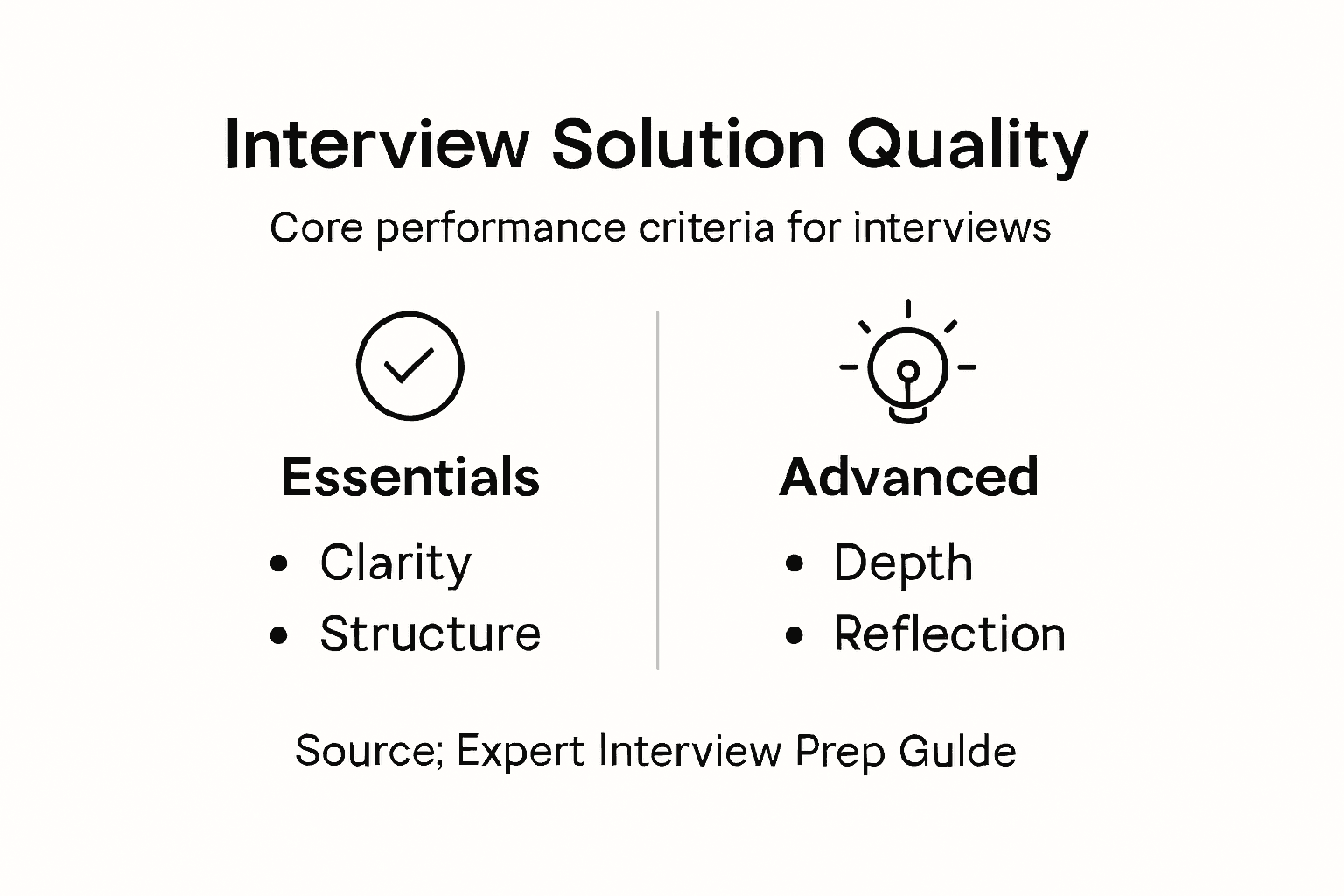
Start by establishing clear criteria for what makes a response strong in an interview context. Assessment frameworks for problem-solving quality measure critical thinking and solution effectiveness, not just whether you arrive at an answer. Does your response show you understand the problem deeply, or are you making surface-level observations? Are you considering edge cases and potential complications, or just the happy path? Do you communicate your reasoning clearly enough that someone unfamiliar with your thought process can follow along? These criteria matter more than having the perfect solution. Watch your recorded practice interviews with a specific focus. First, mute the sound and just watch your body language and facial expressions. Do you look confident and composed, or do you look uncomfortable and uncertain? Your nonverbal communication carries enormous weight in an interview. Next, listen to the content with the video off. Would this answer make sense to someone who couldn’t see you? Are you explaining things clearly, or are you assuming knowledge that the interviewer might not have? Finally, watch the full video together and notice the overall flow. Does one idea naturally lead to the next, or do you jump around?
Below is a summary of interview response criteria to help you evaluate your practice answers effectively:
| Criteria | Why It Matters | Self-Assessment Example |
|---|---|---|
| Clarity | Ensures responses are easy to follow | Ideas presented logically |
| Structure | Shows organized, systematic thinking | Uses a defined framework |
| Evidence & Examples | Demonstrates experience and credibility | Offers concrete examples |
| Conciseness | Respects interviewer time, avoids rambling | Answers focused and brief |
| Handling Unknowns | Shows intellectual honesty | Acknowledges limits or assumptions |
Use your AI tools to conduct deeper analysis of your responses. Ask for specific feedback on whether your answer directly addresses what was asked. Ask whether you provided evidence or examples to support your claims, or whether you made unsupported assertions. Ask whether you acknowledged limitations or alternative approaches, showing intellectual maturity. These targeted questions reveal gaps in your thinking that general impressions miss. When AI feedback or your own analysis reveals a weakness, don’t just note it and move on. Actually practice fixing it. If you rambled through an answer, record a new version where you force yourself to be more concise. If you didn’t ask clarifying questions at the start, record it again with clarifications included. This active practice of improvements is what actually makes you better. Just identifying a problem doesn’t solve it.
Another verification technique involves getting feedback from someone you trust. A mentor, colleague, or friend can catch things you and even AI tools might miss. They notice when you’re being unclear because they genuinely don’t understand you, not because an algorithm detected ambiguous language. They pick up on whether your story feels authentic or rehearsed. They notice when you’re not making eye contact or when you seem nervous. However, not all feedback is equally valuable. Ask your reviewer for specific observations rather than general impressions. Instead of “How did that sound?” ask “Did I answer the question that was asked, or did I go off on a tangent?” or “Where did I lose you in my explanation?” Specific questions yield actionable feedback.
Finally, understand that improvement is iterative and ongoing. You won’t perfect your interview performance before you interview. That’s not the goal. The goal is reducing the gap between your knowledge and your ability to communicate it. Each practice cycle, each piece of feedback, and each adjustment moves you closer to presenting your best self. Track your improvements over time. Compare a recording from your first practice session to one from two weeks later. The difference in your confidence, clarity, and composure will be striking. That tangible progress is what carries you into your actual interview with genuine confidence, not false bravado.
Pro tip: Create a simple scorecard with 5 to 7 criteria that matter most for your industry (clarity, structure, problem-solving approach, evidence of examples, and handling of unknowns), then rate yourself on each criterion after every practice session to track improvements quantitatively rather than relying on vague impressions.
Elevate Your Interview Problem-Solving Skills with Real-Time AI Support
The challenge of mastering structured problem solving and delivering clear, authentic answers in interviews can feel overwhelming. This article highlights the crucial need for organized thinking, focused practice, and personalized feedback to communicate your expertise confidently. If you want to avoid rambling, cover key points effectively, and handle unknowns with poise AI-powered assistance is the game changer you need. Parakeet offers a real-time AI job interview assistant that listens to your responses and automatically generates optimized answers to every question helping you sharpen your problem-solving approach while keeping your unique voice intact.
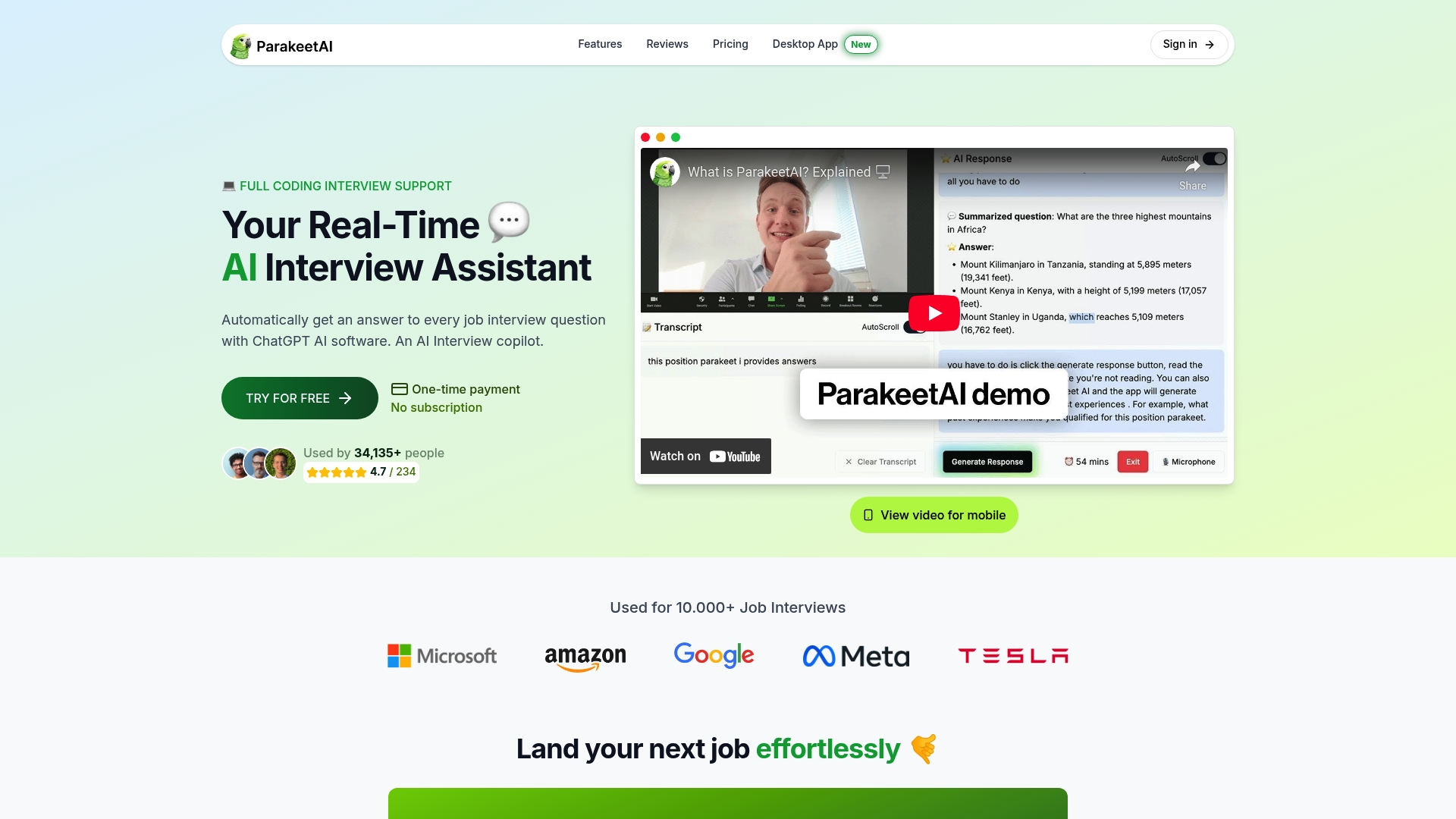
Stop second-guessing your answers or getting stuck mid-interview. Experience how using AI to practice and refine your responses can give you an undeniable edge. Visit Parakeet AI now and start preparing smarter with tools designed to identify moments for improvement, help you apply structured frameworks, and build lasting confidence. Don’t just prepare for your next interview — master it with https://parakeet-ai.com.
Frequently Asked Questions
How can I prepare for problem-solving interview questions using AI assistance?
To prepare effectively, establish a structured approach for solving problems. Start by practicing common problem types specific to your industry and utilize AI tools to analyze your responses, refining them based on feedback. Aim to practice systematically, recording yourself, and iterating on at least 5-10 common questions.
What specific AI tools can help me during my interview preparation?
Consider using AI-powered tools for transcription and feedback analysis to enhance your practice sessions. Focus on tools that provide real-time feedback on clarity and tone, allowing you to fine-tune responses, especially in problem-solving scenarios. Allocate a few hours weekly to explore and integrate these tools into your routine.
How do I evaluate the quality of my problem-solving answers?
Establish clear criteria such as clarity, structure, and handling of unknowns to guide your evaluation. After practicing, rate your responses based on these criteria and identify areas for improvement, aiming to enhance your practice sessions consistently over a few weeks.
What should I do if I freeze during a problem-solving interview question?
If you freeze, take a moment to clarify the question and think aloud to demonstrate organized reasoning. Practice pausing during preparation to gather your thoughts and articulate your approach, ensuring you can respond confidently within 2-3 minutes during the actual interview.
How can I use AI to enhance my authenticity in interview responses?
Utilize AI to refine your phrasing while ensuring your responses maintain your natural voice. Experiment with different explanations based on AI feedback, and practice delivering these answers until they feel authentic and comfortable, aiming for at least 3 versions of your key responses.
What are some effective structured problem-solving frameworks I can use in my practice?
Adopt well-known frameworks like the STAR (Situation, Task, Action, Result) technique to organize your responses systematically. Practice applying these frameworks to common interview problems, ensuring you can present a clear, logical progression of ideas within a dedicated time limit of 15-20 minutes.
Recommended
- 7 Key Manager Interview Questions and How to Answer Them
- 7 Key Customer Service Interview Questions Explained
- best ai interview assistants - ParakeetAI
- role of ai assistants in interviews - ParakeetAI
- Technology in Fertility Clinics: Transforming IVF Outcomes
- Hair Care Treatment: Personalization with AI Insights | MyHair