
Why Real-Time Interview Analysis Matters for Tech Job Seekers

Most American technology job seekers discover that traditional interview feedback often arrives too late to be useful. Real-time analysis now gives candidates a sharper edge, offering instant insights into everything from confidence levels to answer clarity. For anyone stepping into competitive global tech roles, especially recent graduates, understanding how artificial intelligence shapes interview feedback can be a game-changer. This overview clarifies how this advanced approach works and what it truly means for your next interview.
Table of Contents
- Real-Time Interview Analysis Defined and Debunked
- How AI Powers Instant Interview Feedback
- Types of Real-Time Analysis Tools and Methods
- Performance Benefits for Tech Job Candidates
- Privacy, Accuracy, and Potential Limitations
Key Takeaways
| Point | Details |
|---|---|
| Advancements in Interview Analysis | Real-time interview analysis utilizes AI to deliver immediate insights into candidate performance, improving evaluation processes. |
| Multilayered Assessment Techniques | This approach includes linguistic, emotional, and contextual evaluations, enhancing objectivity and detail compared to traditional methods. |
| Competitive Edge for Candidates | Candidates gain an advantage through immediate feedback, allowing for targeted improvements in communication and technical presentation skills. |
| Considerations on Privacy and Bias | It’s crucial to address data privacy and algorithmic bias in AI-powered evaluations to ensure fair and ethical candidate assessments. |
Real-Time Interview Analysis Defined and Debunked
Real-time interview analysis represents an innovative technological approach that transforms traditional job interviews by providing immediate, data-driven insights into candidate performance. Unlike conventional feedback methods, this technique leverages advanced artificial intelligence to interpret verbal and non-verbal communication patterns in actual interview moments. Real-time job interview insights demonstrate how technology can fundamentally reshape candidate evaluation processes.
The core mechanism behind real-time interview analysis involves sophisticated speech recognition and sentiment tracking algorithms. By analyzing communication patterns through advanced IoT systems like InsightPulse, these tools can instantaneously identify key discussion points, evaluate emotional responses, and provide nuanced performance metrics. This approach goes beyond traditional subjective assessments, offering candidates and interviewers objective, quantifiable feedback that can dramatically improve interview outcomes.
Technically speaking, real-time interview analysis breaks down communication into multiple layers of assessment. These typically include linguistic analysis (word choice, sentence structure), emotional intelligence tracking (tone, confidence levels), and contextual interpretation (relevance of responses to specific technical questions). The goal is not to replace human judgment but to augment it with data-driven insights that reveal subtle communication dynamics often missed during live interactions.
Pro Tip for Tech Candidates: Practice your interview responses using AI-powered tools that provide real-time feedback, allowing you to refine your communication skills and identify potential verbal or non-verbal communication weaknesses before actual job interviews.
Here’s a comparison of traditional interview feedback and real-time AI-powered interview analysis:
| Aspect | Traditional Feedback | Real-Time AI-Powered Analysis |
|---|---|---|
| Timing | Delayed, post-interview | Instant, during the interview |
| Objectivity | Subjective, human judgment | Data-driven, algorithmic insights |
| Scope of Analysis | Limited to surface impressions | Multilayered: linguistic, emotional, contextual |
| Customization | Generalized feedback | Tailored, candidate-specific metrics |
How AI Powers Instant Interview Feedback
Artificial Intelligence has revolutionized the interview feedback process by introducing sophisticated real-time analysis capabilities that transform traditional evaluation methods. Advanced interview AI systems now leverage complex algorithms to provide instantaneous insights into candidate performance, breaking down communication nuances with unprecedented precision.

At the core of AI-powered interview feedback are multimodal analysis techniques that simultaneously process verbal and non-verbal communication signals. Hierarchical attention models like HireNet demonstrate how AI can comprehensively assess candidate interactions by integrating speech patterns, facial expressions, tone variations, and contextual language use. These systems go beyond simple speech recognition, creating sophisticated predictive models that can evaluate candidate potential with remarkable accuracy.
The technological infrastructure behind instant interview feedback involves multiple interconnected AI components. Natural language processing algorithms decode spoken content, sentiment analysis tracks emotional undertones, and machine learning models continuously refine their assessment capabilities. Real-time human-AI collaboration systems like Interview AI-ssistant are designed to enhance interviewer capabilities by providing immediate, data-driven insights that supplement human judgment.
Pro Tip for Tech Professionals: Record and analyze your mock interview practice sessions using AI tools, paying close attention to the detailed feedback on communication patterns, emotional intelligence, and response relevance to systematically improve your interview performance.
Types of Real-Time Analysis Tools and Methods
Real-time interview analysis encompasses a diverse range of technological approaches designed to provide immediate, actionable insights into candidate performance. Behavior coding techniques represent one foundational method, systematically categorizing and evaluating communication patterns through standardized observation protocols that capture subtle nuances in verbal and non-verbal interactions.
Modern real-time analysis tools can be categorized into several key technological frameworks. Computer-assisted interviewing platforms leverage advanced algorithms to process multiple data streams simultaneously, including speech recognition, facial expression analysis, emotional sentiment tracking, and linguistic pattern detection. Computer-assisted personal interviewing systems demonstrate how electronic devices can transform traditional interview evaluation methods by introducing unprecedented levels of data granularity and instantaneous feedback mechanisms.
These analysis tools typically integrate multiple sophisticated technologies to create comprehensive candidate assessment frameworks. Machine learning models continuously refine their understanding by processing vast datasets, enabling increasingly nuanced interpretations of interview performances. Natural language processing algorithms decode linguistic subtleties, while neural networks analyze tone, pacing, confidence levels, and contextual communication effectiveness. This multilayered approach allows for a holistic evaluation that goes far beyond traditional subjective interview assessments.
The following table summarizes the core technologies enabling modern real-time interview analysis platforms:
| Core Technology | Function | Contribution to Candidate Evaluation |
|---|---|---|
| Speech Recognition | Transcribes spoken words | Enables accurate content analysis |
| Sentiment Analysis | Detects emotional tone | Assesses confidence, stress, engagement |
| Facial Expression Recognition | Analyzes visual cues | Reveals non-verbal communication habits |
| Natural Language Processing | Interprets complex language patterns | Evaluates relevance and clarity of responses |
Pro Tip for Tech Job Seekers: Familiarize yourself with common AI analysis technologies by practicing interviews using multiple platforms, paying special attention to the specific communication metrics each tool emphasizes to develop a more adaptive and technologically aware interview approach.
Performance Benefits for Tech Job Candidates
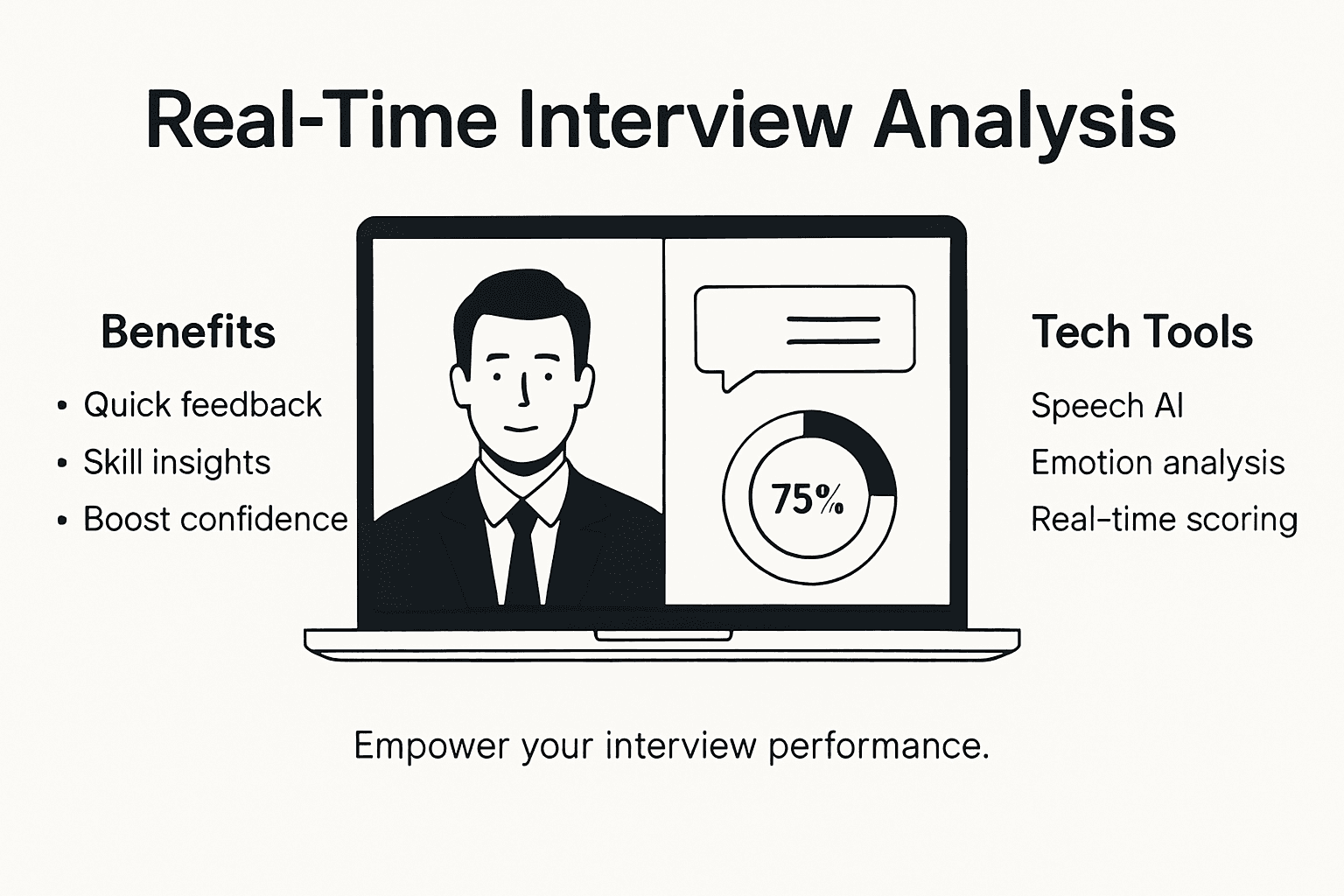
Real-time interview analysis provides tech job candidates with unprecedented opportunities to understand and improve their interview performance. Real-time interview support systems like InsightPulse enable candidates to gain immediate insights into their communication strengths and potential areas of improvement, transforming the traditional interview experience from a high-pressure event to a constructive learning opportunity.
The performance benefits extend far beyond immediate feedback. Cognitive enhancement technologies analyze multiple dimensions of candidate communication, including verbal articulation, emotional intelligence, technical knowledge presentation, and non-verbal cues. AI-assisted interview preparation tools help candidates develop a more nuanced understanding of their communication patterns, allowing them to refine their interview strategies with data-driven precision. This approach enables tech professionals to systematically deconstruct and improve their interview performance across critical competency areas.
Moreover, these advanced analysis tools provide tech job candidates with a competitive edge in increasingly sophisticated hiring landscapes. By offering granular insights into communication effectiveness, candidates can identify subtle communication barriers, develop more compelling storytelling techniques, and demonstrate their technical expertise more confidently. The data-driven approach allows job seekers to transform interview preparation from a subjective experience into a structured, measurable process of continuous professional development.
Pro Tip for Tech Professionals: Record and critically analyze your mock interviews using AI feedback tools, paying special attention to your technical communication clarity, problem-solving narrative structure, and emotional intelligence indicators to systematically enhance your interview performance.
Privacy, Accuracy, and Potential Limitations
Real-time interview analysis technologies raise critical questions about data privacy, algorithmic accuracy, and ethical considerations in candidate evaluation. Investigative interview response analysis reveals complex challenges in interpreting communication patterns, highlighting the nuanced cognitive processes underlying interview interactions and the potential limitations of automated assessment systems.
Algorithmic bias represents a significant concern in real-time interview analysis. These technologies must navigate intricate challenges of fair evaluation, ensuring that assessment mechanisms do not inadvertently perpetuate existing hiring prejudices. Traditional interview evaluation methods often suffer from rapid subjective opinion formation and overreliance on rehearsed responses, suggesting that while AI-powered tools offer improvements, they are not without potential systematic errors.
Privacy considerations demand rigorous protection of candidate data throughout the analysis process. Advanced real-time interview technologies must implement robust encryption protocols, secure data storage mechanisms, and transparent consent frameworks. Candidates should have comprehensive understanding of how their communication data is collected, processed, analyzed, and potentially stored. This requires explicit opt-in mechanisms, clear explanations of data usage, and guaranteed data deletion protocols that protect individual privacy and maintain ethical standards.
Pro Tip for Tech Professionals: Always request detailed information about data handling practices before participating in AI-powered interview analysis, ensuring you understand exactly how your personal communication data will be used, stored, and protected.
Unlock Your True Interview Potential with Real-Time AI Assistance
The challenge of mastering real-time interview analysis is real for every tech job seeker. You want to go beyond subjective opinions and vague feedback. You want data-driven, instant insights on your communication patterns, emotional tone, and answer relevance. This article highlights how advanced interview AI can transform stress into confidence by providing actionable feedback during your conversations.
Our real-time AI job interview assistant listens to your interview and automatically crafts answers to every question using AI technology. This gives you a unique advantage to practice and improve with tailored insights similar to professional AI-powered interview analysis. Don’t let algorithmic bias or delayed feedback hold you back. Use tools that empower your growth with immediate, personalized evaluation.
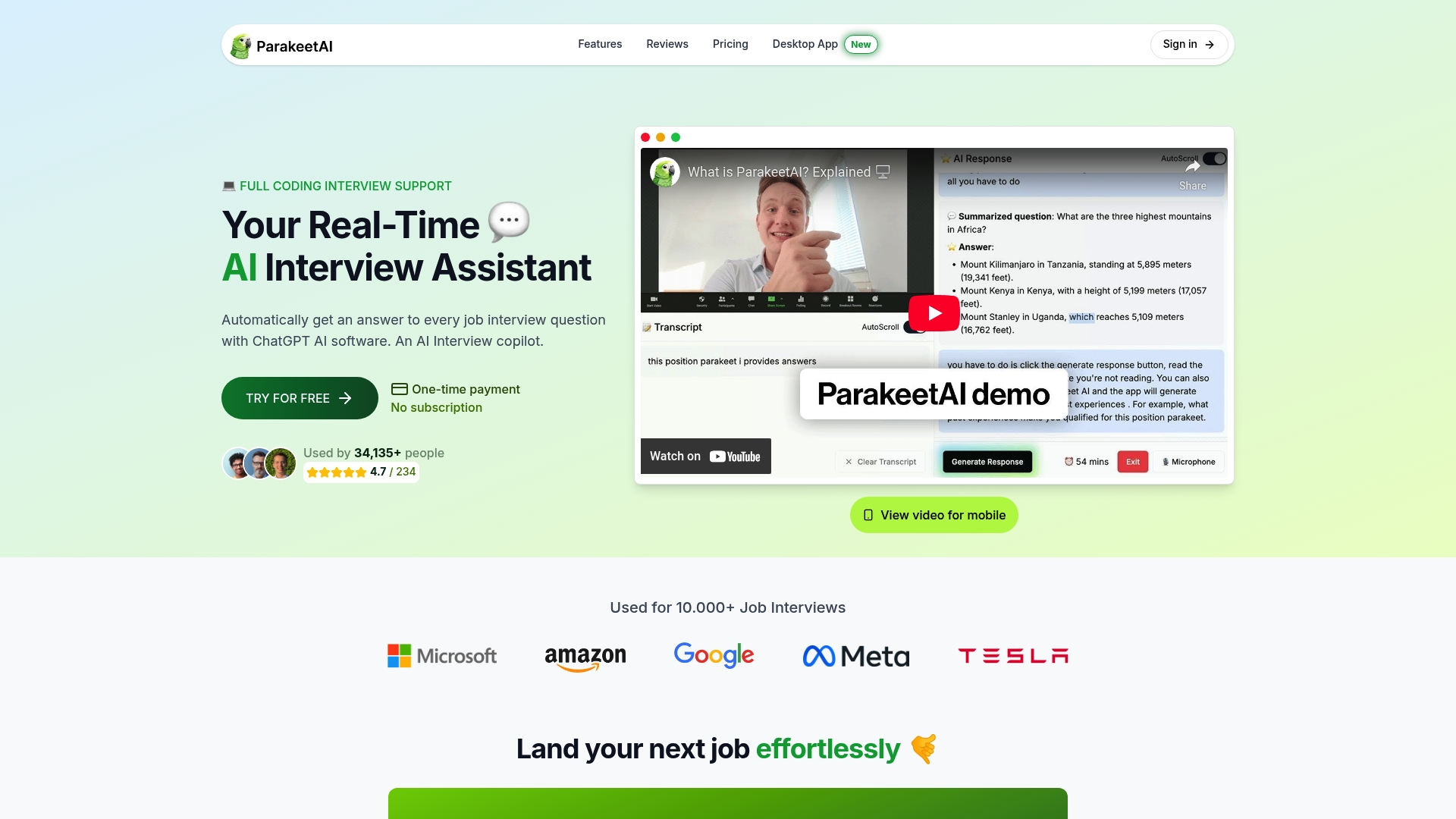
Don’t settle for uncertainty in your tech interviews. Visit Parakeet AI today to experience how real-time AI support can sharpen your communication, boost your confidence, and help you succeed right from the first question. Start mastering your interviews with the cutting-edge tools designed to give you the competitive edge every tech professional deserves.
Frequently Asked Questions
What is real-time interview analysis?
Real-time interview analysis is a technological process that provides immediate, data-driven insights into candidate performance during job interviews. It utilizes AI to interpret verbal and non-verbal communication patterns in real-time.
How does AI improve interview feedback?
AI improves interview feedback by offering instant analysis of candidate performance through modalities like speech recognition, sentiment analysis, and facial expression recognition. This allows for a more comprehensive evaluation of communication skills.
What are the benefits of using real-time interview analysis tools?
The benefits of using real-time interview analysis tools include immediate feedback, objective assessments, and tailored insights into communication strengths and weaknesses, which can significantly enhance interview performance.
Are there any privacy concerns with real-time interview analysis?
Yes, privacy concerns exist regarding data handling and algorithmic bias. It is essential for candidates to understand how their communication data is collected, processed, and stored, and to ensure that robust privacy protections are in place.