
Sample Interview Questions for Nurses: Real Answers to Stand Out

Facing a nurse interview can feel daunting whether you are applying at a Canadian hospital, an American clinic, or a European care facility. Nursing interviews dig deeper than resumes or certifications, challenging you to demonstrate critical thinking, clinical expertise, and communication skills under pressure. Understanding the types of questions you might encounter and planning compelling responses could set you apart and help you shine as a nursing candidate ready for any healthcare environment.
Table of Contents
- Core Concepts Of Nurse Interview Questions
- Types And Formats Of Nursing Interview Questions
- Key Skills Measured In Interviews
- Sample Answers For Common Nursing Questions
- Mistakes Nurses Should Avoid During Interviews
- Expert Strategies For AI-Assisted Interviews
Key Takeaways
| Point | Details |
|---|---|
| Core Concepts | Nurse interview questions assess clinical competence, communication skills, critical thinking, and emotional intelligence to predict success in healthcare settings. |
| Key Skills | Interviews evaluate both clinical skills and soft skills, emphasizing the importance of empathetic, compassionate patient care. |
| Response Strategies | Using the STAR method to showcase structured, authentic responses can significantly impact interview success. |
| Avoiding Mistakes | Preparation is crucial; candidates should avoid vague answers and ensure professionalism in both in-person and virtual interview settings. |
Core Concepts of Nurse Interview Questions
Nurse interview questions serve as a critical assessment mechanism designed to evaluate a candidate’s professional capabilities, personal attributes, and potential for success in healthcare settings. Nursing interview strategies fundamentally explore a candidate’s ability to demonstrate essential professional competencies beyond mere technical skills.
These interview questions typically focus on several core conceptual areas that reveal a nurse’s professional readiness:
- Clinical Competence: Assessing technical nursing skills and knowledge
- Communication Skills: Evaluating interpersonal and patient interaction abilities
- Critical Thinking: Testing problem-solving and decision-making capabilities
- Emotional Intelligence: Measuring empathy, stress management, and adaptability
Interviewers strategically design questions to understand how candidates will perform in complex healthcare environments. They seek professionals who can seamlessly blend theoretical knowledge with practical application, demonstrating the ability to provide compassionate, efficient patient care.
Successful nurse candidates understand that interviews are not just about answering questions, but showcasing their holistic professional capabilities.
Behavioral and situational questions form the backbone of nursing interviews. These scenarios challenge candidates to describe previous experiences or hypothetical clinical situations, revealing their professional judgment, ethical decision-making, and adaptability. Clinical scenario responses help interviewers gauge a nurse’s real-world problem-solving skills.
Here’s a summary comparing behavioral and situational nursing interview questions:
| Interview Type | Purpose | Example Response Approach |
|---|---|---|
| Behavioral | Assess past experiences | Structured reflections using STAR method |
| Situational | Evaluate hypothetical actions | Use clinical judgment and problem-solving |
| Business Impact | Predict professional fit | Ensures safe patient care and teamwork |
Key interview question types include:
- Past experience exploration
- Hypothetical clinical scenario responses
- Technical skill assessments
- Professional ethics and values evaluation
- Team collaboration scenarios
Pro tip: Practice articulating your clinical experiences using the STAR method (Situation, Task, Action, Result) to provide structured, compelling interview responses.
Types and Formats of Nursing Interview Questions
Nursing interviews encompass multiple question formats designed to comprehensively evaluate a candidate’s professional capabilities and potential fit within healthcare environments. Nursing interview strategies typically include several distinct approaches to understanding a candidate’s skills, experience, and potential performance.
The primary interview question formats include:
- Behavioral Questions: Exploring past professional experiences
- Situational Questions: Presenting hypothetical clinical scenarios
- Technical Questions: Assessing specific nursing knowledge and skills
- Competency-Based Questions: Evaluating core professional capabilities
- Career Progression Questions: Understanding professional goals and motivations
Behavioral and situational questions represent the most critical assessment tools. These formats challenge candidates to demonstrate their problem-solving abilities, clinical judgment, and interpersonal skills through detailed responses about past experiences or potential future scenarios. Interview question approaches help hiring managers understand how nurses might respond in complex healthcare environments.
Successful nursing candidates recognize that interview questions are not just queries, but opportunities to showcase their comprehensive professional capabilities.
Interviews can vary significantly in structure, ranging from brief phone screenings to in-depth, multi-stage interviews with hiring managers. Each stage may employ different question formats to progressively assess a candidate’s suitability:
- Initial phone screening
- First-round structured interview
- In-depth clinical skills assessment
- Final panel or management interview
- Potential practical skills demonstration
Professional nurses should prepare by developing concise, structured responses that highlight their clinical expertise, emotional intelligence, and ability to provide compassionate patient care.
Pro tip: Master the STAR method (Situation, Task, Action, Result) to craft compelling, structured responses that effectively demonstrate your professional capabilities during nursing interviews.
Key Skills Measured in Interviews
Nursing interviews are comprehensive evaluations designed to assess a candidate’s multifaceted professional capabilities. Nursing professional qualities represent a complex blend of clinical expertise, interpersonal skills, and personal attributes that determine a nurse’s potential for exceptional patient care.
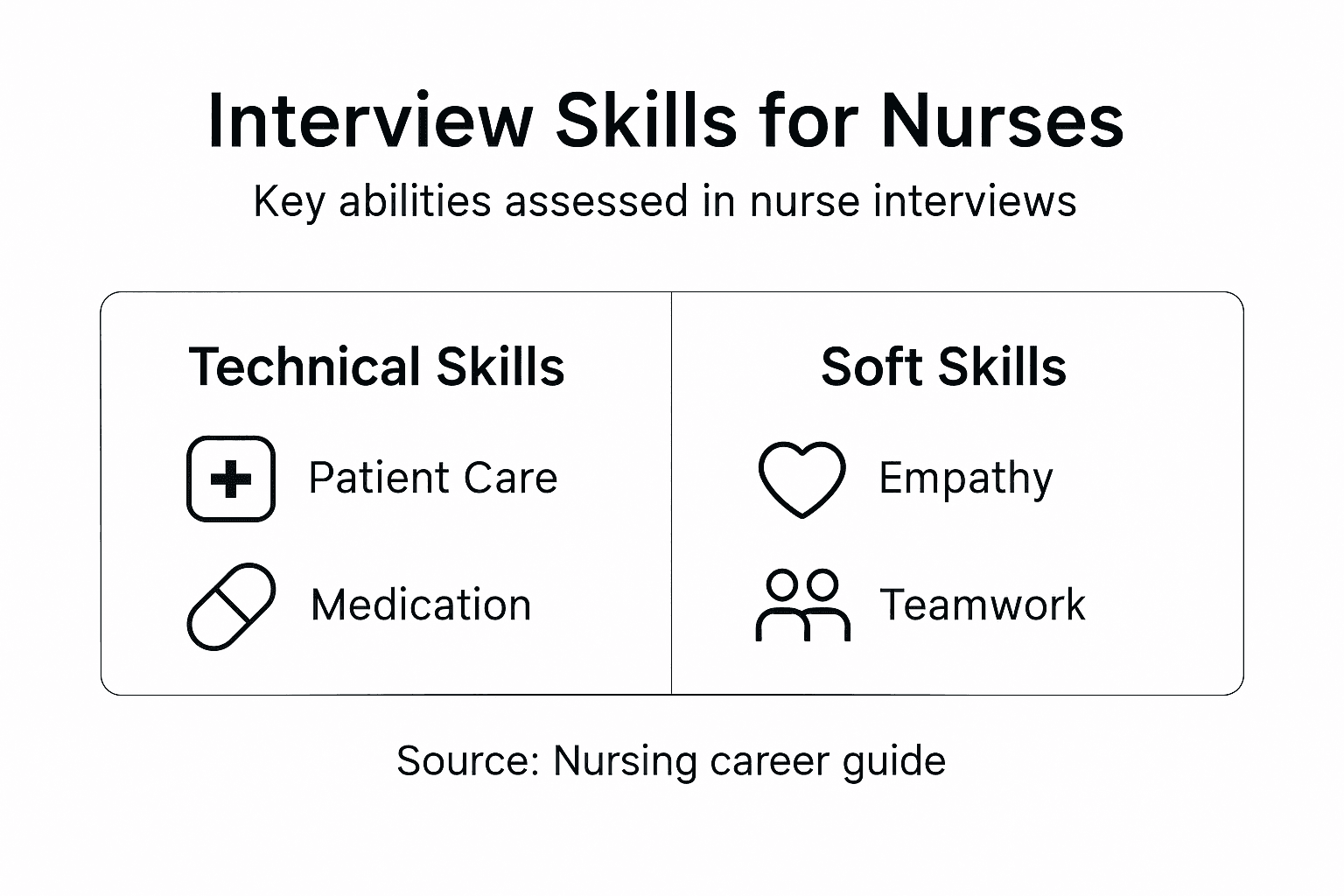
The key skills measured during nursing interviews can be categorized into two primary domains:
Clinical Skills:
- Patient assessment techniques
- Medical procedure proficiency
- Technical equipment management
- Medication administration knowledge
- Diagnostic documentation
Soft Skills:
- Communication effectiveness
- Emotional intelligence
- Team collaboration
- Stress management
- Critical thinking abilities
Interviewers meticulously evaluate candidates’ professional nursing competencies through a combination of behavioral assessments, scenario-based questions, and direct skill inquiries. These evaluations aim to determine not just technical competence, but also the candidate’s potential to provide compassionate, patient-centered care.
Successful nursing candidates demonstrate a harmonious integration of clinical precision and human compassion.
Professional nurses must understand that interviews assess more than just medical knowledge. They explore a candidate’s ability to:
- Adapt to dynamic healthcare environments
- Communicate effectively with patients and colleagues
- Make rapid, accurate clinical decisions
- Maintain professional composure under pressure
- Exhibit continuous learning and growth mindset
Employers seek nursing professionals who can seamlessly blend technical skills with empathetic patient interaction, creating a holistic approach to healthcare delivery.
To understand key clinical and soft skills measured in nursing interviews, see below:
| Skill Category | What Is Assessed | Why It Matters |
|---|---|---|
| Clinical Skills | Safe medication administration, patient monitoring | Minimizes errors, enhances patient outcomes |
| Soft Skills | Teamwork, empathy, adaptability | Improves communication, supports stress management |
Pro tip: Prepare concrete examples from your professional experience that demonstrate your ability to blend technical expertise with emotional intelligence during your nursing interview.
Sample Answers for Common Nursing Questions
Navigating nursing interviews requires strategic preparation and the ability to craft compelling responses that showcase your professional capabilities. Behavioral interview techniques emphasize the importance of structured, authentic storytelling that highlights a nurse’s unique skills and experiences.
Effective interview responses typically follow the STAR method:
- Situation: Briefly describe the clinical context
- Task: Explain your specific responsibility
- Action: Detail the steps you took
- Result: Share the positive outcome and learnings
Common nursing interview questions often explore critical professional dimensions:
Patient Care Questions:
- Describe a challenging patient interaction
- How do you maintain patient dignity?
- Share an example of patient advocacy
Professional Challenge Questions:
- How do you handle workplace stress?
- Describe a time you resolved a team conflict
- What motivates you in nursing?
Authentic, concise answers that demonstrate clinical expertise and emotional intelligence will always stand out in nursing interviews.
Sample response frameworks help nurses prepare structured, impactful answers:
- Start with a clear, relevant clinical scenario
- Focus on your specific role and actions
- Highlight positive patient or team outcomes
- Reflect on professional growth or learning
- Connect the experience to broader nursing values
Successful candidates understand that interview responses are not just about recounting events, but demonstrating professional growth, adaptability, and commitment to exceptional patient care.
Pro tip: Practice your interview responses out loud, focusing on clarity, brevity, and highlighting your unique professional strengths.
Mistakes Nurses Should Avoid During Interviews
Nursing interviews require strategic preparation and professional awareness to successfully navigate potential pitfalls. Professional interview preparation demands careful attention to nuanced behaviors and communication strategies that can make or break a candidate’s chances.
Critical mistakes nurses frequently encounter include:
- Lack of Preparation
- Insufficient research about the healthcare organization
- Minimal understanding of job responsibilities
- Unprepared responses to standard questions
- Communication Missteps
- Providing vague or generic answers
- Failing to articulate specific professional experiences
- Overconfidence without demonstrable humility
Professional Behavior Errors:
- Arriving late to the interview
- Inappropriate or unprofessional dress
- Poor body language
- Speaking negatively about previous employers
- Displaying minimal enthusiasm
Interview success depends not just on clinical knowledge, but on presenting yourself as a thoughtful, professional healthcare candidate.
Technological and virtual interview mistakes can also significantly impact a nurse’s candidacy. Interview performance strategies reveal that candidates must be equally prepared for in-person and digital interview environments, understanding technical requirements and maintaining professional presentation.
Key areas of potential interview failure include:
- Inadequate digital platform familiarity
- Poor internet connection
- Unprofessional virtual background
- Minimal engagement during online interactions
- Technical unpreparedness
Successful nursing candidates recognize that interviews are holistic assessments of professional competence, communication skills, and personal integrity.
Pro tip: Conduct a comprehensive self-review of your social media presence and professional digital footprint before any nursing interview.
Expert Strategies for AI-Assisted Interviews
The landscape of job interviews is rapidly transforming with artificial intelligence technologies, requiring candidates to adapt their preparation and presentation strategies. Interview technology insights reveal that AI-driven interviews demand a nuanced approach to communication and self-presentation.
Key strategies for AI interview success include:
- Technical Preparation
- Ensure stable internet connection
- Test camera and microphone beforehand
- Choose professional, neutral background
- Verify lighting and audio quality
- Communication Techniques
- Maintain direct eye contact with camera
- Speak clearly and concisely
- Use structured, focused responses
- Minimize unnecessary gestures
AI Interview Evaluation Dimensions:
- Verbal communication clarity
- Facial expression authenticity
- Response structure and relevance
- Emotional intelligence indicators
- Technical competence demonstration
AI interview systems analyze far more than just your spoken words - they interpret your entire communicative context.
Technological nuances of AI interviews require candidates to understand how machine learning algorithms assess human interaction. This means developing responses that are not just informative, but also algorithmically optimized for clear comprehension and professional presentation.
Advanced preparation techniques include:
- Recording mock interview responses
- Analyzing nonverbal communication patterns
- Practicing succinct, job-relevant narratives
- Understanding potential AI assessment metrics
- Developing adaptive communication strategies
Successful candidates recognize that AI interviews are sophisticated assessments demanding both technical proficiency and sophisticated interpersonal skills.
Pro tip: Conduct multiple video practice interviews, recording and critically reviewing your performance to identify and refine communication subtleties.
Master Your Nursing Interview with Real-Time AI Assistance
Preparing for nursing interviews can be overwhelming when you need to craft clear and structured responses to complex behavioral and situational questions. The challenge lies in demonstrating your clinical competence, emotional intelligence, and communication skills all at once while staying confident under pressure. Many nurses struggle to find the right words in the moment and wish they had a reliable way to practice with instant, tailored feedback.
Parakeet AI is designed to turn this challenge into your greatest opportunity by acting as a real-time AI job interview assistant. It listens carefully as you answer common nursing questions and immediately provides strategic suggestions and model answers to help you stand out. Whether you want to perfect your STAR method storytelling or sharpen responses related to patient care and professional ethics, Parakeet AI gives you that edge with personalized guidance.

Don’t let interview stress hold you back from showcasing your true potential. Take control of your nursing career by practicing with Parakeet AI right now and transform every question into a confident, compelling answer. Visit Parakeet AI to start your journey toward interview success today.
Frequently Asked Questions
What types of questions should I expect in a nursing interview?
Nursing interviews typically include behavioral questions, situational questions, technical questions, competency-based questions, and career progression questions to evaluate a candidate’s professional skills and fit.
How can I prepare effective answers for nursing interview questions?
Utilizing the STAR method (Situation, Task, Action, Result) can help you structure your responses and articulate specific examples from your clinical experiences.
What are some common nursing interview questions?
Common questions might include scenarios related to patient care challenges, workplace stress management, conflict resolution among team members, and ethical dilemmas in nursing practice.
What key skills are nurses expected to demonstrate during interviews?
Nurses should showcase clinical skills like patient assessment and medication administration, as well as soft skills such as communication, emotional intelligence, teamwork, and stress management.