
7 Key Software Engineering Interview Questions Explained

Tech interviews can feel overwhelming when every question tests both your technical skills and your ability to communicate clearly. Whether it’s breaking down data structures, tackling system design scenarios, or discussing past project challenges, the pressure to perform is real. Without a smart approach, even well-prepared candidates can miss out on great opportunities.
This guide delivers practical techniques you can use for every major question type. You’ll discover effective methods to explain complex topics, answer behavioral questions, and show real problem-solving skills—exactly what interviewers want to see. Get ready for actionable insights that will help you stand out and walk into your next interview with confidence.
Table of Contents
- Explaining Data Structures And Algorithms Clearly
- Approaching System Design Questions Effectively
- Answering Behavioral Questions With Impact
- Talking About Past Projects And Technical Challenges
- Demonstrating Problem-Solving With Code Examples
- Asking Smart Questions To Interviewers
- Using Ai Tools For Real-Time Interview Assistance
Quick Summary
| Takeaway | Explanation |
|---|---|
| 1. Simplify Complex Concepts | Articulate data structures and algorithms using analogies to enhance understanding. This builds your credibility in interviews. |
| 2. Clarify System Design Needs | Begin by asking clarifying questions to define functional and non-functional requirements before diving into technical solutions. |
| 3. Use STAR for Behavioral Questions | Apply the STAR method to structure your responses, focusing on meaningful, concrete examples linked to the job role. |
| 4. Narrate while Coding | Talk through your coding process to reveal your thought process and problem-solving abilities. Clear communication is key. |
| 5. Ask Engaging Questions | Inquire about technical challenges or team dynamics during the interview to demonstrate critical thinking and genuine interest. |
1. Explaining Data Structures and Algorithms Clearly
When interviewers ask you to explain data structures and algorithms, they are not looking for textbook definitions. They want to see if you can communicate complex ideas in simple terms, demonstrating both your technical understanding and your ability to collaborate with others. This is where many candidates stumble. You might know the theory perfectly well, but if you cannot articulate it clearly, the interviewer walks away doubting your competence.
Start by understanding what you are actually explaining. Data structures organize and manage data effectively to reduce time and space complexity, while algorithms are the step-by-step procedures that operate on those structures. Think of a data structure as a container and an algorithm as the instructions for what to do with the contents. Linear data structures like arrays and linked lists arrange data sequentially, while non-linear structures like trees and graphs create more complex relationships. When you interview, your job is to help the interviewer visualize this distinction. Use real-world analogies. An array is like a row of mailboxes where each mailbox has a fixed location. A linked list is like a treasure hunt where each clue points to the next one. A hash table is like a phone directory where you look up a name to instantly find a number. These mental images make your explanations stick.
The practical application is where you demonstrate mastery. When explaining a specific data structure or algorithm, follow this approach: first state the name and primary purpose, then describe its structure or mechanism, then explain its time and space complexity trade-offs, and finally provide a use case where it shines. For example, if explaining a binary search tree, you might say, “A binary search tree is a data structure where each node has at most two children, organized so that left children are smaller and right children are larger. This ordering allows us to search in O(log n) time on average, making it efficient for sorted data retrieval. We use binary search trees when we need fast searching and sorted traversal, like in databases.” Your interviewer now knows you understand not just what it is, but why it matters. Practice explaining algorithm questions and techniques in this structured way before your interview so the words come naturally.
Pro tip: Record yourself explaining three different data structures out loud without notes, then listen back for unclear moments or rambling explanations. This single practice session will reveal communication gaps you did not know you had.
2. Approaching System Design Questions Effectively
System design questions terrify many candidates because they feel open-ended and ambiguous. The truth is, that ambiguity is intentional. Interviewers want to see how you handle vague requirements, break down complex problems, and make architectural decisions under uncertainty. The good news is that system design follows a predictable pattern once you understand the framework. Rather than panic when you hear a question like “Design Twitter” or “Design an e-commerce platform,” you should recognize it as an opportunity to showcase your structured thinking.
The key to approaching these questions effectively is to resist the urge to jump straight into technical details. Start by asking clarifying questions and defining system requirements explicitly. What are the functional requirements, meaning what must the system actually do? What are the non-functional requirements like scalability, availability, and latency? How many users will access the system? How much data will it handle? These questions accomplish two things at once: they give you the information you need to design properly, and they demonstrate to the interviewer that you think systematically. Once you have clarity, you can map out a solution using high-level and low-level design components, starting with architecture overview and then drilling into module responsibilities and technology choices. This structured progression transforms what feels like a chaotic conversation into a logical exploration of trade-offs.
When you actually present your design, communicate constantly. Explain your reasoning as you make choices. Say something like “I chose a NoSQL database here because we need horizontal scalability and flexible schema for this use case, accepting the trade-off of eventual consistency over immediate consistency.” Your interviewer learns not just what you chose, but why you chose it and what you gave up in return. Walk through a concrete example or scenario to show how your design handles real traffic. If you get stuck or unsure about something, say it out loud. Interviewers respect candidates who acknowledge uncertainty and think through problems, not candidates who pretend to know everything. Practice talking through full system designs with friends or mentors before your interview, because comfort with the cadence of explanation matters as much as the technical accuracy.
Pro tip: Draw your architecture on a whiteboard or piece of paper as you explain it, even if you cannot make it perfect. Visual representation helps your interviewer follow your thinking and gives them something concrete to reference when they ask follow-up questions.
3. Answering Behavioral Questions with Impact
Behavioral questions trip up technically brilliant candidates all the time. When an interviewer asks “Tell me about a time you failed” or “Describe a situation where you had to work with a difficult teammate,” they are not testing your memory. They are assessing how you think, how you handle pressure, and whether you have the self-awareness to learn from experience. These questions reveal character in ways that no coding problem ever could. The interviewer wants to hear a real story with specific details, not a polished corporate answer that sounds like everyone else.
The key to answering behavioral questions with impact is using the STAR method, but with genuine substance. STAR stands for Situation, Task, Action, Result. Start by briefly setting the scene without unnecessary background. Then explain the specific task or challenge you faced. Walk through the action you took, emphasizing your personal contribution and decision-making process. Finally, describe the concrete result with numbers or outcomes when possible. The magic happens when you connect your story directly to the job you are interviewing for. If the job requires collaboration, tell a story that shows how you built trust with others. If it requires problem-solving under pressure, pick an example where you stayed calm and found a solution. This intentional matching demonstrates that you understand what the role demands and that you have already proven you can deliver it. Research shows that concrete examples of past performance significantly improve the relevance and impact of your response.
When telling your story, avoid the trap of making yourself the hero who saved the day single-handedly. Interviewers value candidates who acknowledge team contributions and show genuine humility. If you made a mistake in your story, talk about what you learned and how you changed your approach. This honesty builds credibility far more than a perfect story ever could. Practice your behavioral stories out loud so they sound natural, not rehearsed. You want the interviewer to feel like you are having a real conversation, not listening to a script. Have three to five strong stories ready that demonstrate different competencies like leadership, resilience, collaboration, and learning from failure. When the interviewer asks a behavioral question, take a breath, pick the most relevant story, and tell it with confidence.
Pro tip: Before your interview, write down your top five stories with specific details like project names, dates, and measurable outcomes, then practice telling each one in two to three minutes so they feel natural when the question comes up.
4. Talking About Past Projects and Technical Challenges
When an interviewer asks about your past projects, they are not looking for a resume regurgitation. They want to understand how you approach problems, what you learned, and how you contributed to meaningful work. This is your chance to show technical depth while demonstrating problem-solving maturity. Many candidates make the mistake of describing their entire project history in chronological order, boring the interviewer to tears. Instead, select one or two projects that genuinely showcase your skills and the specific technical challenges you faced.
The most powerful project stories follow a clear structure: problem, approach, execution, and outcome. Start by describing the technical challenge you encountered. What made it difficult? Was it performance bottlenecks, architectural complexity, integrating incompatible systems, or something else entirely? Be specific. Instead of saying “we had scalability issues,” say “our database was running into query timeouts when user concurrency exceeded 5,000 simultaneous connections.” Next, explain your approach to solving it. What did you research? What trade-offs did you consider? This is where you demonstrate technical judgment. Then walk through what you actually did and your personal contribution to the solution. Finally, share the measurable outcome. Did you reduce response time by 40 percent? Did you enable the system to handle 10 times more traffic? Did you reduce infrastructure costs by 30 percent? Numbers make impact concrete. The ability to reflect on past obstacles and the strategies employed to overcome them shows maturity and self-awareness that interviewers actively seek.
Here is a critical detail many candidates miss: talk about what you learned. This is what separates junior engineers from senior ones. Did you learn that premature optimization causes more harm than good? Did you discover the importance of monitoring and alerting before pushing to production? Did you realize that the best technical solution is worthless if it breaks team velocity? Interviewers want to see that you extract lessons from your experiences and carry them forward. If your project failed or encountered setbacks, that is actually gold. Discussing failure with honesty and explaining what you would do differently next time demonstrates growth mindset. Avoid projects where you had minimal involvement or where you cannot articulate the technical details. Pick work you are genuinely proud of and can speak about with passion.
Pro tip: Prepare descriptions of three to five different projects with varying scales and technical focuses, then match them to the interviewer’s interests during the conversation. This gives you flexibility to highlight the most relevant work based on what seems to matter to your interviewer.
5. Demonstrating Problem-Solving with Code Examples
When you write code during an interview, you are not just proving you can code. You are showing your thought process, your ability to communicate while solving, and your approach to problem-solving under pressure. This is why writing clean, well-structured code with clear logic matters far more than writing perfect, optimized code on the first try. Your interviewer learns more from watching you solve a problem step by step than from seeing you produce a flawless solution instantly. The code is secondary to the thinking behind it.
Start by talking through your approach before you write anything. Explain your strategy, discuss potential edge cases, and outline the algorithm you plan to use. This narration gives the interviewer visibility into your thought process and prevents you from coding yourself into a corner. As you write, keep your code readable. Use meaningful variable names, add brief comments where logic is not obvious, and write code that a colleague could understand without explanation. When you encounter a problem or realize your approach needs adjustment, articulate what you are noticing and how you plan to fix it. This demonstrates iterative problem-solving steps that show maturity and adaptability. Many candidates panic when they realize they made a mistake. Confident candidates simply acknowledge it, explain their fix, and move forward.
After writing your code, test it with examples. Walk through your code with a simple input, then a complex one, then an edge case. Narrate what happens at each step. This testing phase accomplishes several things at once. It catches bugs you might have missed, it demonstrates that you think about edge cases, and it shows the interviewer that you verify your work. If your code has a bug, stay calm. Debugging is a normal part of development, and your ability to systematically find and fix problems is valuable. Do not write code that you cannot explain. Every line should make sense to you. If you feel stuck, do not sit in silence. Talk about what you are thinking, ask clarifying questions, or suggest approaching the problem differently. Your interviewer wants to help you succeed, and communication is the best way to collaborate toward a solution.
Pro tip: Practice coding problems out loud on a whiteboard or paper before your interview so you are comfortable narrating your thinking while writing code, which feels unnatural until you do it several times.
6. Asking Smart Questions to Interviewers
Most candidates spend their entire interview answering questions without asking a single one. When the interviewer finally says “Do you have any questions for me?” they respond with “No, I think you covered everything.” This is a missed opportunity. The questions you ask reveal how you think about your career, how thorough you are, and how genuinely interested you are in the role. Your interviewer expects you to have questions. Asking thoughtful ones separates engaged candidates from passive ones.
The purpose of your questions is twofold: you gain information to decide if this role fits your career goals, and you demonstrate your critical thinking to the interviewer. This means your questions should not be generic or easily answered by reading the company website. Avoid asking about salary, benefits, or vacation days during the interview, even though these matter. Save those discussions for when an offer comes. Instead, focus on questions that show you have thought deeply about the position and the organization. Ask about specific technical challenges the team faces, how success is measured in the role, what qualities the interviewer values most in their team members, or how the organization handles technical debt and system maintenance. These questions signal that you care about meaningful work and understand what makes teams effective. Questions about company culture, team dynamics, and growth opportunities demonstrate that you are evaluating fit from multiple angles.
Your questions also provide a chance to address concerns the interviewer might have. If you sensed that the interviewer was unsure about your experience with a particular technology, ask “What is the learning curve for someone new to your tech stack, and how does the team support that?” This shows you are self-aware and proactive about growth. Research the company before your interview so your questions feel informed. Reference something specific you learned about their product, recent news, or engineering challenges you noticed. Say something like “I read that you recently migrated to microservices. What was the biggest technical challenge you faced in that migration?” This level of specificity shows you did your homework and are genuinely interested. Write down three to five strong questions before your interview so you are not scrambling to think of them on the spot. Take notes on the interviewer’s answers. This signals respect for what they are saying and gives you material to reference if you follow up after the interview.
Pro tip: Ask your questions naturally throughout the interview when relevant rather than saving them all for the end, and always end with one final question that shows long-term interest in the company and growth within the role.
7. Using AI Tools for Real-Time Interview Assistance
The interview landscape is changing rapidly. Artificial intelligence tools can now listen to interview questions in real time and provide answers, suggestions, and coaching as you respond. This technology represents a fundamental shift in how candidates prepare for and execute interviews. Rather than viewing AI assistance as cheating, think of it as a modern tool that levels the playing field. Just as professional writers use spell checkers and grammar tools, you can leverage AI to enhance your interview performance. The key is understanding how to use these tools ethically and effectively to genuinely improve your abilities.
AI interview assistants work by processing your interview questions in real time and generating relevant responses based on patterns from successful interviews and best practices. Some tools provide instant suggestions you can incorporate into your answer, while others offer feedback and coaching between questions. The value lies not in copying answers word for word, but in using AI as a brainstorming partner and quality control mechanism. When an AI tool suggests an example for your behavioral question, it triggers your memory and helps you articulate your experience more clearly. When it highlights that you have not mentioned specific metrics in your project discussion, it prompts you to add concrete details. This real-time feedback accelerates your learning and prevents common mistakes that candidates make under pressure. Developing a personalized AI toolkit that includes answer generation, response evaluation, and coaching support creates a comprehensive advantage during your interview.
To use AI tools responsibly and effectively, focus on genuine skill development rather than memorized scripts. Before your interview, practice with AI assistance to understand what strong responses look like and where your gaps exist. During your actual interview, use AI suggestions as inspiration rather than verbatim answers. Your authentic voice and genuine experience will always resonate more than a polished but generic response. Consider tools that offer real-time support through AI-based coaching to help you stay calm, confident, and articulate throughout your interview. The goal is to use technology to amplify your best self, not to replace the human qualities that make you valuable as a candidate. With proper preparation and strategic use of AI assistance, you can walk into your interview feeling prepared, confident, and ready to showcase your true capabilities.
Pro tip: Test your AI interview assistant tool with practice questions before your actual interview so you understand how quickly you can process suggestions and incorporate them naturally without disrupting your flow.
Below is a comprehensive table summarizing the main strategies and insights discussed in the article about preparing for and excelling in interviews.
| Aspect | Description | Recommendation |
|---|---|---|
| Data Structures and Algorithms | Explaining complex concepts clearly is key to showcasing understanding and collaboration skills. | Practice using relatable analogies and structured explanations to convey ideas efficiently. |
| System Design Questions | Approach these open-ended questions with systematic problem-solving and trade-off discussion. | Clearly define requirements, consider design implications, and illustrate ideas visually. |
| Behavioral Questions | Relate past experiences to the role and demonstrate growth and problem-solving. | Use the STAR method to effectively elaborate on relevant scenarios and outcomes. |
| Discussing Past Projects | Highlight significant technical challenges and your approach to solving them. | Use specific metrics and examples to demonstrate impact and lessons learned. |
| Coding Demonstrations | Showcase problem-solving and clear thought processes over perfect solutions. | Communicate plans clearly and debug systematically, focusing on readability and logic. |
| Engaging with Interviewers | Asking insightful, thoughtful questions demonstrates genuine interest and critical thinking. | Prepare questions about technical challenges, team dynamics, and growth opportunities. |
| Utilizing AI Tools | Leverage AI for enhanced preparation and real-time assistance to refine skills. | Use AI tools ethically to supplement understanding and articulate genuine experiences. |
Master Your Software Engineering Interviews with Real-Time AI Support
Struggling to clearly explain complex data structures or confidently approach system design questions can leave you feeling unprepared and anxious. This article highlights the challenges interviewees face when communicating technical concepts, solving coding problems aloud, and answering behavioral questions effectively. Your goal is to not only know the theory but also to express it clearly under pressure while managing the unpredictable nature of interviews.
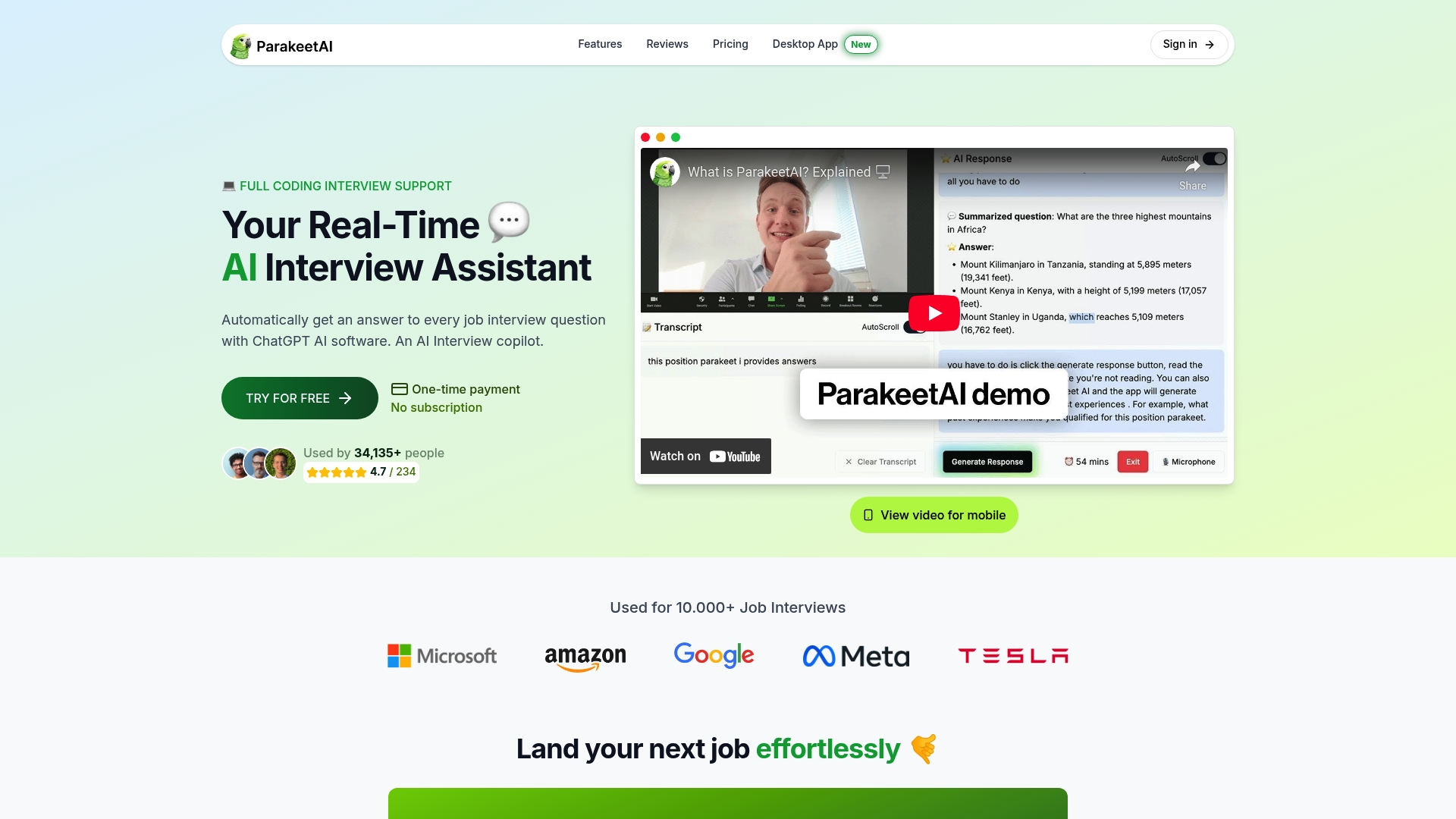
Take control of your next interview with Parakeet AI’s real-time job interview assistant. Our AI listens to your interview, instantly providing tailored answers and coaching so you can confidently articulate your knowledge about algorithms, system design, project experiences, and behavioral stories. Practice smarter with AI-powered feedback that helps you improve your communication, test and refine your coding answers on the fly, and ask insightful questions that make a lasting impact. The time to elevate your interview skills and stand out is now. Visit Parakeet AI and start preparing to succeed today.
Frequently Asked Questions
What are common data structures to discuss in an interview?
Data structures like arrays, linked lists, trees, and hash tables are commonly discussed during interviews. Familiarize yourself with each structure’s purpose and real-world applications to articulate their benefits effectively.
How do I approach system design questions during an interview?
Start by asking clarifying questions to understand the requirements, then outline a high-level solution. Practice breaking down complex systems into manageable components to demonstrate your structured thinking during the interview.
What is the STAR method for answering behavioral questions?
The STAR method stands for Situation, Task, Action, Result, which is a framework to organize your responses. Use this approach to structure your answers by detailing a specific situation, the tasks involved, your actions, and the results achieved.
How can I effectively showcase my past projects during an interview?
Select a few projects that highlight your skills and follow a clear structure: describe the problem you faced, your approach, execution, and the measurable outcome. Prepare these stories in advance so they come across as confident and engaging during the interview.
What is the best way to practice coding problems for interviews?
Practice coding out loud and explain your thought process as you solve problems. Use a whiteboard or paper to write your code and simulate the interview environment, improving your ability to communicate while coding.
How do I formulate smart questions to ask at the end of an interview?
Prepare thoughtful questions that reflect your understanding of the role and the company’s challenges. Focus on aspects like team dynamics, technical challenges, and growth opportunities to leave a lasting impression.