
Why AI Interviews Matter for Modern Job Seekers

Almost half of American tech and marketing job seekers believe AI interviews are just rigid robots, but these systems actually analyze emotional intelligence and even subtle body language. Understanding how AI-driven platforms assess candidate responses is crucial for staying competitive in a global job market. This article reveals practical strategies that help you harness AI tools for personalized feedback and conquer both traditional and digital interviews.
Table of Contents
- AI Interviews Defined And Common Misconceptions
- Types Of AI-Driven Interview Formats
- How AI Evaluates Candidate Responses
- Benefits Of AI Interviews For Applicants
- Risks, Limitations, And Ethical Challenges
- Avoiding Mistakes And Maximizing Success
Key Takeaways
| Point | Details |
|---|---|
| AI Interviews Enhance Evaluation | AI interviews utilize sophisticated algorithms to analyze verbal and non-verbal communication, leading to more comprehensive candidate assessments. |
| Understanding AI Interview Formats | Familiarize yourself with various AI interview types, such as video and chatbot assessments, to better prepare for the process. |
| Beware of Ethical Risks | Recognize potential issues with algorithmic bias and privacy, and inquire about the evaluation methodologies used by AI systems. |
| Prepare Authentic Responses | Practice genuine communication techniques to convey both knowledge and critical thinking, avoiding memorized scripts. |
AI Interviews Defined and Common Misconceptions
AI interviews represent a technology-driven approach to evaluating job candidates using advanced computational algorithms and machine learning techniques. Unlike traditional human-led interviews, these systems analyze verbal and non-verbal communication patterns to provide comprehensive candidate assessments. Understanding AI interview technologies reveals they are sophisticated tools designed to complement human decision making, not replace human judgment.
Contrary to popular belief, AI interviews do not function as robotic, emotionless evaluations. These systems are complex platforms that incorporate nuanced analysis of communication skills, emotional intelligence, and professional competencies. The misconception that AI interviews are rigid and inflexible fails to recognize the advanced natural language processing capabilities that enable these systems to interpret contextual cues and assess candidate potential dynamically.
Most job seekers misunderstand AI interview technologies as purely algorithmic processes. In reality, these systems integrate multiple assessment dimensions, including linguistic patterns, tone modulation, response complexity, and situational understanding. Artificial intelligence terminology itself can be misleading, as AI represents a diverse ecosystem of technologies rather than a monolithic intelligence.
Pro tip: Practice your AI interview skills by recording yourself answering typical questions and analyzing your verbal and non-verbal communication patterns to improve your performance.
Here’s a comparison of traditional human interviews versus AI-driven interviews:
| Aspect | Human Interviews | AI-Driven Interviews |
|---|---|---|
| Consistency | Varies by interviewer | Standardized assessments |
| Bias Reduction | Subject to human bias | Reduced algorithmic bias |
| Feedback Speed | Delayed, often subjective | Instant, data-driven insights |
| Scalability | Limited by resource availability | Easily scales to many candidates |
| Communication Analysis | Relies on interviewer experience | Multimodal algorithmic evaluation |
Types of AI-Driven Interview Formats
AI-driven interview formats have revolutionized the recruitment landscape, offering diverse approaches to candidate assessment. AI interviewing systems now encompass multiple innovative technologies that streamline the evaluation process. These formats range from automated video interviews to sophisticated conversational platforms that assess candidates through multiple communication channels.
The primary categories of AI-driven interview formats include synchronous and asynchronous video interviews, chatbot-based assessments, and virtual avatar interactions. Synchronous interviews simulate real-time conversations, allowing candidates to interact with AI systems in a dynamic, responsive environment. Asynchronous formats enable candidates to record responses at their convenience, with AI algorithms analyzing verbal and non-verbal communication cues, tone, and content complexity.
Common AI Interview Format Approaches:
- Chatbot Interviews: Text-based interactions that evaluate written communication skills
- Video Interviews: Automated analysis of recorded video responses
- Virtual Avatar Interviews: Immersive interactions with computer-generated interviewers
- Multimodal Assessments: Comprehensive evaluations using multiple communication channels
Pro tip: Familiarize yourself with different AI interview formats by practicing with various online platforms and recording mock interviews to understand how these technologies assess candidate responses.
How AI Evaluates Candidate Responses
AI evaluation of candidate responses represents a sophisticated blend of algorithmic analysis and multimodal assessment techniques. These advanced systems go beyond traditional screening by examining verbal and non-verbal communication signals, creating a comprehensive profile of each candidate’s potential. The evaluation process involves sophisticated machine learning algorithms that analyze language patterns, emotional intelligence, and professional competencies with remarkable precision.
The core components of AI response evaluation include linguistic content analysis, tone detection, and contextual understanding. Machine learning models parse candidate responses, identifying key communication markers such as clarity, confidence, problem-solving skills, and emotional intelligence. These systems can detect subtle nuances in language, assess the complexity of responses, and compare candidate performances against predefined professional benchmarks.
Key Evaluation Dimensions:
- Verbal Communication: Clarity, articulation, and depth of response
- Emotional Intelligence: Tone, empathy, and interpersonal communication skills
- Problem-Solving Approach: Logical reasoning and strategic thinking
- Professional Language: Industry-specific terminology and communication standards
- Non-Verbal Cues: Facial expressions, body language, and engagement levels
Pro tip: Record multiple practice interview responses and analyze them critically to understand how AI might interpret your communication style and professional presentation.
Benefits of AI Interviews for Applicants
AI-driven job interviews present significant advantages for modern job seekers, transforming the traditional recruitment experience. These innovative platforms offer unprecedented opportunities for candidates to showcase their skills, receive objective evaluations, and gain valuable insights into their professional presentation. By leveraging advanced algorithmic assessments, AI interviews eliminate many of the inherent biases and inconsistencies found in traditional human-conducted interviews.
The most compelling benefits include enhanced fairness, reduced interview anxiety, and improved preparation opportunities. Candidates experience a more standardized evaluation process that focuses on their actual skills and communication abilities rather than superficial impressions. AI interview systems provide immediate, constructive feedback, allowing job seekers to understand their performance strengths and areas for improvement in real time. This transparent approach empowers applicants with actionable insights that can significantly enhance their future interview performances.
Key Benefits for Job Seekers:
- Objective Evaluation: Consistent, bias-free assessment of skills
- Instant Feedback: Immediate performance insights and improvement recommendations
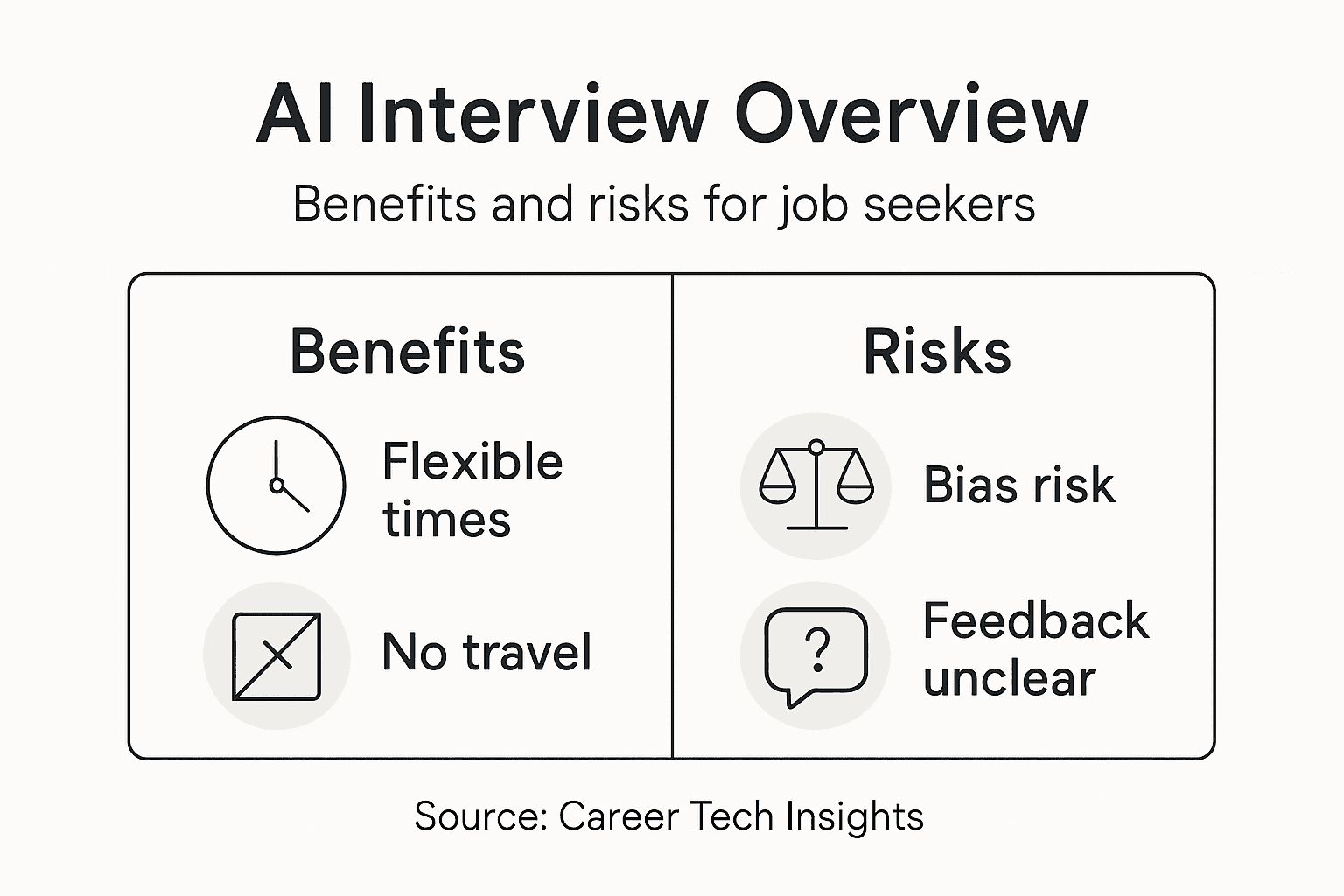
- Flexible Scheduling: Convenience of asynchronous interview options
- Reduced Anxiety: Non-judgmental interview environment
- Skill Development: Structured opportunities for communication improvement
Pro tip: Practice recording interview responses and analyze them objectively to understand how AI systems might interpret your communication style and professional presentation.
Risks, Limitations, and Ethical Challenges
AI interview technologies present complex ethical challenges that job seekers and employers must carefully navigate. While these systems offer innovative assessment approaches, they simultaneously introduce significant risks related to privacy, fairness, and potential algorithmic bias. Understanding these limitations is crucial for maintaining ethical standards and ensuring equitable candidate evaluation processes.

The primary ethical concerns revolve around transparency, data privacy, and potential discriminatory outcomes. AI interview systems may inadvertently perpetuate historical biases embedded in training data, leading to unfair candidate screening. Some algorithms might disproportionately disadvantage candidates from underrepresented groups by applying narrow or historically skewed evaluation criteria. Additionally, the opaque nature of many AI decision-making processes makes it difficult to understand precisely how candidate assessments are generated.
Key Ethical Risks and Limitations:
- Algorithmic Bias: Potential systematic discrimination
- Privacy Concerns: Unauthorized data collection and storage
- Lack of Transparency: Unclear evaluation methodologies
- Limited Contextual Understanding: Difficulty interpreting nuanced responses
- Potential Technical Errors: Inaccurate candidate assessments
Pro tip: Request detailed information about an AI interview system’s evaluation methodology and understand your rights regarding data privacy and algorithmic assessment.
The following table summarizes ethical and practical challenges of AI interviews:
| Challenge | Impact on Candidates | Solution Approach |
|---|---|---|
| Algorithmic bias | Unequal candidate screening | Improve training data |
| Privacy concerns | Potential data misuse | Transparent policies |
| Lack of transparency | Unclear evaluation results | Detailed disclosures |
| Technical errors | Possible false assessments | System monitoring |
Avoiding Mistakes and Maximizing Success
Successful AI interview preparation demands a strategic approach that balances technological understanding with authentic personal presentation. Candidates must recognize that AI interview systems are sophisticated evaluation tools designed to assess not just answers, but communication style, depth of knowledge, and critical thinking capabilities. Effective preparation involves understanding the nuanced ways these systems analyze candidate responses.
Navigating AI interviews requires careful preparation and genuine self-representation. Job seekers should develop responses that demonstrate both substantive knowledge and adaptive communication skills. This means practicing articulate, concise answers that showcase problem-solving abilities, while maintaining a natural conversational tone. Avoid memorized scripts or overly polished responses that might appear artificially generated, as AI systems are increasingly adept at detecting inauthentic communication patterns.
Key Strategies for AI Interview Success:
- Demonstrate Genuine Knowledge: Go beyond surface-level answers
- Practice Adaptable Communication: Develop flexible response techniques
- Understand AI Evaluation Metrics: Learn how systems assess candidates
- Showcase Critical Thinking: Provide nuanced, thoughtful responses
- Maintain Authentic Presentation: Balance professionalism with personal style
Pro tip: Record multiple practice interview responses and critically analyze them to understand how AI might interpret your communication style and professional presentation.
Master AI-Powered Interviews with Real-Time AI Assistance
AI interviews challenge modern job seekers by demanding clear communication, genuine responses, and adaptability to advanced evaluation metrics like verbal communication and emotional intelligence. Many candidates struggle with the pressure of instant feedback and understanding AI evaluation systems, which can amplify anxiety and hinder authentic presentation. At Parakeet AI, we recognize these challenges and provide a real-time AI job interview assistant that listens carefully and automatically generates answers tailored to each question, helping you practice and improve your skills in the most realistic way.
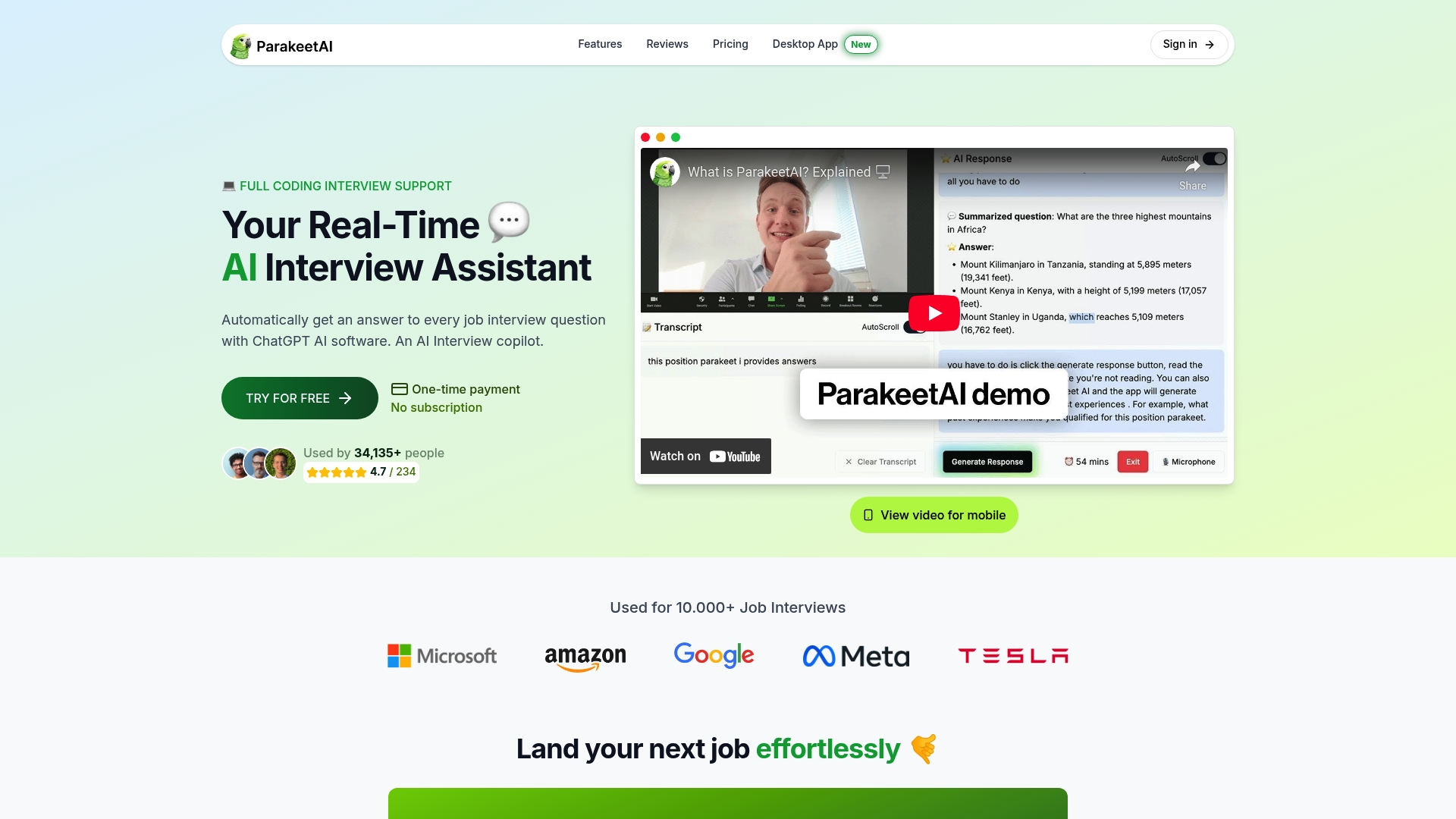
Take control of your next AI interview today by practicing with a tool designed to boost your confidence, sharpen your communication style, and prepare you for every type of AI-driven interview format. Visit Parakeet AI now to experience intelligent support that helps you turn potential interview risks into opportunities. Don’t wait—start mastering AI interviews with Parakeet AI and set yourself apart in the competitive hiring process.
Frequently Asked Questions
What are AI interviews and how do they work?
AI interviews use advanced algorithms and machine learning techniques to assess job candidates by analyzing their verbal and non-verbal communication patterns, providing a more comprehensive evaluation compared to traditional human-led interviews.
What are the benefits of AI interviews for job seekers?
Benefits of AI interviews include objective evaluation, instant feedback, flexible scheduling, reduced anxiety, and opportunities for skill development, allowing candidates to improve their performance in real-time.
How can candidates prepare for an AI interview?
Candidates can prepare for AI interviews by practicing common interview questions, recording their responses to analyze communication styles, and familiarizing themselves with different AI interview formats to understand how they will be assessed.
What are the ethical concerns related to AI interviews?
Ethical concerns include algorithmic bias, privacy issues, lack of transparency in the evaluation process, and potential technical errors that could lead to inaccurate assessments of candidates.