
AI Interview Benefits: Transforming Job Search Success

Nearly every American job seeker faces tough competition and uncertain interview outcomes. Understanding how AI interview assistants reshape the hiring process is now essential, especially for recent graduates entering fast-changing industries. With AI technologies saving up to 35 percent in recruitment costs and offering instant feedback, this guide explores how candidates worldwide can gain confidence, sharpen their communication, and unlock strategic advantages for today’s interviews.
Table of Contents
- AI Interview Benefits Explained Clearly
- Types of AI Interview Assistants Available
- Core Features and Real-Time Functionality
- Real-World Uses for Job Seekers Worldwide
- Addressing Risks, Ethics, and Misuse Concerns
- Comparing AI Assistants to Other Methods
Key Takeaways
| Point | Details |
|---|---|
| AI Interview Benefits | AI interview technologies enhance recruitment by providing efficiency, objectivity, and cost savings through automated processes. |
| Types of AI Assistants | Various AI interview assistants cater to specific professional needs, including real-time guidance and customized question generation. |
| Core Functionality | AI tools analyze responses in real-time, offering dynamic feedback and performance assessments that enrich the interview preparation experience. |
| Ethical Considerations | Users must remain aware of potential risks like algorithmic bias and privacy issues, ensuring responsible use of AI in job preparation. |
AI Interview Benefits Explained Clearly
AI interview technologies are transforming job search strategies by introducing unprecedented efficiency and objectivity into the recruitment process. These advanced systems leverage machine learning algorithms to provide job seekers with intelligent, data-driven insights that dramatically improve interview performance. By analyzing communication patterns, linguistic nuances, and response structures, AI tools help candidates present their most compelling professional narratives.
Government and private sector organizations are rapidly adopting AI-powered recruitment technologies, recognizing their potential to streamline hiring. AI recruitment tools can save up to 35% in budget costs by automating preliminary screening and reducing administrative overhead. These systems offer multiple advantages, including:
- Objective candidate evaluation
- Faster recruitment processing
- Reduced human bias
- Real-time performance feedback
- Comprehensive skill matching
Moreover, AI interview technologies provide candidates with unprecedented preparation capabilities. By simulating realistic interview scenarios, these tools help job seekers refine communication skills, practice responses, and gain confidence. AI-powered preliminary interviews enable candidates to understand potential interview questions, evaluate their own performance, and make targeted improvements before meeting actual hiring managers.
Pro tip: Practice using AI interview simulation tools at least twice before your actual interview to build muscle memory and reduce performance anxiety.
Types of AI Interview Assistants Available
AI interview assistants have evolved into sophisticated tools designed to address diverse job seeker needs across multiple professional domains. AI interview assistant tools represent a breakthrough in career preparation technology, offering targeted solutions for different career stages and industry requirements.
The primary categories of AI interview assistants include:
- Real-Time Interview Copilots: Provide live, instantaneous guidance during mock or actual interviews
- Mock Interview Platforms: Simulate comprehensive interview experiences with adaptive questioning
- Q&A Generation Tools: Create customized interview questions based on specific job roles
- Coding Interview Assistants: Specialized tools for technical and programming role interviews
- Language Support Systems: Offer multilingual interview preparation and translation services
Each type of AI interview assistant brings unique capabilities to job seekers. Real-time copilots, for instance, offer immediate feedback on communication style, body language, and response clarity. Mock interview platforms use advanced algorithms to generate increasingly complex scenarios that challenge candidates and reveal potential improvement areas. Coding interview assistants go beyond general communication skills, providing technical challenge simulations and algorithmic problem-solving assessments.
Here’s a quick comparison of major types of AI interview assistants and their primary use cases:
| Assistant Type | Best For | Unique Strength |
|---|---|---|
| Real-Time Copilots | Live interview feedback | Instantly corrects responses |
| Mock Interview Platforms | Practicing diverse scenarios | Adapts difficulty levels |
| Q&A Generation Tools | Custom question preparation | Job-specific questions |
| Coding Interview Assistants | Technical role candidates | Code and problem analysis |
| Language Support Systems | Multilingual applicants | Translation and language aid |
Pro tip: Select an AI interview assistant that closely matches your specific career field and practice consistently to maximize your preparation effectiveness.

Core Features and Real-Time Functionality
AI interview assistants have revolutionized job preparation through sophisticated, advanced language model technologies that provide dynamic, adaptive support throughout the interview process. These intelligent systems analyze candidate responses in real-time, offering nuanced feedback and instantaneous performance insights that traditional preparation methods cannot match.
The core features of modern AI interview assistants encompass several critical functionality domains:
- Response Analysis: Immediate evaluation of verbal and non-verbal communication
- Adaptive Questioning: Dynamic question generation based on candidate performance
- Performance Metrics: Quantitative scoring across multiple communication dimensions
- Language Processing: Natural language understanding and contextual interpretation
- Emotional Intelligence: Detection of confidence levels and communication effectiveness
Real-time functionality represents the most transformative aspect of these tools. During mock interviews, AI systems can instantaneously detect communication patterns, suggest improvements in tone and content, and provide granular feedback on areas requiring enhancement. This creates a responsive, interactive learning environment that adapts precisely to individual candidate needs.

Pro tip: Record and review multiple AI-assisted mock interviews to track your progressive improvement and identify persistent communication challenges.
Real-World Uses for Job Seekers Worldwide
Job seekers across different industries are increasingly leveraging AI technologies to gain a competitive edge in their career preparation. Generative AI tools transform interview preparation by offering personalized strategies that help candidates craft more compelling responses and understand complex industry dynamics.
The practical applications of AI interview assistants span multiple professional contexts:
- Global Corporate Sectors: Tailoring responses for multinational companies
- Technology Industries: Preparing for technical and coding interviews
- Government Job Applications: Navigating complex public sector recruitment processes
- Academic and Research Positions: Developing discipline-specific communication skills
- Startup and Entrepreneurial Roles: Creating adaptable interview narratives
AI-powered recruitment systems have democratized job search processes by providing instant, unbiased assessment tools that help candidates from diverse backgrounds showcase their true potential. These technologies enable job seekers to receive instantaneous feedback, practice under simulated conditions, and develop communication skills that transcend traditional preparation methods.
Pro tip: Experiment with multiple AI interview assistants to find the one that best matches your specific career goals and communication style.
Addressing Risks, Ethics, and Misuse Concerns
AI interview technologies represent powerful tools that simultaneously offer tremendous benefits and potential ethical challenges. AI misuse presents significant risks including privacy violations, algorithmic bias, and potential psychological manipulation during the job search process.
The primary ethical concerns surrounding AI interview assistants can be categorized into several critical domains:
- Privacy Vulnerability: Risk of personal data exposure
- Algorithmic Bias: Potential discrimination in candidate evaluation
- Transparency Issues: Limited understanding of AI decision-making processes
- Dependency Risks: Potential overreliance on AI-generated responses
- Skill Degradation: Potential reduction in genuine communication skills
Ethical challenges in AI implementation require comprehensive guidelines that promote human oversight and maintain accountability. Responsible AI use demands continuous evaluation, transparent algorithms, and mechanisms that prioritize individual candidate rights and fair assessment. Job seekers must remain critically aware of AI’s capabilities and limitations, using these tools as supplements rather than complete replacements for personal preparation and authentic communication.
This table summarizes key risks associated with AI interview tools and recommended steps for mitigation:
| Risk Type | Example Concern | User Action to Reduce Risk |
|---|---|---|
| Privacy | Data exposure during sessions | Use platforms with strong security |
| Algorithmic Bias | Unfair candidate ranking | Review AI feedback critically |
| Skill Degradation | Over-reliance on automation | Balance AI with human interaction |
| Dependency Risks | Loss of authentic voice | Practice real interviews regularly |
Pro tip: Always cross-reference AI-generated interview advice with industry professionals and maintain your unique personal narrative.
Comparing AI Assistants to Other Methods
Traditional interview preparation methods often fall short of providing comprehensive, personalized guidance that modern job seekers require. AI interview assistants in hiring represent a transformative approach that addresses the limitations of conventional preparation strategies.
Key differences between AI assistants and traditional methods include:
- Personalization: AI provides tailored feedback, unlike generic advice books
- Real-Time Analysis: Instant performance evaluation versus delayed feedback
- Adaptive Learning: Dynamic question generation compared to static practice materials
- Comprehensive Skill Assessment: Multidimensional communication analysis
- Accessibility: 24/7 availability versus scheduled coaching sessions
Traditional methods like mock interviews with friends, career counseling, and self-help books offer valuable insights, but lack the sophisticated analytical capabilities of AI-driven tools. These conventional approaches typically provide linear, standardized guidance that cannot adapt in real-time to individual communication nuances. AI interview assistants, by contrast, leverage machine learning algorithms to create dynamic, responsive training experiences that evolve with each practice session.
Pro tip: Combine AI interview assistants with traditional preparation methods to develop a holistic and comprehensive interview strategy.
Boost Your Interview Success with Real-Time AI Assistance
Navigating the challenges of job interviews involves overcoming anxiety, avoiding bias, and mastering real-time communication. This article highlights how AI interview technologies offer objective evaluations, adaptive feedback, and personalized practice — all crucial for presenting your best self. If you want to eliminate guesswork and gain instant, insightful answers during your practice sessions, our real-time AI job interview assistant is designed exactly for that purpose.
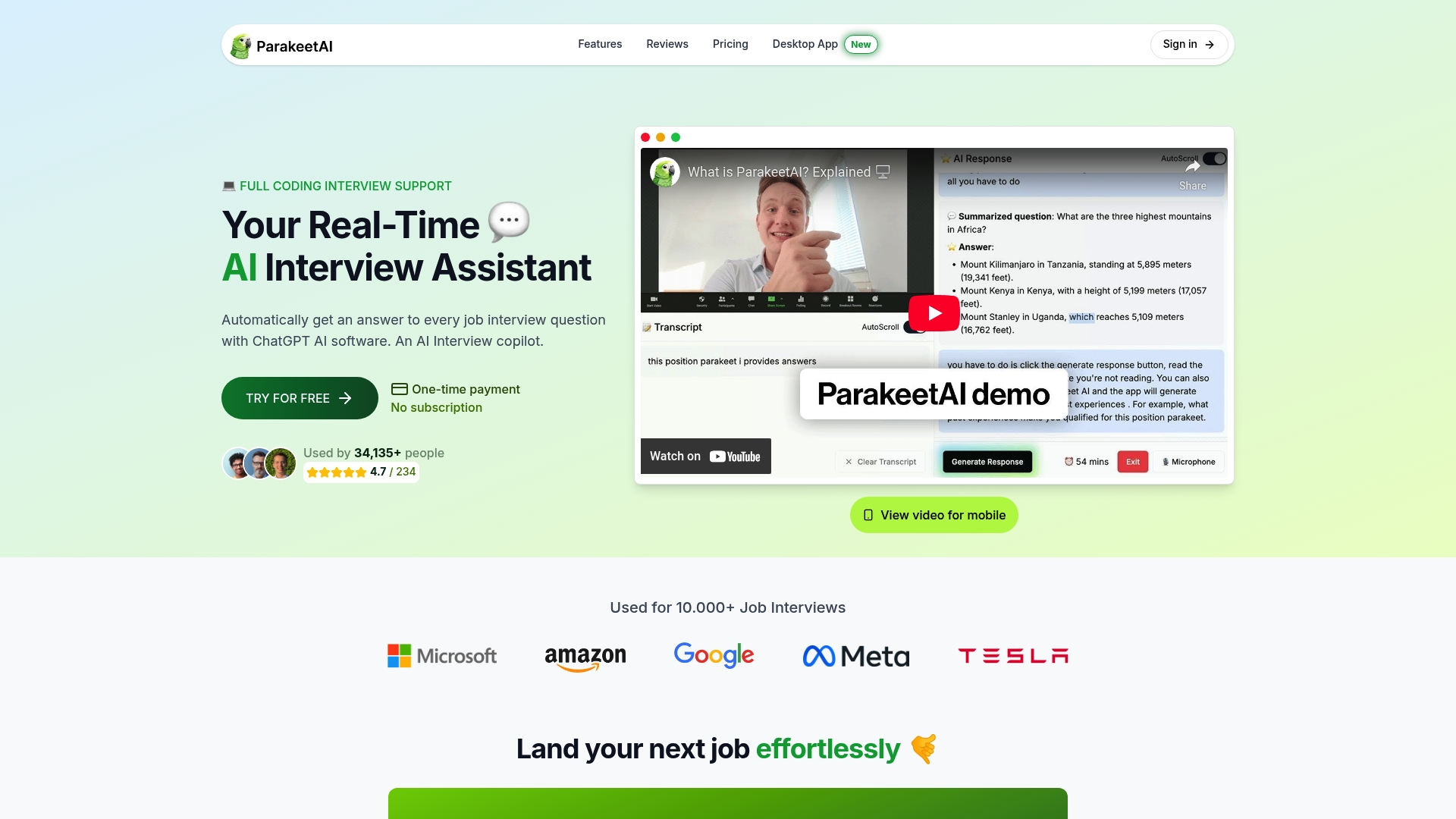
Discover how AI interview assistants can transform your preparation by listening to your answers and providing automatic, data-driven responses tailored to every question. Take control of your job search success today by visiting Parakeet AI for a hands-on experience that turns AI benefits into your personal advantage. Start practicing now and build your confidence with the smartest AI interview partner available.
Frequently Asked Questions
What are the benefits of using AI interview technologies?
AI interview technologies offer enhanced efficiency, objectivity, and real-time feedback for job seekers. They automate preliminary screening, reducing bias while providing personalized insights that improve interview performance.
How can AI interview assistants help with interview preparation?
AI interview assistants simulate real interview scenarios, allowing candidates to practice responses, refine communication skills, and build confidence before meeting hiring managers. They provide instant feedback on performance to facilitate targeted improvements.
What types of AI interview assistants are available for job seekers?
There are various types of AI interview assistants, including real-time interview copilots, mock interview platforms, Q&A generation tools, coding interview assistants, and language support systems, each designed to address specific job seeker needs across different industries.
How do AI interview assistants differ from traditional interview preparation methods?
Unlike traditional methods, AI interview assistants offer personalized feedback, real-time analysis, and adaptive learning experiences that evolve based on candidate performance. They provide comprehensive skill assessments, whereas traditional methods typically offer static guidance.