
AI Interview Compliance: Ensuring Fair Hiring Worldwide

Fairness in hiring is no longer just a hope—it is an urgent need as artificial intelligence reshapes how companies select candidates across countries like Germany, Singapore, and Canada. Both job seekers and HR professionals now face new challenges in making sure AI interview tools adhere to clear, enforceable rules. AI interview compliance standards set formal expectations for fairness, transparency, and bias detection, helping organizations protect candidates and maintain trust, while adapting to rapidly changing global regulations.
Table of Contents
- Defining AI Interview Compliance Standards
- Types of AI-Driven Interview Solutions
- Global Legal Frameworks and Recent Regulations
- Transparency, Bias Audits, and Human Oversight
- Risks, Liabilities, and Common Pitfalls
- Best Practices for Safe and Fair HR Use
Key Takeaways
| Point | Details |
|---|---|
| AI Interview Compliance Standards | Establish guidelines to ensure AI tools in hiring processes operate fairly and transparently while adhering to regulatory requirements. |
| Bias Detection and Mitigation | Implement systems that can identify and correct biases in AI decision-making to protect candidates from discrimination. |
| Human Oversight is Essential | Incorporate human review processes to validate AI recommendations, ensuring accountability and informed decision-making. |
| Regular Auditing is Critical | Conduct systematic bias audits and maintain documentation to track compliance and system performance over time. |
Defining AI Interview Compliance Standards
AI interview compliance standards are formal guidelines that specify how artificial intelligence systems should operate within hiring processes to ensure fairness, transparency, and regulatory adherence across organizations and jurisdictions. Unlike traditional hiring standards that focus on human behavior and decision-making, these standards address the unique challenges posed by algorithmic decision-making. They establish clear expectations for what AI interview tools must accomplish, how they should be monitored, and what safeguards must be in place to protect candidates from bias and discrimination. Think of them as a rulebook that prevents AI from making hiring decisions based on protected characteristics like race, gender, age, or disability—while also ensuring the technology actually helps identify the best candidates rather than filtering them out unfairly.
International AI governance standards define compliance frameworks as documents specifying requirements and guidelines for AI products and services, emphasizing their role in establishing clear expectations and enabling regulatory alignment across borders. These standards must be dynamic because AI technology evolves rapidly, and what works today may become obsolete or problematic within months. For interview-specific applications, compliance typically covers three core areas:
- Bias detection and mitigation: The system must identify when it’s making decisions based on protected characteristics and have mechanisms to prevent or correct those decisions
- Transparency and explainability: Candidates and hiring teams need to understand why the AI made certain recommendations or rejected specific candidates
- Accountability structures: Organizations must have clear ownership of AI decisions, audit trails showing what happened, and processes to address candidate complaints
The ISO/IEC 42001:2023 standard provides a comprehensive international framework for this accountability. It requires organizations to establish governance structures, policies, and controls throughout an AI system’s entire lifecycle—from initial design through deployment, operation, and eventual retirement. For interview tools specifically, this means you cannot simply deploy an AI system and hope it works fairly. You need oversight mechanisms in place, regular testing for bias, documentation of how candidates are being evaluated, and processes to appeal or contest AI-driven decisions. The standard emphasizes that transparency, accountability, and bias mitigation are not optional features—they are foundational requirements. When AI-driven interview tools operate within this framework, they provide real value: faster candidate screening, reduced unconscious bias compared to single-screener approaches, and more consistent evaluation across interview processes.
What makes compliance standards different from general best practices is their enforcement mechanism. Standards like ISO/IEC 42001 are often required by regulators, clients, or industry bodies. Organizations that fail to meet them face real consequences: regulatory fines in jurisdictions with AI-specific legislation, legal liability if a candidate sues over discriminatory practices, damage to employer reputation, or loss of business from clients who demand compliance verification. This is why companies worldwide are now building compliance into their AI hiring tools from the start rather than retrofitting it afterward. The cost of building fairly is far lower than the cost of lawsuits and reputation damage.
Pro tip: When evaluating AI interview solutions, ask vendors directly whether their system has been independently audited against ISO/IEC 42001 or equivalent standards, and request documentation of their bias testing methodology and results—this transparency signals genuine commitment to compliance rather than compliance theater.
Types of AI-Driven Interview Solutions
AI-driven interview solutions come in many flavors, each designed to tackle different hiring challenges. Some platforms focus on speed and scale, screening hundreds of candidates in minutes. Others emphasize depth, analyzing facial expressions, tone of voice, and word choice to assess personality fit. A few combine multiple technologies to create comprehensive evaluation systems. Understanding these different types helps you choose the right tool for your specific hiring needs, whether you’re looking to reduce time-to-hire, improve consistency, or get better insights into candidate potential.

The main categories break down by how the AI interacts with candidates and what it measures. Rule-based chatbots and AI-enhanced interview simulations represent the foundational approaches where the system asks predetermined questions and evaluates responses against established criteria. These work well when you need standardized assessments for large candidate pools. Then there are avatar-based virtual reality environments and gamified assessments that make interviews feel less formal and more engaging. Avatar systems place candidates in realistic scenarios—imagine a software engineer troubleshooting a network issue or a customer service representative handling an angry client—and the AI evaluates how they navigate the situation. Gamified assessments frame interview questions as challenges or puzzles, which can reduce anxiety and give you better insight into how candidates think under pressure rather than how well they perform in a formal interview setting.
Beyond the interaction mode, AI interview platforms vary significantly in their technical capabilities:
- Video analysis platforms: These capture and analyze non-verbal communication patterns like eye contact, facial expressions, hand gestures, and speaking pace. They flag patterns that might indicate confidence, anxiety, deception, or engagement. Some platforms claim this data predicts job performance, though this claim remains contentious in terms of fairness and legality depending on your jurisdiction
- Natural language processing systems: These go deeper into what candidates actually say, analyzing vocabulary complexity, grammar, responsiveness to questions, and semantic meaning. The AI can detect when someone dodges a question versus providing a direct answer
- Coding and skill assessment tools: For technical roles, AI interview platforms integrate coding challenges where candidates write code in real time and the AI evaluates correctness, efficiency, and code quality instantly
- Personality and culture fit assessments: These use questionnaires combined with AI analysis to predict whether a candidate aligns with company values and team dynamics
- Predictive analytics engines: Some platforms analyze all available data about a candidate and their responses to predict job performance, retention likelihood, and promotion potential
Most modern platforms combine several of these capabilities. A comprehensive AI interview solution might start with a video interview, use natural language processing to analyze responses, apply emotion recognition to assess engagement, include a coding challenge for technical roles, and then generate a final score using predictive analytics. The key difference between solutions comes down to which combination they emphasize and how transparent they are about how their AI actually makes decisions.
What matters most for compliance is not just what technology a platform uses, but how it handles that technology responsibly. A platform that analyzes facial expressions must disclose this openly and allow candidates to opt out if local regulations require it. A platform using predictive analytics must validate that its predictions don’t discriminate against protected groups. A platform handling video data must comply with privacy laws in every jurisdiction where it operates. When evaluating AI interview solutions, the most compliant ones are those that use simpler, more explainable technologies rather than black-box systems that even their creators struggle to understand.
Pro tip: Request a live demo where you go through the interview process as a candidate, not just see the hiring dashboard—this reveals whether the system is actually user-friendly and fair, or whether it creates barriers that certain candidates might struggle with more than others.
Global Legal Frameworks and Recent Regulations
The regulatory landscape for AI interviews varies dramatically depending on where you operate. A hiring tool that complies perfectly in Singapore might violate laws in Germany. A platform that passes audits in California could face penalties in the European Union. This fragmentation creates real complexity for global organizations, but understanding the major frameworks helps you navigate compliance more strategically. Rather than scrambling to meet regulations as they emerge, you can anticipate what’s coming and build systems that meet the strictest standards, which typically satisfies requirements everywhere else.
The European Union leads with the most comprehensive approach through the EU AI Act, which took effect in phases and categorizes AI systems by risk level. For hiring applications, AI interview tools typically fall into the “high-risk” category because they make decisions that significantly affect people’s employment prospects and can perpetuate discrimination. High-risk systems face stringent requirements: mandatory impact assessments before deployment, human oversight throughout operation, detailed documentation of how the AI makes decisions, and the ability for candidates to contest algorithmic decisions and request human review. The EU approach is fundamentally about transparency and human control. You cannot simply run candidates through an AI system and accept its verdict. Someone with authority and judgment must review the AI’s recommendation, especially when it’s negative. This sounds burdensome, but it actually reduces legal exposure because you have documented human involvement in the decision-making process.
Outside the EU, regulatory approaches vary significantly across continents. The United States takes a sector-specific approach rather than passing one comprehensive AI law. Employment discrimination laws already on the books, like Title VII, apply to AI hiring tools. The EEOC issued guidance stating that if an AI interview tool has a disparate impact on protected groups, it violates discrimination law regardless of intent. Some states like California have passed their own AI regulations. The UK passed an AI Bill that emphasizes principles-based regulation rather than strict rules. Canada adopted the Artificial Intelligence and Data Act focusing on accountability and transparency. China requires AI systems used in hiring to be “explainable” and subject to government review. Brazil recently passed its AI law with obligations for transparency and human rights protection.
What unites these disparate regulations are common themes: Influential frameworks including OECD principles, UNESCO recommendations, and NIST guidance emphasize transparency, accountability, privacy protection, and fairness as foundational requirements. Organizations using AI interview tools should operate under these principles regardless of local mandate. They provide a stable foundation because if you build your system around transparency and human oversight, you’ll be compliant in most jurisdictions.
Here’s what this means practically for your interview process:
- Bias auditing is non-negotiable: Test your AI system against protected characteristics to identify disparities. Document these tests and results
- Maintain explainability: Choose interview technologies that can explain why they rejected or advanced a candidate, not just output a score
- Allow human override: HR teams must be able to override AI recommendations when they disagree, and this decision-making must be documented
- Provide appeal mechanisms: Candidates should know they can challenge AI decisions and request human review
- Track regulatory changes: Subscribe to updates from jurisdictions where you hire, especially if you operate in Europe, California, or other regulated regions
The regulations will continue evolving. New frameworks emerge regularly, and existing ones get refined based on how AI systems behave in the real world. But the trajectory is clear: regulators worldwide are moving toward requiring more transparency, more human involvement, and better protection against algorithmic discrimination. Organizations that build these features in from the start will adapt easily to future requirements. Those that wait until regulations force change will face costly redesigns.
Here’s a comparison of major global AI interview regulations and their main focus areas:
| Region/Country | Key Regulation/Framework | Main Compliance Focus |
|---|---|---|
| European Union | EU AI Act | Human oversight, transparency, risk assessment |
| United States | EEOC Guidance, State Laws | Employment discrimination, sector-specific compliance |
| United Kingdom | AI Bill | Principles-based, flexibility, ethical AI use |
| Canada | AI and Data Act | Accountability, transparency, impact assessments |
| China | National AI Provisions | Explainability, government review, data privacy |
| Brazil | AI Law | Transparency, human rights, documentation |
This visual summary highlights how compliance priorities differ across regions but converge on transparency and fairness.
Pro tip: Create a simple spreadsheet tracking which regulations apply to each country or region where you hire, then note which AI interview features address each requirement—this helps you spot gaps in your compliance approach and prioritize what to fix first.
Transparency, Bias Audits, and Human Oversight
Transparency, bias audits, and human oversight form the backbone of compliant AI interview systems. Without these three elements working together, you risk deploying technology that looks fair on the surface but discriminates in practice. The good news is that building these safeguards in doesn’t require reinventing the wheel. It requires discipline, documentation, and a commitment to understanding what your AI actually does rather than assuming it works as intended.
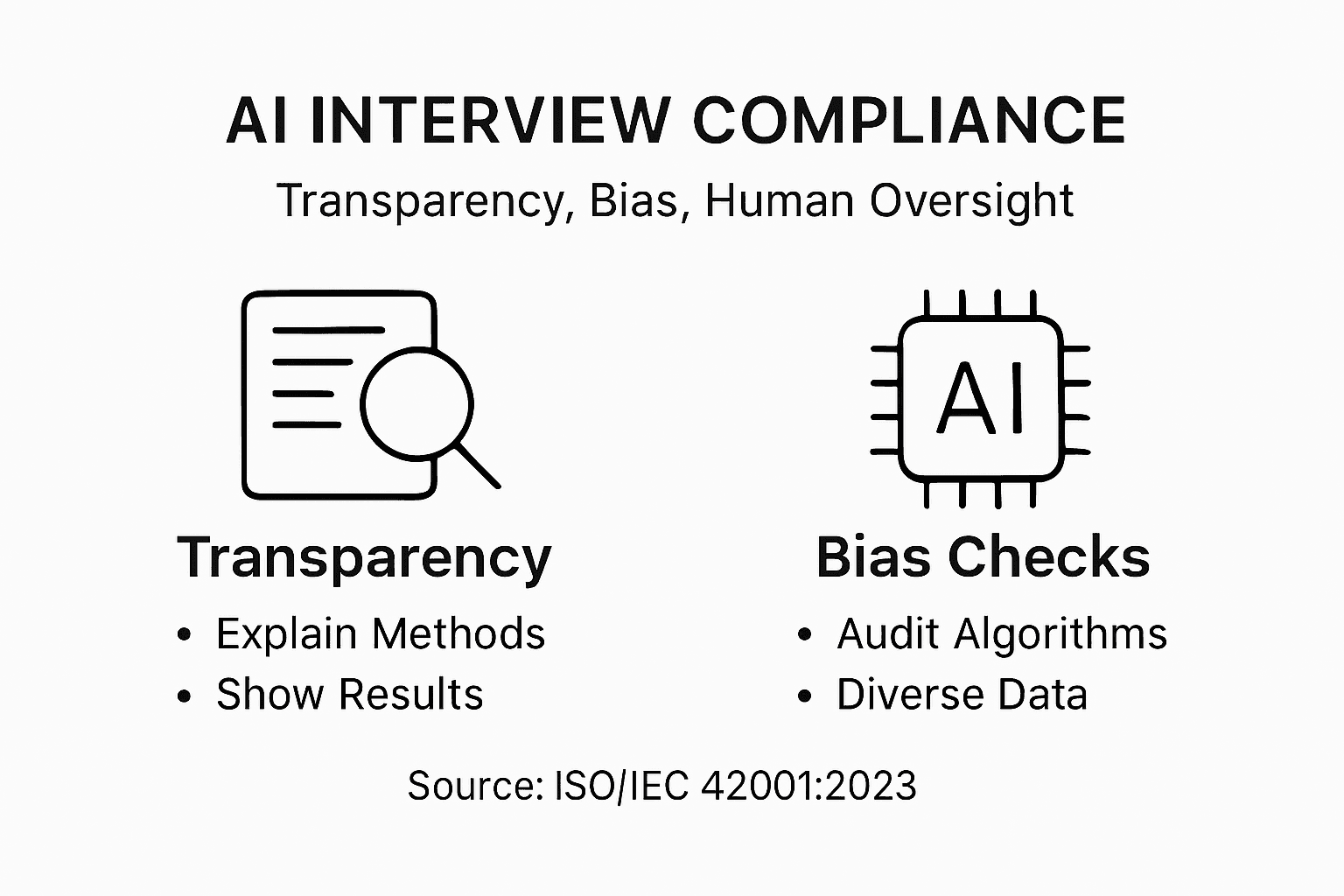
Transparency starts with a simple principle: candidates and hiring managers deserve to know how AI is involved in making decisions about them. This means disclosing upfront that AI will analyze responses, that certain metrics are being measured, and what happens with that data. Many organizations fail here by using vague language like “advanced analytics” without explaining what that means. Under the EU AI Act and similar regulations, this disclosure must happen before the candidate even starts the interview. You cannot surprise someone midway through with “by the way, we’re analyzing your facial expressions.” Beyond disclosure, transparency also means using explainable AI techniques like LIME and SHAP that allow auditors and HR teams to understand specifically why the AI made particular decisions. If the system rejected a candidate, you should be able to point to actual factors that contributed to that decision, not just a black-box score.
Bias audits are where theory meets reality. You design an interview process thinking it will be fair, but bias can hide in unexpected places. A natural language processing system trained on data from your company’s past hires might have learned to value communication styles that correlate with one demographic group. A video analysis system might misinterpret cultural differences in eye contact as lack of confidence. A coding assessment might be weighted toward speed rather than correctness, disadvantaging thoughtful problem solvers. The only way to catch these issues is through systematic testing. Here’s what a basic audit looks like:
- Define protected groups: Identify the characteristics that matter in your jurisdiction (gender, race, age, disability status, veteran status, etc.)
- Collect baseline data: Run your AI interview system on a representative sample of candidates from each group
- Measure outcomes: Compare pass rates, advancement rates, and scores across groups
- Analyze disparities: If one group has significantly lower pass rates, investigate why
- Document everything: Keep records of your audit methodology, findings, and any changes you made
- Repeat regularly: Run audits quarterly or whenever you update the system
The challenge here is that audit methodologies remain inconsistent across organizations, and there’s no single standard everyone follows. Some companies check for disparate impact using statistical measures. Others look at qualitative feedback from candidates in different groups. The best approach combines both: hard numbers showing whether disparities exist, plus interviews with candidates to understand whether those disparities reflect unfair treatment or legitimate skill differences. Without this combination, you might optimize your numbers while still creating a bad experience for certain candidates.
Human oversight is the safety net that catches what audits miss. Even the most thoroughly audited system can behave unexpectedly in edge cases or with new types of candidates. This is why every high-risk hiring decision should involve human review. An HR professional should examine the AI’s recommendation, look at the candidate’s actual responses, and make an informed judgment. This doesn’t mean ignoring the AI. It means treating it as one input among several. The human brings context that algorithms cannot capture: they understand the specific role, the team dynamics, and can recognize when something seems off about the AI’s assessment. Documenting these decisions creates accountability. If someone later questions why a candidate was hired or rejected, you have a record showing human judgment was involved, not just algorithmic gatekeeping.
Many organizations worry that human oversight slows down hiring. It does, slightly. But that friction prevents far costlier problems down the line. An extra thirty minutes of HR review per hire is infinitely cheaper than defending a discrimination lawsuit.
Pro tip: Start your bias audit by analyzing results for just one protected characteristic where you have clear data, then gradually add others as you build your audit infrastructure—this prevents overwhelming your team while still catching major disparities in your first cycle.
Risks, Liabilities, and Common Pitfalls
Deploying AI interview tools without proper safeguards exposes your organization to multiple types of risk, from straightforward legal liability to harder-to-quantify damage to your employer brand. Many companies implement AI hiring systems assuming the technology itself reduces bias and error. This assumption is dangerous. AI can amplify bias at scale, automate discrimination, and create legal exposure that never existed in manual hiring processes. Understanding these risks helps you avoid the most common pitfalls that land organizations in litigation or regulatory trouble.
The primary legal risk is employment discrimination liability. If your AI interview system has disparate impact on protected groups, you violate discrimination law regardless of intent. Title VII in the United States, similar laws in other countries, and the EU AI Act all hold organizations liable for discriminatory outcomes. The bar for proving discrimination has actually gotten lower with AI because regulators can now point to statistical evidence that the system produces different outcomes for different groups. You cannot defend yourself by saying you did not intend to discriminate. You cannot claim the AI vendor is responsible. You are responsible. If a candidate from a protected group can show they were rejected disproportionately compared to others, and your system cannot explain why in specific, job-related terms, you face liability. Settlements in these cases have reached hundreds of thousands of dollars, not including legal fees and reputational damage.
A second major risk involves flawed system reliance. Organizations often assume AI output is objective truth rather than probabilistic guessing. Increasing AI adoption creates emerging risks including flawed system reliance and the need for human-in-the-loop controls to prevent over-automation of hiring decisions. This means your HR team trusts the AI recommendation without scrutinizing the underlying data or logic. They see a score of 8.5 and think it means something objective, when really it reflects patterns in training data that might not apply to the current candidate pool. This leads to bad hiring decisions and leaves you vulnerable if someone challenges the decision. A candidate might ask why they scored lower than another candidate, and if you cannot explain it beyond “the AI said so,” you have a problem.
Data protection and privacy violations represent another category of risk. Legal and ethical pitfalls in AI deployment include transparency deficits and third-party vendor risks that many organizations overlook. If you use an AI video interview tool, you are collecting and storing video data of candidates. If that vendor has a data breach, you may face liability under privacy laws like GDPR or state privacy statutes. If you do not disclose that you are recording and analyzing video, you violate consent requirements. If you retain video data longer than necessary, you violate data minimization principles. Many organizations buy AI tools without understanding what data those tools collect, how long they store it, or who has access to it.
Common pitfalls worth specifically avoiding:
- Assuming AI eliminates bias: It does not. It can move bias around, hide it better, or scale it to more candidates
- Skipping vendor due diligence: Your AI tool vendor may have weak security, poor bias testing, or unclear data practices. You are liable for their failures
- Failing to document decisions: If you cannot show you tested for bias or that humans reviewed important decisions, regulators will assume you did neither
- Not informing candidates: Transparency violations create legal exposure and candidate resentment. Disclose AI involvement upfront
- Treating AI recommendations as binding: Humans must retain decision authority, not just rubber-stamp what the algorithm recommends
- Relying on outdated testing: AI systems drift over time as new candidates come through. Last year’s bias audit means nothing if you have not reaudited recently
The most expensive pitfall is being reactive instead of proactive. Organizations that wait until a lawsuit forces them to address bias end up spending far more than those that build compliance in from the start. A proactive bias audit costs thousands. A discrimination lawsuit costs hundreds of thousands or millions. The math is straightforward.
Here’s a quick-reference table highlighting main risks of poorly governed AI interview tools:
| Risk Type | Example Impact | Prevention Strategy |
|---|---|---|
| Employment Discrimination | Litigation, regulatory fines | Bias audits, human oversight |
| Flawed System Reliance | Bad hiring decisions | Require human-in-the-loop review |
| Data Privacy Violations | Data breaches, non-compliance | Strong data governance, clear vendor contracts |
| Lack of Transparency | Candidate distrust, legal exposure | Proactive disclosure, explainable AI |
This table helps organizations quickly identify and address the main pitfalls associated with AI-driven interviews.
Pro tip: Before signing any AI interview tool contract, require the vendor to provide documentation of their bias testing methodology, results from independent audits, and their data retention and security practices—if they refuse or deflect, that is a red flag worth walking away from.
Best Practices for Safe and Fair HR Use
Implementing AI interview tools safely means building a system of checks and balances that prevents bad decisions before they happen. This is not about finding the perfect tool and then assuming everything works. It is about creating an organizational culture where HR teams view AI as a powerful assistant that needs constant monitoring, not as an oracle that makes final decisions. The best organizations treat AI interview deployment like aviation treats safety: they assume something will go wrong and build redundancies to catch it.
Start with clear objectives for why you are using AI in the first place. Are you trying to screen high volume faster? Reduce unconscious bias? Improve consistency? Your goal determines what you measure and how you govern the system. Too many companies deploy AI interview tools without asking this question, then wonder why the results disappoint them. Once you have defined your objective, balance AI automation with human oversight by establishing clear processes for how humans interact with AI recommendations. This means deciding upfront which decisions AI can make alone, which require human review, and which must involve human judgment from start to finish. For most hiring decisions, AI should provide input, not make the final call. A candidate rejection should require a human to review the AI’s reasoning and confirm they agree.
Transparency in your AI interview process must extend beyond just informing candidates. It also means being transparent with your own HR team about how the system works, what it measures, and what it does not measure. Many HR professionals use AI tools without understanding them. They see a score and treat it as gospel without asking why that score exists or whether it actually predicts job performance. Create documentation that explains how your AI system works in plain language, not technical jargon. Train your HR team to use the tool correctly. Require them to ask critical questions: Why did this candidate score low? Does the AI’s assessment match what you observed in the interview? Would you hire this person despite a low AI score? If the answer is yes, that signals the AI might not be measuring what actually matters for your role.
Establish a governance framework that assigns clear accountability. Who owns the AI interview system? Who decides when to audit it? Who handles candidate complaints about AI decisions? These questions must have answers before you deploy the tool. Key best practices include defining governance frameworks, prioritizing bias mitigation, and encouraging continuous employee education on AI ethics. Your governance framework should include:
- Quarterly bias audits: Test your system regularly for disparate impact across protected groups
- Incident reporting: Create a process for candidates or employees to flag concerns about unfair treatment
- Regular training: Teach HR teams about AI bias, how to use the tool correctly, and why compliance matters
- Tool evaluation: Periodically assess whether the tool is delivering on its intended objectives
- Vendor accountability: Hold your AI tool vendor accountable for accuracy, security, and supporting your compliance efforts
Data governance deserves specific attention. Your AI interview system likely collects sensitive information about candidates: video recordings, voice data, personality assessments, even potentially inferred information about health or family status. Document what data you collect, why you collect it, how long you keep it, who has access to it, and when you delete it. Comply with privacy laws in every jurisdiction where you operate. If you operate in Europe, GDPR compliance is not optional. If you operate in California, you must comply with California privacy law. These laws impose real penalties for violations. Make data minimization a principle: collect only what you actually need to make hiring decisions, not every data point the tool could capture.
Final practical point: choose your AI interview tool carefully. Not all tools are created equal. Some vendors have conducted thorough bias testing. Others have not. Some operate with complete transparency about their methodology. Others treat their algorithms as trade secrets. Some have strong security and privacy practices. Others have experienced data breaches. Conduct vendor due diligence before signing any contract. Request bias audit results. Ask how they secure candidate data. Demand explainability in their system. If a vendor cannot answer these questions clearly, that is your signal to look elsewhere. The cheapest tool is expensive if it exposes you to legal liability or creates unfair hiring outcomes.
Pro tip: Start your AI interview implementation with a pilot program in one department or role, measure the outcomes carefully, gather feedback from both candidates and hiring managers, and only scale to other departments after you have proven the system works fairly and delivers business value.
Ensure Fair and Compliant AI-Powered Interviews
The challenge of maintaining fairness, transparency, and legal compliance in AI-driven hiring is more critical than ever. With regulations like the EU AI Act and other global standards setting high expectations, organizations must take control of bias audits, human oversight, and explainability to protect candidates and their reputation. If you are seeking to reduce unconscious bias while adhering strictly to compliance frameworks, you need solutions designed to support fair outcomes throughout your interview process.
Discover how a real-time AI job interview assistant from Parakeet AI can help you meet these challenges. Our assistant listens and provides automatic answers that align with ethical AI principles, promoting transparency and supporting human decision making. Learn more about the technology that powers responsible hiring at Parakeet AI landing page. Start taking control of your AI interview compliance today and build a hiring process your candidates trust.
Frequently Asked Questions
What are AI interview compliance standards?
AI interview compliance standards are guidelines that ensure fairness, transparency, and adherence to regulations when using AI in hiring processes. They prevent AI from making biased decisions based on protected characteristics and ensure that the technology aids in identifying the best candidates.
How can organizations ensure their AI interview tools are compliant?
Organizations can ensure compliance by conducting regular bias audits, maintaining transparency about how AI operates, implementing human oversight in decision-making, and keeping up to date with relevant regulations regarding AI use in hiring.
What key components should be included in an AI bias audit?
An AI bias audit should include defining protected groups, collecting baseline data from diverse candidates, measuring outcomes across these groups, analyzing disparities, and documenting findings. Regular audits are essential to identify potential biases in the system.
Why is transparency important in AI interviews?
Transparency is crucial as it informs candidates and hiring managers how AI is used in the hiring process. It includes disclosing what data is collected, how it is analyzed, and ensuring that candidates can understand the rationale behind AI-driven decisions.