
AI-Powered Remote Interviews: Transforming Hiring Decisions

Over 60 percent of HR professionals at tech startups now use AI-powered tools for remote interviews, transforming how american and global teams select top talent. In a world where efficient hiring is increasingly critical, these intelligent platforms promise deeper insights and faster decision-making. This guide breaks down what modern AI interview solutions really offer, tackles stubborn myths, and helps you harness technology for a better candidate experience.
Table of Contents
- Defining AI-Powered Remote Interviews and Common Myths
- Types of AI Interview Tools and Their Unique Benefits
- How Real-Time AI Assistants Enhance Remote Hiring
- Risks, Bias, and Compliance in AI Remote Interviews
- Comparing AI-Powered Versus Traditional Remote Interviews
Key Takeaways
| Point | Details |
|---|---|
| AI-Powered Interviews Enhance Recruitment | These tools augment human recruiters by providing data-driven insights and improving efficiency in candidate assessments. |
| Common Myths Addressed | AI is not intended to replace human recruiters but to assist them, and modern systems strive to reduce bias rather than perpetuate it. |
| Real-Time AI Assistants Improve Interactions | They facilitate dynamic questioning and greater engagement during interviews, resulting in a more personalized candidate experience. |
| Hybrid Approach Recommended | Combining AI technologies with human expertise leads to more effective recruitment processes, ensuring both efficiency and emotional intelligence are leveraged. |
Defining AI-Powered Remote Interviews and Common Myths
AI-powered remote interviews represent an emerging technological approach that transforms traditional hiring practices by integrating artificial intelligence into the candidate evaluation process. Unlike conventional interviews, these AI-driven interactions leverage machine learning algorithms to assess candidate responses, analyze communication patterns, and provide nuanced insights beyond traditional screening methods. Complex tensions between efficiency and ethical considerations highlight the sophisticated nature of these technological tools.
The fundamental purpose of AI-powered remote interviews is not to replace human recruiters but to augment their capabilities. These intelligent systems can process multiple candidate interviews simultaneously, evaluate verbal and nonverbal communication cues, and generate comprehensive candidate assessments that help hiring managers make more informed decisions. Key features typically include natural language processing, sentiment analysis, and behavioral pattern recognition that go far beyond basic keyword matching.
Despite their growing popularity, several persistent myths surround AI-powered interviews. One prevalent misconception is that AI will completely replace human recruiters. In reality, AI tools are designed to assist researchers by improving efficiency rather than substitute critical human interpretation. These systems provide data-driven insights but cannot replicate the nuanced emotional intelligence and contextual understanding that experienced human recruiters bring to the hiring process.
Another common myth suggests that AI interviews are inherently biased or unfair. While early AI systems did struggle with potential algorithmic bias, modern platforms incorporate sophisticated mechanisms to minimize discriminatory patterns. Advanced AI interview tools now use carefully designed evaluation frameworks that focus on skills, competencies, and objective performance metrics.
Pro tip: When implementing AI-powered remote interviews, always maintain a human oversight mechanism to validate and supplement the AI-generated insights.
Types of AI Interview Tools and Their Unique Benefits
AI interview tools have emerged as sophisticated technological solutions designed to transform the recruitment landscape. These innovative platforms range from comprehensive assessment systems to specialized evaluation technologies that address different aspects of candidate screening. Advanced AI tools for qualitative research interviews now offer an impressive array of features that go beyond traditional hiring methods.
The primary categories of AI interview tools include advanced screening platforms, automated video analysis systems, and natural language processing (NLP) evaluation technologies. Screening platforms utilize machine learning algorithms to quickly assess candidate qualifications, matching skills and experiences against job requirements with remarkable precision. Automated video analysis tools take this a step further by examining nonverbal communication cues, analyzing facial expressions, tone of voice, and emotional intelligence during interview interactions.

Multi-speaker interview analysis technologies represent another critical category of AI interview tools. These sophisticated systems can simultaneously track multiple candidate interactions, providing comprehensive insights through features like sentiment analysis, thematic clustering, and multilingual support. Such tools enable recruiters to process large volumes of candidate data more efficiently, identifying nuanced patterns and potential talent that might be overlooked in traditional interview processes.
Key benefits of these AI interview tools include enhanced objectivity, increased efficiency, and the ability to conduct standardized evaluations across multiple candidates. By removing human biases and providing data-driven insights, these technologies help organizations make more informed hiring decisions. Advanced tools can now assess candidates’ communication skills, problem-solving abilities, and cultural fit with unprecedented accuracy and depth.
Here is a summary of the main types of AI interview tools and their distinctive purposes:
| Tool Type | Main Focus | Typical Capabilities |
|---|---|---|
| Screening Platforms | Skills and qualification matching | Automated CV analysis, job fit scoring |
| Video Analysis Systems | Nonverbal and behavioral cues | Facial expression, tone, emotion analysis |
| NLP Evaluation Technologies | Communication and language analysis | Linguistic complexity, sentiment detection |
| Multi-Speaker Analytics | Group interview evaluation | Speaker tracking, thematic clustering |
Pro tip: Implement AI interview tools as complementary technologies that augment human decision-making, not as complete replacements for human judgment.
How Real-Time AI Assistants Enhance Remote Hiring
Real-time AI assistants have revolutionized the remote hiring landscape by introducing unprecedented levels of efficiency and interactivity in candidate evaluation. Dynamic AI interview technologies enable organizations to conduct more nuanced, adaptive, and comprehensive candidate assessments without geographical limitations. These intelligent systems go beyond traditional screening methods by providing immediate, context-aware interactions that capture the full spectrum of a candidate’s potential.
The core strength of real-time AI assistants lies in their ability to dynamically adjust interview questions based on candidate responses. Unlike rigid, predetermined interview scripts, these advanced systems can generate follow-up questions that probe deeper into a candidate’s skills, problem-solving capabilities, and thought processes. Adaptive interview platforms can analyze verbal and nonverbal cues in real time, providing recruiters with multidimensional insights that traditional interviews often miss.
Key enhancements brought by real-time AI assistants include instantaneous candidate evaluation, reduced interviewer bias, and streamlined recruitment workflows. These technologies can simultaneously assess multiple candidates, track performance metrics, and generate comprehensive reports that help hiring managers make more informed decisions. By standardizing interview processes and providing objective, data-driven assessments, AI assistants help organizations identify top talent more effectively and efficiently.
Moreover, real-time AI assistants significantly improve the candidate experience by creating more engaging, interactive interview environments. Intelligent systems can provide immediate feedback, adjust communication styles to match candidate preferences, and create a more personalized interaction that reduces interview anxiety and helps candidates showcase their true potential.
Pro tip: Configure your AI interview assistant to prioritize candidate experience by maintaining a conversational tone and providing constructive, real-time feedback.
Risks, Bias, and Compliance in AI Remote Interviews
AI-powered remote interviews introduce complex ethical challenges that demand rigorous scrutiny and proactive management. Systemic bias in AI hiring technologies represents a critical concern that organizations must address to ensure fair, transparent, and legally compliant recruitment processes. These technological systems can inadvertently perpetuate historical discrimination through algorithmic design, training data selection, and computational decision-making mechanisms.
The primary risks associated with AI remote interviews include algorithmic bias, privacy violations, and potential discriminatory outcomes. Computational models might unintentionally favor certain demographic groups by replicating historical hiring patterns embedded in training datasets. These biases can manifest through subtle mechanisms like language processing algorithms that disproportionately penalize candidates based on communication styles, accent variations, or cultural communication nuances.
High-risk AI employment applications require comprehensive regulatory compliance and sophisticated risk mitigation strategies. Organizations must implement robust governance frameworks that include regular algorithmic audits, diverse training data, and transparent evaluation processes. This approach involves developing AI systems with built-in fairness metrics, continuous monitoring for potential discriminatory patterns, and mechanisms to identify and correct systemic biases.
Compliance with emerging legal standards is increasingly critical for organizations utilizing AI interview technologies. Regulatory frameworks like the European Union AI Act are establishing stringent requirements for high-risk AI applications, mandating organizations to demonstrate algorithmic fairness, provide clear explanations of AI decision-making processes, and ensure fundamental human rights are protected throughout automated assessment procedures.
Pro tip: Conduct periodic independent audits of your AI interview algorithms to identify and mitigate potential systemic biases before they impact hiring decisions.
Comparing AI-Powered Versus Traditional Remote Interviews
Traditional remote interviews and AI-powered interview technologies represent two distinct approaches to candidate evaluation, each with unique strengths and limitations. Online interviewing methodologies have rapidly evolved from temporary pandemic solutions to sophisticated recruitment strategies that offer unprecedented flexibility and insight.
AI-powered remote interviews distinguish themselves through advanced technological capabilities that traditional methods cannot replicate. Unlike standard video interviews, AI systems can simultaneously analyze verbal communication, nonverbal cues, linguistic patterns, and emotional intelligence. These intelligent platforms generate comprehensive candidate assessments by processing multiple layers of communication data, providing recruiters with nuanced insights beyond simple question-and-answer interactions.
Key differences between traditional and AI-powered remote interviews include assessment depth, scalability, and objectivity. Traditional interviews rely heavily on human interviewer judgment, which can be subjective and inconsistent. In contrast, AI interview technologies leverage machine learning algorithms to standardize evaluation criteria, reducing individual bias and creating more equitable candidate screening processes. Advanced AI systems can evaluate hundreds of candidates simultaneously, dramatically reducing recruitment timelines and providing consistent, data-driven candidate comparisons.
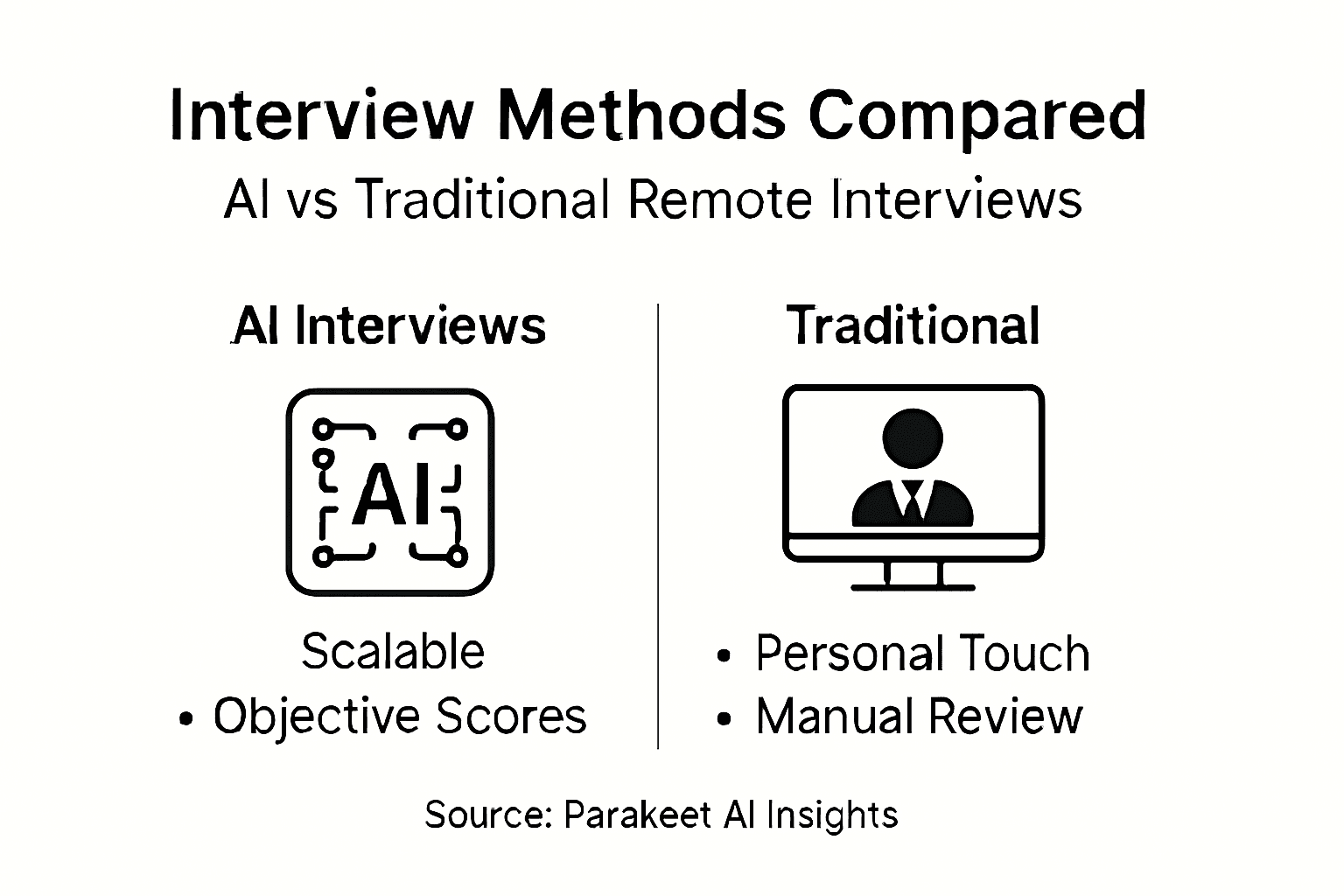
The following table highlights key differences between AI-powered and traditional remote interviews:
| Factor | AI-Powered Interviews | Traditional Remote Interviews |
|---|---|---|
| Assessment Depth | Multilayered data analysis | Primarily surface-level questioning |
| Scalability | Hundreds at once | One candidate per session |
| Objectivity | Algorithmic, standardized | Highly dependent on interviewer |
| Candidate Experience | Interactive, adaptive feedback | Fixed script, limited personalization |
However, AI-powered interviews are not without limitations. While technologically sophisticated, these systems cannot entirely replace human intuition and contextual understanding. The most effective approach combines AI efficiency with human emotional intelligence, using technological insights to enhance rather than completely replace human decision-making in recruitment processes.
Pro tip: Implement a hybrid interviewing approach that uses AI technologies as a complementary tool alongside human expertise, not as a complete replacement.
Elevate Your Hiring Process with Real-Time AI Assistance
The article highlights key challenges in AI-powered remote interviews such as balancing efficiency with human oversight, addressing bias, and delivering adaptive, insightful candidate evaluations. If you want to overcome these hurdles while enhancing interview depth and objectivity, consider how a real-time AI job interview assistant can transform your remote hiring. Imagine having an intelligent system that listens, analyzes, and automatically provides responses tailored to every question, reducing bias and scaling your interview capacity without losing the human touch.
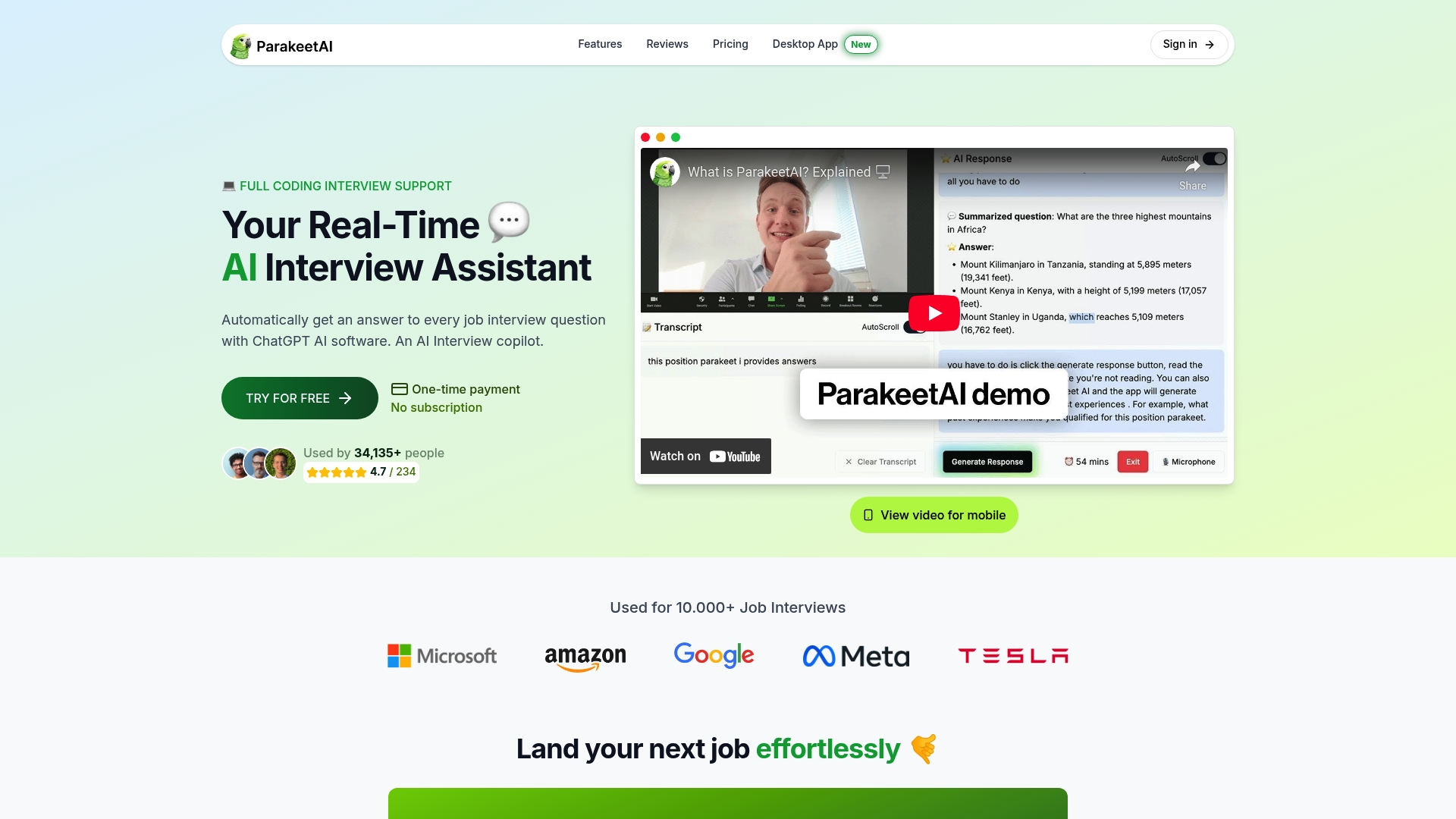
Discover how Parakeet AI can augment your recruitment workflow by delivering standardized, data-driven insights while improving candidate experience. Explore the future of hiring with a solution designed to complement human judgment and eliminate repetitive burdens. Take the next step to eliminate guesswork and speed up your decision-making process by visiting Parakeet AI today.
Frequently Asked Questions
What are AI-powered remote interviews?
AI-powered remote interviews integrate artificial intelligence into the hiring process, allowing for automated assessments of candidates’ verbal and nonverbal communication, providing deeper insights than traditional interviews.
How do AI interview tools improve the hiring process?
AI interview tools enhance hiring by increasing efficiency, reducing bias, and providing standardized evaluations across multiple candidates, helping organizations make data-driven decisions more effectively.
Are AI-powered interviews biased?
While early AI systems faced challenges with bias, modern AI interview platforms have implemented mechanisms to minimize discrimination, focusing on objective performance metrics and skills rather than demographic factors.
How do real-time AI assistants benefit remote hiring?
Real-time AI assistants enhance remote hiring by dynamically adjusting interview questions based on candidate responses, providing immediate feedback, and creating engaging interview experiences that can reduce candidate anxiety.