8 AI Resume Builder Prompts for Tailored, Honest Resumes
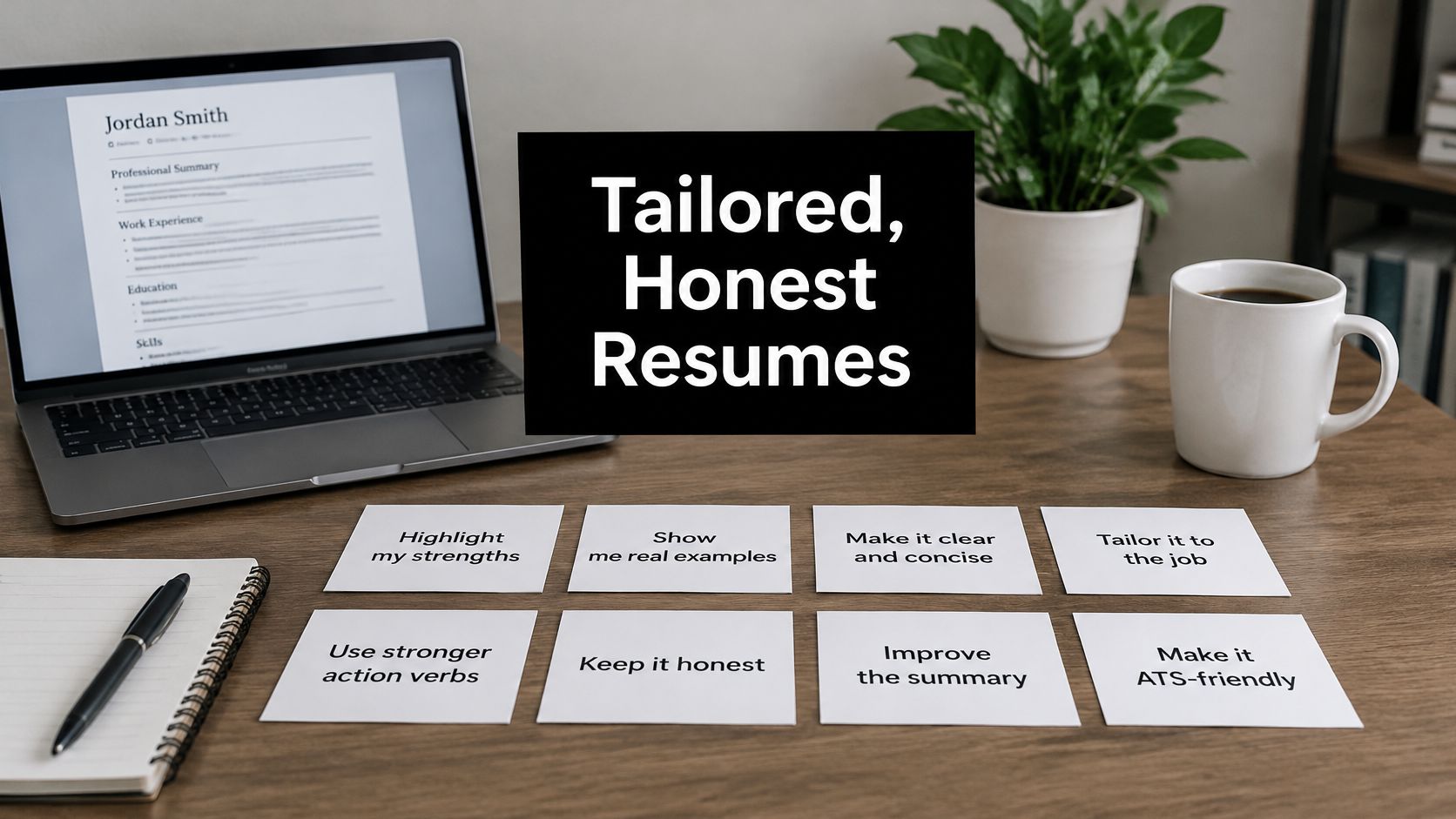
You paste a job description into a chatbot, add your resume, and ask it to make you sound like a stronger candidate. Back comes a polished document full of strategic leadership, cross-functional collaboration, and achievements you don't remember claiming. The bullets sound impressive, but they could belong to almost anyone.
The problem isn't just the writing style. A vague request gives the model room to guess your responsibilities, inflate your ownership, and replace useful details with familiar resume language. Good AI resume builder prompts define the evidence, the target role, and the limits on what the model may change.
Give the tool the exact job posting, your actual experience, and any figures you can verify. Tell it what to leave alone, including employers, dates, credentials, and your contribution to team results. When information is missing, ask for a question rather than a plausible replacement.
Before uploading anything, remove sensitive details the task doesn't need. Resume text entered into an AI tool is sent to the model provider for processing, so use placeholders for contact information and exclude confidential customer names, internal financial details, and identification documents.
- Draft from evidence: Start with your experience, not the employer's wish list.
- Tailor selectively: Change emphasis and terminology without changing facts.
- Verify before submitting: Treat every generated sentence as an unapproved edit.
These eight prompts give you a practical workflow for drafting, tailoring, checking, and adapting your resume. Each includes a truthfulness guardrail that keeps the finished document defensible in an interview.
1. Professional Summary Tailoring Prompt
Your summary should explain why your background fits this vacancy, not describe the ideal employee in abstract terms. Lead with relevant experience, named skills, and an outcome you can explain. Skip unsupported labels such as visionary or industry-leading.

Personalization matters more than cosmetic polish. In a 2025 survey of 925 U.S. HR professionals, 62% were more likely to reject AI-generated resumes lacking personalization, according to Resume Now's AI applicant report.
Copy and adapt this prompt
Using the job posting and my resume below, write a 60-word professional summary for a Backend Engineer role. Lead with my documented Python and PostgreSQL experience, followed by the most relevant supported outcome. Use plain language and preserve my natural voice. Don't add skills, certifications, years of experience, leadership responsibilities, or results that aren't explicitly supported. If a necessary detail is missing, ask me about it. After the summary, identify the resume evidence supporting each claim.
Job posting: [paste the complete posting]. Resume and verified achievements: [paste your material].
Say your experience is mostly Python API development, but the posting emphasizes database performance. If you've optimized PostgreSQL queries, bring that evidence forward. Don't let the model turn routine database use into database architecture ownership.
Tailor to the work, not just the title. A career changer can run the prompt against different vacancies and compare which transferable skills deserve the opening position. For a specialized environmental role, the resume guide for water utility applicants offers a useful industry-specific reference.
Before accepting the summary, check that every claim appears elsewhere in your resume or supporting notes. A concise opening shouldn't introduce a qualification the rest of the document can't substantiate.
2. Experience Bullet Rewriter (Action-Result Format)
Handled customer tickets describes an assignment. A stronger bullet explains what you resolved, how you handled it, and what changed because of your work. Action, work, result is a useful editing structure, but it isn't permission to invent a result.

Copy and adapt this prompt
Rewrite my experience bullets using an action verb, the work performed, and a supported result or purpose. Give me three alternatives for each bullet: concise, technical, and outcome-focused. Preserve the original scope of my contribution. Use only the metrics I supply, and don't imply that I led work I supported. If no measurable result is available, describe the deliverable or operational purpose without fabricating impact. List any questions that would help strengthen the bullet.
Original bullets: [paste]. Verified context and figures: [paste]. Target role: [paste].
For example, a support candidate might supply records showing 40+ tickets resolved per week, a 95% first-contact resolution rate, and a 20% reduction in escalations. Only if those are the candidate's real, attributable figures should the model combine them into a bullet. Without those records, a defensible alternative might describe resolving account-access and billing tickets while documenting recurring issues for escalation.
- Check ownership: Replacing helped with led changes the claim, not just the verb.
- Check causation: An improvement during your tenure doesn't automatically mean you caused it.
- Check variety: Use verbs that describe different work rather than repeating managed.
Editorial rule: A specific, unquantified accomplishment is stronger than a fabricated quantified one.
A teacher, for instance, can describe redesigning assessment materials and adapting lessons to identified learning gaps without claiming an unsupported improvement in student performance. Choose the version you can explain naturally when someone asks what you did.
3. Job Description Keyword Alignment Prompt
A data analyst's resume might describe BI reports while a vacancy asks for dashboards and stakeholder reporting. Those phrases may describe overlapping work, but the model needs your confirmation before treating them as interchangeable.
The EEOC identifies resume scanners that prioritize applications using certain keywords as an example of AI hiring tools, as explained in McGuireWoods' discussion of the agency's guidance. That supports accurate terminology matching, not copying every phrase from the posting.

Copy and adapt this prompt
Compare this job posting with my resume. Separate required qualifications from preferred qualifications, then identify relevant skills, tools, and phrases missing from my wording. Label each proposed addition as confirmed in my experience or needs verification. Show the supporting resume passage and suggest a natural location for each confirmed term. Don't add unsupported skills or treat related technologies as equivalent. Leave genuine qualification gaps visible.
Job posting: [paste]. Resume: [paste]. Additional verified context: [paste].
For the analyst, changing developed BI reports to built dashboards for stakeholder reporting is appropriate only if those reports really were dashboards used by stakeholders. If they were static exports sent to a supervisor, preserve that distinction.
Exact names matter when they're accurate. A developer who built or maintained a CI/CD pipeline can use that term. A developer who merely deployed through an existing pipeline shouldn't automatically claim pipeline engineering.
Keep the final wording readable. Repeating Kubernetes throughout unrelated bullets doesn't establish deeper experience, and adding a detached string of job-description terms makes your resume harder to assess. Run this comparison for each vacancy, because similar job titles can involve different responsibilities.
4. Skills Section Gap Analysis Prompt
Your skills section is a set of claims an interviewer can test. Separate tools you've used independently from tools you've encountered in coursework, tutorials, or observation. The distinction helps you decide what belongs in Skills and what needs context elsewhere.
Keyword filters aren't limited to technical tools. A Jobscan-reported recruiter survey summarized by ScoutApply found that 76.4% of recruiters filtered by skills. The practical response is a focused, evidence-backed section, not an exhaustive list of everything adjacent to your profession.
Copy and adapt this prompt
Compare my documented experience, projects, and education with this job posting. Sort the relevant skills into proven, partially evidenced, and missing. For every proven or partially evidenced skill, name the supporting task or project and describe the limits of that evidence. Draft a concise Skills section using only proven skills. Suggest contextual wording for coursework or supervised exposure elsewhere. Don't infer proficiency from a job title, certificate, or related technology.
Experience and projects: [paste]. Education and training: [paste]. Job posting: [paste].
A marketing specialist might have used Google Analytics in campaign reporting but studied Marketing Mix Modeling only in a course. List the former as practical experience when supported; describe the latter under relevant coursework rather than implying professional implementation.
- Proven: You can name the task, explain your decisions, and discuss the result.
- Partially evidenced: You have limited exposure that needs an honest qualifier.
- Missing: You haven't supplied evidence, so the model shouldn't add it.
For a junior developer, naming the project where a framework was used is more useful than an unsupported proficiency label. Keep the section short enough that every listed skill contributes to the target role. Leave room for the experience and projects that demonstrate how you used those skills.
5. Quantified Achievement Interview Prompt
Don't ask the model to add impressive numbers when you can't remember your results. Ask it to interview you about the work instead. Questions about workload, deadlines, error rates, and project scope can help you locate evidence you already have.
Keep performance reviews, approved reports, or dashboards open while answering. Use redacted notes rather than uploading confidential records, and distinguish a documented figure from an estimate based on memory.
Copy and adapt this prompt
Act as a resume achievement interviewer. Ask me a question at a time about my responsibilities, workload, constraints, actions, and results. Help me identify records that could verify each metric. Don't suggest plausible numbers or assume that a team outcome was my individual achievement. After I answer, draft bullets using confirmed details only. Label any estimate explicitly as approximate in the final wording, and omit figures whose basis I can't explain. Preserve the questions, answers, and evidence notes separately.
Role or project to discuss: [describe]. Available records: [describe without sharing confidential information].
Ask about the denominator
A customer success lead may remember an improved renewal rate but need to check which accounts, reporting period, and calculation the dashboard used. The bullet should preserve those boundaries rather than turn a segment-level result into a company-wide claim.
A student's strongest evidence might be scope rather than commercial impact: completing a working prototype by the submission deadline, implementing a required feature, or documenting test coverage. Those details are useful without inventing revenue or productivity gains.
If you can't explain where a number came from, don't let the model make it look precise.
Save the Q&A transcript alongside your master resume. It becomes an evidence bank for later applications and interview preparation. If you use an estimate, keep the qualifying language in the resume rather than hiding the uncertainty in private notes.
6. Career Change Transferable Skills Prompt
Changing fields requires translation, not a fictional employment history. A restaurant manager can have relevant experience in inventory control, scheduling, supplier coordination, and process improvement without having held a logistics title.
Keep the original job title and context visible. Reframing should help the reader understand your work, not make them believe you performed it in a different industry.

Copy and adapt this prompt
Map my existing responsibilities to the requirements of this target role. For each transferable skill, explain the connection, cite my supporting experience, and identify any important difference in scope or context. Rewrite relevant bullets using the target field's terminology only where the meaning stays accurate. Preserve employers, job titles, dates, credentials, and actual responsibilities. Don't present transferable experience as direct industry experience. Suggest a project or training activity for gaps, but don't include it as completed unless I confirm it.
Current experience: [paste]. Target posting: [paste]. Completed projects or credentials: [paste].
A teacher moving into instructional design might describe curriculum development and learner assessment. That doesn't establish experience with an authoring platform or a corporate learning management system. If the posting requires those tools, identify the gap and support any new claim with completed work.
- Test the translation: Could a former colleague recognize the work from the rewritten bullet?
- Preserve the boundary: Coordinating shifts isn't automatically enterprise workforce strategy.
- Add evidence: A completed project can demonstrate a new skill more clearly than a broad claim.
Keep the most relevant transferable evidence near the top while you're establishing your new direction. The same habit of connecting claims to explainable examples matters in specialized transitions, including how to prepare for residency interviews, where application statements need to withstand follow-up questions.
7. ATS-Friendly Formatting Check Prompt
A resume can read well on screen and still produce confusing extracted text. Content review and file-format review are separate jobs. A chatbot that receives pasted text can't reliably inspect the original document's columns, text boxes, or header placement.
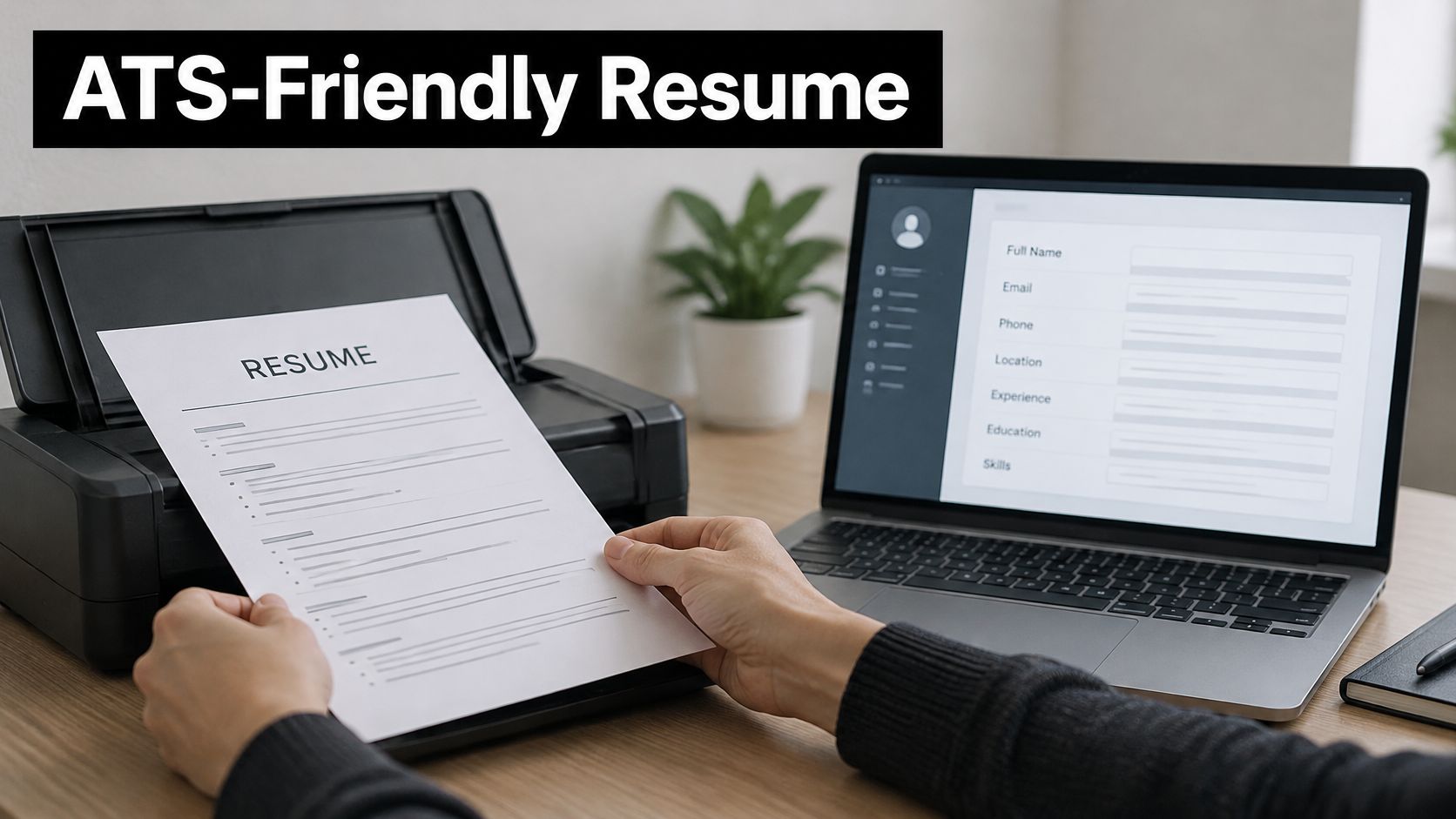
AI ATS Checker's formatting guidance identifies columns, alignment tables, text boxes, graphics, and contact details in headers or footers as potential parsing problems. Use ordinary text, conventional section headings, and a simple reading order.
Copy and adapt this prompt
Review this resume text for structural problems, including scrambled reading order, unusual headings, detached dates, missing contact details, and inconsistent chronology. Suggest a single-column structure with standard headings and consistent date formatting. Preserve all factual content, including employment gaps. Don't claim that this review guarantees ATS compatibility or a hiring outcome. Distinguish issues visible in the extracted text from layout issues that require inspection of the original file.
Text extracted from my submitted-format resume: [paste]. Original layout description: [describe].
Say a PDF extraction places employment dates beside the wrong employer. Rebuild the section so each job title, employer, date range, and bullet sequence stays together. If a skills graphic disappears entirely, replace it with ordinary text.
This video provides an additional reference for the resume-building workflow.
Use the ATS score in our Resume Maker to compare revisions, not as a promise of acceptance. A 2025 observational study of 736 real-world resumes found only minor correlation between GPT-4 ratings and human ratings, according to the NAACL paper.
Test the exported file by copying its text into a plain-text editor. Then inspect the original visually and follow the employer's requested file format.
8. Projects and Education Section Prompt for Students and Early-Career Developers
Limited employment history doesn't mean you lack relevant evidence. Coursework, internships, hackathons, and personal projects can demonstrate problem-solving and technical decisions, provided you distinguish your contribution from the team's.
A project entry should answer practical questions: What problem did you tackle, what did you build, which tools did you use, and what worked? Avoid presenting a classroom prototype as a production system serving customers.
Copy and adapt this prompt
Create concise Projects and Education sections from the material below, prioritizing evidence relevant to the target role. For each project, describe the problem, my personal contribution, tools used, and verified outcome. Separate individual work from team work. Preserve the actual project context, completion status, degree status, dates, and credential names. Don't invent users, deployment scale, awards, grades, or performance metrics. Ask for missing details and use only portfolio or repository links I supply.
Target posting: [paste]. Education: [paste]. Project notes and personal contributions: [paste]. Approved links: [paste].
Show what you personally implemented
For a team app, a computer science student might state that they implemented the authentication module and wrote its tests. That is clearer than claiming they built the entire application. If authentication came mainly from a tutorial, describe what you adapted and what you can explain independently.
- Check the repository: Remove exposed secrets, clarify setup instructions, and confirm the code matches your description.
- Check the link: Use a working repository or deployed project that you supplied.
- Check your explanation: Practice discussing a design decision, a limitation, and what you'd improve.
Education-heavy applications need a structure appropriate to their field. For medical applicants, how to structure your residency application is a more relevant formatting reference than a software-project template.
Keep the emphasis on demonstrated work. A modest project you understand thoroughly is more defensible than an impressive description assembled from technologies you barely used.
Which Resume Prompt Fits Each Stage of Your Application
| Prompt | Best for | Key input | Main output | Main risk to check |
|---|---|---|---|---|
| Professional Summary Tailoring Prompt | Tailoring a resume summary to a specific role | Job description, target title, current summary | Short, role-focused summary | Unsupported or inflated claims |
| Experience Bullet Rewriter (Action-Result Format) | Turning job duties into achievement bullets | Existing duties and verified results | Concise action-result bullets | Invented metrics or wording you cannot defend |
| Job Description Keyword Alignment Prompt | Matching resume language to a job posting | Job description and resume | Relevant keywords and suggested placements | Keyword stuffing or unverified skills |
| Skills Section Gap Analysis Prompt | Building a credible, targeted skills section | Target role requirements and documented experience | Grouped skills with evidence and gaps | Skills listed without supporting evidence |
| Quantified Achievement Interview Prompt | Drawing out measurable accomplishments | Answers about work scope, outcomes, and metrics | Evidence-based resume bullets | Approximate figures presented as exact |
| Career Change Transferable Skills Prompt | Reframing experience for a new field | Past responsibilities and target-role requirements | Mapped transferable skills and suggested resume sections | Overstated relevance or experience |
| ATS-Friendly Formatting Check Prompt | Checking resume structure for parsing issues | Resume text or document structure | Formatting issues and simpler alternatives | Treating general guidance as an ATS guarantee |
| Projects and Education Section Prompt for Students and Early-Career Developers | Showing relevant evidence when work history is limited | Coursework, projects, tools, outcomes, and personal contributions | Concise project or education entries | Overstating individual contributions or project results |
Turn These Prompts Into a Repeatable Resume Routine
Keep a master resume that contains your complete, verified work history, project details, education, and achievements. Store supporting notes separately, including where figures came from, how results were calculated, and which responsibilities belonged to you. The master document is your source of truth, not the last AI-generated version you happened to save.
For each application, create a separate working copy and attach the exact job posting. Run the summary, bullet, and keyword prompts against that posting, but don't accept every proposed edit. Your aim is to make the relevant evidence easier to find, not to make your background resemble every line of the employer's requirements.
Use a consistent editing order:
- Draft: Rewrite the summary and relevant experience from verified material.
- Tailor: Align terminology and prioritize the responsibilities that matter to the vacancy.
- Verify: Compare every new claim with your evidence notes and correct inflated scope.
- Adapt: Use the career-change or student prompt when your strongest evidence needs a different presentation.
- Export: Run the formatting check on the file you intend to submit.
When a model flags a missing qualification, decide whether you have evidence that wasn't included, limited exposure that needs context, or a genuine gap. Those situations require different responses. None justifies adding the skill to your resume.
Our Resume Maker can build and tailor a resume to a role and show an ATS score. Use that feedback alongside your own review of relevance, factual accuracy, and readability. A higher score isn't a reason to keep awkward repetition, unsupported skills, or wording you wouldn't use when describing your work aloud.
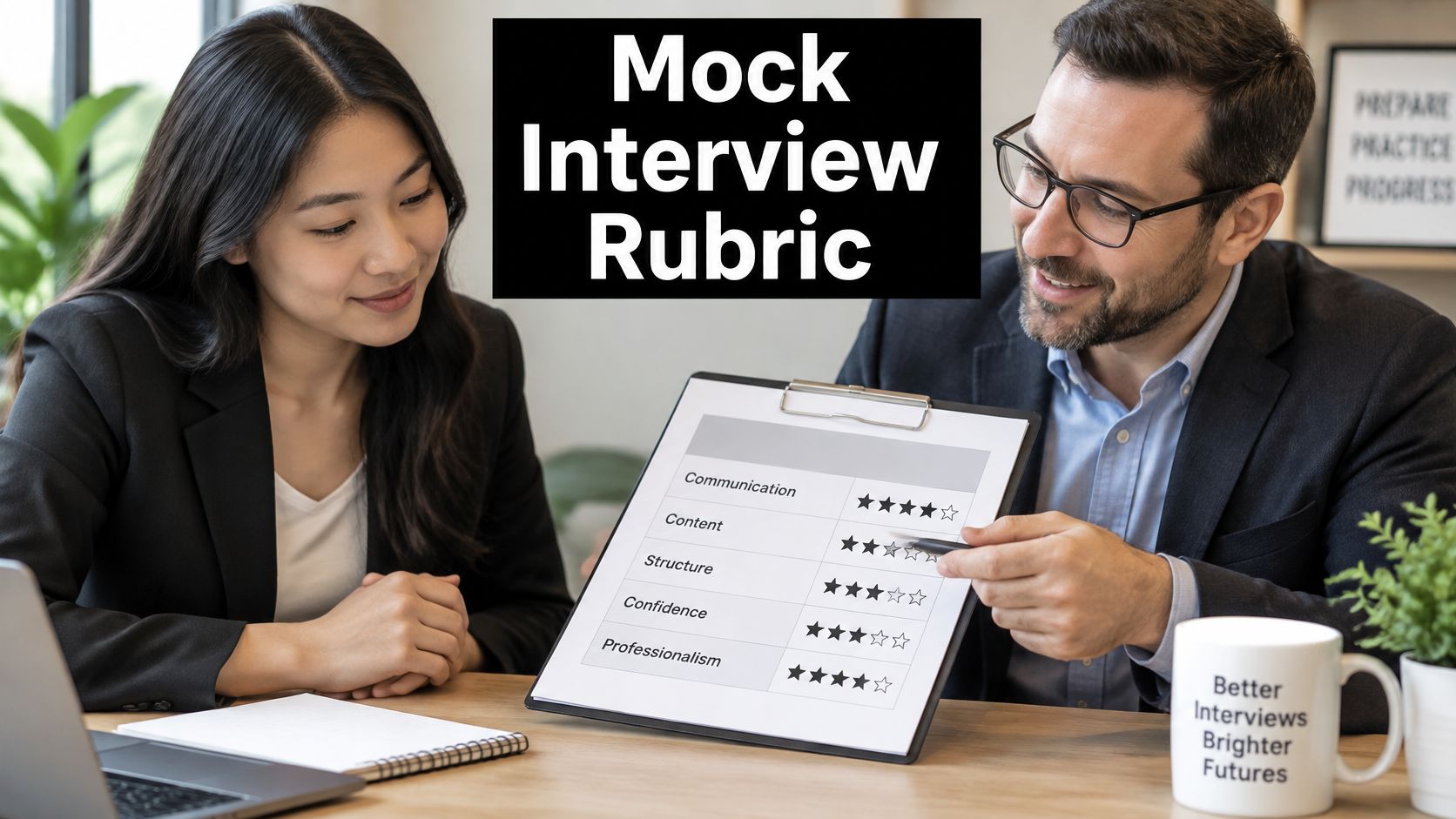
Before submitting, rehearse the claims that are most likely to invite questions. Explain the problem, your contribution, the result, and any limitations without reading the bullet back verbatim. Your first mock interview is free, so you can practice answering questions about the experience you've chosen to highlight.
Final test: Every claim should survive a straightforward follow-up question about what you did and how you know it worked.
Save the submitted version with the relevant posting so you can prepare from the same document the interviewer receives. Keep your evidence notes private and update the master resume when you verify new information, rather than copying unsupported wording back into it.
Pick one prompt and apply it to your next job posting this week. Start with the section that's weakest, verify the changes, and keep only language you can defend comfortably in an interview.
ParakeetAI offers resume building, role-specific tailoring, ATS scoring, and mock interview practice to help you move from application edits to explaining your experience. Visit ParakeetAI to build your next targeted resume and practice discussing the claims it contains.