Mock Interview Rubric: How to Score Answers Fairly
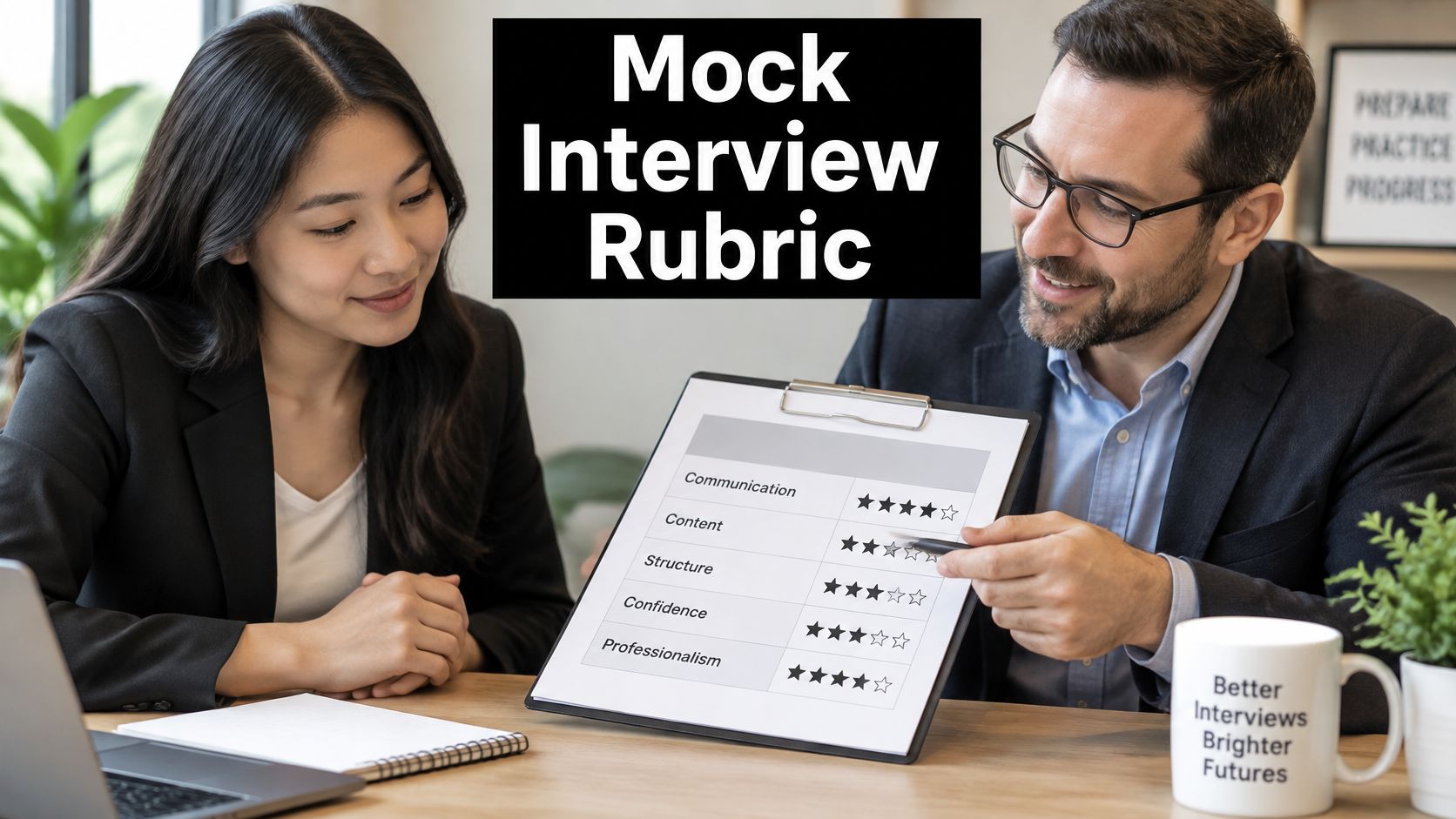
"Good answer."
That's the feedback loop most job seekers have. You run a mock interview with a friend, they give you that vague verdict, and you walk away without knowing what to change. A confident voice can earn a warm "good answer" even when the answer contained no result, no example, and no evidence that anything the candidate did worked.
A mock interview rubric fixes this. It replaces impression with a score, and, if you build it carefully, every score sits next to the line in your transcript that justifies it.
Why Mock Interviews Need a Scoring Rubric
Three principles define a rubric worth using. Ask every practice candidate the same job-related questions. Define the competencies before the session starts. Score each answer against explicit criteria before forming any overall impression.
The evidence for structure runs deep. A meta-analysis by Wiesner and Cronshaw, published in 1988, found structured interviews had a mean validity coefficient of 0.26 before correction and 0.47 after correction for statistical artifacts, characterized as roughly twice the validity of less structured approaches, according to University of Oklahoma research material. That's why credible rubrics standardize questions, define competencies in advance, use behaviorally anchored criteria, and apply the same rating logic to everyone.
Who uses this? Self-practising job seekers who want to see progress across attempts. Students preparing for their first interviews, with no prior pattern to compare against. Career coaches who need to justify feedback to a paying client, because "you seemed nervous" doesn't survive a client asking what specifically to fix.
A checklist and a rubric aren't the same instrument. A checklist asks whether something was said. A rubric asks how well it was supported. "Did the candidate mention a result?" is a checklist item. "How specific and measurable was the result, and did the candidate explain why the number moved?" is a rubric question. You need the second one.
The limit needs stating up front. A rubric measures practice performance and coaching progress. It does not predict a hiring decision, and it doesn't guarantee an offer. Scored practice has been linked to real employment outcomes: in a 2021 randomized controlled trial involving autistic transition-age youth, 25.0% of the virtual-training group reached competitive integrated employment versus 0.0% of the comparison group (chi-square 6.9, p<0.01; adjusted odds ratio 16.0, 95% CI 1.35 to 189.17), per the trial report. But a separate randomized trial of virtual-reality interview training for people with serious mental illness reported 43% versus 28% employment, a difference that wasn't statistically significant overall. Treat the rubric as a measurement and coaching tool, and track both skill progress and longer-term outcomes.
Core Dimensions of a Mock Interview Rubric
Here's the table to copy. Five scored dimensions, weights that sum to 100%.
| Dimension | What It Checks | Evidence for a Top Score | Default Weight |
|---|---|---|---|
| Substance | Whether the answer is relevant and accurate | Specific, correct claims tied directly to the question | 30% |
| Evidence | Concrete examples with actions and results | Named situation, the candidate's own actions, a measurable result | 25% |
| Reasoning | How the candidate reached the answer | Explains why, and names at least one trade-off | 20% |
| Structure | Whether the listener can follow the answer | Direct answer first, logical order, clear ending | 15% |
| Self-correction | Noticing and fixing gaps or errors | Corrects an error or gap without being prompted | 10% |
A top-score picture for each, in one line. Substance 5: every claim is correct and none of it drifts from the question. Evidence 5: a named situation, the candidate's own actions (not the team's), and a number. Reasoning 5: why that path, and what got rejected. Structure 5: the answer arrives in the first two sentences and closes cleanly. Self-correction 5: the candidate catches their own gap mid-answer and fixes it without a prompt.
The weights are starting points, adjusted by role later.
Score the dimensions separately, because one strong trait will otherwise hide a weak one. Say a candidate answers with crisp structure, clean signposting, a clear ending, and no result anywhere. Structure scores 4. Evidence scores 2. The feedback names both: "your order was easy to follow; you never told me what happened after the fix." One number would have averaged this into a 3 and taught nothing.
Note that delivery (pacing, speech clarity, eye contact) is recorded as a separate note outside the composite. The weights sum to 100% across the five scored dimensions only, so no style trait can inflate a substance score.
Five-Point Anchors for Scoring Each Answer
A defensible rubric scores at the question level, not as an overall impression. Ask every participant the same job-related questions, map each question to one or more predefined competencies, and score the response immediately against explicit criteria. The Victorian Government's behaviourally anchored rating guidance sets out a practical 1–5 scale: 1 = unacceptable or irrelevant; 2 = partially relevant but materially incomplete; 3 = competent and sufficiently supported; 4 = strong, specific, and well-reasoned; 5 = exceptional, demonstrating depth, judgment, and measurable impact.
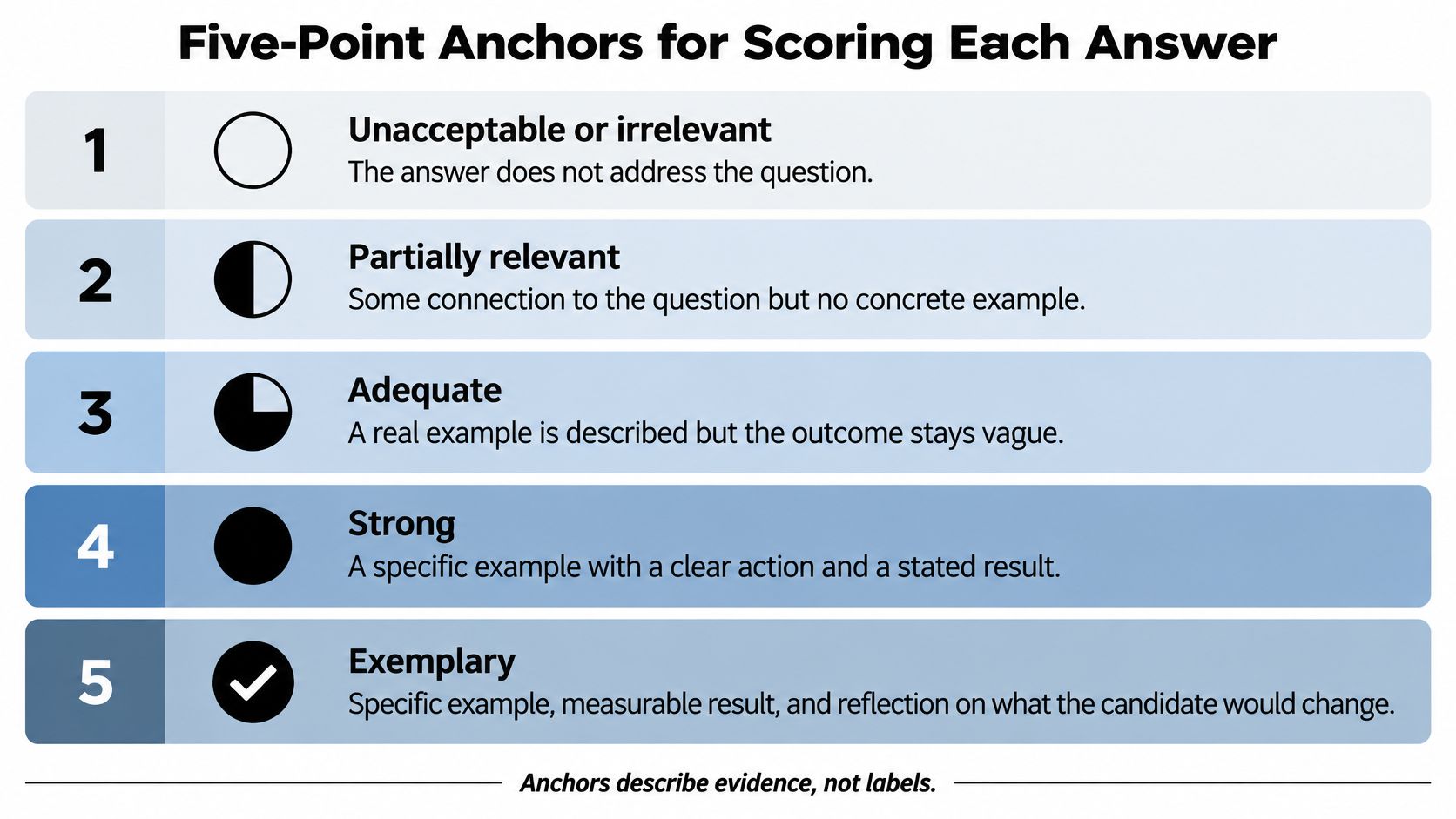
Each level anchors to observable evidence: identifying the situation, explaining the candidate's actions, quantifying results, recognizing trade-offs, or adapting to constraints. Not vague labels such as "good communication." Behaviourally Anchored Rating Scales exist precisely to separate unsatisfactory, competent, and outstanding behavior, and the same guidance recommends predefined behavioral anchors and standardized questions to improve consistency.
Here's the full scale with the test a scorer applies.
| Level | Label | Observable Test | Evidence That Earns the Level |
|---|---|---|---|
| 1 | Unacceptable or irrelevant | The answer does not address the question asked | Off-topic response with no link to the competency being probed |
| 2 | Partially relevant but materially incomplete | A situation is named but the candidate's own action is missing | "We had a conflict on the team" with no individual behavior described |
| 3 | Competent and sufficiently supported | A real experience-based example with some detail, result left implicit | Actions described in order, no outcome or number |
| 4 | Strong, specific and well-reasoned | Own actions named, at least one trade-off, a concrete result | Re-plan, daily check-in, deadline recovered |
| 5 | Exceptional | Depth, judgment and measurable impact, including adaptation to constraints | Quantified result plus the alternative rejected and why |
The 2-to-4 jump in practice
Question: "Tell me about a time you resolved a conflict on your team."
Transcript excerpt: "We had a conflict over the release date. Two people wanted to ship early, one wanted to wait. It was tense for about a week." Nothing about what this candidate did. Evidence 2.
Revised answer: "I set up a 20-minute call, laid out both release options with the risks, and proposed a phased ship. We shipped the core on the original date and the rest a week later. We missed two days on the second half, but nothing broke in production." Own action, trade-off, result. Evidence 4.
Hard rule: a score must sit beside a quoted or paraphrased piece of the answer. If you can't point at the text, you can't award the number.
Every rating also carries an evidence flag: quoted, paraphrased, or not heard. A weak transcript segment gets marked, not averaged into the total. The report then says which level was reached and exactly what was missing to reach the next one.
Separating Answer Substance from Delivery Style
The trap is common. A candidate with a steady voice, good eye contact, and confident pacing collects high marks even when the answer never states a result. Delivery gets scored as if it were evidence.
The rule is simple: substance and evidence sit in their own dimensions, and observable delivery (pacing, clarity of speech) gets recorded separately.

Standard mock-interview guidance pushes STAR structure, confidence, eye contact, pacing, and concise communication, but rarely explains how to stop delivery proxies from overpowering job-relevant evidence. That gap has a real cost. Recent research on AI interview evaluation found that models can score speakers differently based on accent even when assessing the same spoken content, and the models acknowledged accent effects in only about 10%–30% of their explanations, as reported by the Seattle Times on University of Washington research.
That's the case for splitting the report into separate dimensions for role-specific evidence, reasoning accuracy, examples, communication clarity, and observable delivery behaviors, rather than collapsing them into one number.
A clear answer in an unfamiliar style is not an unclear answer
These are two different diagnoses and they need different coaching. A candidate who structures the answer correctly but uses a communication pattern the evaluator didn't expect should score on content. A candidate whose answer can't be followed should score on clarity, with the unclear sentence quoted.
For global candidates, permit equivalent evidence in different English varieties and languages, flag speech-recognition uncertainty, and don't penalize eye contact, facial expression, or vocal style unless the job demonstrably requires those behaviors.
What an honest report looks like
Substance 4. Evidence 2. Delivery 4. With the note: "The content is right and the delivery is fine. You never told me what happened after you escalated. That is the only thing to work on this week."
Professional presence is a weaker coaching target than answer traceability. Show the candidate which claim, example, or reasoning step was missing, not just that they should sound more confident.
The disclosure needs to be visible in the report itself: how much each trait moved the total, and which dimension carried the most weight in the final number. A candidate who can see that evidence was 25% of the score and scored 2 knows exactly where the practice hours go.
Scoring a STAR Answer Part by Part
STAR gives you a mechanic rather than a vibe. Rate Situation, Task, Action, and Result independently on a 1-to-5 scale, then sum the four scores for a question total out of 20.
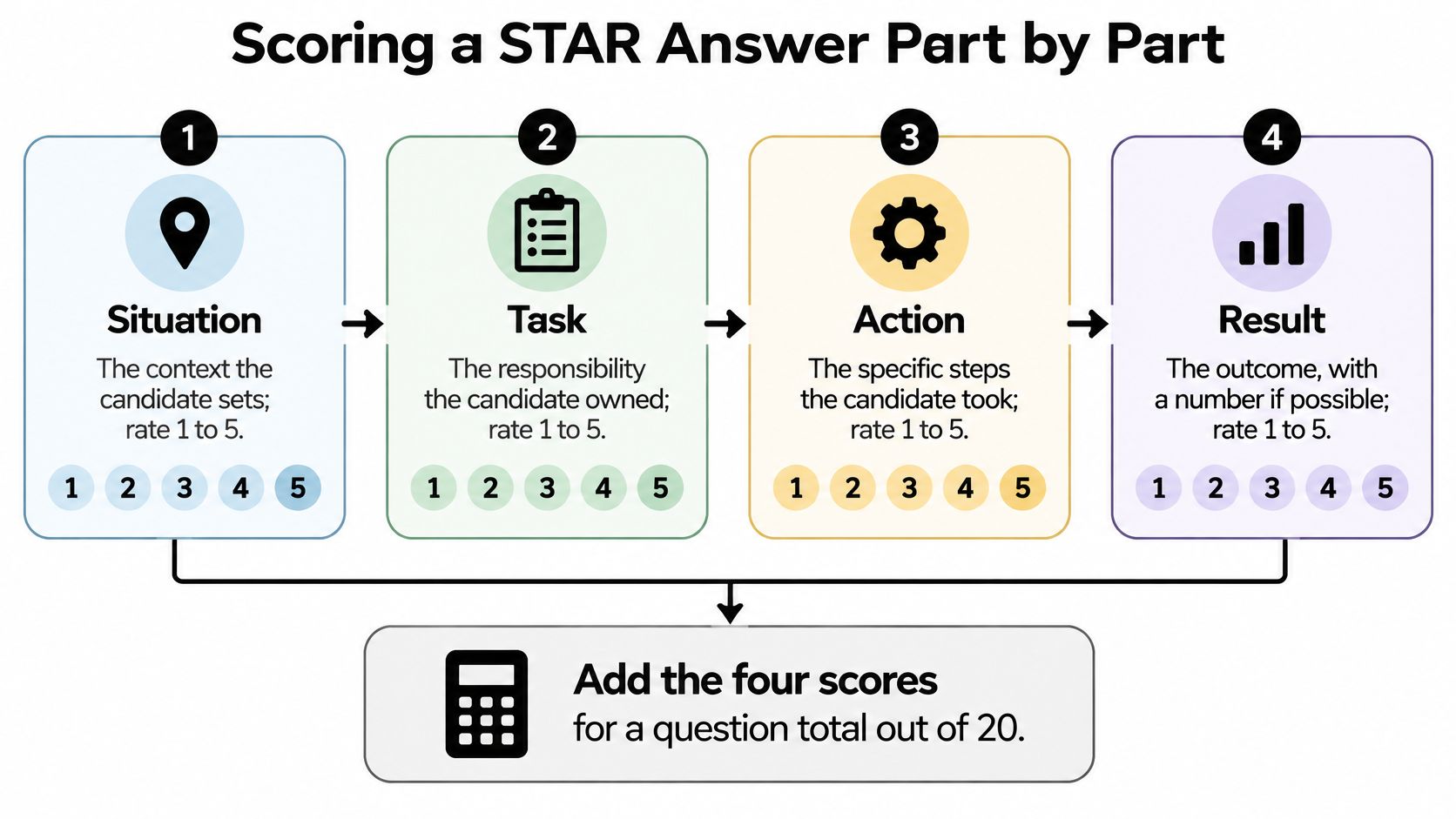
The anchors are concrete, per a published STAR evaluation rubric: a 1 means the component is missing or very unclear, a 3 means it's addressed but lacks detail or clarity, and a 5 means it's clear, detailed, and demonstrates strong skills or judgment. Because each part is scored alone, a polished speaking style can't substitute for evidence across all four.
Worked example: 12 out of 20
Question: "Describe a deadline you missed."
Situation 4: the candidate names the product, the launch date, and the dependency that slipped. Clear context.
Task 2: "I was supposed to keep things on track." Vague. What were they accountable for?
Action 5: re-planned the sequence, ran a daily 15-minute check-in with the two blocking teams, escalated one dependency to the engineering lead with a written risk note.
Result 1: nothing. No recovered date, no metric, no statement of what shipped.
Total: 12 of 20. The storytelling works and the action is strong. The answer never shows whether the action worked. The practice target is one sentence: what date did you hit, or what did you lose?
The four-step scoring routine
- Read the question and note which competency it probes.
- Mark the four STAR parts in the transcript.
- Score each part against its anchor, with the quoted line beside the number.
- Add the total and write the single missing element.
A polished delivery never raises a component score. If the Result is absent, it stays absent regardless of how pleasant the telling was.
Technical and Coding Rubric Dimensions
Coding interviews need their own dimensions, because final correctness hides almost everything. The Tech Interview Handbook coding rubrics split evaluation into four: communication, problem solving, technical competency, and testing.
Communication covers clarifying the problem, explaining the approach, and talking while coding. Problem solving covers understanding the task, choosing a sound approach, analyzing trade-offs, and optimizing. Technical competency covers implementation speed and accuracy, syntax errors included. Testing covers whether the candidate checks common and edge cases and self-corrects bugs.
These four support separate scores and written evidence instead of reducing the session to whether the code compiled.
Why "it worked" is a weak score
Say a candidate writes working code in a few minutes but never tests an empty input and never explains the approach out loud. Problem solving 3 (sound approach, no trade-off discussion). Technical 5 (fast and accurate). Testing 1 (no edge cases). Communication 2 (silent for most of the session).
The composite looks decent. The individual scores say the candidate will pass a friendly whiteboard and struggle in a real review where the interviewer asks why a hash map beats a sort here. Each gap gets named separately in the feedback.
Keep a reference-answer library
Calibration matters most in technical scoring, where several valid paths exist. A candidate who reaches an equivalent solution by a different route than the scorer expected will get marked down for nothing. Keep a small library of reference answers showing multiple valid algorithms and design choices, and score against the outcome, not the route.
Written evidence accompanies each score: the line where the candidate stated a test case, the moment they spotted their own off-by-one, the sentence where they justified the data structure.
Adjusting Rubric Weights by Role
Weights belong to the role, not to your preferences. Read the posting, rank the three or four skills it names most often, and give the top skill the largest share.
| Role | Technical Correctness | Problem Solving | Communication | Impact Evidence |
|---|---|---|---|---|
| Software engineer | 35% | 30% | 15% | 20% |
| Data analyst | 30% | 30% | 20% | 20% |
| Product manager | 20% | 20% | 30% | 30% |
| People manager | 10% | 20% | 35% | 35% |
Use the posting as the evidence. If “stakeholder management” appears in the responsibilities, the requirements, and the interview loop, communication and impact evidence should carry more weight than a side interest in syntax. If you need a fast scan of how titles cluster across functions before rereading the posting, a page built to help teams hire remote talent by role can jog the comparison; the posting still decides the percentages.
The composite score is a weighted mean of the dimension ratings, and each dimension should still be reported separately beside it. For a software engineer scored technical 4, problem solving 3, communication 2, and impact evidence 5, the composite is (4 × .35) + (3 × .30) + (2 × .15) + (5 × .20) = 3.6. That single number is only the summary. The record needs one quoted transcript line beside each dimension and a named missing claim, example, or reasoning step, otherwise 3.6 hides whether the gap is trade-off reasoning or proof of results.
The not-assessed rule
If an answer never reaches a dimension, flag it as not assessed. Don't score it as low ability. An omission and a weak answer call for different practice.
A product manager candidate who answers well about prioritization but never mentions a metric gets flagged for impact evidence, not scored 1. The next session adds a question that forces a number.
Fix the weights before the session. Changing them after you've seen the results makes every cross-attempt comparison meaningless.
Run Your First Scored Mock Interview
One session, scored properly, beats five unscored conversations. Here is the routine.
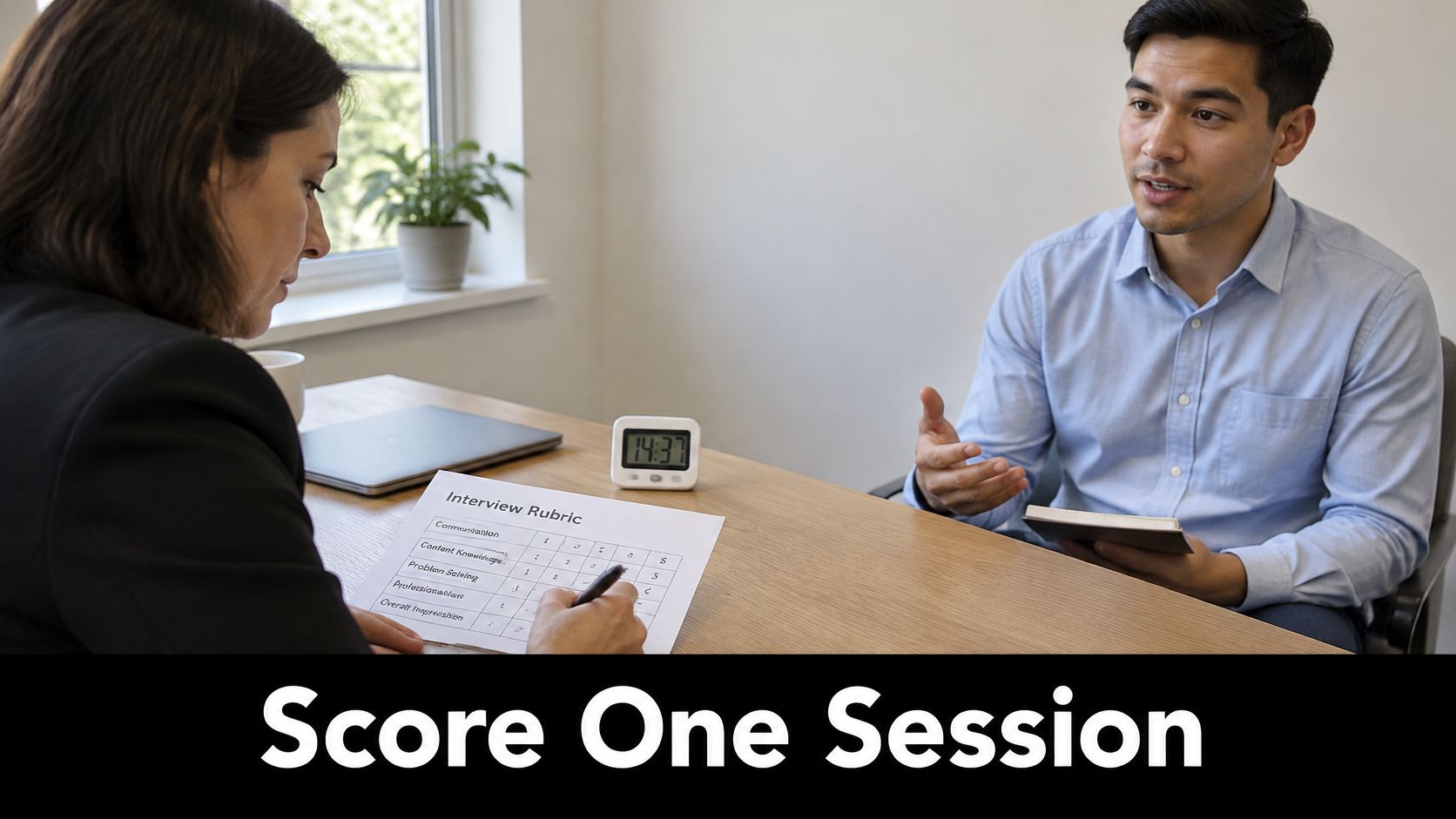
- Pick five questions mapped to the role's top two competencies from the weight table.
- Write the dimension weights down before the first answer and leave them alone until scoring finishes.
- Answer out loud and record it. The transcript is what you mark, not your memory of it.
- Read the transcript and mark each claim, named situation, own action, and result.
- Score every dimension against the anchor table with one quoted line beside each number, and flag missing parts as not assessed.
- Total the weighted mean, compare with the previous attempt, and choose exactly one practice target for next time.
The score sheet is what makes a session auditable.
| Question | Competency | Dimension Scores | Quoted Evidence | Missing Element | Next Action |
|---|---|---|---|---|---|
| Tell me about a time you resolved a conflict | Teamwork | Evidence 2, structure 4 | "We had a conflict over the release date" | What the candidate personally did and the result | Rewrite with one own action and one result |
| Describe a deadline you missed | Planning | Situation 4, task 2, action 5, result 1 (12/20) | "I re-planned and ran a daily check-in" | The outcome after the check-in | Add the recovered date or metric |
| Coding: merge two sorted lists | Problem solving | Problem solving 3, technical 5, testing 1, communication 2 | "I'll write the merge loop first" | Empty-input test and a spoken approach | Narrate the approach, then test an empty list |
That sheet works whatever produces the transcript. ParakeetAI's mock interview practice runs a spoken session against an AI interviewer that answers back, which gives you a transcript to mark, and the scoring is identical whether the partner is that tool, a coach, or a friend holding a copy of the anchors.
Quick Reference for Fixing Weak Rubric Scores
Five symptoms you'll hit, with the cause and the fix.
- Every answer scores 3. The anchors are too vague, usually descriptions of feelings rather than behavior. Rewrite each level with an observable test: what must be in the transcript for this number to apply.
- Scores rise on delivery but not on evidence. The evidence dimension is being scored by feel. Quote the missing element or don't award the score.
- Scores drop between two sessions on the same question. Rater drift. Re-score the first session against the anchors and see whether the second number survives.
- A candidate scores 5 on everything. The questions are too easy or too familiar. Switch to a new question in the same competency.
- Most answers marked not assessed. The question doesn't reach the competency. Remap it or replace it.
Time matters, and the two kinds of fix run on different clocks.
Anchor and weight fixes take one session to test. A candidate's evidence habit takes several sessions of repeated practice before it holds under pressure.
The score sheet is the part many candidates skip, and it's the part that makes practice compound. ParakeetAI gives you a mock interview with an AI interviewer that answers back and a transcript you can mark line by line, and your first mock interview is free with no credit card. Run one session with the five anchors beside you, quote the evidence next to every score, and pick a single target for the next attempt.