ATS Friendly Resume Examples: 7 Formats for 2026
You match the posting line for line. You send the application, and two weeks later the status still reads submitted. The resume wasn't weak. It was invisible. A two-column template placed your job title inside a text box, the employer's applicant tracking system read the company name as part of the date range, and the record saved to the database showed a candidate with no verifiable history.
Applicant tracking systems extract text, organize fields such as employment history and skills, and make records searchable before a recruiter opens anything. The pipeline is close to universal at the top of the market. One industry analysis reported that approximately 97.8% of Fortune 500 companies had a detectable ATS on their career pages in 2025 (eztrackr). That figure doesn't mean every application gets auto-rejected. It means a machine decides which resumes a human is shown, and layout decides what survives extraction.
The seven formats below each pair a career stage with the parsing reason behind its structure, so you can see where it holds up and where it fails.
1. Entry-Level Graduate Resume (Reverse-Chronological, Education-First)
A recent graduate has a thin work history and a strong academic record. The resume's first job is to make the degree, the graduation date and the projects legible in the order a parser expects, so Education sits directly under the contact block, followed by Experience, Projects and Skills.

That order isn't a style preference. A parser maps each section to a database field, and the dated entries inside each block build a timeline that recruiters sort and filter on.
Why the parser reads this layout cleanly
Standard labels do the mapping. Education becomes the education record, Experience becomes employment history. A heading like "My Journey" maps to nothing, and the content under it lands in a free-text blob no recruiter filter ever touches.
The Social Security Administration's Choose Work guidance sets limits worth following exactly: common fonts such as Calibri, Arial, Helvetica, Georgia or Times New Roman, body text between 10 and 12 points, and a save as PDF or DOCX unless the posting names another format. The same page warns against GIF, PNG, JPG and TXT files because an ATS may not read them reliably, and it recommends bold section labels rather than headings placed inside document headers, which many parsers skip entirely.
Practical rule: Keep one column, skip tables and text boxes, and spell every skill the way the posting spells it, so the word a recruiter filters on arrives intact.
Two truthful lines that show the pattern in action:
- Computer science graduate: "Rebuilt the course-scheduling API in Python and PostgreSQL, cutting average response time 40% against a 1,200-record dataset." The stack names carry the search match; the number carries the credibility.
- Business graduate: "Automated 12 monthly client reports in Excel and Power Query, saving the internship team roughly six hours per cycle."
If you want a starting structure, ParakeetAI's Resume Maker builds a draft against a specific posting and reports where it falls short on ATS criteria; building is free, the PDF download is paid.
2. Mid-Career Software Engineer Resume (Reverse-Chronological, Tech-Stack Focused)
Two versions of the same job duty, both honest.
Improved system performance.
Optimized database queries, reducing page-load time by 65% from 1.8 seconds to 0.63 seconds, lowering bounce rate 12%, and increasing trial conversions 9% across 25,000 monthly users.
The second line is the one that survives screening. It carries searchable technical terms (database queries, page-load time, bounce rate, conversions), a measurable change, and a scale that tells a product-focused hiring manager what the work was worth (resumize). Engineers often assume their vocabulary is enough. It isn't. A word only earns a match when it sits inside a sentence a human can also read.
Turn a duty into a parsed achievement
The pattern that holds is action verb, technical intervention, quantified change, business or user scale. Your skills block lists Go, Kubernetes and PostgreSQL to catch the filter. The experience bullet that names the queue migration you ran in Kubernetes earns the callback.
Write tool names the way the job ad writes them. React and TypeScript, not "modern JS frameworks." Include the expansion once for anything a recruiter might search either way, such as Continuous Integration (CI), so both strings match.
- Skills block: mirror the required and preferred qualifications, same spelling, same capitalization, no filler entries.
- Recent experience: three to five bullets per role, each anchored to a system you built and a result you can defend.
- Older roles: one line each. The parser keeps the dates; the human stops reading after the recent position anyway.
Before you send, paste the posting beside the resume and confirm each required term appears at least once inside an achievement, not only in the skills list.
3. Senior Leader or Executive Resume (Leadership Summary, Quantified Impact)
Executives worry about the wrong thing. Screening rarely discards a director's resume over content. It ranks it, and then a recruiter searches the ranked pile for titles, industries and governance language.
What recruiters search for at this level
A late-2025 survey of 25 U.S. recruiters working across more than 10 ATS platforms found that 92% said their systems did not automatically reject resumes based on content alone (eskill). The familiar claim that 75% of resumes are rejected by software has no documented study behind it. What happens instead is search, ranking, eligibility rules and information extraction.
That distinction changes what you optimize. A vice president needs the searchable words attached to outcomes, and the outcomes attached to scope:
- VP of operations: "Owned P&L across 14 distribution sites and $310M in revenue, cutting cost per order 18% over two years through route consolidation."
- Director of engineering: "Grew the platform team from 22 to 60 engineers and moved release cadence from quarterly to weekly without raising the change-failure rate."
State scope before the result in every bullet. The parser grabs the title, the recruiter grabs the number, and the two together get you the call.
Keep the document to two pages, put the most recent 10 to 15 years first, and use only standard section titles such as Professional Experience and Education. A parser looking for an education block won't find one filed under "Credentials and Boards," even if a human would. Finish with a short list of sector terms pulled from your target postings.
4. Career Changer Resume (Hybrid Format with Transferable Skills)
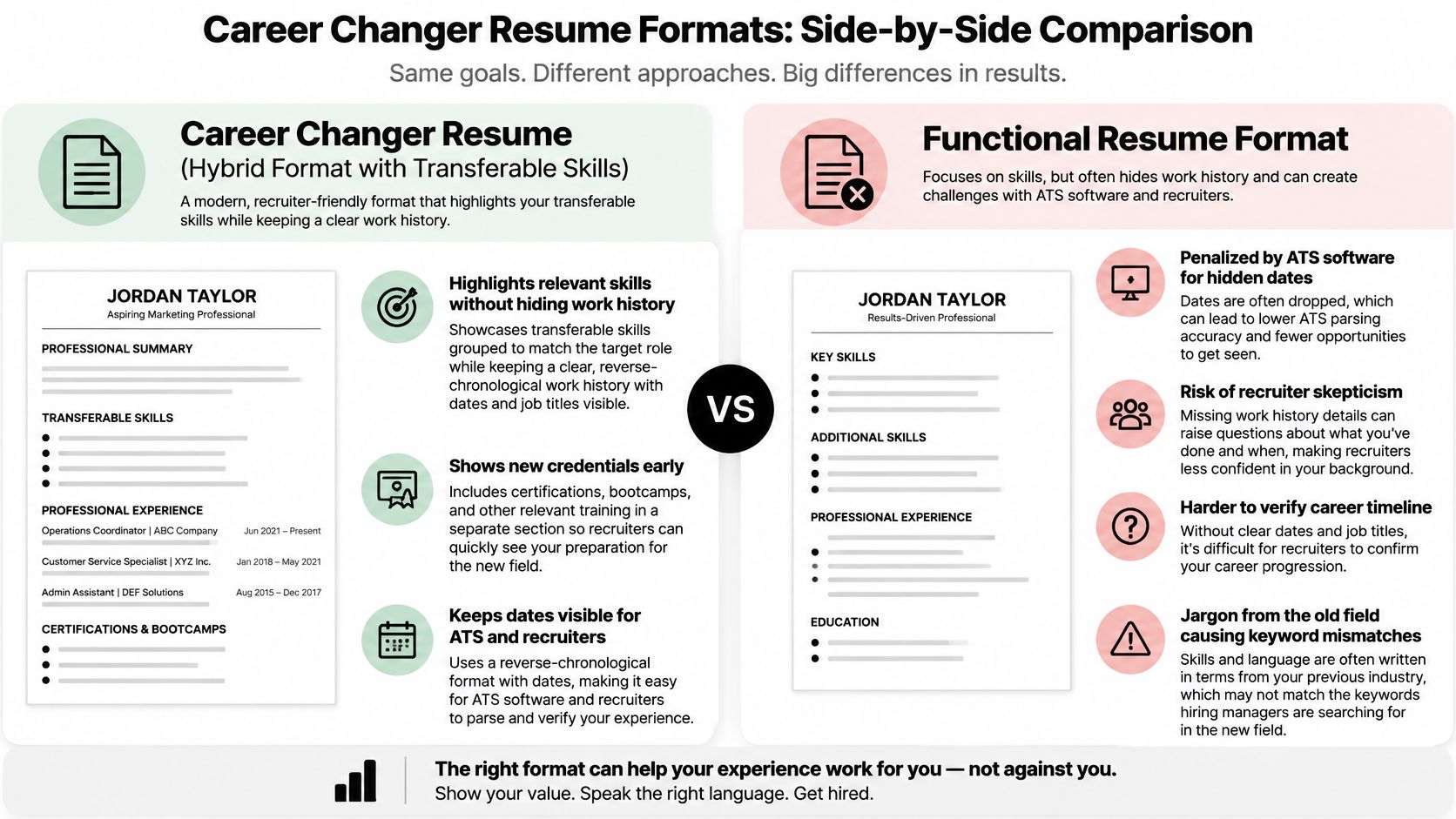
A functional resume feels honest when you're switching fields. It also drops the one thing a parser needs, a dated sequence of employers and job titles. Recruiters searching for a title plus years of experience can't find you in the ranked list because there's no field to match.
Keep the chronology the parser expects
The U.S. Department of Labor's Veterans' Employment and Training Service recommends chronological or combination formats instead of functional ones, because functional resumes may confuse automated screening systems. The same guide advises putting keywords from the posting inside achievement statements rather than only in a separate skills section, and writing both the full term and the abbreviation, for example "search engine optimization (SEO)", so either form matches (DOL VETS).
A hybrid resume keeps the skills block that sells the transition and the dated history that proves it. Drop either half and you lose a reader.
The comparison below shows the two structures side by side, with the version a parser can follow on one side.
- Teacher into instructional design: list curriculum development, learner assessment and an e-learning tools certification, then repeat the posting's phrasing, such as "learning experience design," inside the bullets that describe the courses you built.
- Retail manager into operations analysis: put inventory forecasting and reporting in the transferable skills block, then show the measured result attached to each one in the work history.
New certifications belong near the top with completion dates, not buried at the end.
If you want to see the mechanics of a hybrid in motion, this walkthrough covers how the sections are ordered for a machine reader.
5. Internship and Student Resume (Early-Career Skills and Activities)
You're a third-year student sending twelve applications in one weekend. Three portals are different vendors, and one asks for your resume in a second language. That is where most student resumes fail, and it has nothing to do with how impressive the campus campaign was.
Verify what the parser actually extracted
A systematic review reports parsing and ranking accuracy around 85 to 94% in some tasks, while finding that unconventional layouts and multilingual resumes reduce effectiveness (Atlantis Press). "Plain and simple" is not a guarantee. A conservative-looking file can still lose your employer names when the parser handles a second language or an unusual section order badly.
The check takes two minutes. Copy the entire PDF into a plain text editor and read what lands. Confirm that your name, dates, employers, job titles, skills and section headings all appear in the right order. If the reading order scrambles on screen, it scrambles for the parser too.
- Marketing student: "Ran a campus campaign across Instagram and print, reaching 4,000 students and lifting event sign-ups 30% over three weeks."
- Engineering student: "Programmed the drivetrain controller for a six-person robotics team in C++ and placed second at the regional competition."
Keep it to one page, drop high school details once you're in college, and give volunteer and club work the same action-verb treatment as paid jobs. Use a clean filename such as FirstnameLastname_Resume.pdf. Aviation-track students should name credentials exactly as the issuer does, and it's worth checking the student pilot certificate eligibility rules before listing a certificate you haven't been issued.
6. Returning-to-Work Resume (Employment Gap Presentation)
A two-year caregiving break doesn't break parsing. Dates parse fine. What breaks is the human read, and increasingly the machine's judgement about relevance.
Explain the gap without breaking the date sequence
Keep the standard reverse-chronological layout and keep dates in the same format throughout. Recruiters compare your resume against your profile and anything you've said in the application, and mismatched months read as sloppiness no matter how good the explanation is.
A 2025 audit of eight widely used AI resume-screening platforms found context-dependent and intersectional demographic bias, instability across repeated evaluations, and difficulty distinguishing relevant from irrelevant experience (arXiv). That's not a reason to hide your history. It's a reason to make relevance undeniable on the page rather than left to inference.
Fill the gap with something dated. A certification, a volunteer engagement, a freelance project. A dated line reads as current, and an empty stretch reads as unknown.
- Former accountant returning after caregiving: add the recent accounting software certification with its completion month, plus a volunteer bookkeeping role with the number of accounts reconciled.
- Developer returning after a research sabbatical: list open-source contributions with repository names and updated cloud certifications with dates.
Keep the gap explanation to one line, pointed forward. Something like "Returning to accounting after two years of full-time caregiving; completed the QuickBooks Online certification in March" tells the reader what you can do now. Anything longer turns the resume into an apology.
7. Mid-Level Marketing or Business Professional Resume (Results-Driven Achievements)
A marketing manager's resume lives on two vocabularies: the function language a recruiter filters on, and the platform names the system indexes.
Baseline, period, result
A reported multi-platform test involving Workday, Greenhouse, Lever, iCIMS and Taleo found that resumes using the exact job title from the posting received 10.6 times more interview callbacks than resumes using different wording, and the same report describes recruiters searching resumes through keyword, title and experience filters (Economic Times). Treat that as observational rather than a benchmark. The mechanism it points to is real: if the posting says Data Analyst, and that's truthfully your job, use that title and don't soften it into "insights partner."
- Marketing manager: "Grew qualified leads 41% year over year, tracked in HubSpot and Google Analytics 4, on a $90K quarterly budget."
- Sales operations specialist: "Cut weekly reporting time from nine hours to two by rebuilding the pipeline dashboard in Salesforce and Tableau."
Give every metric a baseline and a period, or it reads as decoration. Group tools by category (analytics, CRM, design) so the block stays scannable. Mirror function titles exactly, whether the posting says "demand generation" or "account management."

If you're aiming a level up, study what a sales enablement director owns and borrow the scope language for your own bullets. Test each version against two or three target postings before submitting, and adjust where the keyword match is thin.
How the seven ATS friendly resume formats compare
| Item | Best For | Layout | Key Keyword Focus |
|---|---|---|---|
| Entry-Level Graduate Resume | Recent graduates with limited work experience | Single-column, reverse-chronological, education-first | Degree, coursework, projects, internships, job-specific skills |
| Mid-Career Software Engineer Resume | Software engineers with 3 to 10 years of experience | Reverse-chronological with a dedicated technical skills section | Programming languages, frameworks, cloud platforms, tools |
| Senior Leader or Executive Resume | Directors, vice presidents, and C-level candidates | Reverse-chronological with leadership summary and quantified achievements | Leadership, governance, industry terms, team and budget scope |
| Career Changer Resume | Professionals transitioning into a new field | Hybrid format with transferable skills and chronological work history | Target-role skills, relevant credentials, new-industry terminology |
| Internship and Student Resume | Students and applicants seeking early-career roles | One page, education and activities focused | Degree, graduation date, coursework, tools, project skills |
| Returning-to-Work Resume | Professionals returning after a career break | Reverse-chronological with a brief gap explanation | Current skills, recent certifications, target-role keywords |
| Mid-Level Marketing or Business Professional Resume | Marketing, sales, operations, and business professionals with 4 to 8 years of experience | Reverse-chronological with quantified achievements and tools section | Job-function terms, software platforms, measurable outcomes |
Turn These Examples Into Your Own ATS Friendly Resume
The work is a sequence, not a single edit. Start with the format that matches your career stage: education-first for a new graduate, tech-stack for an engineer, chronology-plus-transferable-skills for a changer, dated explanation for a returner. Then run four checks.
- Mirror two or three exact phrases from one target posting. The job title, the named tool or platform, and the function term the recruiter filters on. Two or three real matches beat twenty sprinkled keywords.
- Reconcile dates and titles across every document. Resume, profile and application form should agree month for month. Inconsistency is the fastest way to make a human doubt a clean record.
- Test the file for clean parsing. Copy the text into a plain editor and confirm the name, employers, titles, dates and skills appear in order. If a table scrambles the sequence, rebuild it as single-column text.
- Score the draft against the posting before you submit. A builder that reports ATS criteria will flag missing standard headings and weak keyword alignment in seconds.
Nothing here requires a designer, and none of it justifies inventing an achievement. The resume that gets read is the boring one built correctly: standard headings, selectable text, a dated sequence, and numbers a recruiter can repeat back to you in the interview. If you're applying in financial services, the essential bank resume abilities for 2026 overlap heavily with the keyword sets these formats depend on, so the same structure carries over.
A clean file gets you to the interview, and the interview is the next filter. ParakeetAI is an AI interview assistant that listens to the interviewer's questions in a live call and shows suggested answers on your screen, drawn from your resume and notes, and it never joins the meeting as a participant. Its Prepare tools include a Mock Interview with one free session per account and a Resume Maker that builds a resume for a specific role and reports its ATS score, so you can carry one structure from parsed file to practiced answer. Start with the free sessions and see how the feedback lands.