Tailored Resume Examples: 8 That Get Interviews
Customization isn't a nicety. In an analysis of more than 59,000 resumes, applications customized for a specific role converted to an interview or offer-stage outcome at 5.75%, against 2.68% for resumes that weren't customized, a 115% relative improvement, as Forbes reported on the study. Same candidates, same market, roughly double the return for editing the document to the job.
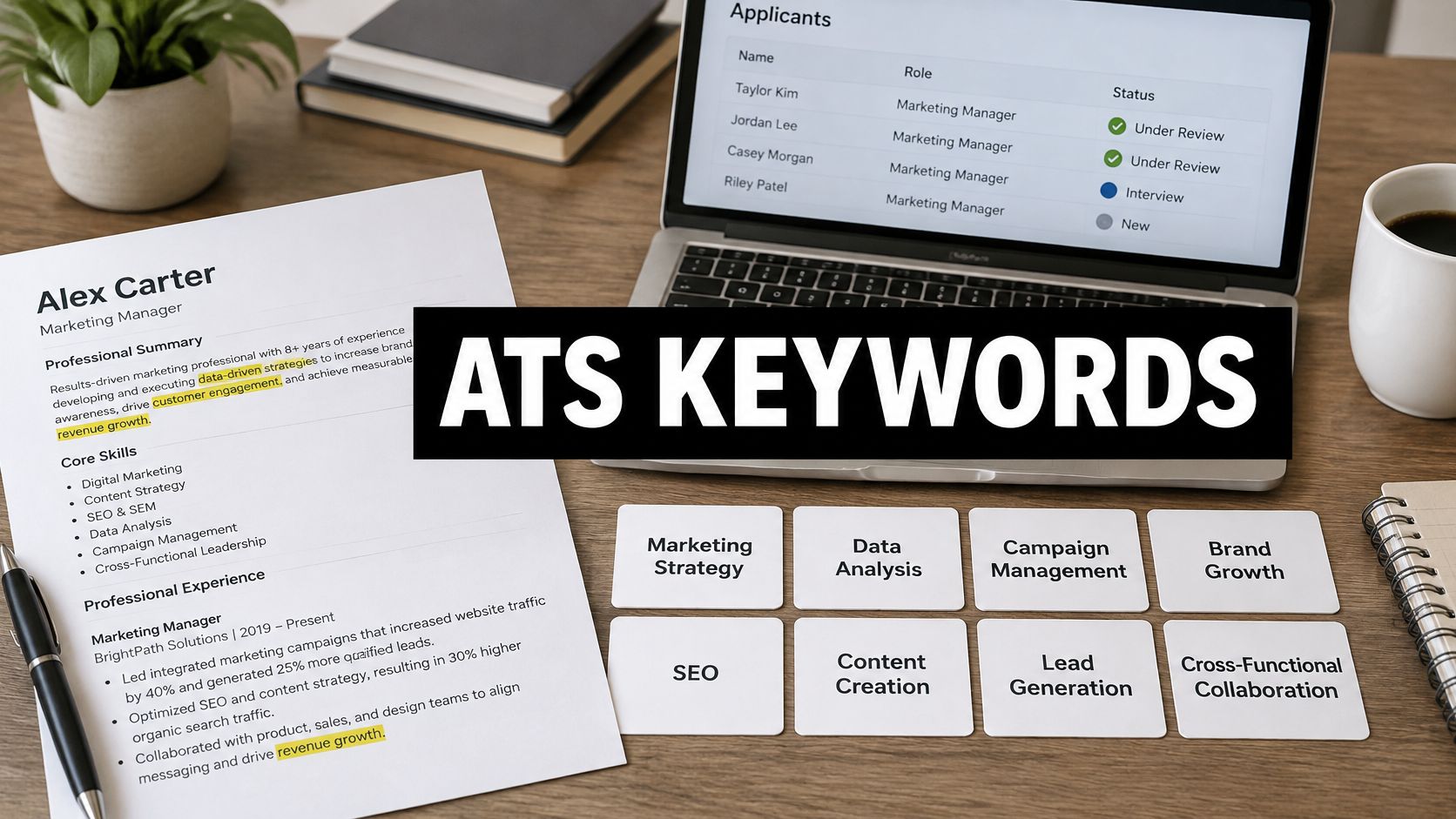
A generic resume fails twice. Software reads it first and matches literal terms against the posting, so a strong candidate whose file says "dashboards" while the posting says "Power BI" gets filtered before a person opens the page. Then the recruiter scans for evidence that you've done this exact job and finds a document that could have gone to any of the other openings they're filling that quarter.
The eight examples below each demonstrate a different tailoring strategy: keyword mirroring for engineers, transferable-skill framing for career changers, writing quality for graduates, methodology alignment for project managers, tool-and-decision bullets for analysts, licensure matching for nurses, quota evidence for sales, and portfolio proof for marketers. Each gets the same dissection: what to copy, why it beats a generic version, and the tactic you can run on your own file tonight.
1. Job-Description Keyword-Matched Software Engineer Resume
A software engineer's resume should reflect the specific posting, not just the candidate's general skill set. Start by identifying its technologies, methodologies, and responsibilities. Then revise the summary and strongest project entry to use the employer's wording where it accurately describes your experience. If the posting asks for PostgreSQL, Kubernetes, event-driven services, and on-call ownership, make each visible near the top only if you can support it in an interview.

Why it beats a generic engineer resume
The format and the match both matter. In a field experiment covering 204 real applications to live postings, a generic AI-generated resume drew a positive response on 10% of applications; the same approach adapted to each vacancy reached 18%. A human-written single-column resume received a positive response on 31%, while a two-column human resume received 12%, as StudyFinds reported on the experiment. The practical takeaway is to tailor the content while keeping the layout easy to scan. A keyword-rich document cannot help if its structure obscures the evidence.
The replicable tactic
Extract the recurring terms from the posting, then place each accurate match in a project or experience bullet. A keyword list on its own does not show how you used a tool or handled a responsibility. Tie terms to concrete work so both a screening system and an interviewer can find and assess the evidence.
- Mirror the spelling exactly. Use PostgreSQL if that is the posting's term, rather than relying on a related shorthand. Exact wording helps the relevant experience register.
- Lead with the closest stack. Put the project that most resembles the employer's environment first, with two or three focused bullets. Compress older, less relevant work below it.
- Keep the claims defensible. List a technology only if you have used it in real work or a project. Requirements in the posting are likely to shape interview questions.
- Name files by company. A filename such as Company_Role_YourName.pdf helps keep versions organized across applications. For readers comparing career options for Indian students, keep each application's resume distinct rather than reusing a generic file.
To start with a draft aligned to the vacancy, use ParakeetAI's Resume Maker to build a role-specific resume, then check each claim against the job description and your own experience before sending it.
2. Skills-Based Resume for a Career Changer
A career changer who leads with a chronological history asks the hiring manager to do the translation. The hybrid format does it for them: a targeted summary naming the target role, a skills block of five or six capabilities the new field hires for, then a compressed work history that proves each one.
Why the skills block earns its space
Employers are testing skills rather than trusting titles. TestGorilla's State of Skills-Based Hiring 2025 found that 76% of employers used skills tests in 2025 while resume use fell from 73% to 67%, and employers rated those tests as better predictors of job success than resumes. The same research found 72% of large organizations still lean primarily on resumes to infer skills, and half struggle to validate them.
That gap is the career changer's opening. Your resume has to make the skill findable in the employer's language, then make it verifiable through a project, a certification, or a story you can tell under questioning.
The two-layer rule: a keyword without proof invites a test you'll fail. Tailor for findability first, then attach evidence.
- Translate three to five achievements. Map each one onto a requirement in the posting, keeping the original numbers.
- Name the target industry in the summary. "Operations analyst with a retail background" removes the guesswork in the first line.
- Close the experience gap visibly. One certification or a short project beats an apology paragraph.
- Keep dates consistent. Gaps and overlaps raise questions you don't need.
Say a store manager targets an operations analyst role. "Ran a 12-person team across two stores" becomes "Built the weekly labor schedule for two stores against forecast demand, cutting overtime by 14%," which surfaces the analytical work the new role hires for.
3. Entry-Level Resume Tailored to a Graduate Program or First Job
At entry level, writing quality does more than keyword insertion. A 2025 study of 183 Canadian postsecondary co-op students found that stronger detail, clarity, and structure in the resume and cover letter were associated with a higher interview yield, while tailoring stopped being a statistically significant predictor once writing quality was controlled for, as reported in the International Journal of Selection and Assessment. The researchers estimated that improving the writing quality of both documents by one point could produce roughly 7% more interviews and shorten time to employment by nearly 10 days.
Read that as permission to spend your hour on the sentences rather than on synonym swaps.
Where the tailoring lives on one page
Education, coursework, projects, and internships sit above the work history. Tailoring means choosing which of those to show: three or four courses or projects that map to the posting, not the full transcript.
Harvard's graduate resume guidance uses the P-A-R structure for bullets: Project describes what was done, Action explains how, Result states the output. It also recommends adding the specific methods or tools the posting names and quantifying where you can, whether that's a grant award amount or the number of paper views, downloads, or citations.

- Pick three or four matches. A data structures project for a backend role; a research methods course for an analyst posting.
- Quantify the project. Users, runtime, accuracy, team size. A class project with a number reads like work.
- Drop high school once you have university or internship experience on the page.
- Get one outside review. A career advisor or a practitioner in the field catches what you can't see.
4. Project Manager Resume Tailored to a Methodology
A posting that reads "Scrum Master for two Agile delivery teams, SAFe experience preferred" is telling you which words to lead with. The customized version names Agile, Scrum, and SAFe in the summary, repeats them inside the relevant role, and puts the matching certification where a recruiter finds it in two seconds.
Why the vocabulary matters more here than in most roles
Project management hiring filters on method first, industry second. The Jobscan State of the Job Search report found 55.32% of recruiters value resumes customized to the job description, and PM searches are where literal terms bite hardest. A recruiter filtering for "Scrum" won't surface a resume that says "iterative delivery sprints."
Harvard's resume guide makes the related point that language should be specific, active, clear, and fact-based, with claims quantified where possible. "Hard worker" and "team player" don't survive that test; a budget line does.
A PM resume that lists "managed projects" with no budget, headcount, or deadline reads as coordination, not ownership.
- Name the methodology exactly. Agile, Scrum, Waterfall, PRINCE2, SAFe, Kanban. List each certification under the name the credentialing body uses.
- Put scope in every relevant bullet. Budget, team size, timeline, stakeholder count.
- Describe one recovery. A delayed launch you pulled back on track is the strongest single bullet a PM can write.
- Separate certifications. A short section near the top, easy to scan.
Instead of "Led website redesign," write "Led a $480,000 redesign across three vendor teams and 14 stakeholders, recovering a five-week slip and launching before the contractual date."
5. Data Analyst Resume Tailored with Metrics and Tools
Data analyst postings attract stacks of resumes listing SQL, Python, and Tableau with no evidence of what the analysis changed. The tailoring that separates candidates is showing the decision your work informed, using the tools the posting names.
Question, method, result
Write each bullet as the business question you answered, the method and tools you used, and the outcome. "Analyzed 18 months of subscription data in SQL and built a cohort model in Python that identified a price-sensitive segment, informing a packaging change adopted in Q3" tells a hiring manager more than five tool names in a skills row.
Harvard's CV and cover letter guide for graduate students recommends starting bullets with an active verb, using sentence fragments, dropping personal pronouns, and minimizing articles. That compression keeps the numbers visible at scanning speed.

- Match tool names exactly. Power BI, not PowerBI. Scikit-learn, not sklearn, unless the posting uses the short form.
- Link a project only if it's clean. A public dashboard or repository works when it contains no employer or customer data.
- Retire old tools. Keeping SPSS from a decade ago dilutes the list you want read.
- Show the handoff. Analysis that led to a decision, a shipped dashboard, or a changed process beats analysis that stopped at a slide.
That last point is where most analyst resumes lose the room: the model gets described, the consequence doesn't.
6. Registered Nurse Resume Tailored to Licensure and Clinical Setting
Nursing screening starts with credentials, so tailoring begins in the license block. License number, state, expiration date, then certifications, then clinical experience ordered by how closely it matches the unit in the posting.
Why the human reader still matters
Software filters first, but a person decides. Resume Now's survey of 925 U.S. human-resources workers found 78% of hiring managers said personalized resume details signal genuine interest and fit. In nursing, personalization is concrete: patient population, unit type, acuity, and the charting system.
A med-surg resume sent to an ICU posting isn't dishonest. It's just ranked below the one that opens with two years of titration and ventilator management.
- Verify license details before submitting. Number and expiration date, checked the day you send, not the day you drafted.
- Mirror the unit and population. Pediatric ED, level II trauma, 1:4 ratios, ages 2 to 17. Use the posting's language where it's accurate.
- Lead with the matching setting. Relevant clinical experience first, float and per diem roles compressed beneath it.
- Spell out abbreviations on first use. BLS, ACLS, and EHR names vary by employer and region.
A float pool nurse applying to a pediatric ED shouldn't open with "Float pool RN, 2019 to 2024." The customized version leads with "Pediatric ED shifts across 300+ encounters, including triage, IV starts, and family education for patients aged 2 to 17," then lists the float work underneath. Specialty certifications and continuing education belong near the top too; if you're deciding where to maintain yours, browse nursing membership options and compare what each one covers.
7. Sales Resume Tailored with Quota Achievement
A sales resume without numbers is a claim, not a record. Tailoring means matching your figures to the market the posting describes, because a $2M annual quota means something different in enterprise software than in SMB retail.
Why the terminology carries the quota
A comparison of 139,927 applications reported a 4.23% interview rate for customized resumes against 2.07% for generic ones, roughly a 2.0x relative increase, as reported in an analysis of ATS optimization. The pattern behind that gap is mapping the posting's exact competency terms onto truthful evidence. If the posting specifies "stakeholder management," use that phrase where you did it rather than retreating to "client relations."
"Consistently exceeded quota" is a rumor. "112% of a $1.4M annual quota, average deal size $38K, 74-day cycle" is evidence.
- Put attainment in every role. Percentage of quota, revenue closed, year-over-year growth, and ranked position on the team if it was strong.
- Name the CRM and the cycle. Salesforce or HubSpot, average days to close, deal count.
- Match the segment. Enterprise, mid-market, or SMB should appear in the same words the posting uses.
- Use ranges when figures are confidential. "Mid six figures in new business" is honest and still directional.
The before-and-after works at bullet level too. "Managed client relationships" becomes "Managed stakeholder communications across product, sales, and implementation teams, reducing launch delays by 18%," which keeps the same job and changes what the reader notices first.
8. Marketing Manager Resume Tailored with a Portfolio Link
Marketing hiring runs on evidence of output, so the resume's second job is routing the reader to your work. The customized version features the channels the posting names, states your role in each campaign, and gives a link that works on a phone in one tap.
Why the portfolio changes the calculation
Apollo Technical's compilation of resume research reports that 63% of recruiters expect resumes customized for the job posting. In marketing, that expectation collides with a flood of similar documents: huntr's 2025 job search trends analysis estimated that 45% of job seekers globally use AI to create, update, or polish resumes. When every bullet sounds polished, the candidate with a working portfolio and a real campaign number is easy to advance.
Selective tailoring beats exhaustive rewriting. Twenty documents that sound alike help nobody, least of all you in the interview.
Here's how that plays out in practice when a recruiter compares a marketing resume customized for the role against a generic one.
- Feature two or three channels. Paid social, lifecycle email, SEO, or partner marketing, whichever the posting centers on.
- Separate your work from the team's. "Owned the email program; contributed creative direction" is more credible than an unqualified "led."
- Shorten and test the link. A personal domain or a clean portfolio page beats a long tracking URL, and you check it before sending.
- Include one before-and-after. Cost per acquisition, conversion rate, pipeline influenced.
Say the posting asks for lifecycle marketing and marketing automation. The resume customized for the role leads with "Built a six-email onboarding sequence in HubSpot that lifted trial-to-paid conversion," and the portfolio shows the sequence itself.
Which Tailored Resume Example Fits Your Situation
| Example | Best For | Core Tailoring Tactic | Key Risk to Avoid |
|---|---|---|---|
| Job-Description Keyword-Matched Software Engineer Resume | Software engineers applying to roles with specific technical requirements | Match genuine skills and project details to the posting's technologies and language | Keyword stuffing or claiming tools you have barely used |
| Skills-Based Resume for a Career Changer | Candidates moving into a new field or with non-linear work histories | Lead with transferable skills and achievements relevant to the target role | Vague skills unsupported by concrete results |
| Entry-Level Resume Tailored to a Graduate Program or First Job | Students and recent graduates with limited work experience | Prioritize relevant coursework, projects, internships, and activities | Including too many unrelated activities |
| Project Manager Resume Tailored to a Methodology | Project managers applying to roles specifying a particular methodology | Highlight the named methodology, project scale, and delivery outcomes | Claiming methodology experience you cannot substantiate |
| Data Analyst Resume Tailored with Metrics and Tools | Data analysts targeting roles with specific tools or business needs | Connect tools and analysis methods to decisions and measurable results | Listing tools without showing how you used them |
| Registered Nurse Resume Tailored to Licensure and Clinical Setting | Nurses applying to a specific unit or clinical setting | Lead with current credentials and matching clinical experience | Inaccurate or outdated licensure details |
| Sales Resume Tailored with Quota Achievement | Sales professionals targeting a particular market, product, or sales cycle | Emphasize quota attainment, revenue, deal size, and relevant customer segments | Using figures that are inaccurate or not defensible |
| Marketing Manager Resume Tailored with a Portfolio Link | Marketing managers whose work can be demonstrated through campaigns or creative output | Match priority channels to the role and link to relevant portfolio work | Broken portfolio links or unclear attribution of results |
Turn These Examples Into Your Own Tailoring System
A focused resume is a selection of relevant evidence, not a new account of your career. Use this routine to decide what an employer should see first:
- Extract the posting's priorities. Note the title, repeated requirements, and outcomes the role owns.
- Reorder your proof. Put the role, project, or certification that best supports those priorities near the top of its section. Order is a tailoring decision, not just a formatting choice.
- Mirror the language accurately. Use the employer's terms when they describe work you have done. Leave them out when they do not.
- Quantify the outcome. Give a number, scale, or range. If a figure is confidential, describe the size of the work you managed.
- Verify before sending. Check license dates, portfolio links, file names, and consistency across your resume, application, and interview answers.
Keep a master file of your roles, projects, and tools. Build each targeted version by selecting and prioritizing evidence from that file.
Tailoring is a filtering decision before it is a writing exercise. Choose which true, relevant details this employer sees first.
According to iHire's 2025 survey of 1,421 U.S. job seekers, 29.3% had used AI to write or customize a resume or cover letter in the previous year. Treat AI output as a draft: verify every claim, metric, and skill against your own experience.
ParakeetAI's Resume Maker can build and tailor a resume with AI for the role you are applying for and check its ATS score. Building is free; downloading a resume PDF costs 0.25 credits, and the Unlimited plan includes unlimited resume PDF downloads. Use Mock Interview to rehearse answers to the claims your resume makes. To start building, visit ParakeetAI.