
ATS Words for Resume: 8 Keyword Sets by Role
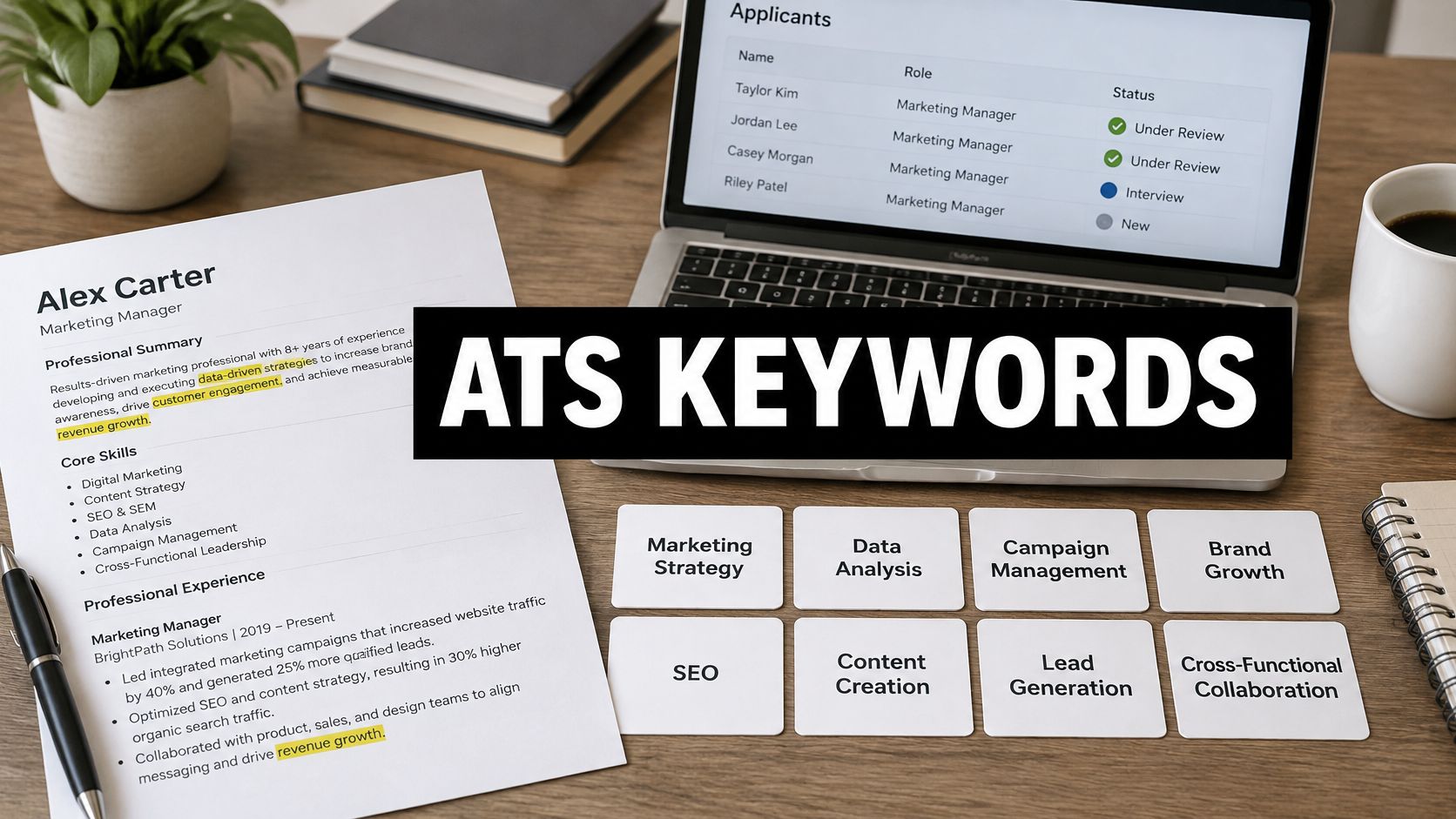
Your resume can miss a recruiter's shortlist without the ATS automatically rejecting it. In Enhancv's interviews with U.S. talent-acquisition professionals, 92% of the 25 participants said their ATS didn't automatically reject applicants based on resume format or content. That's a more useful starting point than the familiar claim that keyword filters reject most resumes before recruiters see them.
ATS keywords still matter. An applicant tracking system extracts resume text into fields, then employers can search, filter, or rank candidates against job requirements. Utah Valley University's ATS resume guide explains why both recognizable terms and standard section headings help software interpret your qualifications.
The best ATS words for resume writing aren't persuasive adjectives like dynamic or hardworking. They're defensible names for the tools, credentials, methods, and responsibilities in a specific job posting.
Use the role-specific sets below as menus, not copy-and-paste inventories. Put searchable terms in Skills, demonstrate them in Experience or Projects, and place formal qualifications under Certifications or Education. Keep your actual job titles accurate, expand unfamiliar abbreviations, and make every important keyword something you could explain in an interview.
1. Software Development and Engineering Keywords
JavaScript is more precise than coding. Node.js says more than backend technology. For development roles, start with the employer's named languages, frameworks, infrastructure, and engineering practices, then show what you built with them.

Choose terms from the relevant groups:
- Languages and frameworks: JavaScript, TypeScript, Python, Java, React, Node.js, Django.
- Infrastructure and delivery: Amazon Web Services (AWS), Docker, Kubernetes, Git, Continuous Integration (CI), Continuous Delivery (CD).
- Engineering work: REST APIs, unit testing, integration testing, code review, database design, microservices.
Connect the stack to the work
For a backend application, a scenario-based bullet could read: Built REST APIs in Node.js and PostgreSQL to support internal order processing, adding integration tests for payment-status updates. That tells the recruiter what you built, where the tools fit, and how you checked the work.
Keep the same technologies in a compact Technical Skills section. Exact naming matters: University of Illinois Chicago career guidance recommends specific product names and targeted keywords within achievement-oriented bullets rather than broad substitutes.
A role-tailored resume builder can help organize a draft, but review every suggested technology before keeping it. Candidates exploring opportunities for LATAM developers should apply the same discipline: match the advertised stack without implying experience they don't have.
Practical rule: List a technology only at a level you can defend. Coursework, a personal project, and production ownership are different kinds of evidence.
2. Data Analysis and Business Intelligence Keywords
A bullet saying created reports hides the qualifications a hiring team needs to evaluate. A better version identifies the data source, analytical method, reporting tool, and decision supported.
For example, a candidate applying to a commercial analytics role might write: Used SQL to combine sales and customer records, then built Power BI dashboards for regional revenue reviews. The sentence contains searchable terms without turning into a software inventory.
Separate tools from analytical methods
Build your keyword selection around the work in the posting:
- Querying and preparation: SQL, PostgreSQL, data cleaning, data validation, extract, transform, load (ETL).
- Analysis: exploratory data analysis, statistical analysis, forecasting, cohort analysis, regression analysis.
- Reporting: Microsoft Power BI, Tableau, Microsoft Excel, dashboards, data visualization, key performance indicators (KPIs).
Put software in Skills, analytical work in Experience or Projects, and earned credentials in Certifications. Don't bury a certification inside a long line of tools where a reader has to guess whether it's a qualification or a course title.
In Jobscan's vendor-associated recruiter survey, 76.4% of respondents reported filtering for skills, making clear skill names useful even though the survey shouldn't be treated as a universal labor-market estimate.
Use the following video as a supporting resource while reviewing your wording:
If the employer asks for Tableau and you've used Power BI, don't substitute the brand name. Explain the transferable reporting work, keep your actual tool, and describe Tableau training separately if you've completed it.
3. Project Management Keywords
Project management resumes need to distinguish how you delivered work from the administrative tasks surrounding it. Scheduling meetings isn't the same as managing dependencies, and updating a tracker isn't the same as owning delivery risk.

Choose the vocabulary that matches your actual responsibility:
- Delivery methods: Agile, Scrum, Kanban, Waterfall, sprint planning, backlog management.
- Project controls: scope management, risk management, dependency management, budget tracking, change control.
- Tools and qualifications: Jira, Asana, Microsoft Project, Project Management Professional (PMP), Certified ScrumMaster (CSM).
Make ownership explicit
Say a coordinator supports a software rollout. A credible bullet would be: Maintained the rollout schedule in Microsoft Project, tracked dependencies across operations and IT, and escalated unresolved risks to the project manager.
A delivery owner could use stronger wording: Led the software rollout, managing scope changes, vendor dependencies, and stakeholder approvals through launch. Both examples contain useful keywords, but they describe different levels of accountability.
Place methodology names in Skills and demonstrate them under the relevant job. Put certifications under Certifications, using the full issued name and abbreviation, and don't present exam preparation as an earned credential.
A methodology belongs on your resume because you used its practices, not because your team mentioned it in meetings.
Mirror the posting's terminology when it's accurate. If the employer emphasizes stakeholder management, describe whose approvals, expectations, or competing priorities you managed.
Add documented budget, team, or delivery scope where available. If you don't have reliable figures, name the departments, workstreams, or decision responsibilities instead of inventing scale.
4. Marketing and Digital Media Keywords
Channel names, platform names, and performance measures give marketing experience definition. Digital marketing alone doesn't tell a recruiter whether you managed paid search, wrote lifecycle emails, or developed an organic content program.

For a demand-generation application, consider Google Ads, paid search, landing page optimization, lead generation, conversion tracking, and customer acquisition cost (CAC). For an organic role, prioritize search engine optimization (SEO), keyword research, content strategy, Google Search Console, and organic traffic.
Show the channel and your contribution
Compare these scenario-based descriptions:
- Too broad: Supported digital campaigns and analyzed results.
- More useful: Managed Google Ads search campaigns, reviewed search terms, and revised landing page messaging to improve lead relevance.
- Organic alternative: Developed an SEO content plan using Google Search Console queries and coordinated updates with subject-matter experts.
Place your main channels and platforms in Skills. Use experience bullets to explain your contribution, then add performance figures only when you can verify the baseline, period, and result.
Spell out specialized metrics once, such as return on ad spend (ROAS) or marketing qualified leads (MQLs). Don't claim revenue ownership if you only reported on a campaign, and don't present clicks as proof of profitable acquisition.
Exact terminology remains useful, but context matters too. Dice's guide to job-search strategies discusses contextual skills matching, supporting a practical balance: name the relevant capability, then describe how you applied it rather than repeating it throughout the resume.
5. Sales and Business Development Keywords
Start a sales resume with the motion you know: outbound prospecting, inbound qualification, account expansion, channel sales, or enterprise sales. These terms help distinguish experience that can otherwise look identical under a generic sales title.
A candidate who books discovery calls shouldn't imply ownership of contract negotiations. Equally, an account executive shouldn't hide closing responsibility behind supported business development.
Choose keywords by sales responsibility
- Pipeline creation: lead generation, outbound prospecting, account research, cold calling, discovery calls.
- Deal progression: needs analysis, product demonstrations, objection handling, negotiation, pipeline management, sales forecasting.
- Systems and methods: Salesforce, HubSpot CRM, consultative selling, solution selling, MEDDIC, SPIN Selling.
Put the CRM in Skills and in the job where you used it. A scenario-based bullet could read: Managed opportunities in Salesforce, documented discovery findings, and coordinated technical demonstrations with solutions engineers.
For a business development representative, a more accurate example might be: Prospected target accounts, qualified inbound inquiries, and maintained HubSpot CRM records for account executive handoffs. The verbs make the scope clear without inflating seniority.
Credibility check: If you name a sales methodology, be ready to explain how it changed your qualification, discovery, or deal-review process.
Quota attainment, bookings, revenue, and pipeline value are useful evidence when accurately documented. Keep their meanings separate: generated pipeline isn't closed revenue, and a team result isn't automatically your individual result.
If the posting uses account management and your background is customer expansion, include that exact phrase only if you owned account relationships. Preserve official job titles and clarify your function in the summary or bullets instead of rewriting your employment history.
6. Customer Service and Support Keywords
A support resume should explain who you helped, through which channels, using which system, and under what service expectations. Excellent communication skills doesn't answer those questions.
Start with the job's service environment. A technical support position might call for troubleshooting and escalation management, while a contact-center role might emphasize case handling, call documentation, and service-level agreement compliance.
Useful terms include:
- Platforms and channels: Zendesk, Freshdesk, Intercom, Salesforce Service Cloud, live chat, email support, phone support.
- Service operations: ticket triage, escalation management, knowledge base maintenance, technical troubleshooting, SLA compliance.
- Measures and outcomes: customer satisfaction (CSAT), first contact resolution (FCR), response time, resolution time.
Turn soft skills into service evidence
For a billing-support scenario, write: Resolved billing inquiries through Zendesk email and live chat, documented account corrections, and escalated disputed charges under the team's approval process. This is stronger than a list of empathy, communication, and problem-solving.
For a technical support application, try: Troubleshot account-access issues, recorded diagnostic steps in the knowledge base, and coordinated escalations with engineering. Add a verified CSAT or resolution-time result if you have one, but don't manufacture an improvement to complete the sentence.
AI-assisted hiring doesn't make those distinctions less important. SHRM's talent trends coverage reports that 43% of surveyed organizations used AI to support HR, with recruiting among its applications.
Keep keywords defensible beyond the resume. If you list de-escalation, prepare an example showing how you clarified the problem, explained available options, and handled a difficult exchange within company policy.
7. Finance and Accounting Keywords
Credentials and reporting standards require exact wording. A candidate working toward a qualification must not appear to hold it, and familiarity with a reporting framework isn't the same as responsibility for preparing compliant statements.
Choose keywords according to the position's actual remit:
- Accounting operations: accounts payable, accounts receivable, general ledger, journal entries, bank reconciliation, month-end close.
- Reporting and analysis: financial reporting, budgeting, forecasting, variance analysis, cash flow analysis, internal controls.
- Standards, systems, and credentials: Generally Accepted Accounting Principles (GAAP), International Financial Reporting Standards (IFRS), QuickBooks, SAP, Microsoft Excel, Certified Public Accountant (CPA), ACCA.
Separate qualifications from working knowledge
List credentials exactly as issued under Certifications or Professional Qualifications. If a qualification is in progress, describe your actual status rather than presenting the completed designation after your name.
Use Skills for systems and reporting capabilities, then show the accounting task in Experience. For example: Prepared month-end journal entries in SAP, reconciled balance sheet accounts, and documented adjustments for controller review.
A financial analyst might instead write: Built Microsoft Excel budget models, investigated departmental variances, and prepared management reporting for operating reviews. These examples identify both the system and the work product without implying authority the candidate didn't have.
Name the standard you actually applied. Don't add GAAP and IFRS together simply because both appear in finance keyword lists.
Scope can make similar bullets meaningfully different. State whether you supported a department, multiple entities, consolidated reporting, or a defined portfolio, and add financial amounts only when accurate and appropriate to disclose.
When reviewing a keyword-match score, watch for misleading suggestions. A missing credential is a genuine qualification gap, not a wording problem that an editor should automatically fix.
8. Leadership and Management Keywords
Led, coached, hired, restructured, and developed are useful opening verbs only when the rest of the bullet explains what you did. Management keywords need evidence of people responsibility, decision-making, or organizational change.

A people-manager application might emphasize people management, performance management, coaching, hiring, succession planning, and employee development. A broader operational role might need change management, resource allocation, strategic planning, cross-functional leadership, and process improvement.
Distinguish leadership from direct management
For a manager scenario, write: Coached engineers through regular development conversations, clarified promotion expectations, and assigned project ownership to strengthen delivery capability. Add verified team size or promotion outcomes when available.
For an individual contributor, a more honest version could be: Led cross-functional planning for a platform migration, coordinating engineering, support, and operations stakeholders. That demonstrates leadership without implying direct reports.
Use a short summary to establish your management scope, a Skills section for relevant functions, and experience bullets for proof. Avoid filling the summary with visionary, transformational, or results-driven when plain descriptions of your decisions would be more persuasive.
- People management: Identify who you managed and your responsibility for feedback, development, or hiring.
- Change management: Explain what changed and how you handled adoption or resistance.
- Strategic planning: Name the priorities, trade-offs, or resource decisions you helped define.
Then pressure-test the wording through practice with an AI interviewer. If you can't explain a leadership bullet through a specific decision, your own contribution, and an observable result, narrow the claim before submitting it.
ATS Keyword Sets by Role
| Keyword Set | Core Term Types | Highest-Weight Terms | Best Placement | Best For |
|---|---|---|---|---|
| Software Development and Engineering Keywords | Languages, frameworks, cloud tools, databases, methods | Exact technology names, frameworks, CI/CD, Agile | Skills section and contextual experience bullets | Developers and software engineers |
| Data Analysis and Business Intelligence Keywords | Query languages, BI tools, analytical methods, data platforms | SQL, Python, Tableau, Power BI, statistical methods | Skills section and results-focused experience bullets | Data analysts, BI specialists, and data scientists |
| Project Management Keywords | Methodologies, certifications, planning tools, delivery metrics | PMP, Agile, Scrum, risk management, Jira | Certifications and project experience bullets | Project coordinators, project managers, and program managers |
| Marketing and Digital Media Keywords | Channels, platforms, performance metrics, campaign methods | SEO, Google Analytics, ROAS, conversion rate | Skills section and campaign achievement bullets | Marketers and digital media professionals |
| Sales and Business Development Keywords | CRMs, sales methods, pipeline terms, performance metrics | Salesforce, quota attainment, pipeline management, win rate | Skills section and measurable sales achievements | Sales representatives and business development professionals |
| Customer Service and Support Keywords | Help desk tools, service metrics, support channels, processes | Zendesk, CSAT, SLA compliance, ticket triage | Skills section and service outcome bullets | Customer service and support professionals |
| Finance and Accounting Keywords | Credentials, accounting software, standards, reporting terms | CPA, GAAP, IFRS, QuickBooks, financial modeling | Credentials, skills section, and reporting experience | Finance and accounting professionals |
| Leadership and Management Keywords | People management, hiring, strategy, budgets, communication | Team leadership, people management, change management | Leadership experience bullets with team scope and outcomes | Managers and organizational leaders |
Turn Keywords Into Interviews. Your Next Steps
The strongest ATS words for resume writing come from a specific job posting and truthful evidence. A generic keyword bank is a starting point, not a finished application.
Separate must-name qualifications from capabilities you need to demonstrate. Programming languages, licenses, software, and certifications usually need explicit names; leadership, communication, and problem-solving need examples of your behavior and contribution.
Use this checklist before submitting:
- Pick the relevant role set: Start with your target function, then remove terms that don't match your background.
- Mirror a specific posting: Identify its required tools, qualifications, responsibilities, and terminology. Keep exact phrases where they truthfully describe your experience.
- Place terms where they belong: Put tools and capabilities in Skills, credentials in Certifications, and supporting evidence in Experience or Projects.
- Quantify supported achievements: Add documented scope, workload, time, revenue, or service outcomes. If reliable figures aren't available, describe the work and result precisely.
- Test your match score: Review missing terms, distinguish wording gaps from qualification gaps, and reject any suggested change that overstates your experience.
- Check the exported document: Confirm that contact details, dates, employer names, titles, and bullets remain readable and in order.
Formatting deserves a separate check. George Mason University's resume guidance recommends clean layouts, standard headings, and simple formatting rather than complex visual structures that can interfere with parsing.
Follow the employer's file instructions first. For a PDF, try selecting and copying the text into a plain document; the University of Connecticut's ATS guidance warns that a scanned resume may contain an image rather than extractable text.
Our Resume Maker builds a resume suited to the role you're applying for and shows an ATS score so you can review keyword coverage. Treat the score as an editing aid, not proof that an employer will shortlist you or that every ATS will interpret the document identically.
Once your application clearly communicates your qualifications, prepare to substantiate them. Our free mock interview lets you practice with an AI interviewer, making it a logical next step after tailoring your resume.
Choose a live vacancy, revise the relevant bullets, and read each claim aloud before submitting. You should be able to explain every important term through work you performed.
ParakeetAI offers a role-specific Resume Maker with an ATS score and a free mock interview to help you prepare beyond the application. Visit ParakeetAI to refine your keyword coverage, then practice explaining the experience behind your strongest resume bullets.