8 Interview Questions by Company: Roles and Prep for 2026
Two candidates can walk into the same role and leave with completely different interviews. One rehearsed generic answers about teamwork and strengths. The other mapped a few stories to the company's stated values and practiced the format that employer uses, whether that is a behavioral loop, a case, or a coding round with follow-ups. The first candidate sounds polished for about a minute. The second can survive the second and third question.
That gap is why interview questions by company change how you prepare. A recurring prompt is not trivia. It is usually a competency the employer wants to see in a repeatable way, such as ownership, judgment, technical reasoning, or how you handle conflict. I would rather you know which prompts come from a published values document or official careers guidance, and which ones are only candidate reports, than memorize a long unofficial list.
This guide covers eight company-specific sets. Each one is labeled by how reliable the source is, what the questions tend to test, and how to practice without treating a rumor as a script.
1. Amazon Leadership Principles Interview Questions
Source label: published values, with behavioral prompts you should treat as practice, not a guaranteed script.
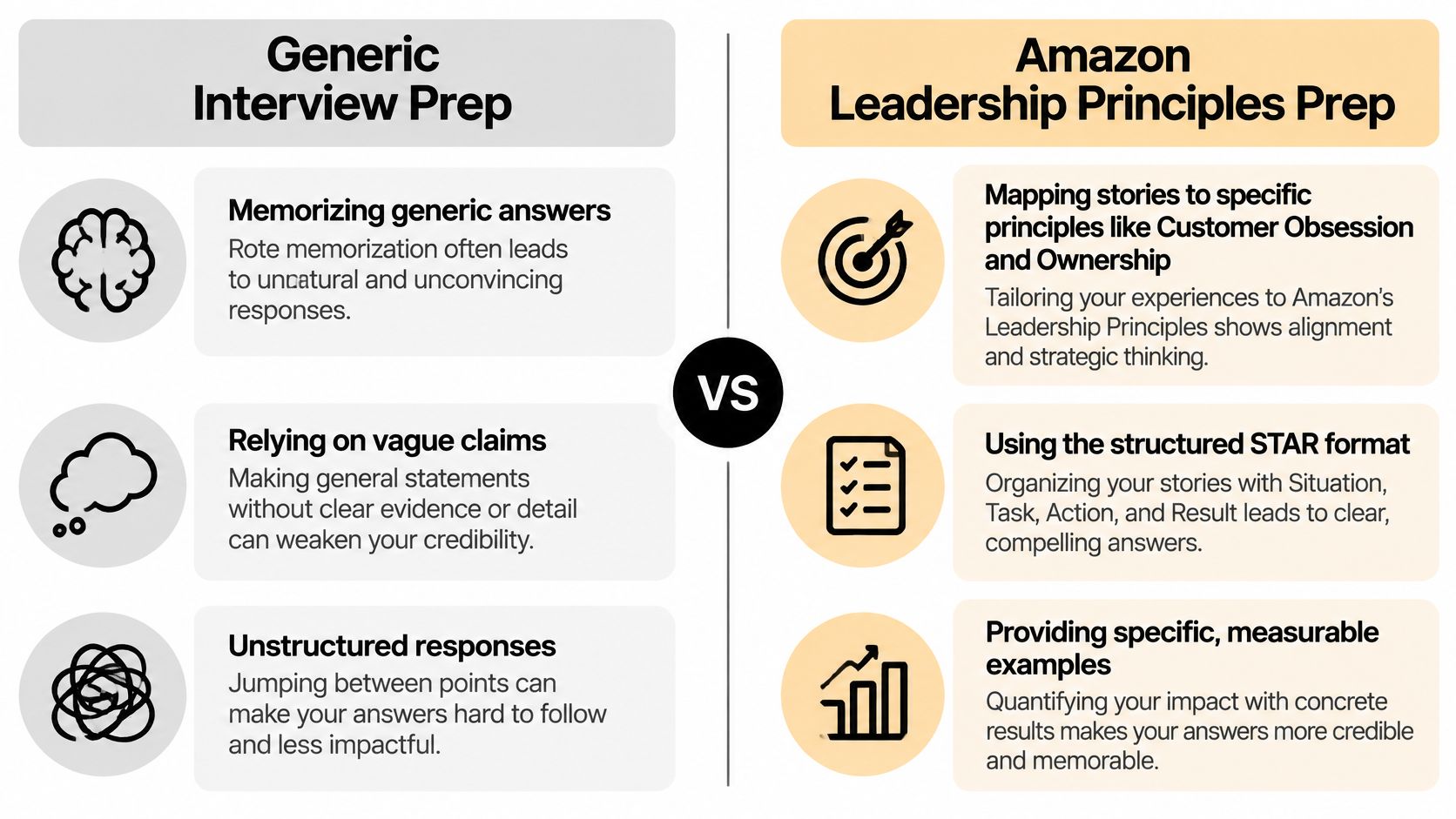
Amazon's public Leadership Principles are one of the clearest company frameworks a candidate can study. Principles such as Customer Obsession, Ownership, Bias for Action, Dive Deep, and Have Backbone; Disagree and Commit tell you what "good" is supposed to look like. Interviewers in this style usually want a past situation, what you personally did, and what changed afterward. The useful format is STAR: situation, task, action, result.
The U.S. Office of Personnel Management describes highly structured interviews as having higher validity, stronger rater reliability, greater agreement among interviewers, and less adverse impact when questions come from job analysis. Amazon's loop is not an OPM exam, but the same idea applies. A question tied to a named principle is a better signal than a free-form chat about your personality.
Say you disagreed with a manager about shipping a feature before the data was clean. That story can map to Have Backbone; Disagree and Commit if you show the disagreement, the data you used, the decision you accepted, and the outcome. A story about fixing a broken handoff nobody assigned you maps more cleanly to Ownership or Bias for Action. One story can carry two tags. Don't force it onto five.
Build a small tagged story bank
Generic prep fails here because "I'm a team player" doesn't name a decision. Effective prep is a bank of 8 to 12 stories, each tagged with the principles it demonstrates.
- Keep the first pass short: Aim for a few minutes, then leave room for two or three follow-ups on your numbers, your alternatives, and what you would do differently.
- Quantify the result: Cycle time, error rate, revenue, tickets closed, or customers affected beats "it went well."
- Separate your action from the team's: Ownership questions fall apart when every sentence starts with "we."
Practical rule: If you can't name the principle a story proves in one line, it isn't ready for this loop.
What doesn't work is writing 16 perfect scripts. Interviewers change the angle. A disagreement story becomes a prioritization story if they ask what you dropped to make the change. Tags let you reuse evidence without sounding memorized.
2. Google Structured Interview Question Sets
Source label: official process guidance, not a published list of exact questions.
Google's own careers guidance tells applicants to expect a structured hiring process and to learn the application and interview stages before they show up. The Google Careers "How we hire" guidance is the right anchor for a company guide. It supports organizing prep by stage, screening, interviews, and the hiring decision. It does not publish one universal question script, so I won't pretend a blog list is official.
That distinction matters because structure is what makes an interview predictive. A 2022 re-analysis by Paul Sackett and colleagues, summarized by Pulsifi, reported an operational validity of 0.42 for structured interviews, compared with 0.19 for unstructured interviews. Validity here is the statistical relationship between interview results and later job performance. Zero means no predictive relationship. One would be perfect. Structured interviews sit among the stronger widely used selection methods in that research. Unstructured conversation is a much weaker signal.
Candidate communities often describe scoring against predefined criteria such as general cognitive ability, role-related knowledge, leadership, and Googleyness, Google's term for collaboration and comfort with ambiguity. Treat those labels as widely reported practice, not as a script Google has posted question by question. Coding rounds commonly ask you to solve a problem while explaining your reasoning. Behavioral rounds often probe how you worked through unclear requirements.

What to practice when the script isn't public
Think out loud on technical problems. The interviewer is scoring the path, not only the final function. When you pick a data structure, say what you gave up. A faster lookup can cost memory. A simpler design can be easier to test.
Google's recruiting materials also include an equal-opportunity statement and access to applicant-rights information, as noted on Google's careers pages. Questions should stay relevant to the role. Don't volunteer protected characteristics, and don't treat a personal tangent as part of the evaluation.
Check the current role page before you build a study plan. Stage names and expectations move, even when the structured idea stays.
A worked example: you're asked how you handled ambiguous requirements on a past project. Spend one sentence on the mess, then most of the answer on how you clarified users, what you shipped first, how you tested it, and what metric moved. That is role evidence. A tour of the org chart is not.
3. Meta Product Sense and Coding Interview Question Sets
Source label: candidate reports. Useful patterns, not an official question book.
Meta doesn't hand candidates a public principle list the way some employers do. What circulates is interview-loop detail from people who went through product and engineering rounds. I treat that as a pattern, not a promise. Product loops are often described as product sense, plus analytical and execution questions. Engineering loops are often described as coding plus system design. Both are trying to see whether you can reason about a large consumer product without hand-waving.
A product sense prompt might be, "How would you improve this feature for a specific user segment?" An analytical prompt might be, "A key engagement metric dropped overnight. How do you investigate?" Those are practice prompts in the shape candidates report. They are not a claim that your interviewer will read them verbatim.
A framework that survives the follow-up
Use four moves and say them out loud.
- Clarify the goal: Who is the user, and what decision are you trying to change?
- Define the constraint: Platform, trust, latency, or a metric the team already owns.
- Propose a few options: Pick one and say why you rejected the others.
- Name the metric: What would tell you the change worked, and what would tell you it hurt something else?
Say the prompt is a drop in comments on a video product. A weak answer jumps to "add notifications." A stronger answer splits the drop by new versus returning users, by app version, and by whether posting failed or people stopped opening the composer. Then you pick one instrumentation check and one product hypothesis. You can be wrong. You can't be vague.
For coding, practice explaining trade-offs while you write, the same way you would in any serious technical loop. Generic memorized answers collapse when someone asks why you chose that API, how you would test it, or what happens at a larger input size.
The Question Bank groups real interview questions by company and ranks them by how often they come up, which is a practical way to see Meta-tagged prompts beside the role you want. Use it to find patterns. Still assume your loop can swerve.
Timed practice helps more than rereading a list. Set a timer, answer one product prompt in a few minutes, then do the follow-up you hope they won't ask. That second pass is where most candidates lose the round.
4. Netflix Culture-Based Interview Question Sets
Source label: published culture guidance. Exact questions are still interviewer-specific.
Netflix publishes a culture document, and that document is the prep, not a leaked questionnaire. It puts weight on judgment, communication, impact, curiosity, and candor. It also describes a high-performance environment in which strong contributors are paid well and weak performance isn't carried for long. If you haven't read that document, you're guessing at the traits the company says it hires for.
Available interview-statistics summaries report that 61% of job seekers prepare answers to common questions in advance, while 41% have difficulty articulating accomplishments effectively, and 47% fail to research the company, according to OneHour Digital's summary of behavioral interview statistics. Those figures are directional benchmarks from secondary summaries, not universal rates. They still describe the failure mode I see in culture interviews. People rehearse "tell me about yourself" and never read the document that explains the room.
Candor is the test, not the slogan
A question about giving a colleague direct feedback is a candor prompt. A question about deciding with partial data is a judgment prompt. Both punish polished vagueness.
Work a real example. You told a teammate their launch note buried the risk. You did it in the meeting, not three days later in chat. You named the missing rollback plan, offered a rewrite, and the launch slipped one day instead of failing in production. That answer shows candor and accountability. An answer that only says "I believe in radical honesty" shows neither.
- Read the culture document the week of the interview: Note the phrases the company uses, then match stories to those phrases.
- Include a mistake: Accountability stories need a cost, not only a win.
- Show the reasoning: On a partial-data decision, say what you knew, what you assumed, and what you checked afterward.
What doesn't work is performing intensity. Netflix's document is not a request for drama. If your story makes you the hero and everyone else slow, rewrite it until the decision is visible.
5. Consulting Case Interview Question Sets (McKinsey, BCG, Bain)
Source label: firm-published prep materials plus a shared case format. Individual cases change.
McKinsey, BCG, and Bain each publish their own practice guidance, and each has a house style. The core is still shared. You get a business problem, you structure it, you use the data you're given, and you recommend a course of action under time pressure. That set matters because it tests structured thinking beyond any one employer. A profitability case at one firm still teaches you how to behave at the others.
A profitability prompt might ask why margins fell over the past year. A market-sizing prompt might ask how many units of a product could sell in a given city. Neither is a secret. Both are drills. The interviewer is listening for a hypothesis, clean math, and whether you update when the data disagrees with you.
A short walkthrough of a case interview shows the rhythm better than a written outline. Watch how the candidate states a structure before touching the numbers.
Hypothesis first, then the math
State a hypothesis early. "Margins fell because price discounts outran any cost cut" is testable. "There are many factors" is a stall. Then ask for the cuts that would confirm or kill that idea, revenue versus cost, price versus volume, one product line versus the whole book.
For market sizing, say the assumptions out loud and keep them rough. Population, share who could use the product, purchase frequency, price. Round so the interviewer can follow. Precision theater with fake decimals doesn't help.
- Drive the case: Check in after each branch instead of monologuing for eight minutes.
- Label your arithmetic: "I'll take 2 million households times 10 percent, so 200,000."
- Close with a recommendation: Name the action, the main risk, and the one piece of data you'd want next.
Rehearse timing with a timed mock interview, where you speak to an AI interviewer and then read the transcript. The first mock is free, and you don't need a card to try it. Cases punish silent thinking. If the structure only exists in your head, it doesn't count.
6. Microsoft Growth Mindset Behavioral Question Sets
Source label: public culture emphasis, with behavioral and technical rounds that vary by role.
Microsoft has talked for years about a growth mindset under its leadership, and behavioral questions often follow that lead. Learning, setbacks, and cross-team collaboration show up more often than clever self-promotion. Technical roles still include coding and design. The culture language doesn't replace the technical bar. It changes which stories are worth telling beside it.
I treat the official careers and culture pages as the stable source, and candidate-reported prompts as practice. A question about a project that failed, and what you changed afterward, is the classic shape. So is a question about learning a skill quickly because the team needed it. Don't claim either one is guaranteed on your loop.
Show the change, not the attitude
"I love learning" is an attitude line. Interviewers can't score it. They can score a before-and-after.
Picture a service that missed its latency target after a dependency change. You owned the postmortem, learned the tracing tool the other team already used, added one alert that would have caught the regression, and the next release caught a similar issue in staging. That is a growth story. It has a failure, a skill you didn't have on Monday, and an outcome someone else could verify.
Prepare two or three setback stories, not a greatest-hits reel of ten. Use specific actions. "I paired with the on-call engineer for a week and rewrote the runbook" beats "I embraced feedback."
Review Microsoft's current culture pages before you lock the wording. Values language shifts, and you want the phrases the company uses now, not a memory of a keynote. If the role is technical, spend at least as much time on design trade-offs as on the mindset story. A beautiful learning narrative won't carry a design round you haven't practiced.
A setback answer should name what you stopped doing, not only what you started saying.
What doesn't work is a failure with no cost. If the project "failed" and nothing changed for users, the interviewer hears a humblebrag. Pick a miss that stung, then show the repair.
7. Company-Tagged Question Banks (Glassdoor, Blind, LeetCode)
Source label: candidate reports and community tags. Indicators, not official questions.
This is the layer many candidates have in mind when they search interview questions by company. Glassdoor and Blind host interview write-ups with rounds, timelines, and question types. LeetCode lets you filter problems by company tag. Those sets are practical. They are also unverified. One detailed post can be an outlier, a different role, or a process the team has already changed.
The reliability problem got sharper as applications got easier to fake. In a survey of nearly 1,350 recruiters and hiring managers across the US, UK, Ireland, Germany, and Australia, 86% said they had changed hiring processes because of fake or AI-generated applications, 57% of those employers added an extra human interview, and 81% identified applicants attempting to evade AI systems, according to HR Dive's report on AI use in applications. An exact-question database gets less reliable when employers respond with adaptive probes, work samples, and a human round that checks whether you can explain your own resume.
How to read a tag without being fooled by it
Look for the same topic across several recent reports, not one dramatic post. Separate role-specific questions from process notes. "We had a system design round" is more stable than a single problem title. Date matters. A question from several years ago can still be good practice and a bad prediction.
- Treat tags as drills: A company-tagged coding problem is a way to practice a topic, not a promise it will appear.
- Cluster by theme: Group reports into coding, design, behavioral, and hiring-manager rounds before you study.
- Prepare the follow-up: For every claim on your resume, know the constraint, the test, and the metric.
- Check it with someone else: A peer or coach will hear the memorized sentence you can't hear yourself.
Say three Glassdoor reports for a backend role mention debugging a production incident and one mentions a puzzle about bridges. Practice the incident. Skip the puzzle until it shows up again. That is how you tell a company habit from a single applicant's memory.
What doesn't work is collecting 200 problems and recognizing them by title. Interviewers who added a human check are listening for whether you can re-derive the answer when the prompt shifts by one constraint.
8. Company-Specific Interview Question Practice with AI Tools
Source label: your own practice set, built from official guidance first and candidate reports second.
A static list doesn't become skill until you say the answers under a clock. The workflow I recommend is short. Collect questions for one company. Mark each as published guidance or candidate report. Rehearse a small set out loud. Rewrite the weak ones. Repeat.
Recent multi-market evidence shows why format matters as much as the question text. The Greenhouse 2026 candidate AI interview report found that 63% of surveyed job seekers in the US, UK, Ireland, Germany, and Australia had already experienced an AI interview, 70% were not clearly informed beforehand, and 38% had abandoned a hiring process because it included one. More automation has not made candidates want less human involvement. The leading preferences in that research are stronger disclosure, an explanation of what the AI measures, and the option to request a human interview.
Practice for the room you might actually get
Before you consent to a recorded or scored interview, ask what is being evaluated, whether a person reviews it, and how you can request a human conversation. That question is reasonable. It is also preparation, because a clear answer tells you whether to optimize for a rubric or for a conversation.
For rehearsal, pick 10 to 15 questions for one company and rotate them. Five behavioral prompts in a timed sitting will show you where you ramble. A technical explanation, recorded or transcribed, will show where the reasoning skips.
ParakeetAI's mock interview is built for that spoken pass. You practice out loud against an AI interviewer that answers back, then you read the transcript. Our mock interview is one place to start before a live loop. Use it on questions you chose, including company-grouped prompts, and rewrite anything that only makes sense on the page.
Two cautions. Don't paste a model answer into the interview. Employers are already adding human checks because coached and synthetic answers are common. And don't use an assistant in a process where the employer, school, or caller has said no. If assistance is allowed, a tool that never joins the call can sit with your notes. If it isn't allowed, close it.
A clean week looks like this. Monday, read the company's public values or careers page. Tuesday, pull 10 prompts and label the source. Wednesday and Thursday, speak five each day and cut every answer that runs long. Friday, redo the three you stumbled on. That plan beats another night of scrolling question titles.
How the 8 company question sets compare
| Item | Question style | Best for | Main prep focus |
|---|---|---|---|
| Amazon Leadership Principles Interview Questions | Behavioral questions mapped to named principles; STAR-style answers and follow-up probes | Candidates targeting Amazon roles | Prepare distinct, measurable stories mapped to several principles |
| Google Structured Interview Question Sets | Structured technical and behavioral rounds with predefined scoring criteria | Candidates seeking roles with technical or analytical assessments | Explain reasoning, trade-offs, and collaboration clearly |
| Meta Product Sense and Coding Interview Question Sets | Product sense, analytical, coding, and system design questions | Product and engineering candidates | Structure answers around users, goals, solutions, and metrics |
| Netflix Culture-Based Interview Question Sets | Behavioral questions about judgment, candor, autonomy, and decisions with incomplete information | Candidates comfortable with direct communication and autonomy | Prepare candid examples that show accountability and sound judgment |
| Consulting Case Interview Question Sets (McKinsey, BCG, Bain) | Business cases involving structured analysis, quantitative work, and recommendations | Candidates pursuing management consulting roles | Practice hypothesis-driven problem solving, mental math, and clear communication |
| Microsoft Growth Mindset Behavioral Question Sets | Behavioral questions about learning, setbacks, collaboration, and empathy, sometimes paired with technical questions | Candidates pursuing Microsoft roles | Prepare specific stories about learning from setbacks and improving |
| Company-Tagged Question Banks (Glassdoor, Blind, LeetCode) | Company- and role-tagged questions based on candidate reports and problem banks | Candidates researching interview trends for a specific company and role | Compare multiple reports and treat questions as practice prompts, not guarantees |
| Company-Specific Interview Question Practice with AI Tools | Timed mock interviews using company-focused questions, with feedback and revision | Candidates seeking flexible, repeatable interview practice | Rotate through questions, review recorded answers, and verify AI feedback |
Turning Company Question Lists Into a Preparation Plan
Start with what the company has published. Amazon's Leadership Principles, Netflix's culture document, Microsoft's growth-mindset language, a consulting firm's own practice cases, and Google's description of a structured hiring process are the stable layer. Candidate reports from Glassdoor, Blind, and company tags on LeetCode are the practice layer. They show themes. They don't guarantee your interviewer will ask that item on that day.
Build a small story bank before you touch a giant list. Eight to twelve examples, each with a result you can quantify, will cover more behavioral prompts than fifty half-written scripts. Tag them by competency, not by a single company, so you can retarget the same evidence when the wording changes. For technical roles, attach the decision to each project. Constraints, tests, what you measured, and what you would revisit. Follow-ups are where memorized answers die.
Rehearse out loud with a timer. Reading in your head makes every answer feel tight. Speaking shows the detour, the missing number, and the moment you start narrating the team instead of your action. Review the recording or the transcript the same day, while you still remember what you meant to say. Then cut. A few minutes plus room for two follow-ups is enough for most behavioral prompts. Cases and design rounds need a visible structure even earlier.
Separate confidence from certainty. Prepare hard for published values and official stage descriptions. Use reported questions as drills, and prefer a pattern that shows up in several recent write-ups over a single vivid post. If a company has added an extra human round or an AI-scored screen, ask what is being measured and whether you can speak with a person. Disclosure is part of a fair process, and your prep should match the format you will face.
Pick one company this week. Choose 10 questions. Label each one as published guidance or a candidate report. Run one timed practice session, then rewrite the two answers that wandered. That is a preparation plan. A longer list without a spoken rep is still just a list.
ParakeetAI is an interview assistant and a set of practice tools for this kind of company-specific prep. The Question Bank groups questions candidates were asked by company, and the mock interview lets you practice those prompts out loud, then read the transcript. If you want to turn a target company's question list into repeated practice before a live interview, visit ParakeetAI.