
How to Prepare for Microsoft Interview: Step-by-Step Success

Landing your dream engineering job at Microsoft can feel like an intense puzzle with many moving parts. Every candidate faces timed coding tests, live design challenges, and behavioral rounds that demand both technical precision and clear communication. Knowing exactly which core skill areas to prioritize and what each Microsoft interview stage looks like sets you apart from the crowd. This guide helps you cut through uncertainty and build a plan that targets each phase of Microsoft’s rigorous interview process.
Table of Contents
- Step 1: Assess Required Skills And Microsoft Interview Format
- Step 2: Gather Essential Resources And Practice Coding Solutions
- Step 3: Simulate Microsoft Questions With AI Job Interview Assistant
- Step 4: Review Feedback And Refine Interview Strategies
- Step 5: Verify Readiness And Optimize Final Preparations
Quick Summary
| Key Point | Explanation |
|---|---|
| 1. Understand core skills needed | Familiarize yourself with data structures, algorithms, system design, and role-specific knowledge relevant to Microsoft positions. |
| 2. Utilize effective practice resources | Leverage platforms like FreeCodeCamp, LeetCode, and the Blind 75 list to focus on high-impact problems to enhance your preparation. |
| 3. Conduct mock interviews with AI | Practice realistic interview scenarios using AI tools to simulate the pressure and receive tailored feedback on your responses and approach. |
| 4. Review and act on feedback | Organize feedback from mock interviews to identify patterns, improve specific weaknesses, and refine your coding and communication skills. |
| 5. Finalize your interview readiness | Verify technical skills, research the company thoroughly, and prepare thoughtful questions to engage your interviewer effectively during the actual interview. |
Step 1: Assess required skills and Microsoft interview format
Microsoft’s interview process tests your technical depth across multiple dimensions. Understanding what they evaluate helps you focus your preparation effectively and build confidence before you interview.
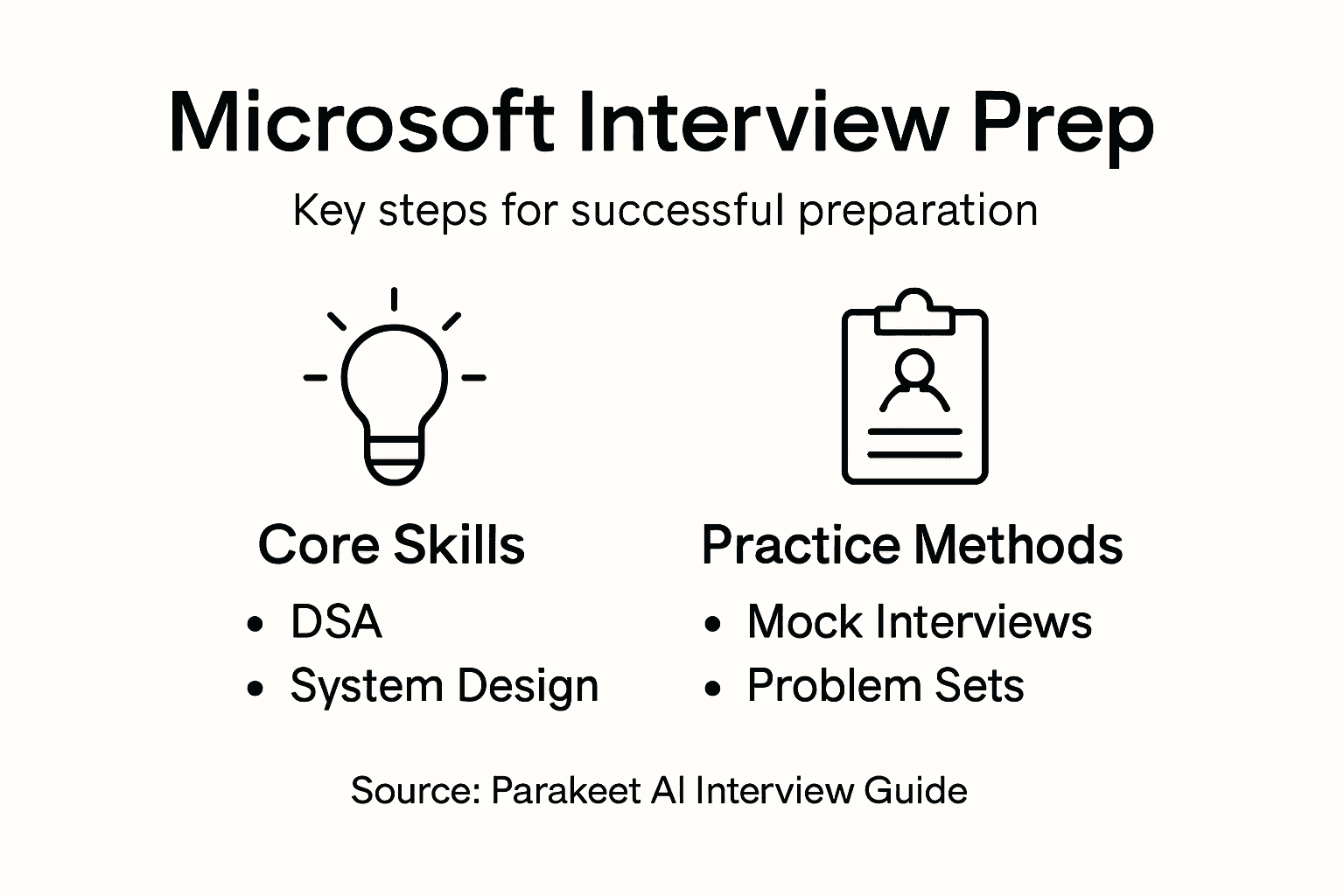
Start by recognizing the core skill areas Microsoft prioritizes. The initial screening typically involves a coding test focusing on data structures and algorithms, including arrays, strings, and linked lists. Later technical rounds explore operating systems, networking, and databases tailored to your specific role.
Technical skills you need:
- Data structures and algorithms (arrays, linked lists, trees, graphs, hash tables)
- Problem-solving ability under time constraints
- System design and architecture thinking
- Core computer science concepts (operating systems, databases, networking)
- Role-specific knowledge (cloud engineering, AI frameworks, backend systems)
Next, familiarize yourself with the actual interview format. Microsoft uses multiple rounds spanning several weeks. Expect a screening round conducted by phone or video, a series of technical interviews involving live coding and design discussions, and often a behavioral round assessing your fit with Microsoft’s culture.
Here’s a comparison of Microsoft interview rounds and their typical focus:
| Interview Round | Key Skills Evaluated | Typical Format |
|---|---|---|
| Screening | Coding basics, problem-solving | Phone or video call |
| Technical Interviews | Algorithms, system design | Live coding, design analysis |
| Behavioral Interview | Communication, cultural fit | Discussion, scenario review |
Microsoft interviews emphasize both algorithmic skills and problem-solving tests, meaning you’ll solve coding challenges while explaining your approach. Interviewers also evaluate how you ask clarifying questions, handle edge cases, and communicate your thinking.
Determine your specific role’s requirements. A software engineer position emphasizes DSA and system design. A cloud engineer role requires cloud platform knowledge. An AI engineer position focuses on machine learning concepts and algorithm optimization. Review the job description carefully.
Your preparation strategy depends entirely on understanding which skills matter most for your target role, so invest time here before coding.
Pro tip: Create a personal skill matrix listing each technical area (DSA, system design, databases) and rate yourself honestly on each, then allocate study time proportionally to your weakest areas rather than spending equal time everywhere.
Step 2: Gather essential resources and practice coding solutions
You need the right materials and a structured practice routine to build coding confidence. The goal here is to collect proven resources and establish a consistent practice schedule that mirrors real interview conditions.

Start by identifying your primary learning platforms. Free resources like FreeCodeCamp offer extensive collections covering algorithms, data structures, and mathematics problems essential for Microsoft interviews. Paid platforms such as LeetCode and HackerRank provide curated problem sets with difficulty ratings and company-specific filters.
Focus your practice on fundamental data structures first. Master arrays, linked lists, trees, graphs, and hash tables before moving to complex algorithms. This foundation makes later problems feel less overwhelming and helps you recognize patterns across different challenges.
Consider using curated problem sets to maximize your preparation time. The Blind 75 list contains the most frequently asked problems across top tech companies, including Microsoft. This focused approach beats trying to solve hundreds of random problems.
Here is a summary of recommended study platforms and their advantages:
| Platform | Type | Unique Advantages |
|---|---|---|
| FreeCodeCamp | Free | Broad curriculum, beginner-friendly |
| LeetCode | Paid | Company-specific filtering |
| HackerRank | Paid | Difficulty ratings, realistic tests |
| Blind 75 List | Free | Most frequent tech interview topics |
Your practice framework:
- Solve 2 to 3 problems daily with a timer (20 to 30 minutes per problem)
- Write clean, efficient code under timed conditions simulating real interviews
- Explain your approach out loud while coding to practice communication
- Review solutions and understand multiple approaches to each problem
- Track which problem types give you trouble and revisit them weekly
Practice writing code by hand or in a text editor without autocomplete. This forces you to remember syntax and think more carefully about your solution. Many candidates stumble during interviews because they relied on IDE features during preparation.
The quality of your practice matters far more than the quantity of problems you solve, so focus on understanding each solution deeply rather than rushing through more problems.
Set a 4 to 6 week timeline for focused practice. Dedicate the first 2 weeks to fundamentals, the next 3 weeks to medium-level problems, and the final week to tougher challenges and mock interviews with peers.
Pro tip: Record yourself explaining a problem solution as if talking to an interviewer, then watch the recording to catch filler words, unclear explanations, and pauses—this self-awareness transforms your communication during actual interviews.
Step 3: Simulate Microsoft questions with AI job interview assistant
Mock interviews are where preparation transforms into confidence. Using an AI job interview assistant lets you practice realistic scenarios repeatedly without scheduling pressure or judgment from others.
Start by selecting an AI-powered mock interview platform designed for technical interviews. These tools simulate real interview conditions by generating dynamic questions tailored to your target role. AI-based mock interview platforms use natural language processing and deep learning to provide personalized feedback on both technical responses and communication style.
Begin with easier difficulty levels and progressively increase challenge. Your first session should feel comfortable so you build momentum. Gradually move toward Microsoft-style questions that test system design, algorithm optimization, and behavioral fit.
How to structure your mock interview sessions:
- Schedule 1 to 2 sessions weekly over your final month of preparation
- Choose questions randomly to avoid memorization
- Set a timer matching real interview pacing (45 to 60 minutes total)
- Speak your solutions out loud, explaining each step clearly
- Review AI feedback on your code quality, problem-solving approach, and communication
Focus on areas where the AI identifies weaknesses. If feedback shows you’re skipping edge cases, practice specifically on that. If your communication seems rushed, slow down deliberately in subsequent attempts.
Pay special attention to behavioral questions during these sessions. Microsoft evaluates cultural fit alongside technical ability. The AI can assess whether you articulate your motivation clearly and demonstrate Microsoft’s leadership principles.
Mock interviews fail when you treat them casually—approach each session as if it were the real thing, and you’ll eliminate interview-day surprises.
Record key feedback items from each session and identify patterns. Are you struggling with specific data structures? Do you freeze under time pressure? Target these issues in your daily problem practice between mock interviews.
Pro tip: After completing a mock interview, watch your recorded session and note every instance where you hesitated, said “um,” or explained poorly—then redo that specific question the next day focusing only on clarity and confidence.
Step 4: Review feedback and refine interview strategies
Feedback is only valuable if you act on it. This step transforms your mock interview results into concrete improvements that directly impact your real interview performance.
Start by organizing feedback systematically after each mock interview session. Create a simple spreadsheet tracking the question, your approach, feedback received, and areas to improve. This prevents valuable insights from getting lost and reveals patterns you might otherwise miss.
Focus on three categories when reviewing feedback. Technical issues include algorithm efficiency, code quality, and handling edge cases. Communication problems involve unclear explanations or missing context when describing your solution. Behavioral gaps show where your answers don’t align with Microsoft’s leadership principles or cultural expectations.
Iterative practice and learning from mistakes while reinforcing core concepts are essential to improving interview performance. This means identifying specific weaknesses and targeting them deliberately rather than randomly solving more problems.
Your feedback review process:
- Read through all feedback with fresh eyes the next day
- Identify the top 3 most critical issues to address
- Revisit the specific problem that generated feedback
- Reattempt the problem with your improvements in mind
- Compare your new solution to your original attempt
- Move forward to new problems once you’ve solidified the concept
Pay attention to recurring feedback patterns. If multiple sessions show you’re missing edge cases, spend dedicated time on constraint analysis before coding. If communication feedback appears repeatedly, record yourself explaining simple problems and listen critically.
The candidates who improve most rapidly are those who treat feedback like actionable intelligence, not criticism—use it to adjust your approach, not to doubt your ability.
Refine your problem-solving strategy based on what the feedback reveals. Are you jumping to solutions too quickly? Slow down and spend more time understanding constraints. Are you overthinking simple problems? Practice recognizing patterns faster.
Track your progress across sessions. You should see measurable improvement in problem-solving speed, code quality, and explanation clarity within 2 to 3 weeks of focused refinement.
Pro tip: Create a “common mistakes” document listing every error from your mock interviews—before each new session, review this list for 5 minutes to prime your brain to avoid repeating the same patterns.
Step 5: Verify readiness and optimize final preparations
You’re in the final stretch. This step ensures you’ve covered all technical, logistical, and mental bases before your Microsoft interview arrives.
Start with a technical readiness assessment. Run through your most challenging problem types one final time. Can you solve a medium-difficulty problem in under 30 minutes? Do you explain your approach clearly? If you’re hesitating or struggling, you need one more week of focused practice before interviewing.
Next, verify your company and role knowledge. Research Microsoft’s recent product launches, engineering challenges, and leadership principles deeply. Understand which division you’re interviewing for and what problems that team solves. Understanding the interview type, reviewing commonly asked questions, and practicing the articulation of your professional story optimizes confidence and performance.
Your final readiness checklist:
- Technical skills test: Solve 3 medium problems correctly in one sitting
- Company research: Name 3 recent Microsoft initiatives and explain why they matter
- Role understanding: Describe the team’s mission and your specific contributions
- Behavioral preparation: Articulate your motivation for Microsoft with specific examples
- Logistics verification: Test your camera, microphone, and internet speed
- Appearance: Choose professional attire and ensure your background is clean
Prepare thoughtful questions for your interviewer. Ask about team dynamics, current projects, or engineering challenges. This shows genuine interest and makes conversations feel more natural rather than interrogation-like.
Manage your mindset during final days. Avoid overconfidence, take time to think before coding, and maintain a positive mindset. Overconfidence leads to careless mistakes. Panic leads to frozen thinking. Steady confidence comes from knowing you’ve prepared thoroughly.
You’ve completed the preparation. Now your job is to execute calmly, trust your training, and remember that interviewers want you to succeed.
Three days before your interview, stop learning new material. Instead, review your personal study notes and revisit problems you initially struggled with. Sleep well, eat normally, and manage stress through exercise or meditation.
Pro tip: The night before your interview, do one lightweight problem just to build momentum and confidence, then stop—your goal is to feel sharp without exhaustion or doubt.
Elevate Your Microsoft Interview Preparation with Real-Time AI Support
Preparing for a Microsoft interview requires mastering complex coding challenges, system design, and clear communication while managing stress and time constraints. Many candidates struggle with articulating their thought process clearly and handling unexpected questions confidently. If you want to transform your preparation by practicing realistic scenarios and receiving instant, personalized feedback on both your technical answers and behavioral responses the solution lies closer than you think.
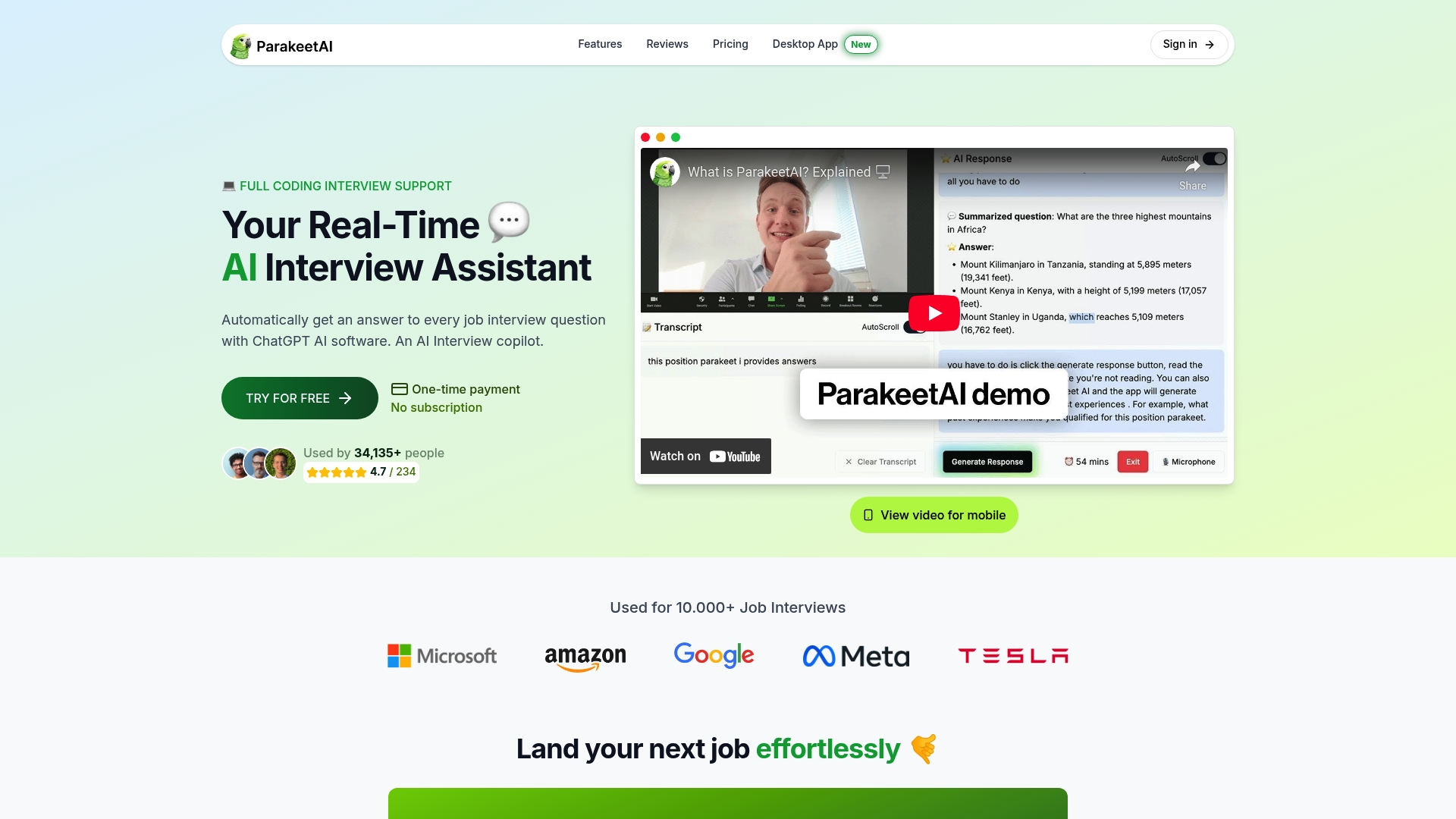
Unlock your potential with Parakeet AI, a real-time AI job interview assistant designed to listen and respond to your interview attempts automatically. This innovative tool helps you practice Microsoft-style questions at your own pace and refines your skills in problem-solving, coding, and articulation before the big day. Don’t let nerves or uncertainty hold you back when you can train smarter and improve faster with AI-powered mock interviews. Start practicing now on Parakeet AI and face your Microsoft interview with unwavering confidence.
Frequently Asked Questions
What are the core skills required for a Microsoft interview?
The core skills required for a Microsoft interview include data structures and algorithms, problem-solving under time constraints, system design, and knowledge of core computer science concepts. Focus on mastering arrays, linked lists, and trees before diving into role-specific knowledge, such as AI frameworks if applying for an AI engineer position.
How can I simulate the Microsoft interview experience?
You can simulate the Microsoft interview experience by using an AI job interview assistant that adapts questions to your target role. Schedule 1 to 2 sessions weekly and practice under timed conditions, aiming for a complete mock interview that mirrors the actual interview process.
What resources should I use to prepare for Microsoft coding challenges?
Utilize a combination of free platforms and curated problem lists to prepare for coding challenges at Microsoft. Prioritize resources like FreeCodeCamp for foundational topics and the Blind 75 list for the most frequently asked problems, dedicating time to practice consistently.
How should I track and act on feedback from mock interviews?
Track feedback from mock interviews by creating a simple spreadsheet that organizes questions, your approaches, received feedback, and areas for improvement. After each session, review the data to identify the top 3 critical issues and focus on addressing them before your actual interview.
How can I optimize my final preparations for the Microsoft interview?
To optimize your final preparations, conduct a technical readiness assessment by solving medium-difficulty problems in under 30 minutes. Additionally, deepen your understanding of Microsoft’s recent initiatives and ensure that your logistics, such as technology setup and attire, are ready before the interview day.