
Best Interview Questions for Administrative Assistants

Hiring an administrative assistant who can juggle complex calendars, manage multiple personalities, and solve problems on the fly often feels like searching for a needle in a haystack. These roles demand a seamless mix of technical know-how and soft skills that keep your entire office running smoothly. Knowing what truly matters—and how to uncover it during interviews—helps you find candidates who can handle pressure and support your team’s success. Discover how the right questions and AI tools make that search easier and more effective.
Table of Contents
- Defining Key Administrative Assistant Interview Skills
- Variations of Interview Questions and Their Benefits
- Evaluating Technical and Behavioral Competencies
- Common Mistakes in Interviewing Administrative Assistants
- Leveraging AI Tools for Smarter Interviews
Key Takeaways
| Point | Details |
|---|---|
| Technical and Soft Skills | Candidates must demonstrate both technical proficiency with office software and strong interpersonal skills, which are essential for effective office operations. |
| Balanced Interview Approach | Utilize a combination of behavioral, situational, and technical questions to comprehensively evaluate a candidate’s skill set and cultural fit. |
| Holistic Evaluation | Assess both technical abilities and behavioral competencies to ensure hires can manage tasks while working collaboratively under pressure. |
| Leverage AI in Hiring | Incorporate AI tools to standardize evaluations and enhance objectivity, complementing them with human judgment during final interviews for better hiring outcomes. |
Defining Key Administrative Assistant Interview Skills
Administrative assistants are the backbone of efficient office operations. They juggle calendars, manage correspondence, coordinate meetings, and keep everything organized while working with diverse personalities. To hire the right person, you need to understand which skills separate strong candidates from average ones.
The role demands a unique blend of technical and interpersonal abilities. Candidates must demonstrate technical proficiency with office software, alongside soft skills like communication and problem-solving. These aren’t separate competencies—they work together to keep offices running smoothly.
Core Technical Skills
Administrative assistants need hands-on experience with the tools that power modern offices. This includes calendar management systems, spreadsheet applications, email platforms, and document management software. A candidate who can navigate these tools efficiently saves your team time and prevents costly scheduling mistakes.
When interviewing, ask candidates about their specific experience with software your company uses. Generic answers suggest they lack depth. Look for candidates who can discuss how they’ve optimized workflows or solved technical problems using these tools.
Essential Soft Skills
Strong communication and organizational abilities form the foundation of administrative excellence. These skills enable assistants to manage schedules, handle correspondence, and maintain filing systems that others depend on.
The most valuable soft skills for this role include:
- Communication: Clarity in emails, phone calls, and in-person interactions
- Organization: Ability to prioritize tasks and maintain systems others can follow
- Attention to detail: Catching errors before they escalate into bigger problems
- Problem-solving: Finding solutions when schedules conflict or resources are limited
- Adaptability: Working effectively across departments and with different personalities
Multitasking and Pressure Management
Administrative work rarely follows a predictable rhythm. Candidates must handle multiple demands simultaneously—answering phones, managing calendars, organizing documents, and supporting executives. Ask interview questions that assess how they’ve prioritized tasks under pressure in previous roles.

This skill separates candidates who can handle chaos from those who crumble when deadlines compress. Request specific examples of times they’ve juggled competing priorities successfully.
Interpersonal Skills and Emotional Intelligence
Administrative assistants interact with everyone in your organization—from entry-level employees to C-suite executives. They need strong interpersonal skills and emotional intelligence to navigate these different relationships smoothly.
Look for candidates who discuss how they’ve built relationships with colleagues, resolved conflicts diplomatically, or adapted their communication style based on who they’re working with. These examples reveal genuine emotional intelligence.
Your strongest candidates will demonstrate not just individual skills, but how those skills work together to support office operations and team success.
Pro tip: Create a scoring rubric during interviews that rates each skill on a consistent scale, allowing you to compare candidates objectively rather than relying on interview impressions alone.
Variations of Interview Questions and Their Benefits
Not all interview questions are created equal. Different question types reveal different aspects of a candidate’s abilities, work style, and fit within your organization. Using a mix of question formats gives you a complete picture of who you’re hiring.
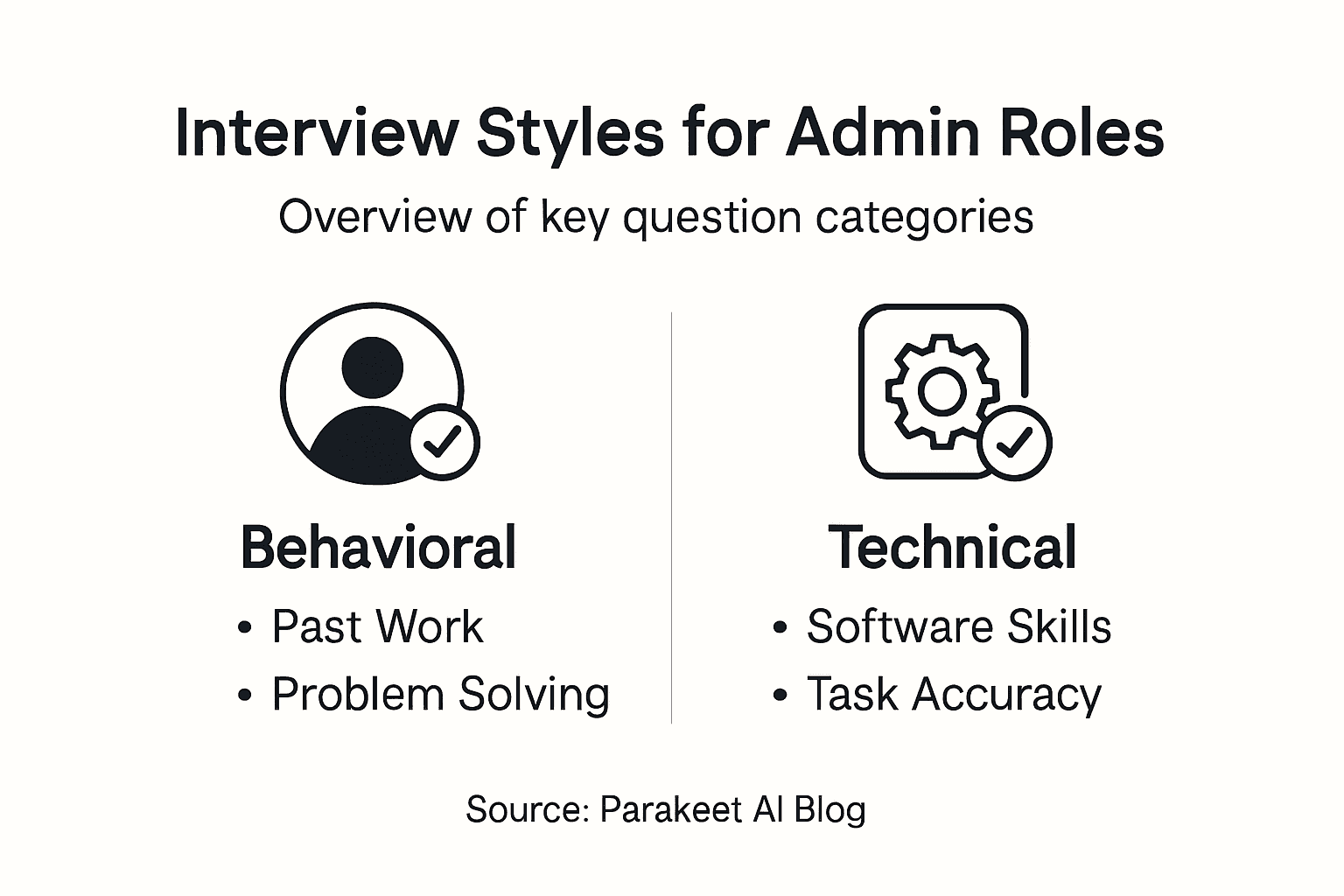
The best interviews blend multiple approaches. Behavioral, situational, and technical questions each serve a distinct purpose in evaluating administrative assistant candidates. Together, they uncover adaptability, alignment with company culture, and technical competencies that matter most.
To clarify how interview question types differ, here’s a side-by-side comparison:
| Question Type | What It Reveals | Best Use Case |
|---|---|---|
| Behavioral | Past actions and habits | Assess real-life performance |
| Situational | Problem-solving approach | Test decision-making skills |
| Technical | Software and tool proficiency | Verify hands-on expertise |
| Culture Fit | Values and interpersonal style | Ensure alignment with team |
Behavioral Questions
Behavioral questions ask candidates to describe past experiences and actions. These questions start with phrases like “Tell me about a time when…” or “Describe how you’ve handled…”
These questions work because past behavior predicts future performance. When a candidate describes how they’ve actually managed a crisis or resolved conflict, you learn far more than if you asked a hypothetical question.
Benefits of behavioral questions:
- Reveal authentic problem-solving approaches
- Show how candidates handle pressure and difficult situations
- Demonstrate communication skills through storytelling
- Expose organizational tendencies and work habits
Situational Questions
Situational questions present hypothetical scenarios and ask how candidates would respond. These questions start with “If…” or “What would you do if…”
Situational questions evaluate multitasking and prioritization skills under pressure. They’re especially valuable for administrative roles where competing demands happen daily.
You might ask: “Your executive has three urgent requests at the same time. How would you handle this?” This reveals their thinking process, not just what they’d do.
Technical Questions
Technical questions assess specific software skills and procedural knowledge. These questions test hands-on competency with tools your organization actually uses.
Ask about calendar systems, spreadsheet formulas, email management, or document organization. Specific answers reveal genuine experience over generic knowledge.
Culture and Relationship Questions
These questions explore how candidates fit your organizational culture and work with different personalities. They address enthusiasm, values alignment, and interpersonal approach.
Examples include: “How do you prefer to work with executives?” or “What kind of team environment brings out your best work?” These responses reveal whether someone thrives in your specific setting.
Combining question types creates a 360-degree view of your candidate, reducing the risk of hiring someone with strong technical skills but poor cultural fit—or vice versa.
Pro tip: Record candidate responses or take detailed notes for each question type, then compare how consistently their answers align across behavioral, situational, and technical formats—inconsistencies often signal concerns worth exploring further.
Evaluating Technical and Behavioral Competencies
Hiring managers need to assess both what candidates can do and how they do it. Technical skills show competency with tools; behavioral competencies reveal how they handle pressure, work with others, and solve problems.
The strongest candidates excel in both areas. Balancing these two evaluation types prevents hiring someone who knows software but can’t manage interruptions, or someone organized but unfamiliar with your office systems.
Technical Skill Assessment
Technical competencies are measurable and observable. They include proficiency with calendar systems, spreadsheet applications, email management, document organization, and industry-specific software your company uses.
Practical exercises and technical skill tests identify candidates’ ability to manage office tasks and software use. Real-world scenarios work better than generic questions. Ask candidates to organize a mock calendar, format a document, or create a spreadsheet to see actual performance.
Key technical areas to evaluate:
- Calendar management systems
- Microsoft Office or Google Workspace proficiency
- Email and correspondence handling
- Data entry accuracy and speed
- Filing and document organization systems
Behavioral Competency Assessment
Behavioral competencies reveal how candidates actually perform under real conditions. These include communication, organization, time management, and pressure handling. You assess these through stories about past experiences and hypothetical scenarios.
Ask candidates to describe times they’ve managed multiple priorities simultaneously, handled a difficult colleague, or made a mistake and corrected it. Their answers show authentic patterns.
Scenario-Based Evaluation
Scenario-based questions bridge technical and behavioral assessment. Present realistic administrative situations and ask how candidates would respond.
Example: “Your boss asks you to schedule three executives for a meeting. One is in a different time zone, one has a packed schedule, and one just cancelled an open block. How do you proceed?” This reveals both technical calendar knowledge and problem-solving approach.
Time Management and Pressure Handling
Administrative work thrives on managing competing demands. Test how candidates prioritize when everything feels urgent. Ask about times they’ve handled conflicting deadlines or unexpected tasks.
Strong responses show clear prioritization logic and the ability to communicate constraints. Weak responses suggest they panic or take everything equally seriously.
The candidates who score well on both technical and behavioral assessments are your most reliable hires—they know the tools and handle the chaos that comes with the job.
Pro tip: Use a weighted scoring rubric that allocates 40% to technical competency, 40% to behavioral competency, and 20% to cultural fit, ensuring balanced evaluation across all three dimensions.
Common Mistakes in Interviewing Administrative Assistants
Even experienced hiring managers fall into predictable traps when interviewing administrative assistants. These mistakes cost time, money, and often result in hiring the wrong person. Knowing what to avoid improves your selection process dramatically.
The most critical error is overweighting technical skills while ignoring everything else. A candidate might ace a spreadsheet test but fail catastrophically when managing office politics or handling pressure. Balance matters more than perfection in any single area.
Overlooking Cultural Fit and Interpersonal Skills
Technical abilities get most of the attention during interviews. But administrative assistants work across your entire organization, interacting with people daily. Overlooking cultural fit and interpersonal skills while focusing too much on technical abilities leads to hiring mismatches that damage team dynamics.
A technically skilled candidate who can’t work well with others creates friction. They might know calendar software perfectly but alienate executives through poor communication. Ask about how candidates handle difficult personalities and work within different team environments.
Failing to Probe Workplace Challenges
Surface-level questions produce surface-level answers. Many hiring managers ask what candidates’ weaknesses are and accept generic responses. This reveals nothing.
Instead, insufficiently probe how candidates actually handle workplace challenges. Ask specific scenarios: “Tell me about a time you disagreed with your manager’s approach.” or “Describe a situation where you had to deliver bad news.” Real stories expose genuine problem-solving abilities.
Not Testing Prioritization Logic
Administrative assistants face constant competing demands. Yet many interviews never test how candidates prioritize conflicting tasks.
Ask candidates to walk through their thinking when everything feels urgent simultaneously. What factors drive their decisions? Do they communicate constraints to stakeholders? Can they explain the logic behind their choices?
Common mistakes to avoid:
- Asking only technical questions without behavioral depth
- Accepting “I’m a perfectionist” as weakness discussion
- Failing to assess how they communicate under stress
- Ignoring how they’ve handled office politics
- Not exploring their work style preferences
Insufficient Question Variety
Asking only behavioral or situational questions creates blind spots. Mix your approach to see candidates from multiple angles.
Use behavioral questions (“Tell me about…”), situational questions (“What would you do if…”), and technical assessments together. This combination prevents hiring someone who talks great but can’t perform, or vice versa.
The candidates who succeed aren’t just technically skilled—they’re adaptable, communicative, and emotionally intelligent enough to thrive in your specific office culture.
Pro tip: Before interviews, document 3-5 specific workplace scenarios your organization actually faces, then ask each candidate how they’d handle them—this reveals who fits your real environment, not a hypothetical one.
Leveraging AI Tools for Smarter Interviews
Traditional interview methods rely on gut feelings and note-taking that often miss critical details. Modern hiring demands better tools. AI-powered interview platforms are transforming how organizations assess administrative assistant candidates by standardizing evaluations and reducing bias.
These tools don’t replace human judgment—they enhance it. AI platforms handle routine tasks, track behavioral cues, and provide data that hiring managers can use to make smarter decisions faster.
Standardizing Evaluations Across Candidates
AI-driven interviews standardize evaluations and provide data-backed hiring decisions by conducting structured interviews that adapt in real time. Every candidate answers the same core questions, removing inconsistency from the process.
When you interview candidate A on Monday and candidate B on Friday, fatigue and context shift your perspective. AI ensures both candidates experience identical questioning frameworks. This objectivity improves hiring quality significantly.
Assessing Soft Skills and Non-Verbal Cues
Administrative assistants succeed through communication, emotional intelligence, and interpersonal finesse. These soft skills are invisible on resumes but critical for performance.
AI-powered interviewing platforms assess verbal and non-verbal cues, soft skills, and technical competence, providing holistic understanding of candidate suitability. The technology analyzes word choice, tone, response time, and even facial expressions to gauge confidence, engagement, and authenticity.
Real-Time Question Adaptation
AI platforms adjust interview difficulty and direction based on candidate responses. If someone struggles with a technical question, the system can probe deeper or pivot to different competencies.
This adaptive approach reveals more than rigid scripts. You discover not just whether candidates know something, but how they think when challenged.
Key Benefits for Administrative Hiring
- Consistency: Every candidate experiences the same evaluation framework
- Speed: Automated screening reduces time-to-hire by weeks
- Objectivity: Data-driven assessments reduce unconscious bias
- Documentation: Complete records support compliance and decision transparency
- Deeper insights: Non-verbal analysis reveals authentic responses
Combining AI with Human Judgment
AI tools excel at analyzing patterns and flagging concerns. Human hiring managers excel at nuance, intuition, and relationship building. The best approach uses both.
Let AI handle standardized assessments and data collection. Use human interviews for final-round conversations where chemistry, culture fit, and gut feeling matter most.
Here’s a summary of how AI tools and human judgment complement each other for hiring:
| Approach | Strengths | Limitations |
|---|---|---|
| AI Tools | Standardized, unbiased analysis | Limited intuition and context |
| Human Interviews | Personal fit, nuanced insights | Risk of bias, less consistency |
| Combined Use | Balanced, objective, thorough | Requires integration strategy |
AI doesn’t make hiring decisions—it provides the objective information you need to make better ones, eliminating guesswork and bias from early-stage screening.
Pro tip: Implement AI interview tools for standardized first-round screening, then reserve in-person interviews for your final 2-3 candidates, combining AI objectivity with human judgment for optimal hiring decisions.
Elevate Your Administrative Assistant Interviews with AI-Powered Support
Hiring managers face the challenge of asking the right mix of behavioral, situational, and technical questions to identify candidates who excel in multitasking, communication, and software skills. It can be overwhelming to evaluate diverse responses quickly while ensuring consistency and uncovering authentic problem-solving abilities. Common struggles include managing interview bias, gauging emotional intelligence, and probing prioritization strategies effectively.
Parakeet AI offers a real-time interview assistant that listens carefully and generates intelligent answers to every question using AI This empowers you to better understand candidate skills and responses during administrative assistant interviews, making your evaluation more objective and insightful. Explore how AI-driven interviewing guarantees standardized assessments and deeper insights into communication and multitasking capabilities.
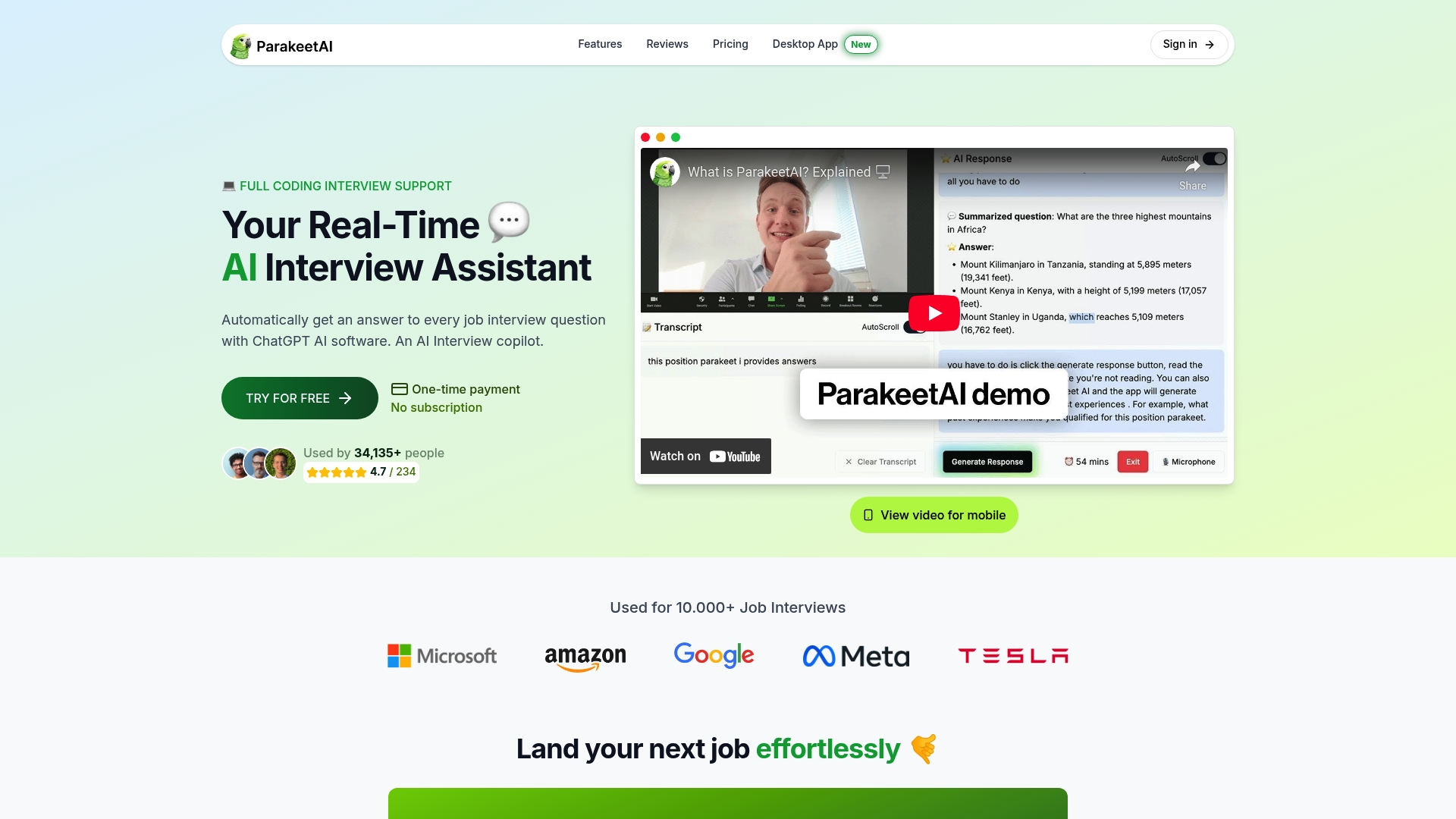
Take control of your hiring process today with Parakeet AI and reduce guesswork by leveraging technology designed to complement your expertise. Visit Parakeet AI to learn how you can streamline your interviews and confidently choose the candidate best equipped to thrive under pressure and handle your office’s unique challenges. Don’t wait to transform how you assess talent—try it now and see the difference.
Frequently Asked Questions
What are some important technical skills to look for in administrative assistant candidates?
Candidates should demonstrate proficiency with office software such as calendar management systems, spreadsheet applications, email platforms, and document management software. Hands-on experience with the specific tools your company uses is crucial.
How can I assess soft skills during the interview process for an administrative assistant?
To evaluate soft skills, ask behavioral questions about past experiences involving communication, organization, attention to detail, and problem-solving. Look for examples where candidates successfully navigated interpersonal relationships or managed conflicting demands.
What types of interview questions are most effective for administrative assistant roles?
Utilize a mixture of behavioral, situational, and technical questions. Behavioral questions assess past actions, situational questions evaluate problem-solving abilities, and technical questions verify tool proficiency.
How do I determine a candidate’s fit for company culture during the interview?
Ask questions that explore their preferences for teamwork and collaboration, how they resolve conflicts, and their experiences working with different personalities. Responses to these queries can indicate how well they will align with your organization’s culture.