How to Respond to an Interview Offer by Email

You're staring at an email with the subject line you've been waiting for, your thumb hovering over reply, and your first instinct is to type a fast, grateful yes before they change their minds. Don't. I've watched candidates accept a time they can't make, thank a recruiter for a job they weren't offered, and agree to pay they'd never seen in writing. Speed matters, but so does knowing exactly what you're answering. That's how to respond to an interview offer without locking yourself into the wrong commitment.
What Kind of Interview Offer You Received
The email lands at lunch. It says the team was impressed, they'd like to move forward, and there's a date and time near the bottom. You reply within the minute. "Thank you so much, I accept."
Now the recruiter has to write back and clarify that you haven't been hired. You've only been invited to interview. You then send a second email walking it back, confirming the slot, and apologizing for the confusion. Nothing here is fatal, but you've made your first impression as someone who doesn't read carefully.
That mistake is common because people use interview offer for two different documents. They need opposite replies.
Read the Subject Line Like a Label
An interview invitation is a logistics message. It's offering you a conversation, not a job. Look for a proposed date and time, a location or video link, interviewer names, a format such as panel or phone screen, and an expected duration. The correct reply settles scheduling. It doesn't discuss salary, start dates, or whether you want the role long term. You haven't earned that conversation yet, and they haven't offered it.
A formal job offer is a decision message. Look for a role title tied to compensation language, benefits details, a start date, conditions such as a background check or probation period, and a deadline to respond. Sometimes this arrives as a phone call first, with numbers mentioned verbally and a promise that paperwork will follow. Treat that call as incomplete until you see the terms in writing. The correct reply here isn't a calendar confirmation. It's an acknowledgment that buys you time to evaluate.
Scan the first paragraph before you draft anything. Does it ask you to pick a time, or does it ask you to make a decision? That one question routes your entire email.
Enthusiasm Is Not Acceptance
Both messages deserve a warm thank you. Neither deserves an unconditional yes in your first sentence.
- For an invitation: Thank them, confirm interest in interviewing, and lock the logistics.
- For an offer: Thank them, confirm interest in the role, and ask for the complete written terms and the decision deadline.
Notice what neither opening does. You don't write "I accept the position" to a scheduling note. You don't write "Tuesday works great" to an offer letter and accidentally agree to its salary by momentum.
Practical rule: Say you're pleased and interested. Don't say you've decided until you've seen what you'd be deciding on.
Write the thank you. State your interest plainly. Then ask for the one thing the message requires, either a confirmed time or a complete package with a deadline. If you can't tell which document you've received after reading it twice, that ambiguity is itself a reason to ask a clarifying question before you commit to anything. Name the document first. Choose your tone second.
How to Confirm an Interview Invitation
You have an interview invitation in your inbox and a calendar that may not be free. Confirm the appointment promptly, but check the details before you lock in a time. An invitation to interview is a request to schedule a conversation, not a formal job offer or a decision about pay.
Indeed recommends replying within 24 hours, and its related guidance gives two working days as a general outer limit in related Indeed guidance. If the invitation gives an earlier deadline, meet it. The University of Washington Bothell notes recruiters have limited time to wait for confirmation, so don't leave the sender guessing.
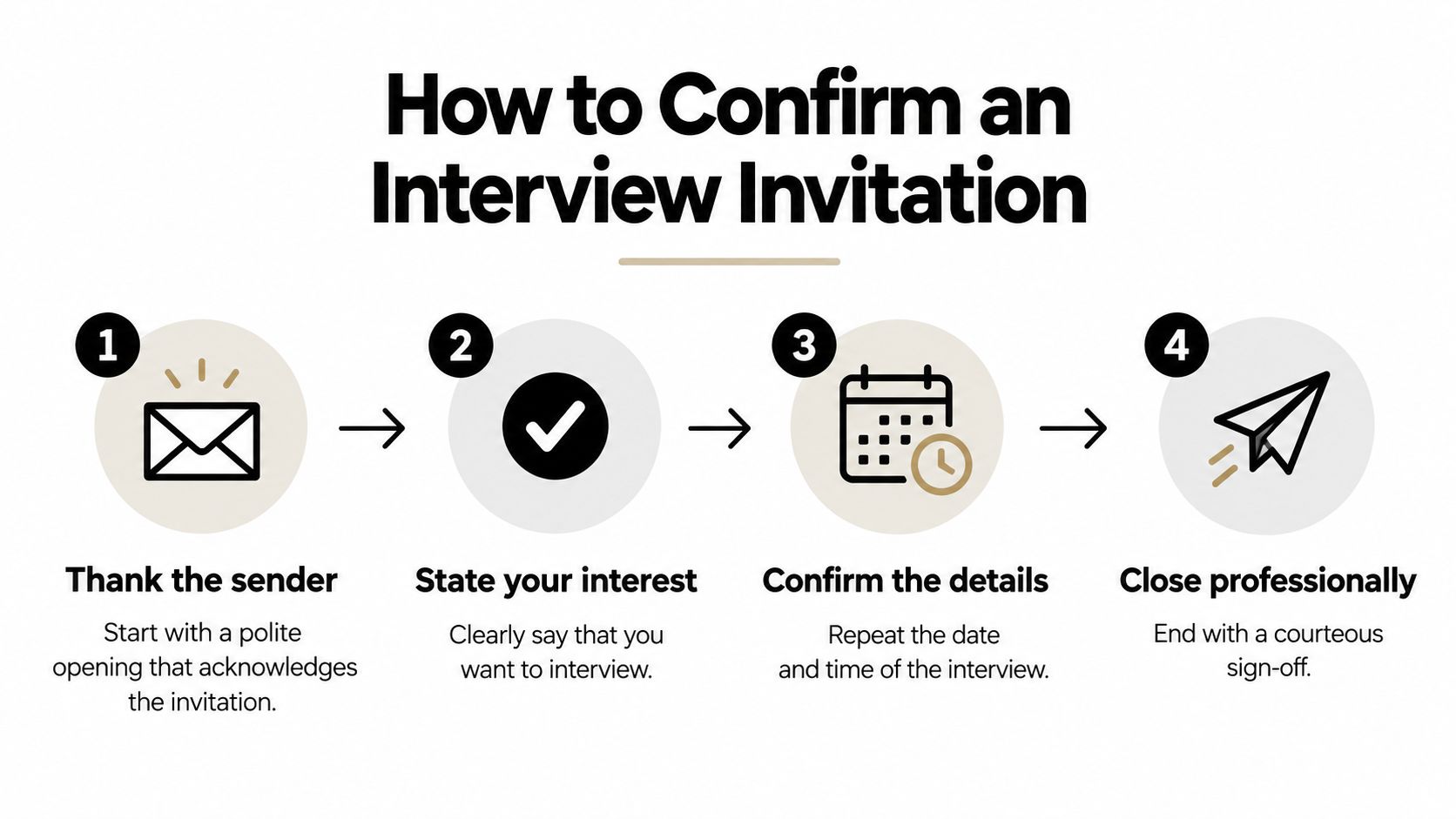
Use Four Steps in This Order
Reply in the existing email thread. Thank the sender, then follow how to accept an interview invitation with a clear confirmation of the appointment details.
- Acknowledge and thank: Name the role and thank the sender for inviting you.
- State your availability clearly: Confirm that you can attend. If you cannot, ask to arrange another time rather than implying the slot works.
- Repeat the logistics: Restate the date, time, and time zone, along with the format, location or video platform, and interviewer names if provided.
- Ask only what's missing: If the invitation leaves out the expected duration, participants, or preparation requirements, ask for those details.
Use this template and edit it to fit the invitation:
Thank you for inviting me to interview for [role]. I'm pleased to confirm my interest. I'm available on [date, time, time zone]. Could you please confirm the interview format, expected duration, participants, and whether there's anything I should prepare?
Then sign with your name and phone number. Keep the reply focused.
The Mistakes That Cost Slots
Careless replies can cost you a slot. A delayed answer gives the recruiter time to offer it to another candidate. Leaving out your time zone can cause a remote interview no-show. Accepting before checking your calendar creates an avoidable reschedule. Casual wording can weaken a professional first impression, and asking questions already answered in the invitation suggests you skimmed it.
Read the invite twice. Check your calendar, then reply.
If the invitation came by phone, confirm the details aloud and send a written recap the same day. Thank the caller, repeat the agreed date, time, time zone, platform, and participants, and ask what to prepare. This audit trail gives both sides a record to check if they misheard a detail. Once the time is confirmed, use mock interview practice to prepare for the conversation.
When the Time or the Invite Does Not Work
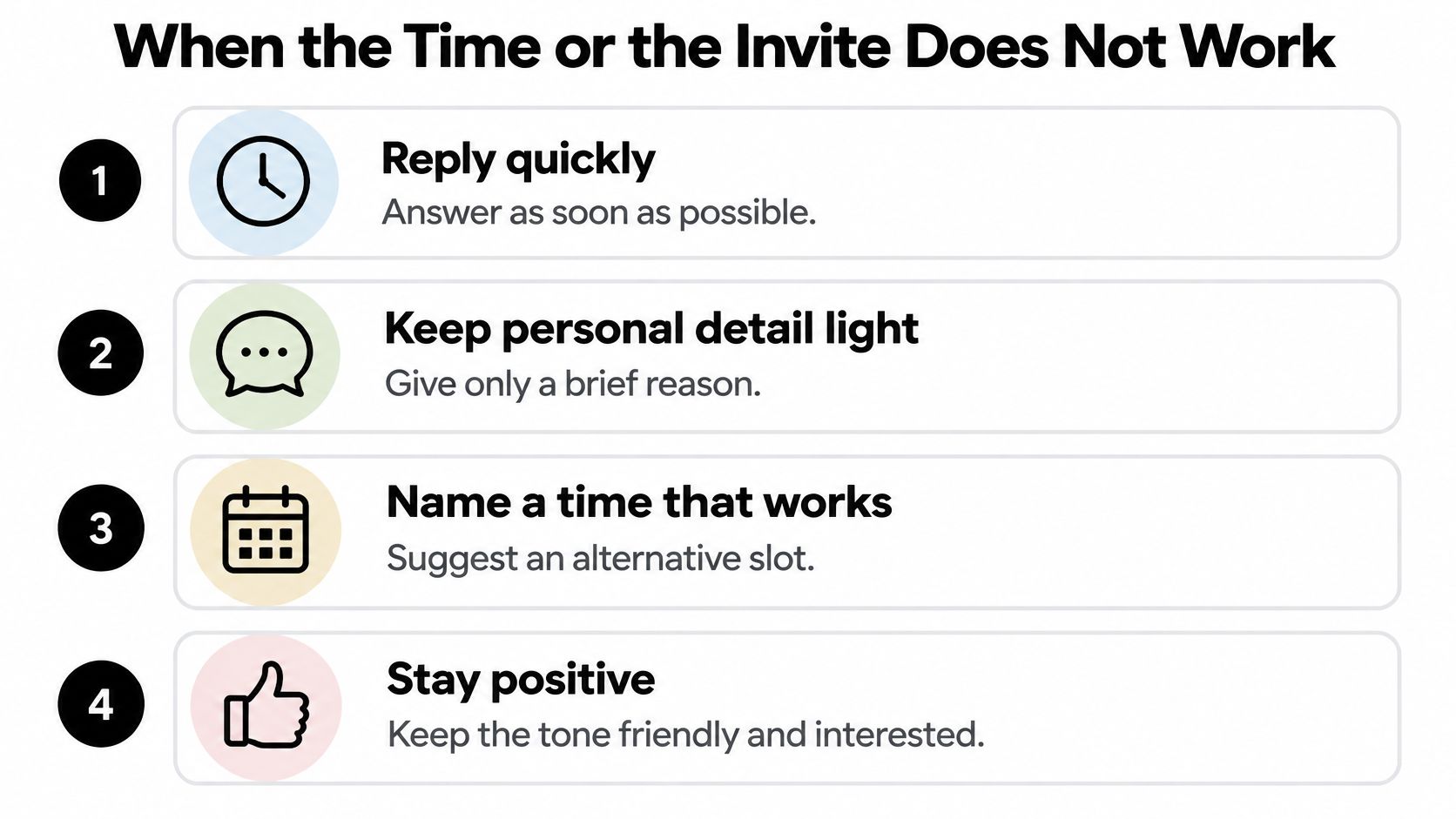
A same day yes isn't always the safer move. Accepting a time you'll probably cancel damages you more than a prompt, specific request for a different one. Declining a slot isn't declining the job, and recruiters handle reschedules constantly. What they can't work with is silence followed by a vague "let me know what works."
Say No to the Slot, Not the Opportunity
Reply in the original thread, quickly, and keep your reason to one short clause. You don't owe a recruiter your caregiving schedule, your shift pattern, or your medical history. Flexible scheduling isn't a trivial preference, since a 2025 Job Seeker Nation report found 51% of respondents selected flexible scheduling among the factors contributing most to a positive candidate experience. Indeed likewise advises contacting the sender promptly to arrange another appointment, and notes employers often accommodate inflexible schedules.
Thank you for inviting me to interview for [role]. I'm very interested, but I can't attend during that window. I'm based in [time zone] and I'm available [option one], [option two], or [option three]. Would any of those work?
Give two or three concrete windows, not an open ended question. You've done the scheduling labor for them, which is exactly the impression you want.
Separate Accommodation From Convenience
A shift conflict is a scheduling problem. A disability related need is different, and you're entitled to ask directly. Under U.S. Equal Employment Opportunity Commission guidance on disability rights in employment, applicants can request reasonable accommodation for the interview and application process, including modified examinations or policies and readers or interpreters. The EEOC gives a sign language interpreter during a job interview for a deaf or hard of hearing applicant as a concrete example. An employer generally must provide an accommodation to a qualified applicant unless it can show undue hardship, meaning significant difficulty or expense. State what you need, tie it to the interview, and confirm the time in the same email.
When the Invite Itself Looks Wrong
Some invitations are vague, and a few are worse than vague. Don't let a 24 hour reply target pressure you into confirming something you haven't verified. Guidance on responding to interview invitation emails supports asking for missing information and restating the date, time, and location so mistakes surface early.
Send two messages. First, a short holding reply that keeps you responsive without committing.
Thank you for the invitation to interview for [role]. I'm interested. Before I lock a time, could you confirm the interviewer names, format, expected duration, and platform?
While you wait, check the employer's identity, the exact role title, and the employment entity if a third party recruiter is involved. Be wary of any next step asking for payment or unusual personal data. Only after those details check out do you send the final confirmation with the date and time repeated back.
How to Acknowledge a Formal Job Offer
An offer call feels like a finish line. It isn't. It's the start of a decision with a deadline, and your first reply should be prompt, grateful, and deliberately unfinished. Thank them the same day. Say the role still interests you. Then get the package in writing and get a date.

Ask for the Whole Package, Not the Headline Number
A spoken salary isn't an offer. Request the complete terms in writing if any of these are missing or were only covered verbally.
- Compensation: Base salary, bonuses, and any variable pay, including how and when it's calculated.
- Benefits and time: Health coverage, retirement contributions, leave, and working hours.
- Working arrangements: Location, remote rules, and any travel expectations.
- Employment terms: Probation period, start date, notice terms, and contingencies such as checks or references.
You can't compare this offer against another job, or against staying where you are, until every line is visible. Ask focused questions now, while asking is expected.
Get the Deadline in a Sentence You Can Quote
Don't guess how long you have from the recruiter's tone. Ask directly when a final decision is required.
There's a useful market benchmark for what normal looks like. The 2022 National Association of Colleges and Employers Recruiting Benchmarks Report found candidates received an offer an average of 26 days after interviewing, up 28.6% from just under 20 days in 2015, and took an average of 12 days to accept once an offer was made. That report surveyed 816 organizations from May 9 to June 17, 2022, so the pattern reflects a large market rather than a handful of employers.
Read those numbers correctly. A 12 day average means candidates commonly get roughly one to two weeks. It does not grant you two silent weeks. Acknowledge receipt fast, confirm your interest, and let the employer's stated deadline govern your timeline. Ethical recruitment guidance supports clear deadlines, reasonable consideration periods, and employers considering extension requests, so asking is normal professional behavior, not stalling.
A Same Day Acknowledgment That Books Your Thinking Time
Thank you for offering me the [role] position. I'm excited about the opportunity and appreciate the team's confidence. Could you please send the full offer and benefits details in writing, and confirm the date by which you'd like my decision? I'll review everything carefully and respond by that date.
If you later realize you need more time, ask before the deadline expires and propose a specific alternative date. "Could I have until Thursday the 18th" gets a yes far more often than silence followed by an apology. You've now got a complete package and a date. That's everything you need to decide.
Accept, Negotiate, or Ask for Time
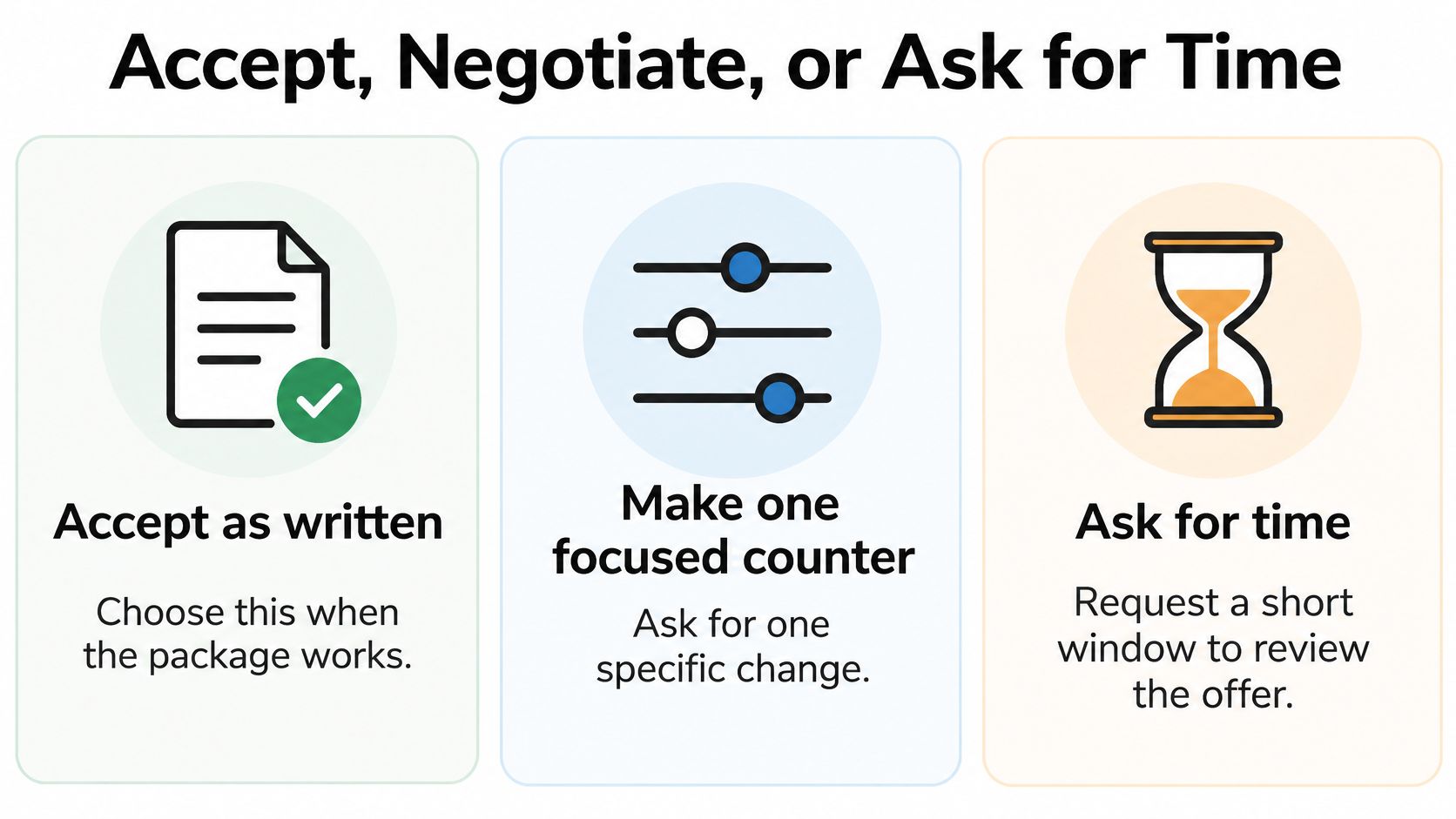
A formal offer is not an interview invitation. You have the written package and a deadline, so check the terms before you accept, counter, or ask for more time. Compare the role's scope, your constraints, and any competing decisions. Choose one reply and make it clear.
Which Reply Fits This Offer
| Reply | Send it when | Must include | Main risk |
|---|---|---|---|
| Accept as written | The full package works for you | Clear acceptance, role title, start date | Agreeing before checking contingencies |
| Make one counter | Two or three terms fall short | Prioritized requests and a reason for each | Making the request sound like an ultimatum |
| Ask for time | You need information or a competing decision is near | Thanks, a reason, and a specific new date | Letting the original deadline pass |
Negotiate Once, on Evidence
Separate terms that may be flexible, such as base pay, a bonus, or start date, from policies that apply to everyone at your level. Then make one counterproposal focused on your top two or three priorities. Tie each request to a concrete reason, such as the role's scope, a documented constraint, or a cost you would take on. Do not invent salary comparisons or competing offers. A request grounded in your circumstances is more credible than a bluff.
Negotiation is common, but a survey result is not a guarantee. A Fidelity survey reported that 85% of Americans who countered received at least something they requested, while 58% accepted their initial offer without negotiating. Treat those figures as one survey's findings, not a prediction of your employer's response. Get any agreed changes in writing, following guidance on written offers and written confirmation of any modifications.
I'm enthusiastic about joining as [role]. Based on the scope we discussed, would you be able to move the base salary to [amount] and shift the start date to [date]? If so, I'm ready to accept.
That final sentence sets a clear condition for your yes.
Avoid negotiating before you have reviewed the full package, issuing ultimatums, or letting the deadline pass without contact. Do not accept verbally and then reverse course. If a conversation is easier by phone, send a brief holding reply first: confirm you received the offer, say you are reviewing the details, and give a date for your response. After the call, email a concise summary of what you agreed. Accept only once the employer sends the revised terms in writing.
Decline Clearly and Lock the Next Step
If you have decided to turn down an offer, say so clearly and in writing. A phone call can feel personal, but a concise email gives both sides a reliable record of your decision.
If the Answer Is No
Decline the role, not the people. Thank the employer, name the position, state your decision, and close warmly. Skip a long apology or made-up criticism of the compensation. Both can invite a conversation you do not want or damage a relationship that could matter later.
Thank you for offering me the [role] position and for the time your team invested in the process. After careful consideration, I've decided to decline. I genuinely enjoyed speaking with everyone and hope we stay in touch.
Send your response before the deadline. A timely, professional no lets the recruiter return to other candidates and leaves the relationship on good terms. If you want to keep the door open, say so directly, without suggesting that you might change your mind.
If the Answer Is Yes
Accept only after you have the revised written terms. Check the offer letter, then repeat the key details in your acceptance so any mismatch surfaces before your start date.
- Confirm the role: Use the exact title in the offer letter.
- Confirm the package: Restate the compensation details shown in writing.
- Confirm the start: Repeat the agreed start date and ask where and how to sign.
If the employer has not sent an updated letter after negotiation, reply that you are ready to accept once you receive it. A phone conversation can settle the terms, but it does not replace written confirmation. Keep the call brief, then email the same points that day.
If you are continuing your search after a decline, prepare for the next interview rather than replaying the last decision. ParakeetAI's live interview assistant listens to questions and displays suggested answers based on your resume and notes. It does not join the call, and its desktop app window can stay hidden from screen sharing. You can also rehearse with the Mock Interview practice tool. Check current plans on the ParakeetAI pricing page before making assumptions about cost.
Send one clear email today: confirm, counter, or decline. Add the next date to your calendar. A quick reply and a careful review can go together. That is how you keep control of the decision instead of letting a deadline or missing detail decide for you.