
Interview Questions for a Full Stack Developer: Top 10
You've got an hour, maybe less, and the next question can jump from React rendering to a slow SQL query to a broken login flow without warning. That's what makes full stack interviews feel unfair. You're not being tested on one skill, you're being tested on whether you can carry a feature from the browser to the database and explain every trade-off on the way.
That breadth matches the job. In the Stack Overflow 2025 Developer Survey, JavaScript was reported by 66% of respondents, HTML/CSS by 61.9%, SQL by 58.6%, Node.js by 48.7%, and React by 44.7%, from more than 49,000 responses in 177 countries. A good interviewer will sample across that stack, then dig where you claim depth.
The ten interview questions for a full stack developer below are organized by layer, because that's how interviewers think. Each one gives you the answer structure, a worked example, and the trap that turns a pass into a fail. If you're hiring instead of applying, companies that run skills-first full stack developer interviews use the same logic from the other side of the table. Don't memorize definitions. Learn to say what happens, why you'd choose one approach over another, and how you'd prove it works.
1. Front-End How Does React Decide When to Re-Render and How Do You Prevent Unnecessary Re-Renders
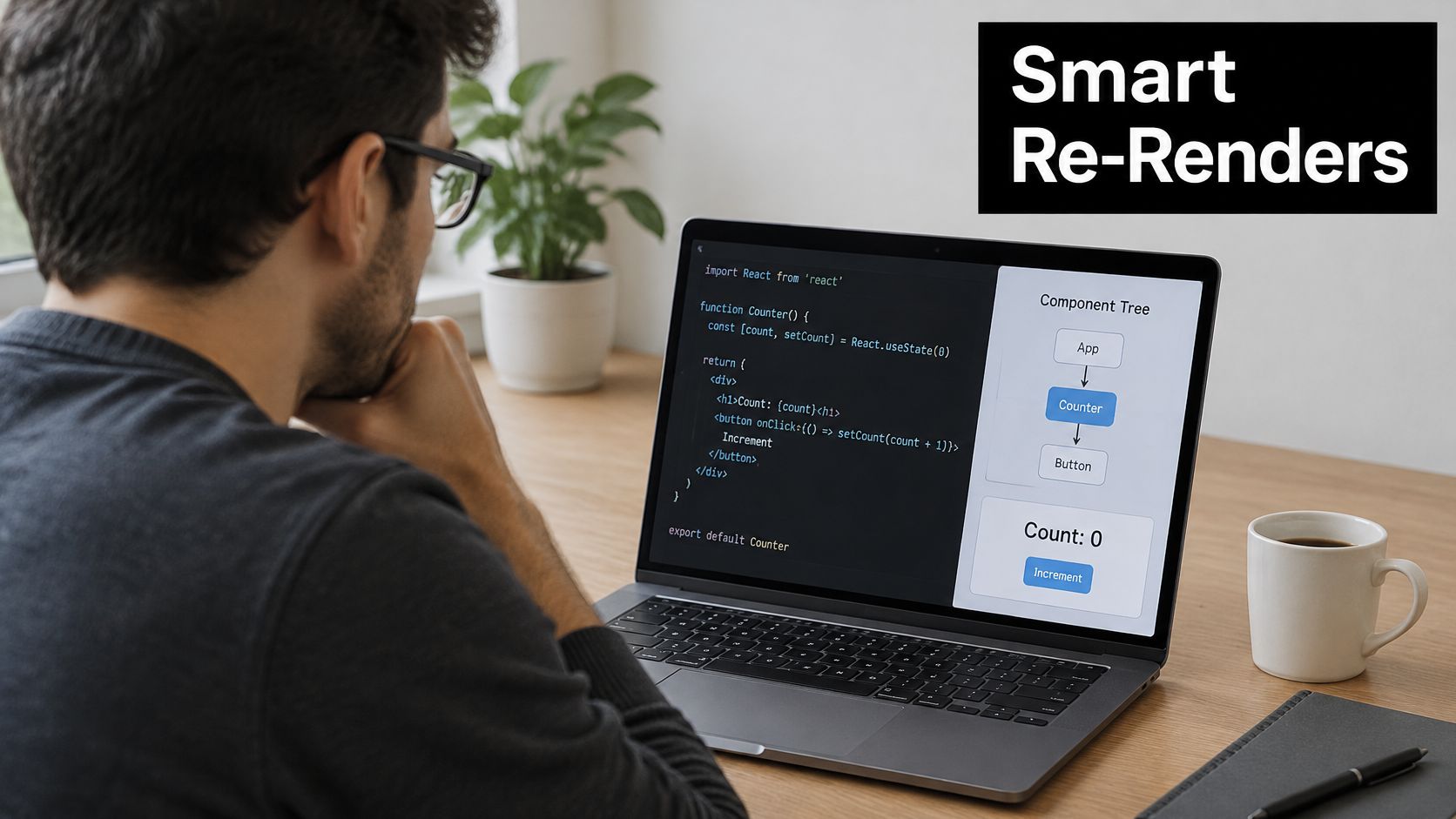
Say this first. A component re-renders when its state changes, when its props change, or when its parent re-renders. React then runs reconciliation, diffing the new element tree against the previous one to work out the smallest DOM update. A re-render means calling your component function again. It doesn't always mean the DOM changes, and that distinction is what interviewers are listening for.
What a Strong Answer Sounds Like
Use a concrete case. A search input stored at page level re-renders the whole page on every keystroke, including an expensive chart. Move that state into a small SearchInput child so only it updates, and wrap the chart in React.memo so stable props skip its render. Reach for useMemo for costly calculations and useCallback only when a stable function reference stops a memoized child from re-rendering.
- Measure first: Profile with React DevTools Profiler and fix the renders that cost time, not every render you can see.
- Colocate state: Keep state as low in the tree as possible before you memoize anything.
- Practice phrasing: Rehearse short, structured answers against real prompts in the ParakeetAI Question Bank, where questions are grouped by company.
Memoizing everything is not optimization. It's extra comparison work and more code to maintain.
2. Back-End How Does the Node.js Event Loop Work and What Happens With CPU-Heavy Code
Node runs your JavaScript on a single main thread and uses the event loop to juggle work without blocking on I/O. When you fire a database query or an HTTP request, Node hands that wait to the system, keeps serving other requests, and runs your callback or promise continuation when the result arrives. That's non-blocking I/O, and it's why a small Node service can hold a lot of concurrent connections.
CPU-heavy synchronous code breaks the model. Parse a huge file, resize images, or hash passwords in a tight loop on the main thread, and the loop can't process anything else. Every other request queues behind yours, latency spikes for everyone, and health checks can start failing even though the server looks busy rather than down.
How You'd Fix It in Production
Move image resizing out of the upload endpoint into a background queue, return a fast response, and let a worker process the file and update the record. For work that must stay in the service, worker threads run CPU-bound tasks off the main thread. Name the trade-off. Queues add infrastructure and eventual consistency. Worker threads add complexity around shared state and memory.
Say what you'd watch. Event loop lag is the signal that tells you something's blocking, long before users report timeouts. Candidates who name a metric sound like they've operated Node, not just written it.
3. Databases When Would You Add an Index and How Do You Diagnose a Slow Query
Start with the query, not the index. Reproduce the slowness, run EXPLAIN (or EXPLAIN ANALYZE), and look for a sequential scan on a large table, a bad join order, or an estimate that's wildly off. An index helps when a query repeatedly filters, joins, or sorts on the same columns. It costs you on every write and in storage, so you add it because a real query pattern needs it.

A paginated order history is the classic example. A composite index on (user_id, created_at) lets the database find one user's orders already sorted, instead of scanning and sorting on every page load. Verify the change in staging with realistic data volume, because an index that looks great on a thousand rows can behave differently at scale.
- Spot N+1 queries: Turn on query logging and look for one query followed by a loop of near-identical ones, then replace it with a join or a batched query.
- Bound your results: Unbounded result sets are a self-inflicted slow query, so paginate at the database.
Strong candidates also go past CRUD. The PostgreSQL transaction isolation documentation lists Read Uncommitted, Read Committed, Repeatable Read, and Serializable, with Read Committed as PostgreSQL's default. If you're asked which level you'd pick for concurrent updates, name the anomaly you're preventing, not just the level.
4. APIs How Do You Design a REST API and Handle Versioning and Pagination
Design around resources, not actions. Use nouns in URLs, the right HTTP methods for create, read, update, and delete, and a consistent error shape the front end can render. Returning a 400 with a JSON body that names the invalid fields lets the client show messages next to inputs. Returning 200 with an error buried in the body forces every client to guess.
Get status codes precise. The MDN HTTP status code reference groups responses into informational 100 to 199, successful 200 to 299, redirections 300 to 399, client errors 400 to 499, and server errors 500 to 599. So say when you'd return 201 for a creation, 204 for success with no body, 401 for missing authentication, and 403 for authenticated but not allowed. Interviewers notice when you separate those last two.
Pagination and Versioning Trade-Offs
Offset pagination is simple and fine for stable admin lists. For an activity feed, cursor-based pagination wins because items inserted while a user scrolls don't shift pages and create duplicates or gaps. On versioning, explain how existing clients keep working when you change a response, whether that's a versioned path or additive changes only.
Close with the contract. Document the API with OpenAPI so front end and back end share one source of truth. A quick REST versus GraphQL comparison helps too. REST caches easily and fits resource-shaped data. GraphQL avoids over-fetching when clients need very different shapes, at the cost of more server complexity.
5. Security How Do You Protect a Web Application Against XSS CSRF and SQL Injection
Answer in three tight blocks. Name the attack, then the specific defense. Interviewers fail candidates who say they'd "sanitize inputs" and stop there.

SQL injection happens when request data becomes part of a query string. The fix is parameterized queries through your driver or ORM, every time, so user input is treated as data and never as SQL. XSS happens when attacker content renders as markup or script in someone else's browser. You mitigate it by escaping output, using your framework's safe rendering APIs instead of injecting raw HTML, and adding a Content Security Policy as a second layer.
- CSRF defense: Use SameSite cookies plus anti-CSRF tokens on state-changing requests, so a malicious site can't ride a logged-in browser.
- Cookie settings: Set session cookies HttpOnly, Secure, and SameSite=Lax to limit script access and cross-site sending.
- Server-side validation: Validate again on the server even when the front end already checks, because the client is not a trust boundary.
Mention the OWASP Top 10 as your checklist and dependency scanning in CI as routine hygiene. That signals layered defenses, which is the point. No single control carries the whole answer.
6. Authentication How Does Token-Based Authentication Work With JWTs and What Are Its Risks
Walk the flow in order. The user logs in, the server verifies credentials, then issues a signed JWT containing claims like the user ID and expiry. The client sends that token on later requests, usually in an Authorization header, and the server verifies the signature and expiry before trusting the claims. The payload is only encoded, not encrypted, so anyone can read it. Never put secrets or sensitive personal data in it.
Then cover storage and revocation, where most answers fall apart. A token in localStorage is readable by any script on the page, so one XSS bug hands it to an attacker. A common production pattern is a short-lived access token paired with a rotating refresh token in an HttpOnly cookie. Rotation means a stolen refresh token gets detected or expires quickly instead of granting permanent access.
The session side deserves equal weight. The OWASP Session Management Cheat Sheet recommends cookies for session-ID exchange, HTTPS for the entire web session, and the Secure cookie attribute so the identifier travels only over an encrypted channel. It also says identifiers should be unique per user and computationally difficult to predict.
Compare the approaches. Server-side sessions make logout and revocation trivial and suit server-rendered apps. JWTs scale statelessly across services but are hard to revoke before expiry. Mention verifying the signing algorithm explicitly to prevent algorithm confusion, and describe what happens on logout, password change, and re-authentication. That's the complete answer.
7. Testing What Is the Testing Pyramid and How Would You Test a Feature End to End
The testing pyramid is a budget, not a slogan. You write many fast unit tests for isolated logic, fewer integration tests that prove components work together, and a small number of end-to-end tests that drive the UI. Invert that ratio and you get a slow, brittle suite nobody trusts, which is worse than a smaller suite people run.
Apply it to checkout. Unit tests cover price calculation, discounts, and tax edge cases in milliseconds. Integration tests hit the order endpoint against a test database and verify the rows written, the stock decrement, and the error responses. One browser test then walks the full purchase path a user takes. Each layer protects against a different failure, so describe that instead of listing tool names.
Making the Suite Believable
Run integration tests against a test database in Docker so they execute the same SQL as production rather than a mocked approximation. Run the whole suite in CI on every pull request, and keep it fast enough that developers don't route around it.
Practical rule: Every bug you fix earns a regression test at the lowest layer that could have caught it.
That's the line that separates candidates who've maintained a suite from candidates who've only read about one. Explain your approach out loud when you practice, because interviewers grade the reasoning you narrate.
8. Deployment How Would You Deploy a Full-Stack Application With Zero Downtime and Automated Checks
Describe the path from commit to production without skipping steps. A CI pipeline runs tests, lints, and builds a deployable artifact. CD promotes that same artifact through environments, with configuration and secrets kept outside the code so one build works everywhere. If you rebuild per environment, you're no longer shipping what you tested.

For zero downtime, name a strategy and its cost. Blue-green deployment runs the new version beside the old one and switches traffic behind a load balancer only after health checks pass, which makes rollback a traffic switch. Canary releases expose a small slice of users first, which catches problems blue-green misses but needs better metrics. Either way, say what you'd watch after release. Error rate and latency are the minimum.
Container hygiene gets probed too. The Docker multi-stage build documentation explains that each FROM begins a new build stage and only the last stage becomes the image that is tagged and shipped. So build in one stage and copy only runtime output into a minimal final stage, leaving compilers and test tools behind.
Handle migrations in two steps. Add a new column as nullable, deploy code that writes it, backfill, then enforce the constraint later. Old and new code both survive, and your rollback stays safe.
9. System Design How Would You Design a Real-Time Notifications Feature for Many Users
Don't draw boxes yet. Spend the first minutes clarifying how many users, how fast delivery must feel, whether notifications can be lost, and whether they must survive a user being offline. Interviewers fail confident designs built for the wrong requirements more often than they fail imperfect architectures.
Then trace one event end to end. Something happens in the app, a notification record is written to the database, and a push goes out to connected clients. Storing the notification first matters, because it's your source of truth when a client reconnects and needs to fetch what it missed. The push is an optimization for liveness, not the record itself.
Choosing the Delivery Mechanism
WebSockets give you bidirectional, low-latency delivery but cost you persistent connections to hold and load-balance. Server-Sent Events are simpler when traffic only flows server to client. Polling is the least efficient and the easiest to operate, and sometimes that's the right call at small scale. State that trade-off out loud.
For fan-out across multiple servers, Redis pub/sub lets any connection server publish an event that reaches the server holding that user's socket. Then talk bottlenecks and failure. What happens when a connection server dies, how you avoid duplicate notifications on retry, and what you'd measure after launch. A guide like the InterviewBit full stack interview questions shows how these prompts branch into follow-ups, so practice defending each choice rather than memorizing one diagram.
10. Full-Stack Integration How Do You Debug a Bug That Spans the Front End API and Database
Interviewers want a method, not a lucky guess. Start by reproducing the issue with the smallest reliable case you can build. Then move layer by layer, collecting evidence at each boundary instead of changing code on a hunch.
In the browser, check the console and the Network tab for the exact request payload, status code, and response body. At the API, read server logs for that request and confirm what the handler received after validation and middleware. In the database, inspect the stored state and compare it with what the API returned. The bug lives wherever the data first stops matching your expectation.
- Trace with a request ID: Attach one ID in the browser and log it through the API and downstream services, so a failed checkout becomes one searchable thread.
- Watch for double transformations: A date shown wrong on the page often means a timezone conversion ran twice, once in the API and once in the client.
- Confirm before you claim: State the root cause only when you can make the bug appear and disappear on demand.
This walkthrough shows the same layer-by-layer discipline applied live, including how to narrate what you're checking.
Finish the story properly. Explain the fix, then the regression test that prevents recurrence, then how you'd tell the team what broke. That last step is production ownership, and senior interviewers weight it heavily.
10 Full Stack Developer Interview Questions at a Glance
| Stack Area | What It Tests | Key Concepts to Cover | Common Pitfall |
|---|---|---|---|
| Front-end: React rendering | Understanding of component updates and render performance | State, props, parent renders, reconciliation, memoization, keys, state colocation | Confusing a component re-render with a DOM update; overusing memoization |
| Back-end: Node.js event loop | Understanding of non-blocking I/O and CPU-bound work | Single JavaScript thread, event loop queues, I/O, worker threads, job queues | Blocking the event loop with synchronous CPU-heavy work |
| Databases: Indexing and query performance | Practical ability to improve and diagnose slow queries | Index trade-offs, EXPLAIN, composite indexes, N+1 queries, query logging | Adding unused or excessive indexes that slow writes and consume storage |
| APIs: REST design | Ability to build consistent, backward-compatible interfaces | Resources, HTTP methods and status codes, pagination, versioning, OpenAPI | Breaking existing clients or using unstable pagination for changing data |
| Security: Web vulnerabilities | Knowledge of layered defenses against common attacks | XSS escaping and CSP, CSRF tokens and SameSite, parameterized queries, server-side validation | Trusting client-side validation or misconfiguring CORS and CSP |
| Authentication: JWTs | Understanding of token issuance, verification, storage, and lifecycle | JWT claims and signatures, expiry, refresh rotation, storage trade-offs, revocation | Treating JWT payloads as secret or storing tokens in localStorage without considering XSS |
| Testing: Full-stack testing strategy | Ability to balance test coverage, speed, and reliability | Unit, integration, end-to-end, and contract tests; mocks; CI | Over-mocking integrations or relying on slow, flaky end-to-end tests |
| Deployment: Zero-downtime release | Understanding of automated delivery, release safety, and recovery | CI/CD, rolling, blue-green and canary releases, runtime configuration, migrations, health checks | Deploying incompatible database changes or lacking a rollback plan |
| System design: Real-time notifications | Ability to design scalable, reliable event delivery | WebSockets, SSE, polling, brokers, persistence, pub/sub, rate limiting, delivery guarantees | Underestimating persistent connection costs or assuming exactly-once delivery |
| Full-stack integration: Debugging | Systematic troubleshooting across browser, API, server, and database | Reproduction, DevTools, request IDs, logs, database state, tracing, regression tests | Guessing without evidence or overlooking environment-specific conditions |
Turn These Questions Into Offers
Knowing the questions is half the work. Delivering a structured, trade-off-aware answer out loud, under time pressure, is the other half, and it's a separate skill. Build a one-page answer skeleton for each of the ten items above. For every question, write the mechanism in two sentences, one example from your own work, the main trade-off, and the metric or test that proves it. If you can't fill in the example line, that's your study list.
Prepare for the AI angle too, because it's now standard. The Stack Overflow 2025 Developer Survey press release reports that 84% of respondents use or plan to use AI tools in development and 51% of professional developers use them daily, while favorable sentiment fell to 60%. Interviewers read that as permission to ask how you verify generated code. Have a real answer ready. Talk about reading the diff, checking for hallucinated APIs, adding tests, reviewing authorization logic, and auditing new dependencies. Fluency you can't explain is fluency you don't have, and hiring managers have started testing exactly that by handing candidates code and asking them to walk through it unaided.
The effort is worth it because the demand is real. The U.S. Bureau of Labor Statistics employment projections project software-developer employment to grow 15.8% from 2024 through 2034, adding approximately 267,700 jobs, against 3.1% projected growth for total U.S. employment. Treat that as a United States projection, not a global guarantee, but the direction is clear. Companies are hiring people who can ship and operate, which is why these questions keep returning to testing, deployment, monitoring, and security rather than framework trivia.
Rehearse out loud, on a timer, and record yourself. Short answers with a named trade-off beat long answers that wander. Once your answers are sharp, make sure your resume earns the interview in the first place. ParakeetAI's Resume Maker builds an AI-optimized resume and checks its ATS score, so you can work the ten questions above as your study list and walk in ready on both fronts.
Pick two questions a day, answer them standing up, and end each one with what you'd measure after shipping. Do that for a week and the interview stops feeling like an ambush from ten directions. It starts feeling like a conversation about work you've already thought through.
If you're preparing for a full stack loop, ParakeetAI can help you practice with an AI interviewer that asks role-specific questions and follows up on your answers, and it also offers a question bank of interview questions grouped by company. Use it to rehearse these ten answers out loud before the call, then visit ParakeetAI to try your first mock interview free, with no credit card required.