8 Interview Questions for Clerk Roles and How to Answer
You've got a clerk interview coming up, and the job posting looks familiar: maintain records, answer questions, enter information, stay organized. Then you start preparing examples and realize that a good answer depends on what happens behind that particular desk.
The same question gets a different answer at a records desk than at a retail counter. Say two candidates are asked how they'd handle an error in a customer file. One describes checking entries against source documents; the other explains how they'd calm a frustrated shopper at the till. Both approaches fit their settings. Neither, by itself, would adequately answer the question in the other job.
Preparing for interview questions for clerk roles means connecting your skills to the employer's actual risks. An administrative clerk might prevent a missed appointment. A data entry clerk might catch an incorrect account number. A retail clerk might resolve a price discrepancy without approving an unauthorized refund.
These eight questions give you a practical starting point, including what interviewers are checking and how your answer should shift across administrative, data entry, retail, and records or front-desk positions.
Prepare the method, not a script. You should be able to explain what you checked, what you decided, and when you involved someone else.
1. Tell me about yourself
The interviewer isn't asking for your life story. They're checking whether you can select relevant information, communicate clearly, and explain why your background fits this desk.
Start with your current or most recent work, connect it to the posting, and finish with your reason for applying. If you're entering the workforce, use genuine examples from coursework, volunteering, or student responsibilities rather than apologizing for not having a clerk title.
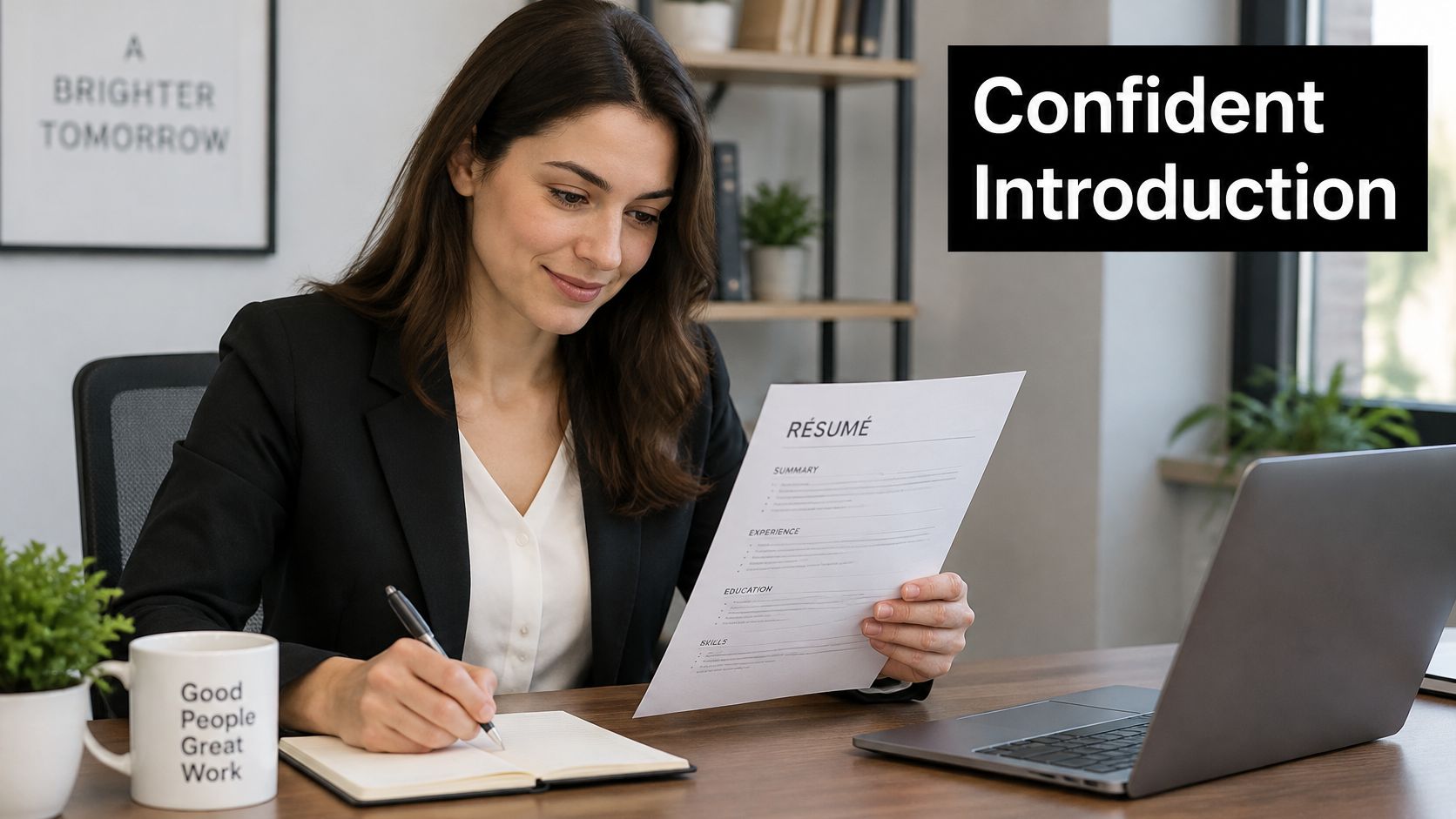
Match your introduction to the desk
- Administrative clerk: Lead with scheduling, correspondence, document preparation, and coordinating requests.
- Data entry clerk: Emphasize source verification, spreadsheet work, repetitive-task discipline, and resolving incomplete information.
- Retail clerk: Highlight customer contact, transaction accuracy, stock knowledge, and staying composed during busy periods.
- Records or front-desk clerk: Focus on document retrieval, visitor handling, confidentiality, and explaining procedures clearly.
For an administrative position, a model approach would be to describe supporting a shared inbox, maintaining appointment records, and checking documents before forwarding them. Then explain that you're interested in work where dependable follow-through helps colleagues serve customers. Replace those duties with your own experience, and add a measurable result only if you can substantiate it.
To build a high-impact career narrative, connect your experience rather than reciting your résumé chronologically. Leave unrelated background out unless it explains a useful transferable skill.
Write three short versions and practice aloud with a timer. ParakeetAI's Mock Interview supports spoken practice with an AI interviewer, while its Question Bank organizes real candidates' questions by company. Use practice to make your answer clearer, not more elaborate.
2. How do you prioritize multiple tasks with competing deadlines?
An urgent email, a ringing phone, and unfinished paperwork don't all deserve equal attention. The interviewer wants to hear how you decide what comes first, especially when you can't finish everything immediately.
Explain your method before giving an example. Use a task list, shared calendar, or spreadsheet to record deadlines, consequences of delay, dependencies, and progress. When requests conflict, confirm the order with the person responsible rather than choosing whose request to disappoint.

Explain your decision, not just your workload
Say you're preparing documents for a scheduled meeting when a colleague requests an immediate spreadsheet update. A strong approach is to establish whether that update affects an earlier deadline, explain your existing commitment, and agree on a realistic delivery time. Your example should end with what happened, such as completing the meeting pack on schedule without losing the later request.
Adjust the competing demands to your target role:
- Administrative clerk: Discuss calendar commitments, approval dependencies, and documents colleagues need before they can proceed.
- Data entry clerk: Separate time-sensitive batches from routine work, but retain required validation.
- Retail clerk: Prioritize customers and immediate safety concerns while arranging coverage for replenishment or paperwork.
- Records or front-desk clerk: Balance visitors with filing deadlines, authorized requests, and sensitive tasks that need uninterrupted attention.
Avoid claiming you handle everything simultaneously. Switching constantly between complex tasks can create mistakes.
Practical rule: Explain what can wait, who needs an update, and what check you won't skip. That's stronger evidence of prioritization than saying you work well under pressure.
3. How do you make sure your data entry is accurate?
Accuracy isn't a personality trait you can prove by calling yourself detail-oriented. Describe a repeatable process that another clerk could follow.
Start by checking that the source document is complete and that you've opened the correct record. Enter information consistently, compare critical fields against the source, and resolve exceptions before treating the work as finished.
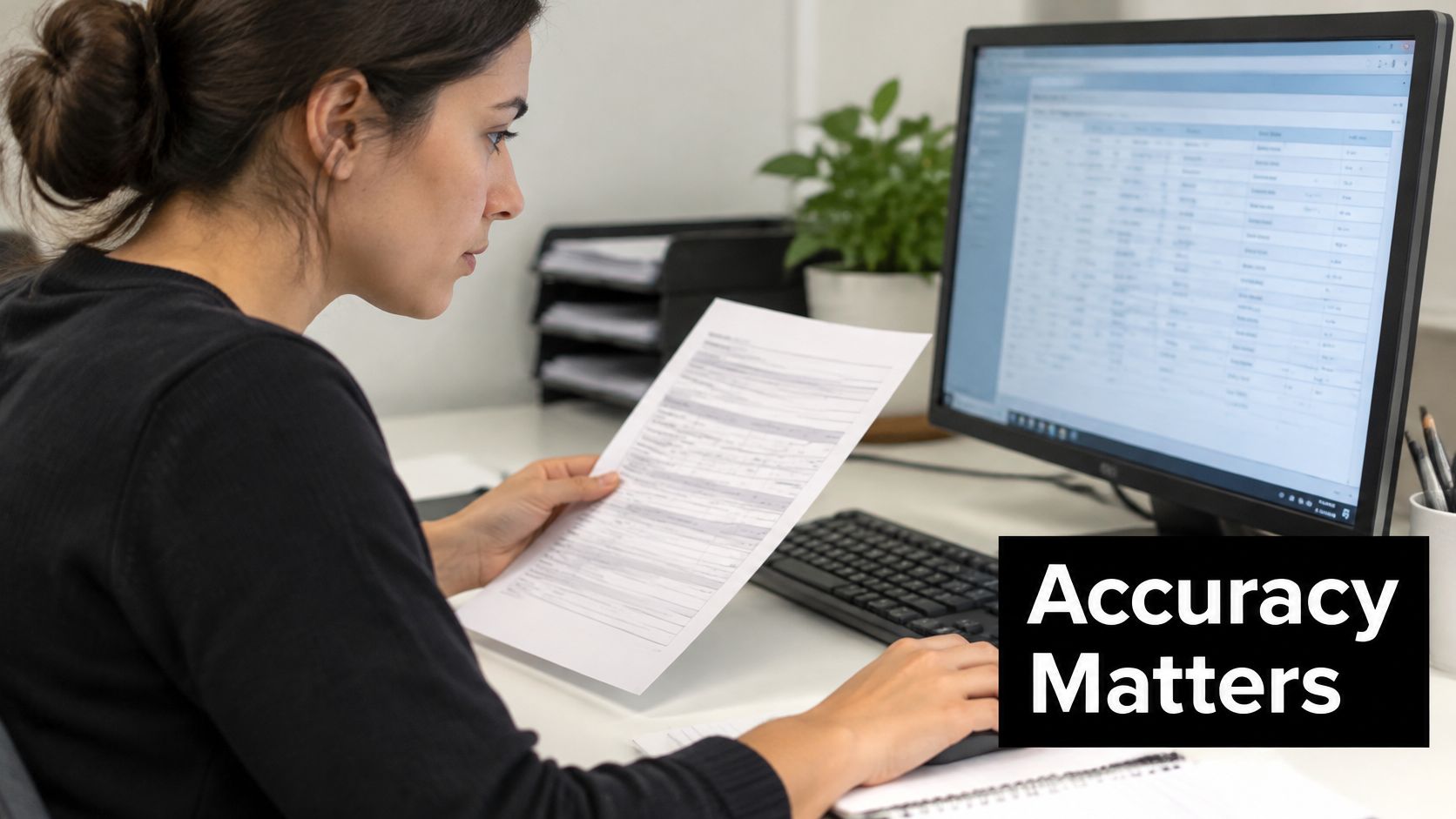
Describe checks that catch specific mistakes
- Administrative clerk: Check names, dates, attachments, and document versions before distributing correspondence.
- Data entry clerk: Explain Excel data validation, duplicate checks, source-to-entry comparisons, and reconciliation of batch totals.
- Retail clerk: Verify item codes, quantities, prices, and payment amounts before completing a transaction.
- Records or front-desk clerk: Confirm identifiers, document categories, and the correct destination before saving or routing information.
For example, suppose a spreadsheet import places an identification code into the wrong column. Explain how comparing the imported fields with the source would reveal the mismatch, why you'd stop the batch, and how you'd verify the corrected import before continuing.
Financial work makes source checking especially concrete. The U.S. Bureau of Labor Statistics' financial-clerks guidance describes billing clerks checking transaction documents and payroll clerks verifying attendance, hours, and adjustments.
Mention a real error you caught early and the check you added afterward. Sampling can help monitor routine batches, but don't imply that checking a sample replaces required verification of critical fields. Speed matters only when the employer can trust what you entered.
4. How would you handle an upset customer or visitor?
Start with the person's problem, not a defense of company policy. Interviewers are checking whether you can remain courteous while protecting boundaries, keeping the queue moving, and involving the right colleague.
A useful sequence is to listen, acknowledge the frustration, establish the facts, explain available options, and follow through. Acknowledging frustration doesn't mean accepting an inaccurate accusation or promising an exception you can't authorize.
The video below can serve as a prompt for practicing your tone and delivery.
Keep empathy separate from authority
For a worked scenario, suppose a visitor arrives for an appointment that isn't showing on the calendar. You'd listen, check the booking details discreetly, contact the relevant colleague, and explain what you can confirm. You wouldn't blame another employee or guarantee an immediate appointment.
Change the resolution to match the position:
- Administrative clerk: Clarify a delayed document or missed response, establish ownership, and provide a realistic update.
- Data entry clerk: Investigate a disputed entry against its source instead of changing it just to end the complaint.
- Retail clerk: Check the receipt and applicable return or pricing policy, then offer authorized options.
- Records or front-desk clerk: Explain the request process without revealing someone else's information or giving advice outside your role.
Use a real past situation if asked for one. Keep your account neutral, explain your actions, and finish with the outcome or handoff.
Don't claim you can calm every person. If someone becomes threatening or abusive, explain that you'd follow the organization's safety and escalation procedures rather than continue negotiating alone.
5. Which office software are you proficient in, and how have you used it?
A list of application names tells the interviewer very little. Microsoft Excel, Word, and Outlook become useful evidence only when you explain what you've done with them.
Describe your level and tie each tool to a task. Working knowledge of sorting, filtering, and formulas is different from advanced spreadsheet modeling; being able to retrieve a record isn't the same as administering a database.
Connect the software to a completed task
For a spreadsheet example, explain that you organized a request log, filtered outstanding items, checked for duplicates, and shared an updated report. If you've used mail merge, describe how you checked the recipient list and previewed the output before sending it.
The technical emphasis should change with the role:
- Administrative clerk: Discuss Word formatting, Outlook calendars, shared documents, and Excel tracking sheets.
- Data entry clerk: Explain validation, sorting complete datasets, filters, lookups if you use them, and checking imported files.
- Retail clerk: Include point-of-sale systems, stock lookup tools, and transaction or inventory reports.
- Records or front-desk clerk: Cover appointment systems, scanning, document indexing, permissions, and record retrieval.
Digital records deserve particular attention in court settings. The 2025 Thomson Reuters survey of state courts found that 86% used case-management systems and 85% used e-filing.
Don't call yourself advanced unless you're comfortable demonstrating the functions you name.
If the employer uses software you haven't encountered, say so directly. Then explain the closest system you know and how you'd learn through approved training, supervised practice, and checking your output. Confidence is useful; pretending that all systems work alike isn't.
6. Tell me about a time you made an error in records and how you fixed it.
Denying that you've ever made a mistake is less convincing than explaining how you handled one responsibly. The interviewer is checking accountability, judgment, and whether you understand the difference between correcting information and concealing an error.
Choose a genuine mistake with a clear resolution. Use STAR: situation, task, action, and result. Keep the setup brief and spend most of your answer on checking the impact, making an authorized correction, notifying affected people, and preventing recurrence.
Choose the right example for the role
- Administrative clerk: A wrong address, missing attachment, or calendar entry can demonstrate careful correction and communication.
- Data entry clerk: A transposed value or incorrect classification can show how you checked related entries and identified the cause.
- Retail clerk: A transaction or stock-entry mistake can demonstrate reconciliation and proper supervisor involvement.
- Records or front-desk clerk: A misfiled document or incorrect appointment detail can show respect for audit trails and notification procedures.
Consider a hypothetical address error discovered before a mail run. A credible response would explain verifying the address against an authorized source, updating the record through the approved process, checking whether other documents used it, and adding a verification step before future dispatches.
That's a model for organizing your account, not a story to present as your own. If you don't have paid experience, use an appropriate school or volunteer example and explain its setting clearly.
Avoid selecting an insignificant typo with no consequence, but don't turn a serious incident into a casual anecdote either. Prepare two or three genuine stories so you can answer follow-up questions without stretching one example beyond what happened.
7. How do you keep confidential information secure?
The strongest answer describes ordinary habits, not just a promise to be discreet. Interviewers want to know whether you protect information when you're busy, interrupted, or pressured by someone who sounds authoritative.
Explain that you use approved systems, lock your screen when away, secure paper records, and share information only with authorized recipients. Before releasing a record, verify both the requester's identity and their authority to receive it.
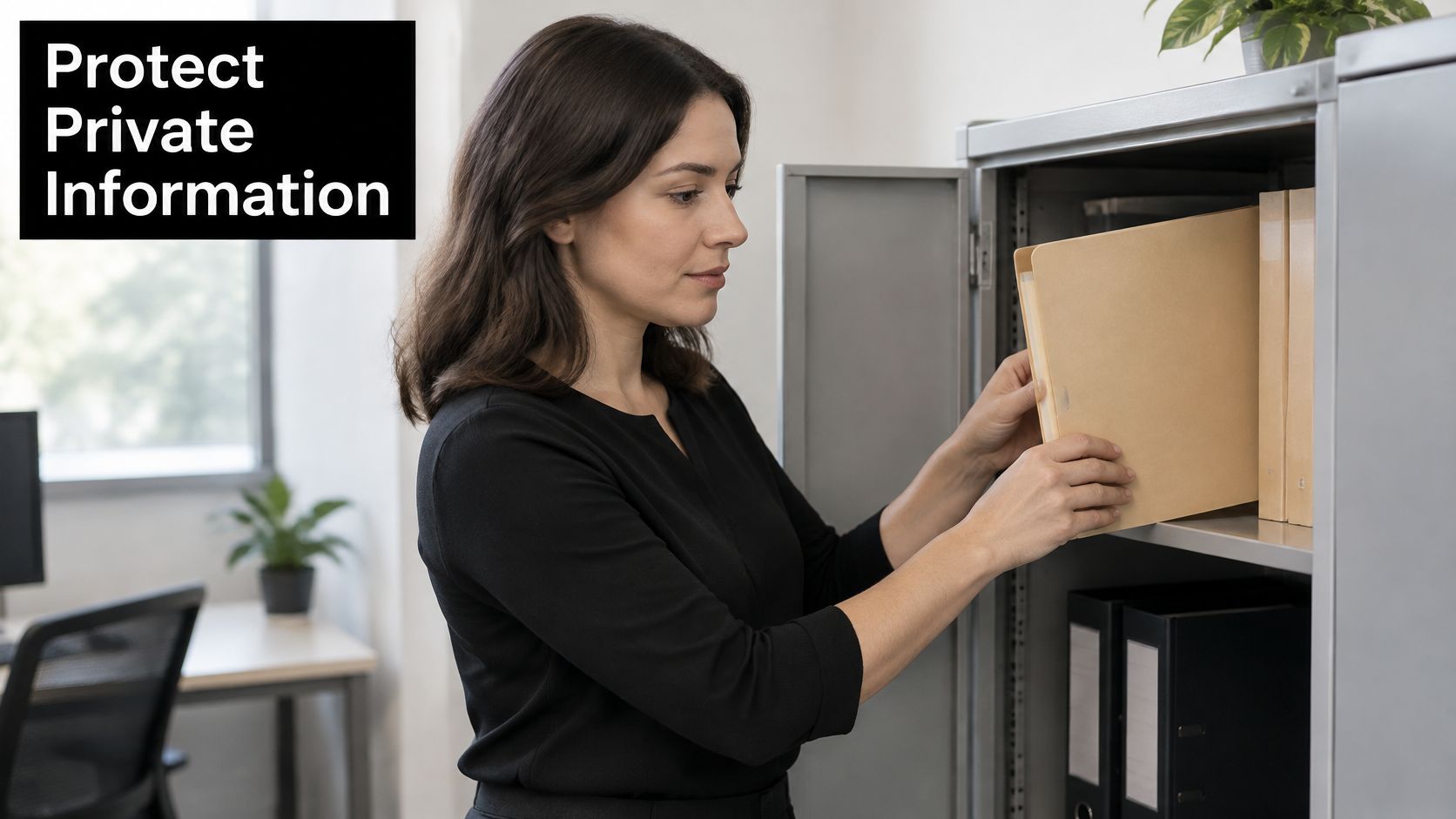
Show what you'd do under pressure
Suppose a caller knows a customer's name and urgently requests their address. You wouldn't treat that knowledge as permission. Explain that you'd follow the approved verification process, decline unauthorized disclosure, and refer uncertainty to the appropriate colleague.
Tailor the sensitive information in your answer:
- Administrative clerk: Protect personnel documents, internal correspondence, contact lists, and restricted calendars.
- Data entry clerk: Avoid personal email, unapproved storage, and copying confidential records into unauthorized AI tools.
- Retail clerk: Keep customer and payment information out of conversations, personal devices, and unnecessary notes.
- Records or front-desk clerk: Check release permissions and keep screens, visitor logs, and paperwork from public view.
Don't claim that every document is confidential or that every request should be refused. A clerk needs to provide legitimate access through the correct process, not create unnecessary barriers.
If you suspect a breach, say you'd report it promptly through the organization's procedure and preserve relevant details. Deleting evidence or trying to resolve it privately can make investigation harder.
8. Why do you want to work as a clerk, and what would you do in your first 90 days?
An employer wants a grounded reason for applying and a realistic learning plan. Saying you enjoy organization is a start, but explain whose work becomes easier when you organize information well.
Connect your motivation to the organization's service. Perhaps you're interested in helping residents work through applications, supporting accurate orders, or making sure colleagues can retrieve the documents they need. Use an actual detail from the employer's website or posting rather than invented familiarity.
Learn the workflow before changing it
During the first weeks, focus on approved procedures, system access, common requests, and escalation routes. Shadow an experienced colleague and ask them to review your work. By day 90, aim to handle agreed routine duties independently and suggest an improvement based on what you've learned.
Adjust that plan to the position:
- Administrative clerk: Learn scheduling conventions, document templates, approval routes, and team priorities.
- Data entry clerk: Understand field definitions, source documents, quality checks, and exception handling before increasing throughput.
- Retail clerk: Learn products, point-of-sale procedures, returns, stock locations, and when supervisor approval is required.
- Records or front-desk clerk: Learn indexing rules, access permissions, visitor procedures, and how to explain services accurately.
A worked example might be noticing that incomplete request forms cause repeated follow-ups. You could first learn which fields are essential, confirm the problem with your supervisor, and then propose clearer submission guidance.
Don't promise to redesign the filing system immediately. You may not yet understand retention requirements, integrations, or why the current categories exist.
A credible starting goal: Become dependable at the existing process before proposing a replacement.
How the eight clerk interview questions compare
| Item | Common Format | Core Skill Tested | Best Prepared For |
|---|---|---|---|
| Tell me about yourself | Behavioral opener; verbal introduction | Concise communication and relevant self-presentation | A 60–90 second summary of your experience, skills, and fit |
| How do you prioritize multiple tasks with competing deadlines? | Situational; behavioral | Organization, time management, and communication | Explaining a clear prioritization system with a specific example |
| How do you make sure your data entry is accurate? | Competency-based; technical | Attention to detail and quality control | Describing repeatable checks for records, billing, or database work |
| How would you handle an upset customer or visitor? | Situational; role-play | Patience, professionalism, and customer service | Showing how you listen, resolve issues, and escalate when needed |
| Which office software are you proficient in, and how have you used it? | Technical; skills-based | Office software proficiency and practical application | Naming relevant tools and describing tasks completed with them |
| Tell me about a time you made an error in records and how you fixed it. | Behavioral; STAR method | Accountability, problem solving, and learning | Sharing a realistic example focused on correction and prevention |
| How do you keep confidential information secure? | Situational; policy-based | Privacy awareness and sound judgment | Explaining secure handling and authorized access practices |
| Why do you want to work as a clerk, and what would you do in your first 90 days? | Motivational; forward-looking | Role fit, initiative, and planning | Connecting your motivation to a realistic onboarding plan |
Turn These Eight Answers into Your Own Clerk Interview Plan
Choose the three questions most relevant to your target role. For data entry, start with accuracy, software, and correcting mistakes. For front-desk and retail positions, prioritize customer handling, confidentiality, and competing demands; for administrative work, give scheduling and coordination more attention.
Write a 60 to 90 second answer for each, using a real example and a measurable result where you have one. A result doesn't need to be dramatic: meeting a deadline, reconciling a total, or correcting a record before dispatch can demonstrate useful judgment. Don't invent a percentage improvement because you think every answer needs a statistic.
Rehearse for follow-up questions
Practice each answer aloud at least twice with a timer. Listen for unnecessary background, vague verbs, and claims you couldn't explain if challenged. Replace statements about being organized with the actual tool and decision you used.
Ask yourself what the interviewer might probe:
- Your contribution: What did you personally do, rather than the team as a whole?
- Your checks: How did you know the information or outcome was correct?
- Your authority: What could you decide yourself, and what needed approval?
- Your learning: What did you change afterward?
Adjust the emphasis for each employer without changing the facts. Records-heavy positions call for more process detail, including identifiers, verification, and audit trails. Customer-facing positions need clear evidence that you can listen, explain options, and maintain boundaries without sounding dismissive.
Prepare questions that help you evaluate the job
Bring two or three questions about workload and training. Ask which tasks take priority during busy periods, how new clerks learn the systems, and what work needs review before it's finalized. Those questions help you understand the role while showing that you take accuracy and responsibility seriously.
Review the practical side of your examples, too. If you mention Excel filters, practice using them; if you describe document retrieval, be ready to explain naming and indexing conventions without disclosing confidential information.
You don't need a polished speech for every possible question. You need relevant evidence, an understandable method, and an honest account of your limits. A strong clerk candidate makes it easy for the interviewer to see how they'll handle routine work, unexpected problems, and the point where asking for help is the right decision.
Our Mock Interviews let you practice aloud with an AI interviewer that answers back, then review the transcript. Visit ParakeetAI to rehearse your clerk interview answers and identify where you need clearer examples or a more focused explanation.