
Is 25 Dollars an Hour Good? It Depends on Where You Live

$25 an hour equals $52,000 a year gross at 40 hours a week for 52 weeks, slightly above the U.S. all-occupation median wage, making it good for one adult in a moderate-cost area but not automatically enough for a household with dependents.
The more revealing question is what you must give up to earn it. An offer with guaranteed hours, paid leave, and health coverage isn't financially equivalent to the same rate with unpaid preparation and unpredictable shifts. To judge the offer, separate annual earnings, purchasing power, and effective hourly compensation rather than treating them as the same thing.
The Short Answer and the Annual Math Behind $25 an Hour
$25 an hour is respectable middle-market pay, but the schedule determines how much income you can realistically budget. The headline annual salary assumes you're paid throughout the year, not merely that you're available to work.
The calculations below use the MIT Living Wage Calculator's full-time convention of 2,080 annual hours, with the shorter schedule and daily amounts calculated directly from the stated hourly rate.
Gross pay at $25 an hour by schedule
| Pay period | Hours worked | Gross pay |
|---|---|---|
| Per day (8 hours) | 8 hours | $200 |
| Per week at 35 hours | 35 hours | $875 |
| Per week at 40 hours | 40 hours | $1,000 |
| Per month (average) | Annual full-time hours averaged monthly | About $4,333 |
| Per year at 35 hours | 1,820 hours | $45,500 |
| Per year at 40 hours | 2,080 hours | $52,000 |
These are gross amounts, not deposits into your bank account. The monthly figure is an annual average, so it also shouldn't be mistaken for a promise about the timing or size of individual paychecks.
The schedule is part of the offer
The shorter weekly schedule in the table produces a noticeably smaller annual income without changing the hourly rate. That's why an employer's answer about guaranteed hours matters as much as the number printed beside “pay.”
Unpaid leave and irregular shifts also change the calculation. If an employer describes the position as full-time but won't commit to a schedule, treat the annualized figure as a scenario, not a guarantee.
Practical rule: Build your recurring budget around dependable paid hours, not the maximum hours an employer says might be available.
To test an offer, multiply the hourly rate by scheduled weekly hours, then by the paid weeks you reasonably expect. Alternatively, calculate a full-year total and subtract unpaid hours at the offered rate, but don't subtract the same absence twice.
Ask whether holidays, vacation, sick days, and training are paid before relying on the result. The arithmetic is straightforward; deciding which hours belong in it requires reading the offer carefully.
How $25 an Hour Stacks Up Against National Wage Benchmarks
The federal minimum wage is $7.25 per hour for covered, nonexempt employees, making the proposed rate $17.75 higher and approximately 3.45 times as large, according to the Department of Labor's consolidated minimum-wage guidance. States and localities can require higher rates, so this federal comparison establishes distance from a legal baseline, not financial comfort.
The difference is substantial, but it isn't the most useful stopping point.
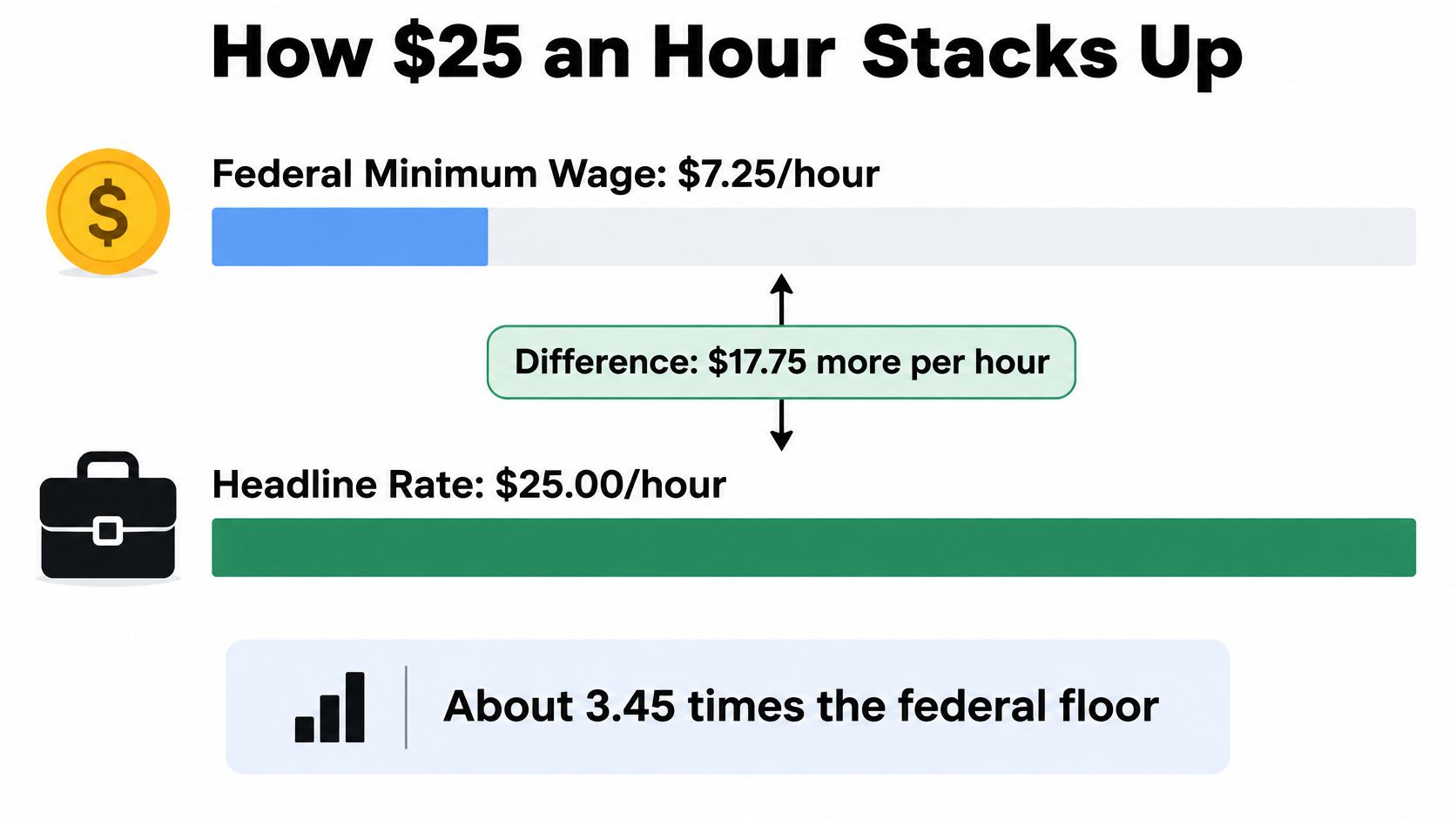
The occupational figures below come from the BLS occupational wage reference; the civilian wage percentiles come from its March 2025 employee-benefits publication. Differences in the final column are direct arithmetic against the offered rate.
$25 an hour against national wage benchmarks
| Benchmark | Value | How $25 compares |
|---|---|---|
| Federal minimum wage | $7.25 per hour | $17.75 higher, about 3.45 times as high |
| Cashier median (May 2025) | $15.81 per hour | $9.19 higher |
| Bartender median (May 2025) | $16.51 per hour | $8.49 higher |
| Janitor and building cleaner median (May 2025) | $17.71 per hour | $7.29 higher |
| 25th percentile wage (March 2025) | $18.57 per hour | $6.43 higher |
| All-occupation median (May 2025) | $24.51 per hour | $0.49 higher |
| Civilian median (March 2025) | $25.50 per hour | $0.50 lower |
| 75th percentile wage (March 2025) | $40.87 per hour | $15.87 lower |
| Full-time weekly median (2025) | $1,204 per week | $204 lower per 40-hour week |
The weekly benchmark is reported in the BLS release on 2025 full-time wage-and-salary earnings. That population includes people usually working at least 35 hours weekly, so it isn't a perfectly standardized hourly comparison.
Why the medians give different answers
These benchmarks describe different worker populations and measurement periods. Being just above an occupational median and just below a civilian median isn't a contradiction, nor does either position establish what your employer should pay.
The defensible conclusion is near the national middle, not unusually high. The service-occupation comparisons make the offer look stronger; the upper-percentile comparison makes it look weaker.
Use national benchmarks for orientation. Your occupation, experience, and location should determine whether you accept the offer.
Why Location and Household Size Decide Whether $25 Is Enough
A living wage measures basic household sufficiency, not rank within the wage distribution. MIT defines it as the hourly income a full-time worker needs to cover basic needs without public or private assistance, and its estimates depend on household composition and geography.
The Providence-Warwick example illustrates the narrow margin: its estimate for one adult without children is about $25.11 an hour, alongside the household-based approach described in the MIT Living Wage Calculator methodology. Being close to that threshold means being close to basic self-sufficiency, not necessarily having room for every personal financial goal.
A household budget makes that distinction tangible.

The same wage can support different lives
- Single adult in a lower-cost area: The rate may cover essentials with some flexibility, depending on housing, deductions, and existing obligations. Living alone and sharing housing should be evaluated as different personal budgets.
- Parent or worker supporting another adult: The same paycheck must cover more household needs. Childcare or another dependent's expenses can create a shortfall even when the worker's hourly pay looks nationally typical.
- Worker in an expensive metropolitan area: Housing is usually the main pressure point, alongside transportation, healthcare, and childcare where applicable. A nationally ordinary wage doesn't guarantee locally affordable living.
Apply the local test without mixing hourly and annual figures:
- Find your household category for your county or metropolitan area in MIT's calculator.
- Compare like with like. Use its annual basic-needs estimate against your annual gross earnings, or compare its hourly estimate with your hourly wage.
- Test your actual budget against benefit deductions, debt payments, and emergency savings rather than stopping at the calculator's threshold.
Housing choices can change the result, but they don't erase household responsibilities. A budget that works only with no unexpected expenses deserves a different verdict from one with a dependable surplus.
Good for one adult in a lower- or moderate-cost location doesn't mean broadly comfortable for a household with dependents.
The Hidden Costs That Lower the Real Value of an Hourly Rate
Effective hourly compensation = total annual compensation ÷ all work-related hours. For a more practical comparison, include employer-funded benefits in compensation and subtract commuting and other work-related expenses before dividing.
This is a personal decision tool, not a payroll or legal definition of paid working time. Including your commute helps you compare what a job requires from your life, even when that time isn't compensable.
A worked example with unpaid time
The following example assumes 80 unpaid commuting and preparation hours annually. That's an illustrative input, not a measured average; the base earnings use the full-time calculation established earlier, and the effective rate is direct division.
Effective hourly pay with unpaid hours (worked example)
| Line item | Hours | Amount |
|---|---|---|
| Base pay at $25 per hour | 2,080 paid hours | $52,000 |
| Unpaid commuting and preparation (assumed) | 80 unpaid hours | No additional pay |
| Total time spent on the job | 2,160 total hours | $52,000 |
| Effective hourly rate | Per total work-related hour | About $24.07 |
The example isolates time, so it doesn't yet add benefits or subtract travel expenses. It also isn't an after-tax wage estimate.
The important result is directional: when unpaid obligations increase and compensation doesn't, your effective rate falls. You can apply that reasoning to your own commute and preparation requirements without assuming everyone has the same burden.
Benefits change the numerator
Ask the employer for the actual contribution and eligibility terms rather than assigning a generic dollar value.
- Health insurance: Count the employer-funded portion when comparing total compensation, while keeping your own premium deductions visible in the cash budget.
- Retirement contributions: Include the contribution you're eligible to receive, subject to the plan's terms.
- Paid vacation and sick leave: Check whether paid leave is already included in annual cash earnings. Don't add the same wages again as a separate benefit.
- Employer-paid training: Consider both covered expenses and whether the time spent learning is paid.
A contractor without paid leave, employer health coverage, or retirement contributions may need a higher nominal rate to match an employee's package. That doesn't establish a universal contractor premium; it tells you which missing items to price individually.
Payroll and income taxes reduce spendable cash, but employer-funded benefits aren't interchangeable with money for rent. Keep total compensation and take-home cash as separate calculations.
Compare benefits when choosing between offers. Compare after-deduction cash when deciding whether you can pay your bills.
Irregular scheduling and required availability can complicate the denominator further. Ask what on-call time really requires rather than assuming either that all availability is working time or that it has no personal cost.
When $25 an Hour Is Strong Pay and When It Falls Short
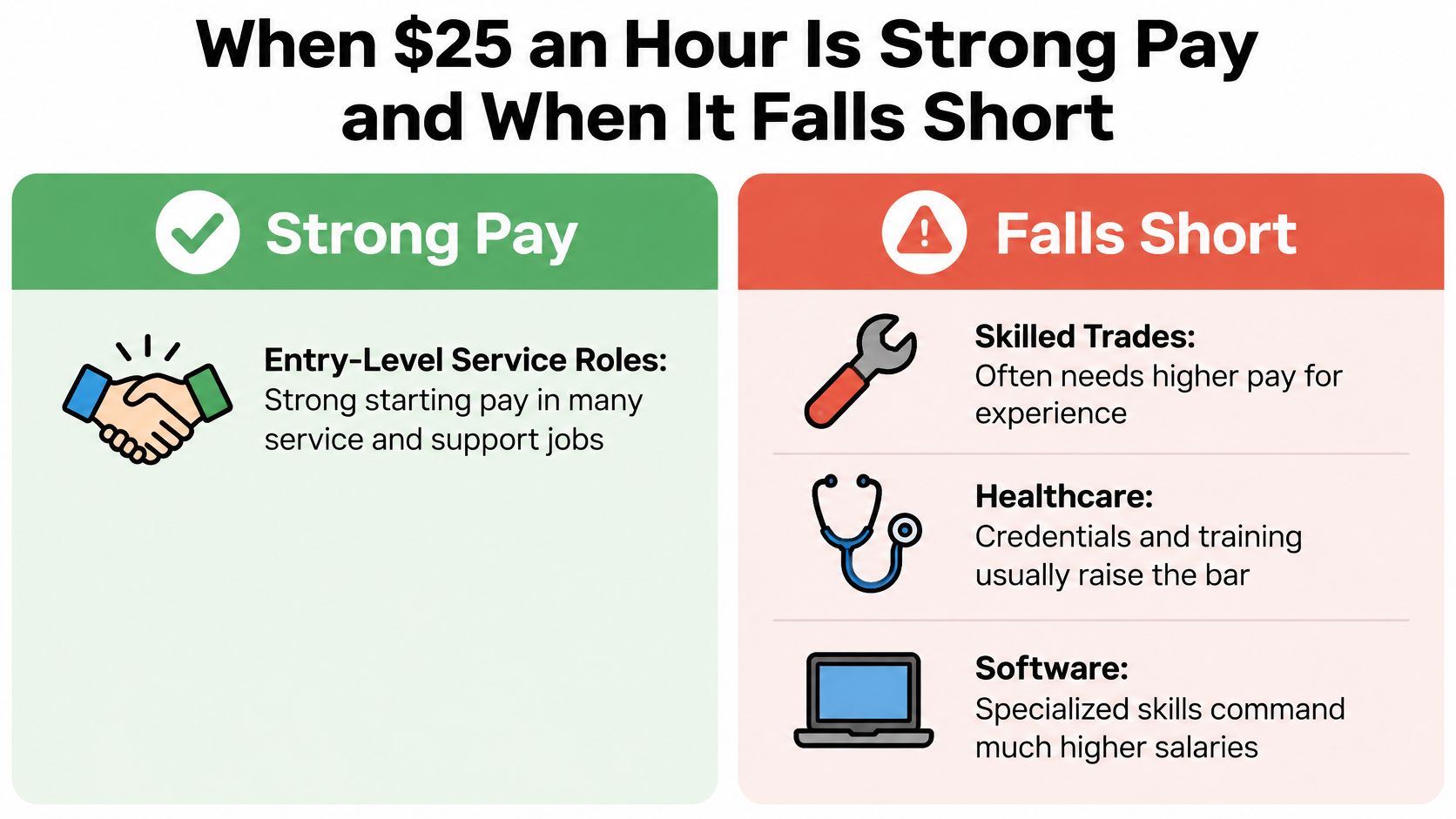
The headline rate says little about career competitiveness without the job title and experience requirements. The service-role medians above support calling it strong pay relative to those particular benchmarks, but they don't establish competitiveness for skilled trades, healthcare, software, or professional work.
An occupation-focused compensation discussion makes the relevant distinction: national medians can't substitute for an occupation-specific comparison that accounts for benefits and predictable hours. Treat the following visual as a screening guide, not proof that every job within a broad field should pay the same amount.
What strengthens or weakens the offer
Reasons to view it favorably
- Relevant entry-level comparison: The offer compares well with starting opportunities for the same work, not merely with unrelated lower-paid occupations.
- Usable earnings opportunities: Available overtime may improve earnings, provided you confirm eligibility, availability, and the applicable rules.
- Documented progression: A clear review process and defined requirements for advancement make future pay discussions more concrete.
Reasons for caution
- Unpaid preparation: Required effort reduces the effective rate calculated earlier.
- Uncertain income: No guaranteed hours makes the annual projection less dependable.
- Missing support or progression: No paid leave and no credible growth path weaken the overall package, even if the starting rate sounds attractive.
Experience changes the comparison
An entry-level applicant should compare the offer with entry-level postings for substantially similar responsibilities. A worker with five years in the field should instead compare it with experienced-role ranges; this is a decision scenario, not a claim about what every experienced worker earns.
In either case, match the scope of work. A role requiring credentials, independent judgment, or specialized responsibility needs a more specific benchmark than the overall national median.
For a separate perspective to consider alongside your own calculations, this video is an optional supplement.
Don't infer competitiveness from a field's name alone. Check the occupation's actual range, then use the effective-pay calculation to determine whether the offer still compares well after accounting for what the employer expects.
Decide Whether a $25 an Hour Offer Is Good for You
Use this checklist before accepting or negotiating:
- Confirm paid hours and guarantees. Ask what the employer commits to, how schedules change, and whether the advertised annual income assumes hours that aren't guaranteed.
- Value the benefits. Request health-coverage contributions, retirement-match terms, and paid-leave details. Keep cash compensation separate from benefits you can't use for everyday expenses.
- Calculate effective pay. Subtract commuting expenses from compensation and add unpaid preparation and commuting time to the denominator. Use the worked example's approach without borrowing its assumed time requirement.
- Check your occupational range. Compare similar responsibilities, experience requirements, and employment arrangements rather than selecting whichever national benchmark looks most favorable.
- Run the household affordability test. Use the local method above, then check whether your own obligations leave enough room for savings and unexpected expenses.
- Clarify progression and overtime. Ask when reviews occur, how raises are decided, and which overtime rules apply to the role.
A good offer passes both the occupational comparison and the household affordability test; a weak offer looks good only at the headline level. That's the most useful answer to “Is 25 dollars an hour good?” because it separates fair compensation for the work from sufficient income for your life.
Turn a shortfall into a specific request
If the offer falls short, identify why before negotiating. A market-pay gap supports a discussion about the base rate, while uncertain hours call for a scheduling commitment and missing benefits call for a broader package discussion.
Use the benchmark table as context, not as proof that every employer owes the same wage. Your strongest case connects comparable responsibilities, relevant experience, and the actual terms of the offer.
Prepare a concise record of your qualifications and the work you can perform. A resume-building and tailoring tool can help organize that evidence, but the negotiation should remain grounded in accurate accomplishments and the job's requirements.
Before the conversation, decide which change would make the offer acceptable and which terms you need in writing. Don't substitute a possible future raise for an offer that doesn't work today.
Rehearse the pay conversation with the Mock Interview tool, focusing on your target, supporting evidence, and response if the employer can't change the rate. Check available plans on the pricing page before choosing a paid option.
ParakeetAI offers AI mock-interview practice and resume-building tools to help you prepare for job conversations. Bring your compensation calculations and role-specific evidence, then practice explaining what would make the offer work for you.