
Master Interview Question Matching for Smarter AI Prep

TL;DR:AI-powered interview question matching personalizes questions based on your resume and the job description.Semantic analysis improves accuracy and fairness by understanding the meaning behind skills and experience.Effective use involves critical review, practicing out loud, and combining AI feedback with human input.
Most job seekers spend hours rehearsing the same tired questions: “Tell me about yourself” and “What’s your greatest weakness?” That approach feels productive, but it mostly builds confidence around answers that may never come up. Interview question matching flips this entirely. Instead of guessing what an employer might ask, AI analyzes your resume and the specific job description to generate questions that actually reflect the role’s requirements and your personal experience gaps. This guide breaks down exactly how that works, why it outperforms generic prep, and how you can use it to walk into any interview feeling genuinely ready.
Table of Contents
- Understanding interview question matching
- How AI powers personalized interview questions
- Semantic analysis vs. keyword matching: Why it matters
- Best practices for using interview question matching tools
- Our take: What most people get wrong about interview question matching
- Take the next step with tailored AI-powered prep
- Frequently asked questions
Key Takeaways
| Point | Details |
|---|---|
| AI delivers personalized prep | Interview question matching uses AI to tailor practice directly to each job and applicant’s unique strengths and gaps. |
| Semantic analysis boosts fairness | Modern matching tools use context, not just keywords, to generate more fair and relevant questions. |
| Effective use requires engagement | Success with AI-based tools comes from actively practicing and interpreting their targeted feedback. |
| Combining methods yields results | Pairing AI-powered question matching with traditional prep gives you the most comprehensive readiness. |
Understanding interview question matching
Generic prep gives you a list of 50 common questions and tells you to practice them all. Interview question matching gives you the 10 questions most likely to trip you up in this specific role. That distinction matters more than most people realize.
At its core, interview question matching is an AI-driven process that cross-references your resume with a job posting to produce a personalized set of practice questions. It is not a static question bank. It is a dynamic system that reads your background, identifies where your experience aligns with the role, and flags where it does not. Those gaps become the focus of your practice.
Here is what makes it fundamentally different from traditional prep:
- Personalized targeting: Questions reflect your actual work history, not a hypothetical candidate’s.
- Role-specific focus: The tool reads the job description to surface competencies the employer cares about most.
- Gap identification: If your resume lacks a skill the job requires, the AI generates questions designed to probe that area.
- Culture alignment: Some tools factor in company values and industry norms to shape question tone and style.
The NLP for resume parsing involved in this process includes keyword extraction from job descriptions and generative AI to create behavioral, technical, and situational questions matched to skills, experience gaps, and company culture.
“The best preparation is not the most preparation. It is the most targeted preparation.”
Traditional prep treats every candidate the same. A marketing manager and a software engineer might get the same “Tell me about a challenge you overcame” prompt. Interview question matching recognizes that the marketing manager needs to talk about campaign performance, while the engineer needs to discuss debugging under pressure. These are entirely different conversations, and AI interview question generators are built to know the difference.
The result is a practice session that feels less like a rehearsal and more like a real interview. You are not just practicing answers. You are practicing the right answers for the right role.
How AI powers personalized interview questions
When you upload your resume and a job description into an AI-powered prep tool, a multi-step process begins almost instantly. Understanding each step helps you use these tools more effectively.
- Resume parsing: The AI reads your resume using natural language processing (NLP), a branch of AI that interprets human language. It extracts job titles, skills, years of experience, industries, and notable achievements.
- Job description analysis: The tool breaks down the posting to identify required competencies, preferred qualifications, keywords, and implied values.
- Gap mapping: The system compares your profile against the role’s requirements and flags mismatches.
- Question generation: Generative AI creates custom behavioral, technical, and situational questions based on both your profile and the job’s demands.
- Adaptive follow-ups: Advanced tools go further. They adapt follow-ups in real-time based on how you respond, evaluating content relevance, technical depth, and communication clarity.
Here is a side-by-side look at how AI-driven prep compares to manual prep at each stage:
| Stage | Manual prep | AI-driven prep |
|---|---|---|
| Resume review | Self-assessed | Machine-parsed for gaps |
| Question source | Generic lists | Role and profile specific |
| Follow-up questions | Static | Adaptive and real-time |
| Feedback | None or peer-based | Instant and structured |
| Time investment | High | Significantly reduced |
The AI interview generator tools available today can also generate technical interview questions that reflect current industry standards, not outdated textbook scenarios. That matters especially in fields like software engineering, data science, and finance, where the bar shifts quickly.

Pro Tip: After each AI-generated practice session, write down the three questions that caught you off guard. Those are your actual weak spots, and they deserve dedicated practice time before the real interview.
Semantic analysis vs. keyword matching: Why it matters
Not all AI matching systems work the same way. There is a significant difference between tools that use basic keyword matching and those that use semantic analysis, and that difference directly affects the quality of your practice.
Keyword matching works like a simple search engine. It looks for word overlap between your resume and the job description. If the job posting says “project management” and your resume says “project management,” the system registers a match. Simple, fast, and often misleading.
Semantic analysis goes deeper. It understands the meaning behind words and phrases. It recognizes that “led cross-functional teams” and “coordinated multi-department initiatives” describe similar competencies, even though they share no keywords. This matters because candidates rarely use identical language to describe their experience.
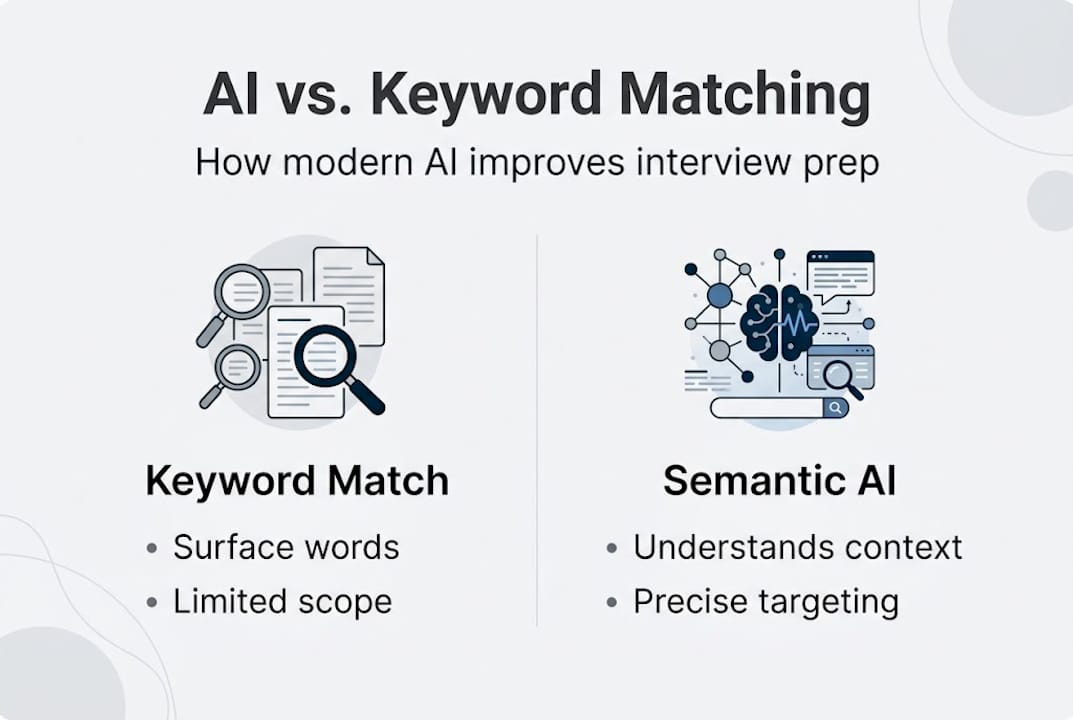
Here is how the two approaches compare in practice:
| Factor | Keyword matching | Semantic analysis |
|---|---|---|
| Accuracy | Moderate | High |
| Bias risk | Higher | Lower |
| Nuance | Low | High |
| Question relevance | Generic | Contextually precise |
| Fairness for diverse candidates | Limited | Significantly better |
The fairness angle is worth pausing on. Basic keyword matching versus contextual semantic analysis reveals a clear preference: general large language models underperform task-specific models in both accuracy and fairness. Candidates from different educational backgrounds or industries often describe the same skills using different vocabulary. Keyword-only tools penalize them unfairly.
Semantic tools also reduce the risk of AI interview fairness issues by evaluating the substance of your experience rather than the surface-level phrasing. This is why AI is critical for interviews when the goal is genuine preparation rather than gaming a word-match algorithm.
- Semantic AI identifies transferable skills across industries.
- It surfaces questions tied to competencies, not just job titles.
- It creates a more realistic and equitable practice environment.
When choosing a tool, ask whether it uses semantic understanding or simple keyword overlap. The answer tells you a lot about how useful your practice sessions will actually be.
Best practices for using interview question matching tools
Knowing how the technology works is only half the equation. Using it well is where most candidates leave value on the table. Here is a step-by-step approach that consistently produces better results.
- Upload tailored materials: Do not use a generic resume. Upload the version you customized for this specific role. The more precise your input, the more accurate the AI’s output.
- Paste the full job description: Avoid summarizing. Copy the entire posting, including preferred qualifications and company boilerplate. Hidden signals live in that text.
- Review the generated questions critically: Do not just accept every question at face value. Ask yourself whether each one reflects a real concern for this role. If something seems off, adjust your resume or rerun with a refined version.
- Practice out loud: Reading questions silently is not practice. Speaking your answers builds fluency and reveals filler words or hesitation patterns you would not catch otherwise.
- Engage with follow-up feedback: This is where most people stop too early. The NLP-driven feedback from AI tools on behavioral, technical, and situational responses is where the real learning happens.
- Combine AI prep with human review: Share your AI-generated answers with a mentor, friend, or career coach. AI catches gaps in content. Humans catch gaps in delivery.
Pro Tip: Run the tool twice for the same role using two different versions of your resume. Compare which questions change. This reveals exactly which parts of your background the employer’s requirements are reacting to.
Common mistakes to avoid: ignoring the follow-up questions the AI generates, treating the first output as final, and skipping the behavioral question section because it feels soft. Behavioral questions are often where best tech interview answers separate strong candidates from great ones. Also, do not overlook AI fairness in interviews when evaluating which tools you trust with your data and your prep.
Our take: What most people get wrong about interview question matching
Here is the uncomfortable truth: most people use these tools the same way they use generic question lists. They generate the questions, skim the answers, and feel prepared. They are not.
The real value of interview question matching is not the questions themselves. It is the process of sitting with a hard question you did not expect, struggling to answer it, and then figuring out why. That friction is where growth happens. AI tools are mirrors, not scripts.
We also see a lot of candidates treat AI prep as a way to game the system, memorizing AI-generated answers word for word. That is a trap. Interviewers are good at detecting rehearsed responses. What they respond to is someone who clearly understands their own experience and can speak to it naturally.
AI and interview consistency is a real advantage, but only when you use the tool to practice thinking, not to replace it. Context and critical thinking remain your edge. The AI just helps you find where to sharpen them.
Take the next step with tailored AI-powered prep
Reading about interview question matching is one thing. Experiencing it changes how you prepare entirely. ParakeetAI delivers truly customized, AI-matched interview practice built around your unique profile and every specific job you apply for. It listens in real time during your practice sessions and provides instant, relevant answers and feedback tailored to the role.
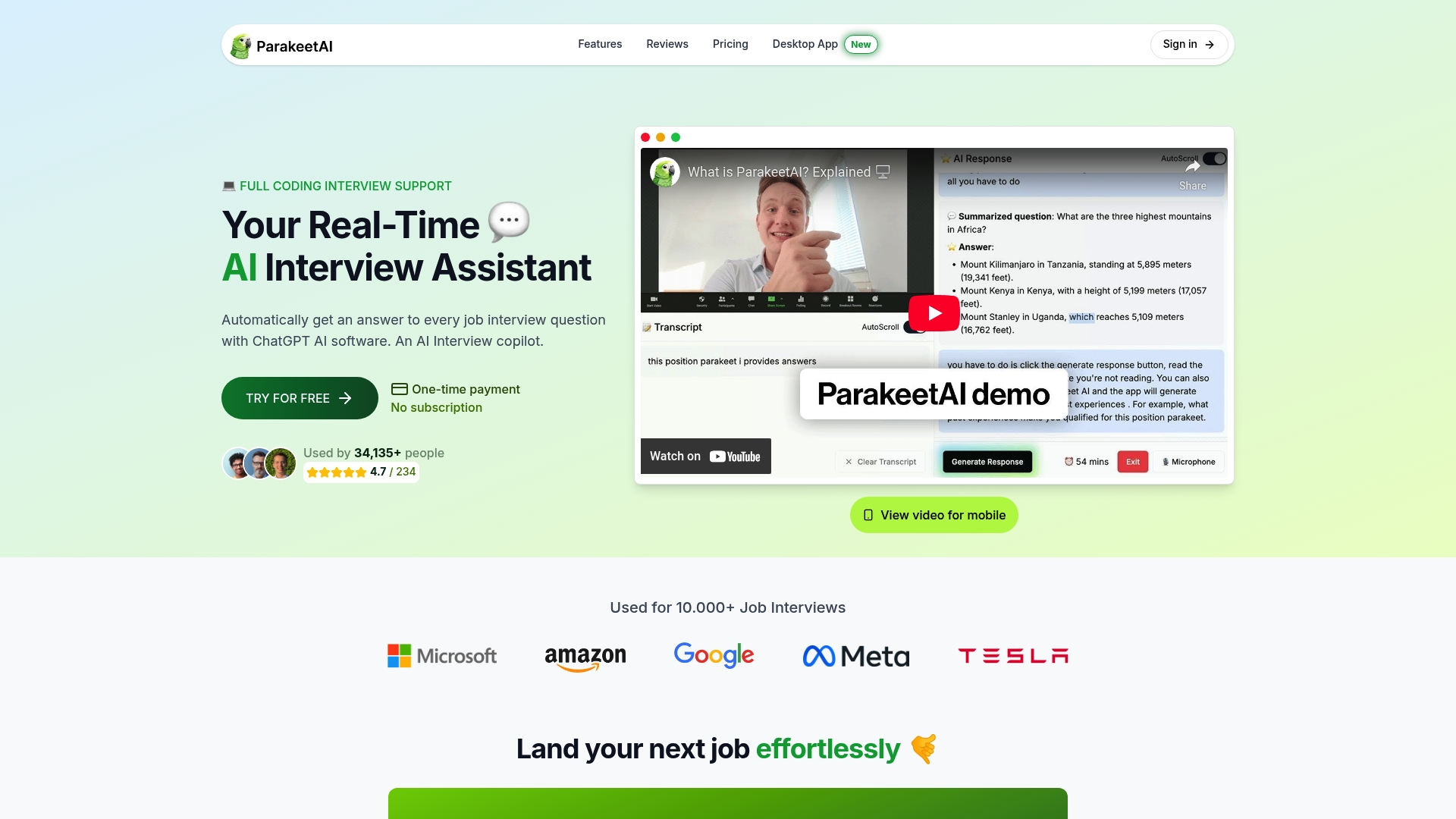
You can get started in minutes, with no complicated setup. Upload your resume, paste a job description, and let the AI surface the questions that actually matter for your next interview. The difference between generic prep and targeted prep is the difference between hoping you get asked the right questions and being ready for all of them.
Frequently asked questions
How does interview question matching differ from traditional prep?
Interview question matching uses AI to tailor questions to your experience and the specific job, rather than relying on generic lists that apply to every candidate equally.
Are AI-matched questions more accurate than standard sets?
Yes. Semantic analysis delivers more accurate and fairer questions than keyword matching, making the practice experience far closer to what you will actually face.
What technologies are used in question matching tools?
These tools rely on NLP, keyword extraction, and generative AI to analyze your materials and create behavioral, technical, and situational questions customized to your profile.
Can I practice follow-up questions using AI tools?
Yes. Advanced platforms adapt follow-up questions in real-time during practice sessions, giving you a more dynamic and realistic interview simulation.