
Office Manager Interview Questions: Choosing Top Global Talent

Every hiring manager knows the stakes are high when choosing the right office manager for a multinational team. Whether your offices operate in Toronto, Singapore, or London, each candidate must prove they can adapt, communicate, and solve problems across cultures. Defining effective interview questions goes beyond routine screening. It means crafting tools that reveal leadership, decision-making, and interpersonal strength to match the realities of global business.
Table of Contents
- Defining Office Manager Interview Questions
- Essential Categories and Key Differences
- Best Practices for Multinational Interviews
- Leveraging AI Tools for Interviews
- Legal Compliance and Cultural Sensitivity
Key Takeaways
| Point | Details |
|---|---|
| Tailored Interview Questions | Design specific questions that mimic actual office challenges to effectively assess candidates’ real-world capabilities. |
| Diverse Competency Focus | Emphasize core competencies such as leadership, communication, and problem-solving tailored to the global context. |
| Cultural Sensitivity in Hiring | Recognize and respect different cultural norms during interviews to ensure a fair and effective evaluation process. |
| Utilize AI for Efficiency | Leverage AI tools to standardize assessments and reduce bias while maintaining human judgment in final evaluations. |
Defining Office Manager Interview Questions
Office manager interview questions serve a specific purpose: they reveal whether a candidate can handle multiple responsibilities, work across departments, and manage administrative operations effectively. These aren’t generic screening questions. They’re designed to uncover how someone thinks, acts under pressure, and contributes to organizational success.
At their core, management interview questions assess leadership abilities, decision-making skills, and interpersonal competencies that go beyond basic administrative tasks. For office managers specifically, you’re looking for candidates who can juggle budgets, handle conflicts, supervise teams, and adapt to shifting priorities.
What Makes an Office Manager Question Effective
A strong interview question for this role accomplishes three things:
- Reveals how the candidate actually behaves (not just how they describe themselves)
- Tests their ability to prioritize when everything feels urgent
- Shows their communication style with diverse teams and departments
Good questions go deeper than “Tell me about yourself.” They dig into real scenarios where decisions matter. You need to see how candidates handle resource constraints, difficult people, and competing deadlines.
The best office manager interview questions mirror the actual challenges your team faces daily. Ask about situations that match your workplace reality.
Why Specificity Matters for Global Teams
When hiring office managers for multinational corporations, vague questions waste everyone’s time. A candidate might excel in one cultural context but struggle in another. Your questions need to explore how they adapt to diverse communication styles, work across time zones, and respect different workplace norms.
Questions about conflict resolution and decision-making under pressure help you understand whether someone can navigate the complexity of global teams. Office managers in international settings constantly balance local preferences with corporate standards.
You’re not just assessing their resume. You’re evaluating their flexibility, emotional intelligence, and ability to solve problems independently when immediate guidance isn’t available.
The Core Question Categories
Focus your interviews around these competency areas:
- Operational efficiency: How do they streamline processes and improve workflow?
- Team leadership: Can they motivate, delegate, and hold people accountable?
- Problem-solving: How do they handle unexpected obstacles and competing demands?
- Communication: Do they explain decisions clearly and listen to concerns?
- Adaptability: Can they adjust strategies when circumstances change?
When you’re building interview questions, pull examples from your actual business challenges. If budget management is critical, ask directly about it. If you’ve struggled with interdepartmental coordination, test that specific skill.
Pro tip: Create a question bank based on your office manager’s biggest job responsibilities, then rotate questions among candidates to ensure consistency and fair evaluation across your global hiring process.
Essential Categories and Key Differences
Not all interview questions work the same way. Different question types reveal different information about your candidates. When you’re hiring office managers globally, you need to mix question styles to get a complete picture of how someone actually performs.
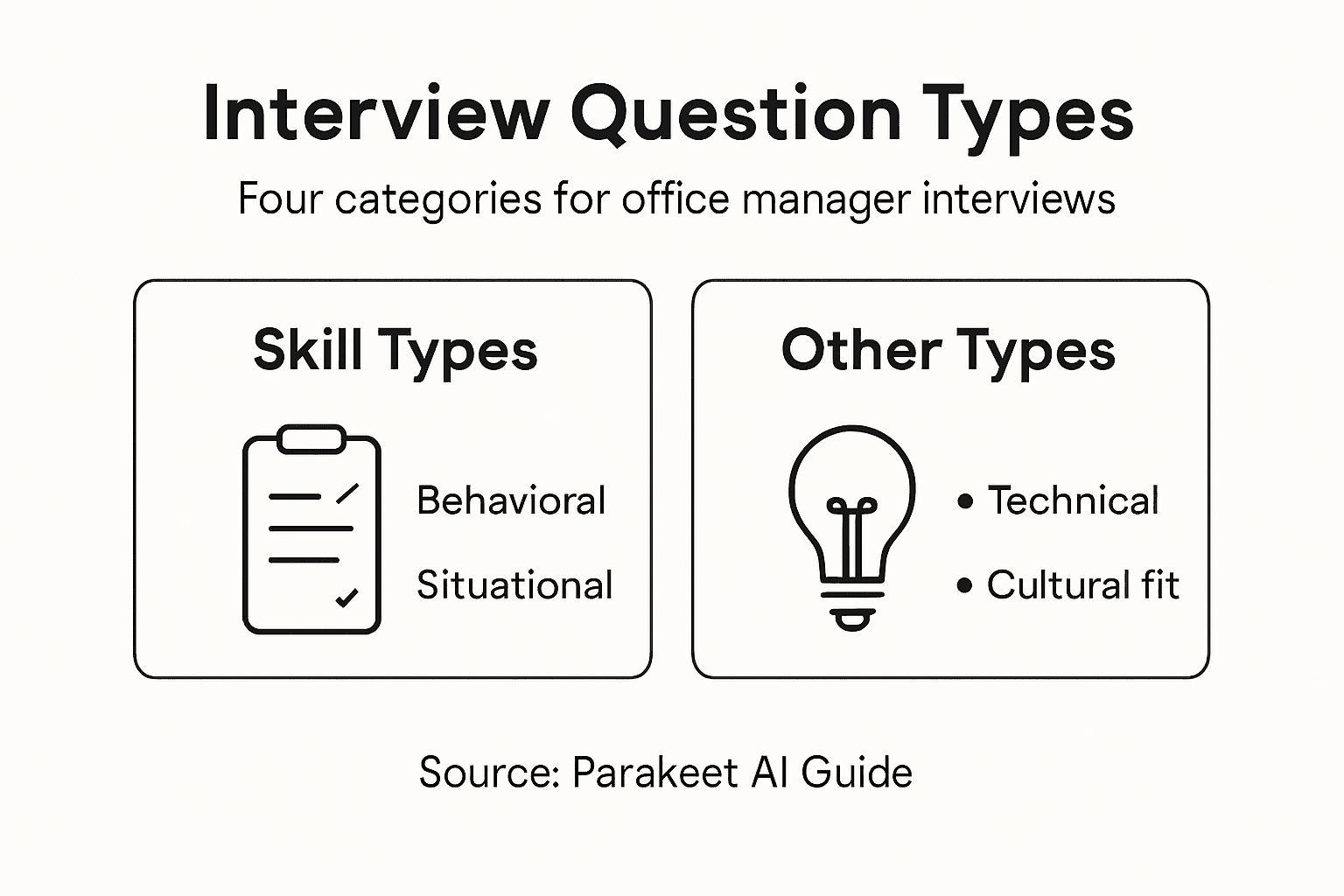
The Four Core Question Types
Interview questions organized by competencies help you systematically evaluate candidates across multiple dimensions. Understanding which type to use and when makes your interviews significantly more effective.
Here’s what each type reveals:
- Behavioral questions: Focus on what candidates have actually done in past roles. They uncover patterns and real-world decision-making.
- Situational questions: Present hypothetical scenarios your office manager might face. These show how someone would approach new situations.
- General questions: Explore motivation, values, and cultural fit with your organization.
- Technical questions: Assess job-specific skills like budget management, scheduling systems, or compliance knowledge.
Behavioral questions are especially valuable. When someone describes a real conflict they resolved, you learn far more than if they just tell you their conflict resolution philosophy.
Here’s a quick guide comparing interview question types and the unique insights they provide for office manager roles:
| Question Type | Reveals About Candidate | Best Use Case | Limitations |
|---|---|---|---|
| Behavioral | Actual past actions | Assess real-world experience | May not predict future response |
| Situational | Approach to new challenges | Test decision-making skills | Lacks proven track record |
| General | Motivation and cultural fit | Evaluate value alignment | Can produce generic answers |
| Technical | Job-specific expertise | Validate hard skills | May miss soft skills assessment |
Use behavioral questions to confirm what candidates have done. Use situational questions to predict what they’d do in your specific environment.
Key Competency Areas for Office Managers
While question types matter, the competencies you assess matter more. Leadership, communication, problem-solving, relationship building, and time management are the areas that separate strong office managers from average ones.
For global hiring, this breaks down further:
- Leadership: Can they motivate diverse teams and make decisions independently?
- Communication: Do they explain complex information clearly across language and cultural differences?
- Problem-solving: How do they handle the unexpected when support from headquarters isn’t immediately available?
- Relationship building: Can they work effectively across departments and with remote teams?
- Time management: Do they prioritize strategically when everything demands attention simultaneously?
An office manager in Toronto faces different pressures than one in Singapore. Your questions should probe how candidates adapt to their local context while following corporate standards.

Why Question Mixing Matters
Asking only behavioral questions misses how candidates think about novel situations. Asking only situational questions doesn’t show their actual track record. You need both to triangulate the truth.
When you’re building your interview for global candidates, layer the question types. Ask what they’ve done. Ask what they’d do in your situation. Then ask why they make those choices.
This combination prevents candidates from giving rehearsed answers. It forces them to think deeply and reveals their actual problem-solving approach, not just their interview technique.
Pro tip: Create a question matrix mapping each core competency to behavioral, situational, and technical questions specific to your office environment, then use it consistently across all global candidates to ensure fair, comprehensive evaluation.
Best Practices for Multinational Interviews
Hiring office managers across different countries requires more than translating your questions. You need to fundamentally rethink how you evaluate candidates when cultural norms, legal requirements, and workplace expectations vary dramatically by region.
The foundation starts with recognizing that one-size-fits-all approaches fail globally. An office manager who excels in Germany’s structured, hierarchical environment might struggle in Australia’s flat organizational culture. Your interview process must account for these differences while maintaining fairness.
Build Inclusive Evaluation Criteria
Inclusive and equitable hiring practices require crafting interview frameworks that respect cultural diversity. This means using consistent evaluation standards while recognizing that candidates express competencies differently.
Start with these concrete steps:
- Use identical evaluation rubrics for all candidates, regardless of location or background
- Train all interviewers to recognize unconscious bias about communication styles, decision-making approaches, and work values
- Define competencies through observable behaviors, not personality preferences
- Score answers against predetermined criteria, not gut feeling
When you interview an office manager from Mexico City, you’re not looking for someone who communicates like your Toronto team. You’re assessing whether they can manage operations effectively in their context.
Consistency in evaluation criteria doesn’t mean treating everyone identically. It means measuring the same competencies using standards that don’t favor any cultural approach.
Respect Legal and Cultural Differences
Different countries have different laws governing what you can ask in interviews. Some regions prohibit questions about age, family status, or health. Others have strict data protection requirements that affect how you record and store interview information.
Responsible business conduct includes transparency and cultural sensitivity across all recruitment activities. Before conducting interviews in any new market, verify local employment laws with legal counsel.
Beyond legality, understand cultural expectations:
- Direct criticism during interviews may be offensive in hierarchical cultures
- Silence doesn’t always mean disagreement—some cultures value thoughtful pauses
- Questions about personal relationships aren’t inappropriate in some regions, while others consider them intrusive
- Success metrics differ: some cultures prioritize individual achievement while others emphasize team harmony
Adapt your interview style to respect these differences without lowering standards.
Create Structured, Consistent Processes
Structured interviews reduce bias and ensure fairness. When every candidate answers the same questions in the same format, you can compare responses objectively.
For multinational teams, this means:
- Write interview questions in English, then have local experts review them for cultural appropriateness
- Conduct interviews using the same format globally (video calls maintain consistency better than phone calls)
- Use the same evaluation rubric across all locations
- Include at least one interviewer familiar with the local market on every panel
- Document scores and reasoning in real time to prevent memory bias
Consistency builds trust with candidates and protects your organization legally.
Pro tip: Document your interview process, evaluation criteria, and scoring rationale for every candidate before interviews begin, then review them post-interview to ensure compliance with local laws and prevent unconscious bias from influencing hiring decisions.
Leveraging AI Tools for Interviews
Artificial intelligence is transforming how multinational corporations interview office managers. Instead of relying solely on human judgment, you can use AI to reduce bias, analyze responses objectively, and scale your hiring process across time zones and languages.
The challenge is clear: candidates increasingly prepare using AI themselves. They craft polished answers that sound genuine but may not reflect their actual capabilities. Your job is using AI strategically to cut through the noise and identify real talent.
How AI Improves Interview Quality
AI-assisted tools enhance interviewer efficiency and reduce bias by automating routine tasks and analyzing candidate responses systematically. For global hiring, this means consistent evaluation regardless of where the candidate sits.
AI excels at several specific tasks:
- Standardizing scoring: AI evaluates responses against predetermined criteria, eliminating the gut-feeling decisions that introduce bias
- Analyzing communication patterns: Detects evasiveness, inconsistencies, or deflection in answers
- Transcribing and summarizing: Captures exact words from interviews, preventing memory bias when reviewing candidates later
- Screening at scale: Processes hundreds of initial screening questions across global candidates simultaneously
- Identifying follow-up needs: Flags answers that require deeper probing before you conduct live interviews
The real power emerges when you combine AI analysis with human judgment, not replace it entirely.
AI tools handle the data. Humans handle the decisions. When office managers are involved in final hiring choices, your process gains both precision and wisdom.
Deploy AI Strategically in Your Process
Not every interview stage needs AI. The most effective approach layers AI at specific points where it adds maximum value without creating friction.
Consider this structure:
- Initial screening: Use AI to evaluate written responses to standardized questions from all global candidates
- Response analysis: AI transcribes and analyzes video interview responses for consistency and depth
- Structured follow-up: AI identifies which candidates need probing questions to verify claims beyond scripted answers
- Final evaluation: Humans score qualified candidates using AI-provided analysis as context
This hybrid approach maintains the human element while leveraging AI’s consistency and objectivity.
Protect Against AI-Coached Candidates
Candidates increasingly use generative AI to prepare personalized responses, which requires interviewers to ask probing questions that go beyond scripted territory. Surface-level questions fail when everyone’s answer sounds equally polished.
Ask follow-up questions that demand real-time thinking:
- “Walk me through the exact steps you took” instead of “Describe a time you solved a problem”
- “What would you do differently now?” to test learning and growth
- “Why did you choose that specific approach instead of alternatives?”
These questions expose whether candidates understand their own experience or just memorized an AI-generated story.
Pro tip: Use AI to transcribe all interviews verbatim, then review the actual language candidates use—hesitations, corrections, and tangents often reveal more truth than polished answers do.
Legal Compliance and Cultural Sensitivity
Hiring office managers across borders means navigating a complex web of legal requirements that vary dramatically by country. One question that’s perfectly legal in Canada might expose your organization to legal liability in Germany. Cultural norms that seem neutral in the United States might offend candidates in other regions.
Ignoring these differences isn’t just ethically wrong. It’s a business risk. Discriminatory hiring practices lead to lawsuits, damaged reputation, and loss of top talent who feel disrespected.
Understand Legal Boundaries by Region
Legal compliance in hiring mandates adherence to international and local labor laws and anti-discrimination regulations that vary significantly by country. Before conducting interviews in any new market, consult with local legal experts.
Common legal pitfalls by region:
- European Union: GDPR restricts data collection, including interview recordings and candidate information. Age and family status questions are prohibited.
- Canada: Human rights legislation prohibits questions about disability, family plans, marital status, and national origin.
- Australia: Discrimination laws cover age, disability, gender identity, and religious belief.
- Latin America: Many countries protect union membership and political affiliation from employer inquiry.
- Asia-Pacific: Data protection laws vary widely; some countries require explicit consent before recording interviews.
One compliance failure can invalidate your entire hiring process and expose your company to claims from rejected candidates.
This summary table shows how legal compliance requirements differ by region for multinational hiring:
| Region | Key Legal Requirements | Typical Interview Pitfalls | Compliance Tip |
|---|---|---|---|
| European Union | GDPR, anti-discrimination laws | Asking about age or family status | Get consent for recordings |
| Canada | Human rights codes | Inquiring about disability or origin | Avoid personal questions |
| Australia | Broad discrimination protections | Gender, religious belief questions | Standardize competency criteria |
| Latin America | Political affiliation protected | Union membership inquiries | Review local labor regulations |
| Asia-Pacific | Diverse data protection laws | Recording interviews without consent | Confirm legal requirements first |
Consult legal counsel in each market before your first interview. The cost of prevention is far less than the cost of litigation.
Practice Cultural Responsiveness
Cultural responsiveness requires understanding and appropriately addressing diverse cultural backgrounds of candidates through cultural humility and adapted communication styles. This isn’t about being politically correct. It’s about getting accurate information from candidates who feel respected.
Cultural differences affect interview dynamics significantly:
- Direct feedback: Western cultures value candid criticism; hierarchical cultures find it disrespectful
- Eye contact: American business culture expects it; many Asian cultures see too much eye contact as aggressive
- Silence: British and American norms interpret silence as uncertainty; many other cultures value thoughtful pauses
- Question directness: Some cultures prefer indirect questions; others find them confusing
- Personal space: Physical distance expectations vary dramatically across regions
Adapt your interview style without lowering standards. An office manager from Japan isn’t less capable because they communicate more indirectly. They’re operating within their cultural framework.
Build a Compliant Interview Framework
Structured interviews reduce legal risk by creating documented, objective evaluation criteria applied consistently across all candidates regardless of location.
Implement these protections:
- Document all interview questions and evaluation criteria before conducting interviews
- Train interviewers on legal boundaries and cultural differences specific to each market
- Use standardized scoring rubrics that focus on job-related competencies
- Record interviews (where legally permitted) to create an audit trail
- Avoid questions about protected characteristics
- Have legal counsel review your process annually
This documentation protects you if hiring decisions are ever questioned.
Pro tip: Create a regional compliance checklist for each country where you interview candidates, including prohibited questions, required disclosures, and recording permission requirements, then have each local office sign off before interviews begin.
Elevate Your Global Office Manager Hiring with Real-Time AI Support
Navigating the complex challenges of evaluating office manager candidates across multiple regions requires precision, cultural sensitivity, and consistent assessment methods. The article highlights key pain points such as managing behavioral and situational interview questions, ensuring legal compliance, and adapting for cultural differences while striving to identify top global talent who can lead with operational efficiency and adaptability. These demands make it difficult for hiring teams to maintain fairness and objectivity throughout the process especially when candidates may present polished but rehearsed answers.
With a real-time AI job interview assistant like Parakeet AI, you can overcome these hurdles effortlessly. Our solution listens closely during interviews and provides immediate, AI-generated insights and answer suggestions aligned with your specific questions. This empowers interviewers to dig deeper into candidates’ true capabilities, uncover authentic experiences beyond scripted responses, and maintain standardized evaluation criteria across international offices. The ability to analyze communication patterns, detect inconsistencies, and transcribe verbatim supports fairer decisions and reduces unconscious bias.
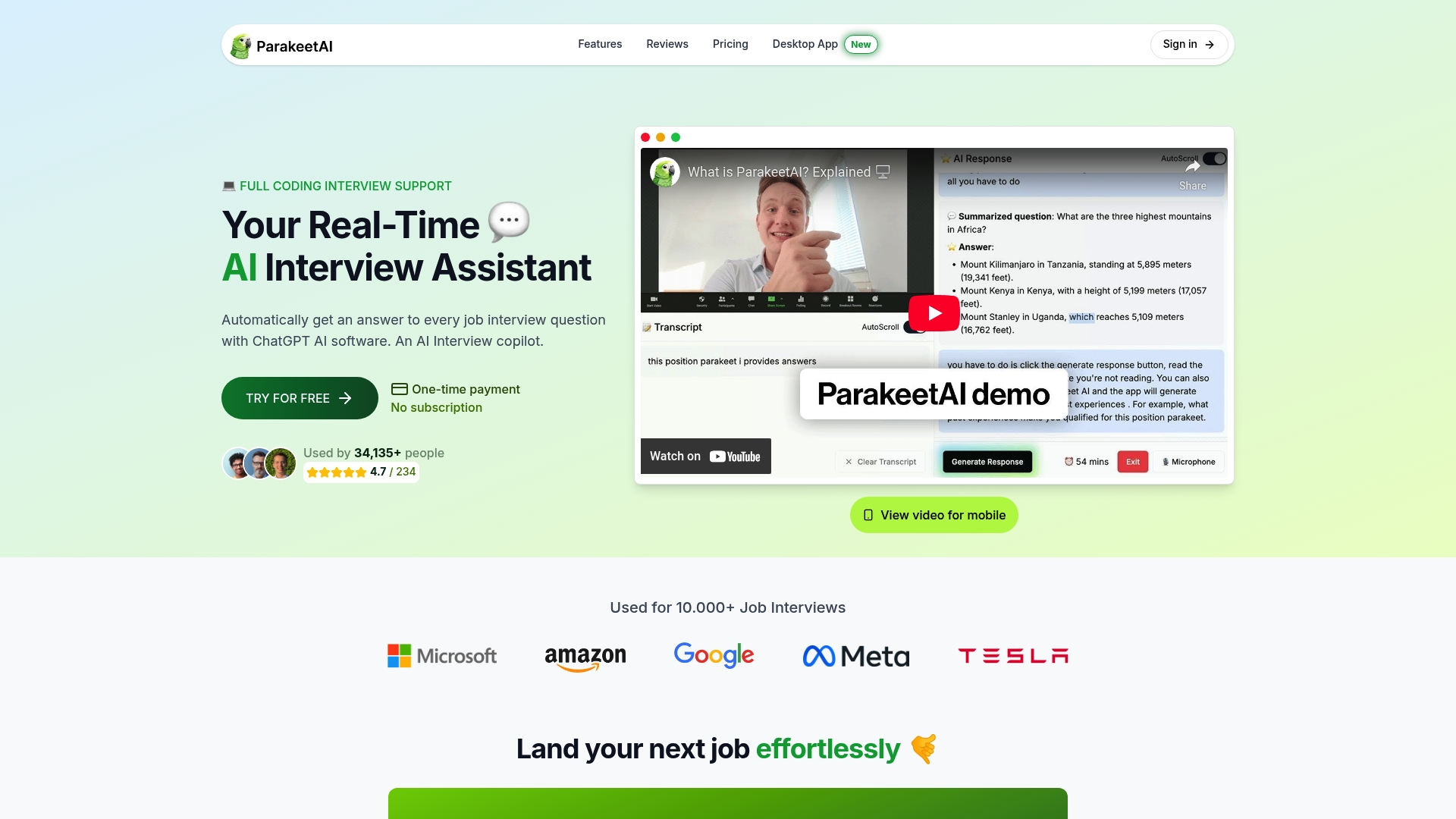
Start transforming your office manager interview process today with Parakeet AI. Experience how AI-enhanced hiring improves candidate evaluation accuracy and cultural responsiveness in real time. Visit our landing page now for a personalized demo and take the first step toward choosing top global talent with confidence.
Frequently Asked Questions
What types of questions should I ask during an office manager interview?
Ask behavioral questions to identify past experiences, situational questions to gauge potential responses to hypothetical challenges, general questions to understand motivation, and technical questions to verify job-specific skills.
How can I effectively assess an office manager’s problem-solving abilities during an interview?
Use situational interview questions that present specific challenges related to your business. This approach allows you to evaluate how candidates would approach problem-solving in real-time based on your unique context.
Why is it important to consider cultural differences in office manager interviews?
Cultural differences can impact communication styles and decision-making approaches. Being aware of these differences helps you create a respectful interview environment while ensuring that you accurately assess the candidates’ competencies.
How can I create a structured interview process for global hiring?
Develop a consistent set of questions and evaluation criteria that can be applied to all candidates, regardless of location. Create a rubric that focuses on job-related competencies, and ensure all interviewers are trained in recognizing bias and cultural sensitivity.