8 Risk Management Questions for Interview Prep
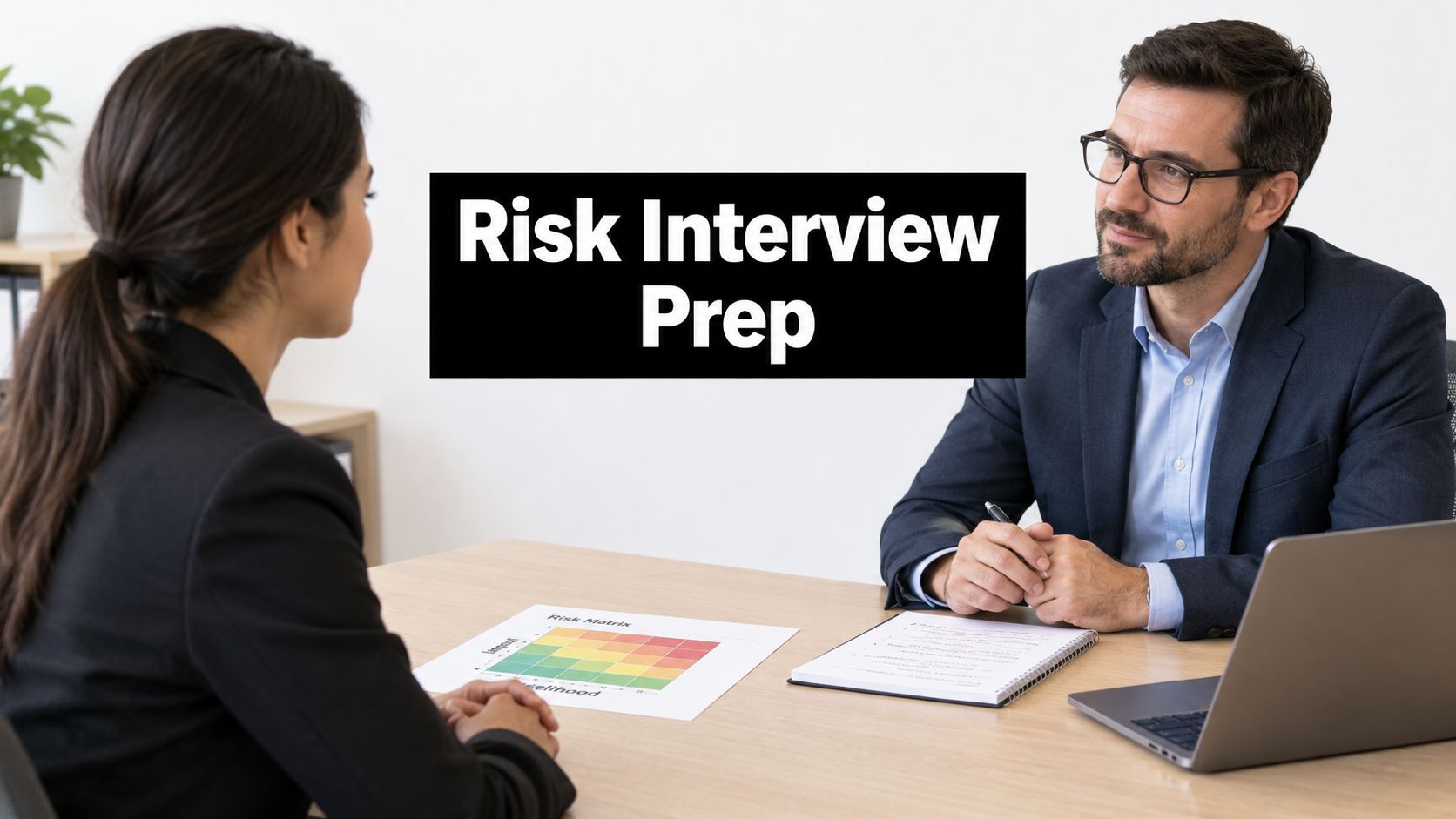
You've got the interview on the calendar, your resume lists the right frameworks, and you still don't know which story proves you can make a risk decision. That's the gap most candidates feel the night before. Interviewers aren't checking whether you can recite a definition. They're checking whether you can spot uncertainty early, tie it to a business objective, choose a response that fits the cost and appetite, and explain the trade-off without hiding behind jargon.
The eight risk management questions for interview prep below follow that logic. Each one tests a different decision, from defining risk and setting appetite to measuring exposure, picking controls, and working across governance lines. You'll get a response framework, a concrete example, and the pitfalls that make otherwise capable candidates sound vague.
Prepare with real situations from your own work. A credible answer names the objective at stake, the assumption behind your assessment, who owned the decision, and how you'd know the response worked. That structure travels well, whether the role sits in projects, operations, compliance, security, or finance.
1. What is the difference between a risk and an issue?
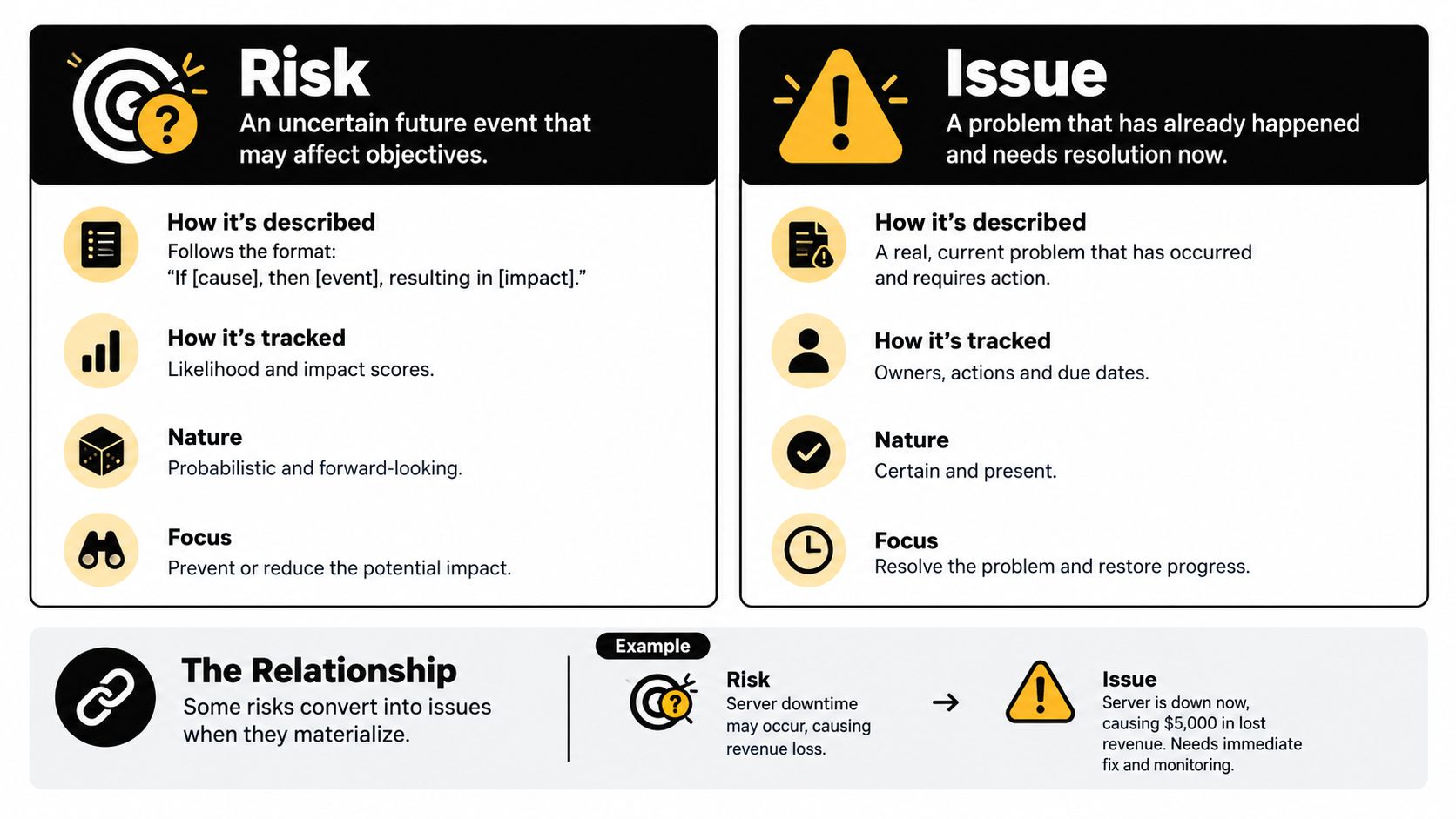
A risk hasn't happened yet. It's an uncertain future event that could affect an objective, and you describe it with a cause, an event, and a consequence. An issue has already happened and needs resolution now. Confusing the two causes real damage. Teams either panic over future uncertainty as if it's today's fire, or they park an active problem in a register where nobody acts on it.
Use the If, then, resulting in format to prove you can write a risk statement properly. It forces precision and separates the trigger from the impact.
- Risk example: If the key vendor's contract isn't renewed, then the data migration will be delayed, resulting in a missed launch date.
- Issue example: The vendor has already missed two deliverables and the migration is now two weeks late.
How to answer it well
Give a short example from your work where a risk became an issue, and explain what changed in your handling. Risks get reviewed on a regular cycle, with owners updating likelihood, impact, and response plans. Issues get worked in daily or weekly stand-ups until they're closed. That operational difference shows the interviewer you'd escalate correctly instead of logging everything in one place.
If you want more phrasing practice, browse the Question Bank of real interview questions grouped by company and rehearse your own risk statements out loud. Keep them short, specific, and tied to an objective.
2. How would you build a risk register from scratch?
The visual below shows the working document most interviewers have in mind when they ask this.

Start with context, not a blank spreadsheet. Define the objectives, scope, and risk criteria first, then gather input through workshops, interviews, and checklists. A useful risk register holds a clear description, category, owner, likelihood, impact, score, response, and status for each entry. Keep it limited to risks that matter to objectives and remove duplicates early, or nobody will trust it.
Anchor your process in a recognized cycle. ISO 31000 describes risk management as identifying, analyzing, evaluating, treating, monitoring, and communicating risks, and it's generic guidance rather than a sector specific control catalogue. COSO's Enterprise Risk Management framework adds the strategy link, which matters because a register disconnected from performance becomes a compliance artifact.
Keeping the register alive
Explain your review rhythm, escalation rules, and how owners update scores when evidence changes. That maturity point lands well because a 2010 COSO sponsored survey of 460 senior executives found nearly 60% described their risk management processes as ad hoc and informal. Interviewers want to hear how you'd move a team from informal handling to a repeatable process.
This walkthrough shows a structured build in practice.
3. What is the difference between risk appetite and risk tolerance?
Define each term in one sentence, then separate them with an example. Risk appetite is the broad amount and type of risk an organization is willing to pursue to achieve its objectives, usually set by the board. Risk tolerance is the acceptable variation around a specific objective, expressed as a measurable threshold. Appetite sets direction. Tolerance sets the limit that triggers action.
A bank may show a higher appetite for credit risk in small business lending because growth depends on it, while setting strict tolerance limits on single counterparty exposure. A software company might tolerate limited downtime for a noncritical internal service but set no tolerance for payment processing outages. The contrast proves you don't treat every risk the same way.
Translating appetite into thresholds
Walk through how you'd convert a board level statement into operational limits, owners, and escalation points. Name who approves a breach, how quickly it's reported, and what decision follows. Strong candidates also explain that appetite isn't permission to ignore losses. It's a boundary for pursuing value, reviewed when strategy, capital, or market conditions change.
Practical rule: If you can't state the threshold, the owner, and the escalation path, you have an appetite slogan, not a working limit.
That discipline connects risk decisions back to business objectives, which is exactly what this question tests.
4. What is the difference between qualitative and quantitative risk analysis?
Qualitative analysis ranks risks with descriptive scales such as low, medium, and high, usually on a probability and impact matrix. It's fast, it works with limited data, and it helps a team agree on priorities. Quantitative analysis estimates risk in measurable terms, using probability distributions, expected monetary value, Monte Carlo simulation, or the FAIR model for cyber loss exposure. It's slower and depends heavily on data quality and calibration.
The image below reflects the matrix teams start with before they quantify anything.

A credible answer explains sequencing. Start qualitatively to screen the register, then quantify the top risks where a decision needs a number, such as a contingency reserve, an insurance limit, or a control investment. Project teams use Monte Carlo simulation to model schedule and cost ranges for large IT and construction work, because a single point estimate hides uncertainty.
Making prioritization defensible
Don't hide behind a color. NIST describes risk assessment as identifying, prioritizing, and estimating impacts to the organization, its operations, and its mission or business. State the consequence, affected asset, likelihood estimate, tolerance, and escalation threshold. Then explain how the ranking changes when new evidence arrives.
5. What is the difference between KRIs and KPIs?
A Key Performance Indicator measures how well an activity achieves its objective. A Key Risk Indicator signals rising exposure to a specific risk, ideally before a loss occurs. They can overlap, but their intent differs. A KPI tells you how you performed. A KRI warns you that conditions are moving toward trouble.
- KRI example: Failed login attempts climb above a set threshold, signaling a possible credential attack.
- KPI example: System uptime for the quarter, or features shipped per sprint.
- KRI example: Turnover in a critical engineering team crosses a threshold, signaling delivery risk.
Designing a KRI that actually warns
Tie each KRI to one named risk, define the threshold logic, and specify the action when it's breached. Then test whether the indicator predicts the risk it tracks, using past incidents, near misses, and false positives. A metric that moves after the loss isn't an early warning, and interviewers will push on that point.
Reporting quality matters here. A global risk report found 40% of respondents identified insufficient real time visibility as their largest portfolio management challenge. Explain how you'd review KRIs alongside the register, check data freshness, and show inherent, residual, and emerging risk separately. That shows you treat reporting as a control, not a chart.
6. Explain the three lines of defense model
Interviewers use this question to check whether you think risk management belongs only to a risk department. It doesn't. The model divides accountability so the people who create risk, the people who oversee it, and the people who assure it independently don't blur into one function.
- First line: Operational managers and front line teams own and manage risk in daily work.
- Second line: Risk, compliance, and control functions set policy, set limits, and challenge first line decisions.
- Third line: Internal audit provides independent assurance that the first two lines work as intended.
In a bank, a relationship manager in the first line approves a loan within delegated authority. A credit risk team in the second line sets limits and reviews exposures. Internal audit in the third line tests whether approvals followed policy and whether controls operated. The Institute of Internal Auditors updated this in 2020 as the Three Lines Model, emphasizing principles rather than a rigid org chart.
Why independence matters
Explain that the third line can't own the controls it audits, or assurance loses credibility. For security heavy roles, you can add depth by noting that NIST's Risk Management Framework has seven steps, Prepare, Categorize, Select, Implement, Assess, Authorize, and Monitor. That shows you understand documented implementation, assessment, and a risk based authorization decision, not just a slogan about oversight.
7. What are the main risk response strategies, and when would you use each?
List the four responses quickly, then spend your time on selection logic. Avoid means stop the activity or remove the cause. Transfer means shift part of the impact through insurance or contract terms. Mitigate means reduce likelihood or impact with controls. Accept means acknowledge the risk, monitor it, and hold a contingency if needed. Interviewers care less about the list than about cost, feasibility, and appetite.
Take a cloud migration that moves customer data to a provider. You might transfer some financial impact through liability terms, mitigate with encryption, access controls, and testing, and accept a small residual risk of minor disruption with a rollback plan. You wouldn't claim the contract eliminates your accountability to customers. That distinction matters.
Transferring impact doesn't transfer ownership. You still own the customer outcome, the regulatory duty, and the decision to continue.
Choosing under constraints
Pick one risk from your experience and explain why you rejected the other responses. Regulation gives a useful parallel. The Basel Capital Accord of 1988 required internationally active banks to hold capital equal to at least 8% of risk weighted assets. Capital mitigates loss absorption, but it doesn't avoid model error or liquidity stress. Always assess residual risk after the response and state whether it sits within tolerance.
8. Tell me about a time you identified and managed a significant risk
This behavioral prompt is where definitions stop helping. Use STAR, Situation, Task, Action, Result, and keep your role honest. Interviewers listen for how you spotted the risk, how you assessed it, who you informed, what you changed, and how you tracked the outcome.
The presentation setting below fits this question well, because escalation and clear communication often decide whether a good assessment becomes action.
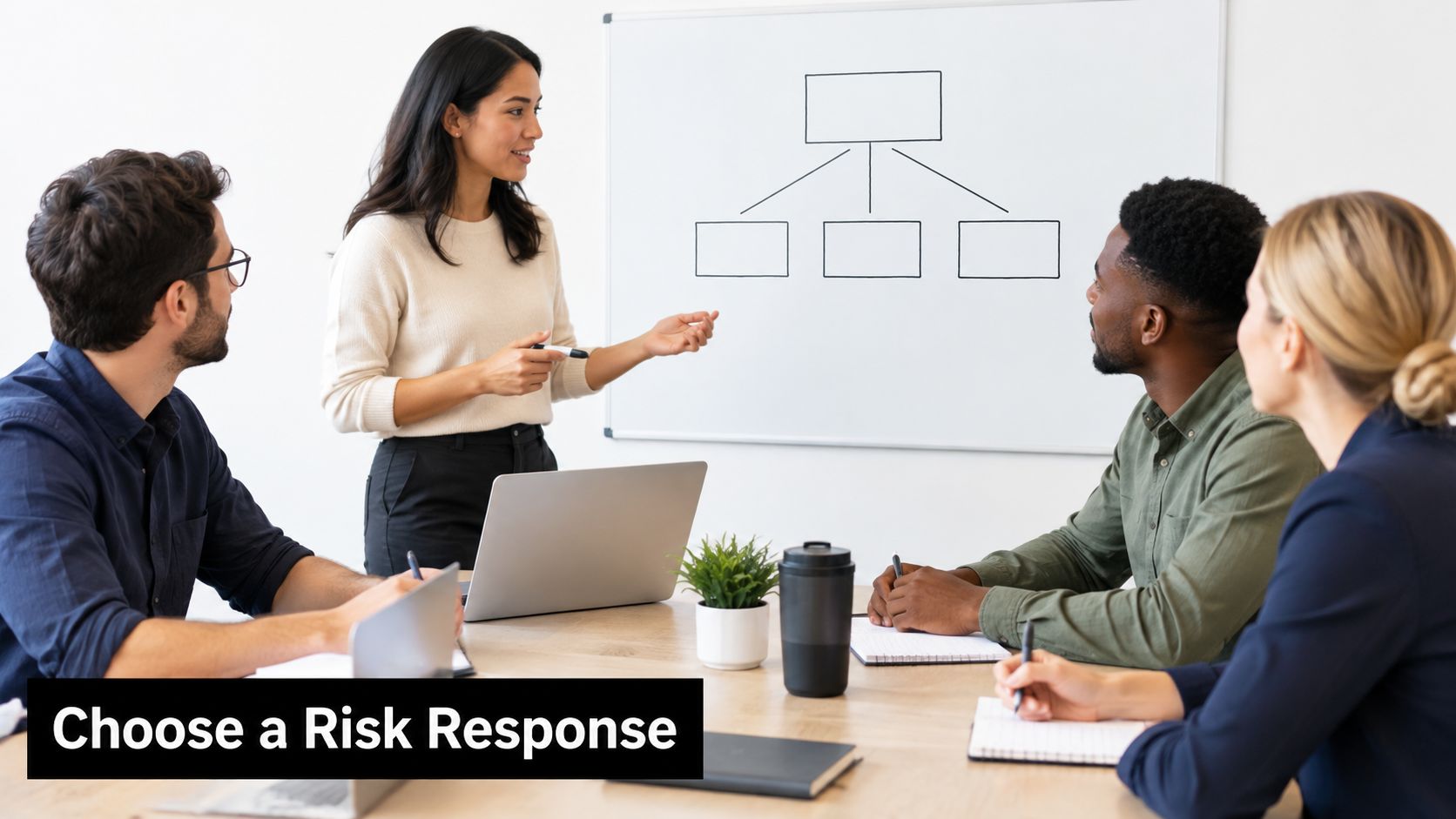
A project coordinator notices a key supplier has missed two shipment dates. She scores the delivery risk as high impact, builds a backup supplier list, qualifies an alternative, and reduces a potential delay from several weeks to a few days. A compliance analyst flags an access control gap during a routine review and works with IT to close it before an audit. Both stories work because the trigger, assessment, and action are specific.
Preparing stories that hold up
Prepare two or three stories covering different risk types, such as operational, financial, and security. Quantify the outcome where you can, using days saved, exposure reduced, or cost avoided, and end with a lesson learned. Rehearsing out loud helps, and a Mock Interview practice session can help you test whether your structure stays clear under follow up questions.
8 Essential Risk Management Interview Questions Comparison
| Topic | Core Focus | 🔄 Implementation Complexity | ⚡ Resource Requirements | 📊 Expected Outcome | ⭐ Ideal Use / Key Advantage |
|---|---|---|---|---|---|
| Risk vs. issue | Uncertain future events vs. problems already occurring | Low; classify and track separately | Risk and issue logs, owners, review cadence | Risks receive preventive action; issues receive immediate resolution | 💡 Useful for clear reporting and prioritization |
| Building a risk register | Identify, assess, assign, respond to, and monitor risks | Medium; requires a repeatable process and governance | Stakeholder input, scoring criteria, register, review time | A current, prioritized source of risk information | ⭐ Supports consistent oversight and accountability |
| Risk appetite vs. tolerance | Broad willingness to take risk vs. acceptable limits for specific objectives | Medium; translate strategy into measurable thresholds | Leadership input, objectives, metrics, escalation limits | More consistent risk decisions and escalation | 💡 Helps align risk-taking with business strategy |
| Qualitative vs. quantitative analysis | Descriptive ranking vs. numerical estimation | Low to high; quantitative modeling is more demanding | Qualitative: expert judgment; quantitative: reliable data and analytical tools | Prioritized risks or measurable estimates of potential exposure | ⚡ Use qualitative analysis to screen; quantify priority risks for decisions |
| KRIs vs. KPIs | Early warning of risk exposure vs. measurement of performance | Medium; indicators need meaningful thresholds and validation | Relevant data, metric owners, monitoring and reporting | Earlier risk signals or clearer performance tracking | ⭐ KRIs help prompt action before losses or failures occur |
| Three lines model | Risk ownership, oversight, and independent assurance | Medium; roles must be clear while remaining practical | Defined responsibilities, risk and compliance functions, internal audit | Fewer accountability gaps and stronger assurance | 💡 Clarifies that risk management is shared across the organization |
| Risk response strategies | Avoid, transfer, mitigate, or accept a risk | Medium; assess feasibility, cost, and residual risk | Risk assessment, controls or contracts, owners, contingencies | A documented response matched to risk priorities | ⭐ Turns risk assessment into practical action |
| Behavioral risk-management example | Demonstrate risk identification and management using STAR | Medium; requires a specific, structured example | Prepared story, supporting facts, measurable results | Evidence of judgment, communication, and follow-through | 💡 Best for showing personal contribution and lessons learned |
Build an Interview-Ready Risk Management Playbook
Turn these eight questions into a personal playbook before the interview. Prepare one operational example, one compliance example, and one security or financial example. For each one, write the objective at stake, the risk statement, your likelihood and impact reasoning, the response you chose, the alternatives you rejected, and the residual risk you accepted. That one page per story will answer most follow ups without forcing you to improvise structure under pressure.
Rehearse the frameworks until they sound natural, not memorized. You should be able to explain ISO 31000 as a cycle, describe the three lines without turning them into departments, and move from a qualitative ranking to a quantitative estimate when a decision needs a number. Practice naming your assumptions out loud. Interviewers trust candidates who say what data they used, what they didn't know yet, and what would change their ranking.
Don't ignore newer risk areas just because traditional guides focus on registers and audits. AI risk is now part of the conversation for many security and governance roles. The 2025 ISC2 Workforce Study found AI was the most frequently cited cybersecurity skills need, named by 41% of respondents. Prepare a short answer that separates model risk, data protection risk, third party AI risk, and unsafe output risk, then connects each one to ownership, controls, monitoring, and escalation.
Technology answers need the same discipline. If you're asked about a risk platform, define the baseline, the users, the workflow, and the measures you'd check after launch. A 2025 Risk and Insurance technology survey found implementation and licensing costs were the leading obstacle, cited by 55% of respondents. A phased rollout with integration testing, data quality controls, and an adoption scorecard sounds credible. Buying software and declaring maturity doesn't.
In the room, connect every answer to business impact. State the decision, the trade off, and how you'd measure whether the response worked. If a question falls outside your experience, say so briefly, then show your method with the closest relevant example you have. That honesty beats inventing a story that collapses on the second follow up.
Keep building your preparation alongside your applications. Wider career material, including LatoJobs job search resources, can help you align your examples with the roles you're targeting. Bring your playbook, your thresholds, and your lessons learned. That's what a risk manager sounds like.
Practice these answers beforehand so your structure, thresholds, and examples are ready when follow up questions get specific. ParakeetAI offers a live AI interview assistant that listens to questions and shows suggested answers based on your resume and documents, plus Prepare tools including Mock Interview and a Question Bank. Try it before your next risk management interview and rehearse your playbook with support in place.