
Master sales interview questions with AI skills in 2026

Sales interviews have evolved dramatically, with sellers who partner with AI tools 3.7 times more likely to meet quotas. Today’s candidates must demonstrate both traditional selling expertise and cutting-edge AI fluency to stand out. This guide equips you with essential sales interview questions across all categories, from core sales processes to AI readiness and behavioral skills, plus proven frameworks to deliver compelling, metric-driven answers that win offers.
Table of Contents
- How To Choose The Right Sales Interview Questions To Prepare For
- Core Traditional Sales Interview Questions
- AI Readiness And Data Fluency Questions
- Behavioral And Situational Sales Interview Questions
- Consultative And Sales Process-Focused Questions
- Role-Specific Sales Interview Questions
- Effective Answering Techniques And Frameworks
- Preparation Strategies For Sales Interviews
- Summary Comparison Of Sales Interview Question Types
- Situational Recommendations For Prioritizing Question Types
- Boost Your Sales Interview Success With Parakeet AI
- FAQ
Key takeaways
| Point | Details | |-------|---------|| | AI and data fluency are critical in 2026 sales interviews | Modern interviews assess your ability to leverage automation tools, CRM analytics, and AI-assisted prospecting alongside traditional selling skills. | | Core questions cover sales process, behavioral skills, and consultative selling | Expect questions on lead generation, objection handling, rejection resilience, and strategic customer engagement across all experience levels. | | STAR method with metrics improves answer quality | Structure responses using Situation, Task, Action, Result framework while quantifying achievements with quota attainment and revenue growth data. | | Role-specific customization helps target unique expectations | Inside sales, managers, and account executives face different question priorities requiring tailored preparation strategies. | | Preparation with AI tools boosts confidence and performance | Practice with AI-powered mock interviews to refine answers, integrate metrics naturally, and build confidence before actual interviews. |
How to choose the right sales interview questions to prepare for
Selecting which sales interview questions to prioritize saves time and maximizes your preparation impact. Start by evaluating questions based on four key criteria: AI readiness requirements, data skill demands, behavioral competencies, and role-specific relevance.
Sales interviews in 2026 demand questions around AI tool usage and automation to assess candidates’ ability to improve prospecting efficiency and quota attainment. If you’re targeting modern sales organizations, prioritize questions about CRM automation, sales intelligence platforms, and predictive analytics tools. These technical questions increasingly separate top performers from average candidates.
Behavioral and situational questions measure problem-solving ability, collaboration skills, and adaptability under pressure. These universal competencies matter across all sales roles and experience levels. Expect interviewers to probe how you handle rejection, navigate team conflicts, and maintain motivation during slow periods.
- Prioritize questions aligned with the specific sales role type, like territory management for outside sales or pipeline velocity for inside sales representatives
- Focus on AI and automation questions if targeting tech-forward companies or SaaS organizations
- Balance traditional sales process questions with modern data literacy topics to demonstrate well-rounded expertise
- Research the company’s tech stack and emphasize questions related to tools they actually use
- Consider seniority level when selecting questions, as managers face more strategic and leadership-focused inquiries
Pro Tip: Create a matrix scoring each potential question by relevance to your target role, frequency in interviews, and your confidence level to systematically identify preparation gaps.
Your selection strategy should also account for broader industry trends. Companies increasingly value tech fluency as a predictor of sales success, making AI and data questions non-negotiable for competitive candidates. However, foundational sales skills remain essential. Balance your preparation between emerging competencies and timeless selling fundamentals. If you’re preparing for management positions, explore sales manager interview questions to understand leadership-specific expectations.
Core traditional sales interview questions
Every sales candidate must master foundational questions about sales processes, lead generation, and closing techniques. These universal questions appear in interviews across industries and experience levels, forming the baseline assessment of your selling capability.
Interviewers commonly ask you to describe your complete sales process from prospecting through close. They want to understand your methodology, adaptability, and strategic thinking. Questions about lead acquisition reveal your resourcefulness and creativity in building pipeline. Expect to explain how you identify prospects, qualify opportunities, and prioritize your efforts for maximum efficiency.
Objection handling questions test your resilience and problem-solving skills. Interviewers probe how you address price concerns, competitive threats, and timing objections. Your answers demonstrate whether you view objections as obstacles or opportunities to provide additional value. Closing strategy questions assess your ability to recognize buying signals and confidently ask for commitments without being pushy.
- Describe your typical sales cycle from first contact to closed deal
- How do you generate and qualify new leads in your territory?
- Walk me through your approach to handling common objections like budget constraints
- What closing techniques do you use and when do you deploy them?
- How do you maintain relationships with clients after the initial sale?
Lead acquisition and closing strategy questions feature in over 70% of sales interviews, making them essential preparation topics regardless of your specialization. These questions provide interviewers with concrete evidence of your practical selling skills and real-world experience. They also reveal your ability to articulate complex sales concepts clearly, which matters when explaining solutions to prospects.
Traditional questions establish your credibility as a sales professional before interviewers dive into more specialized topics. Prepare specific examples that showcase your methodology, quantify your results with metrics, and demonstrate consistent application of proven techniques. These foundational questions create the platform for discussing more advanced AI and behavioral competencies later in the interview.
AI readiness and data fluency questions
Modern sales interviews increasingly focus on your ability to leverage AI tools, automation platforms, and data-driven insights to improve performance. These questions assess whether you can thrive in technology-enabled sales environments that define competitive advantage in 2026.

Interviewers want to know which AI-powered tools you’ve used and how they improved your outcomes. They’ll ask about your experience with sales intelligence platforms, automated prospecting systems, and predictive lead scoring. Your answers reveal whether you embrace technology as a force multiplier or resist innovation. Data literacy questions probe your ability to analyze pipeline metrics, interpret win/loss patterns, and forecast accurately using quantitative methods.
Sellers who partner with AI tools are 3.7 times more likely to meet quotas, creating enormous pressure on candidates to demonstrate genuine AI proficiency. You must articulate specific use cases where automation saved time, AI insights identified opportunities, or analytics improved your decision-making. Vague claims about being “comfortable with technology” no longer suffice.
The transition to data-driven selling has become universal, with 60% of B2B organizations using data as their primary selling approach. Interviewers expect you to discuss how you use dashboards, what metrics drive your daily activities, and how you’ve adapted strategies based on data insights. Questions about CRM mastery, sales analytics tools, and reporting capabilities now appear in virtually every sales interview.
- Which AI-powered prospecting tools have you used and what results did they deliver?
- How do you use data and analytics to prioritize accounts and opportunities?
- Describe a time when CRM automation improved your efficiency or win rate
- What sales metrics do you track daily and how do they inform your activities?
- How have you adapted your approach based on pipeline analytics or performance data?
Pro Tip: Prepare a brief story about a specific AI tool or data insight that directly contributed to winning a major deal or exceeding quota, quantifying the impact with precise metrics.
Expected competencies extend beyond basic CRM data entry to sophisticated applications like AI-assisted email personalization, conversation intelligence platforms, and predictive analytics. If you’re interviewing for tech-focused sales roles, review tech job interview answers to understand how technical fluency intersects with sales skills. For management positions, explore sales manager interview questions focused on driving team adoption of sales technology.
Behavioral and situational sales interview questions
Behavioral questions assess the soft skills and emotional intelligence that separate high performers from average sellers. These questions explore how you handle rejection, maintain motivation, resolve conflicts, and collaborate with remote teams in hybrid work environments.
Interviewers commonly ask how you cope with rejection and maintain positive momentum after losing deals. Your answer reveals resilience, self-awareness, and coping mechanisms that sustain long-term success in a challenging profession. Motivation questions probe what drives you beyond commission, helping interviewers understand whether you’ll thrive in their specific culture and compensation structure.
Conflict resolution skills have become critical as buyer committees grow larger and more complex. 74% of buyer teams experience unhealthy decision-making dynamics, requiring sellers who can navigate political tensions, build consensus, and facilitate productive conversations. Questions about team collaboration assess your ability to work cross-functionally with marketing, customer success, and product teams to deliver value.
Remote communication questions address the realities of hybrid selling models. Interviewers want to know how you build rapport virtually, read digital body language, and maintain relationships without face-to-face contact. These questions became universal after remote work transformed sales operations.
- How do you maintain motivation after a string of rejections or lost deals?
- Describe a conflict with a colleague or client and how you resolved it
- What drives you in sales beyond financial compensation?
- How do you build relationships and trust in virtual selling environments?
- Tell me about a time you collaborated with other departments to close a complex deal
The most common behavioral questions include “How do you cope with rejection?” and “What is your strategy for cold calling?” according to interview data from thousands of sales positions. These questions appear regardless of industry, company size, or sales methodology, making them essential preparation topics.
Use the STAR method to structure your behavioral answers: describe the Situation, explain the Task you faced, detail the Actions you took, and quantify the Results you achieved. This framework helps you deliver concise, memorable stories that showcase your competencies without rambling. For additional guidance on situational questions, review common situational interview questions to see how STAR applies across various scenarios.
Consultative and sales process-focused questions
Consultative selling questions evaluate your ability to understand customer needs deeply, provide strategic guidance, and position yourself as a trusted advisor rather than a transactional vendor. These questions distinguish mature sales professionals from order-takers.
The consultative framework emphasizes diagnosis before prescription. Interviewers want to know how you uncover underlying business problems, quantify the cost of inaction, and align solutions with strategic objectives. Questions about your discovery process reveal whether you ask insightful questions, actively listen, and synthesize information to create compelling value propositions.
Objection handling in a consultative context goes beyond memorized rebuttals. Structured consultation and objection handling are standard expectations in 2026 sales interviews. Interviewers assess whether you view objections as opportunities to deepen understanding and provide additional value. Your approach to addressing concerns demonstrates problem-solving ability and emotional intelligence.
Strategic questions vary significantly by sales cycle type and client profile. Enterprise sales roles emphasize long-term relationship building, executive engagement, and navigating complex organizations. Transactional sales focus on efficiency, volume, and repeatable processes. Your answers must align with the specific selling motion of the target role.
- How do you conduct discovery to understand a prospect’s true business challenges?
- Describe your approach to selling to C-level executives versus end users
- Walk me through how you’ve navigated a complex, multi-stakeholder buying process
- How do you differentiate your solution when competitors offer similar capabilities?
- Tell me about a time you had to educate a prospect about a problem they didn’t know they had
| Question Focus | Core Traditional | Consultative Strategic |
|---|---|---|
| Primary Goal | Assess basic selling skills | Evaluate strategic thinking and advisory capability |
| Typical Topics | Lead generation, closing, objection handling | Discovery process, value creation, stakeholder management |
| Best For | Entry to mid-level roles, transactional sales | Senior roles, enterprise sales, complex solutions |
| Answer Style | Process-focused, tactical examples | Strategic frameworks, business outcomes |
Consultative questions help interviewers differentiate candidates who can execute a defined sales process from those who can adapt their approach to unique customer situations. Prepare examples that demonstrate strategic thinking, business acumen, and the ability to create value beyond product features. These questions become increasingly important as you advance to senior sales roles or target complex, high-value opportunities.
Role-specific sales interview questions
Interview questions vary significantly based on whether you’re pursuing inside sales, outside sales, business development, account management, or sales leadership positions. Understanding these differences helps you prepare targeted answers that align with role-specific expectations.
Sales managers face questions about coaching, performance management, hiring, and team strategy. Interviewers probe your leadership philosophy, ability to develop underperformers, and track record of building successful teams. Management questions emphasize metrics like team quota attainment, turnover rates, and pipeline coverage ratios. For comprehensive preparation, explore sales manager interview questions covering leadership scenarios.
Business development representatives encounter heavy emphasis on prospecting creativity, activity metrics, and top-of-funnel generation. Questions focus on cold calling strategies, email campaigns, social selling techniques, and qualification frameworks like BANT or MEDDIC. Account executives face more questions about deal progression, proposal development, and closing complex opportunities.
Inside sales roles emphasize phone skills, CRM proficiency, and high-volume efficiency. Outside sales questions focus on territory management, relationship building, and face-to-face presentation abilities. Account managers encounter questions about retention strategies, upsell techniques, and customer satisfaction metrics.
- Managers: How do you coach a rep who consistently misses quota?
- BDRs: What’s your approach to researching and personalizing outreach at scale?
- Account Executives: How do you manage multiple complex deals simultaneously?
- Inside Sales: How do you build rapport and credibility over the phone?
- Outside Sales: Describe your territory planning and account prioritization process
Sales role classification improves interview question relevance and candidate assessment accuracy by ensuring alignment between expectations and evaluation. Customize your preparation by identifying 8 to 10 questions most relevant to your specific target role. Research the position description carefully to understand which competencies matter most.
Role-driven question prioritization helps you allocate preparation time efficiently. A BDR shouldn’t spend equal time on account management scenarios, and a manager shouldn’t over-prepare for cold calling techniques. Focus your energy on questions that directly assess the skills you’ll use daily in the target position. This strategic approach improves answer quality and demonstrates your understanding of the role’s unique demands.
Effective answering techniques and frameworks
The STAR method provides the most effective framework for structuring sales interview answers that are concise, memorable, and impactful. This approach ensures you deliver complete stories without rambling or losing the interviewer’s attention.
STAR stands for Situation, Task, Action, and Result. Start by briefly describing the Situation and context where the example occurred. Explain the specific Task or challenge you faced. Detail the Actions you took to address it, focusing on your individual contributions. Conclude with quantified Results that demonstrate the impact of your actions.
The STAR method combined with sales metrics improves candidates’ answer quality, helping demonstrate impact and track record clearly. Integrating specific metrics transforms generic stories into compelling evidence of your capabilities. Replace vague claims like “significantly increased sales” with precise data like “grew territory revenue 34% year-over-year, adding $2.1M in new business.”
Sales-specific metrics that strengthen your answers include quota attainment percentages, win rates, average deal sizes, sales cycle length reductions, and pipeline coverage ratios. These numbers provide objective proof of your performance and help interviewers compare you against other candidates. Even if you lack direct sales experience, quantify related achievements like fundraising results, volunteer recruitment numbers, or academic project outcomes.
- Identify 5 to 7 significant achievements from your sales career that demonstrate different competencies
- Structure each story using the STAR framework, keeping the Situation and Task sections brief
- Write out your Action steps in detail, emphasizing your specific decisions and behaviors
- Quantify Results with at least two metrics that show business impact
- Practice delivering each story in 90 seconds or less to maintain interviewer engagement
- Prepare variations of each story that can address multiple related questions
- Record yourself answering questions to identify verbal fillers, redundancy, or lack of clarity
Pro Tip: Create a metrics sheet listing your top 10 performance statistics with context, so you can naturally integrate precise numbers into any answer without hesitation or calculation delays.
Avoid generic answers that could apply to anyone. Vague responses like “I’m a hard worker” or “I’m passionate about sales” provide no evidence of your capabilities. Instead, share specific examples that showcase your unique approach, problem-solving ability, and measurable results. Practice telling your stories conversationally rather than reciting memorized scripts, which sound robotic and disconnect you from the interviewer.
Preparation strategies for sales interviews
Effective preparation combines company research, answer practice, achievement quantification, and strategic role alignment. These elements work together to build confidence and maximize your interview performance.
Start by thoroughly researching the target company, their products, competitive position, and recent news. Understand their customer profile, sales methodology, and growth trajectory. Review the job description multiple times to identify which skills and experiences they emphasize most. This research enables you to customize your answers and ask intelligent questions that demonstrate genuine interest.
Practice answering questions out loud, ideally with a partner or using AI-powered mock interview platforms. Parakeet AI and similar tools provide realistic interview simulations with real-time feedback on your responses. Recording yourself reveals verbal tics, pacing issues, and areas where your answers lack clarity or confidence.
Prepare a comprehensive achievement inventory listing 10 to 15 significant accomplishments with quantified metrics. Include quota attainment records, major deals won, efficiency improvements, and recognition received. Having these examples documented ensures you can quickly recall relevant stories during the interview without awkward pauses or memory lapses.
- Research the company’s sales methodology, tech stack, and ideal customer profile to tailor your examples
- Practice with AI interview assistants to refine your delivery and receive objective feedback
- Prepare quantified examples for each major competency the role requires
- Review common mistakes like talking too much, failing to ask questions, or bad-mouthing previous employers
- Balance your preparation across technical skills, behavioral competencies, and AI fluency
Avoid common sales interview mistakes by understanding what turns off hiring managers. Never speak negatively about previous employers or colleagues, even if asked about challenging situations. Don’t dominate the conversation or fail to listen carefully to questions. Avoid appearing desperate or willing to accept any offer, which signals low value. For comprehensive guidance, review how to avoid common interview pitfalls and questions to avoid in interviews.
Plan to arrive 10 minutes early for in-person interviews or log in 5 minutes early for virtual meetings. Prepare thoughtful questions to ask the interviewer about team structure, success metrics, and growth opportunities. Bring extra copies of your resume and a notepad for taking notes. These details demonstrate professionalism and genuine interest in the opportunity.
Summary comparison of sales interview question types
Understanding the four main categories of sales interview questions helps you allocate preparation time strategically and ensure comprehensive readiness across all competency areas.
| Question Category | Primary Focus | Key Strengths Assessed | When to Prioritize |
|---|---|---|---|
| Traditional Sales Process | Lead generation, objection handling, closing techniques, sales methodology | Foundational selling skills, tactical execution, process discipline | All experience levels, particularly entry to mid-level roles and transactional sales positions |
| AI and Data Fluency | Tool usage, automation, analytics, CRM mastery, predictive insights | Technical adaptability, data-driven decision making, modern sales competencies | Tech-forward companies, SaaS roles, competitive candidates seeking differentiation |
| Behavioral and Situational | Rejection resilience, motivation, conflict resolution, collaboration, remote communication | Emotional intelligence, adaptability, interpersonal skills, cultural fit | Universal importance across all roles, especially for team-based and hybrid selling environments |
| Consultative and Strategic | Discovery process, value creation, stakeholder management, strategic thinking | Business acumen, advisory capability, complex problem solving | Senior roles, enterprise sales, solution selling, high-value opportunities |
Each category serves a distinct evaluation purpose and reveals different aspects of your sales capability. Traditional questions establish your baseline competency and practical experience. AI and data questions differentiate you from candidates who lack modern technical skills. Behavioral questions assess whether you’ll thrive in the company culture and handle the emotional demands of sales. Consultative questions evaluate your potential to progress beyond transactional selling into strategic account management.
This comparison framework helps you identify preparation gaps and balance your practice across all areas. Most interviews blend questions from multiple categories, requiring broad readiness rather than narrow specialization. However, the specific mix varies by role, company, and interviewer preference, making adaptability your most valuable asset.
Situational recommendations for prioritizing question types
Your experience level, target role, and interview context should drive which question categories deserve the most preparation attention. Strategic prioritization maximizes your readiness within limited preparation time.
Entry-level candidates and career changers should emphasize traditional sales process questions and behavioral competencies. Interviewers expect less sophisticated technical knowledge but demand evidence of coachability, resilience, and fundamental selling skills. Focus 60% of your preparation on traditional and behavioral questions, 30% on AI basics, and 10% on consultative approaches.
Experienced sales professionals must demonstrate both mastery of fundamentals and proficiency with modern tools and methodologies. Allocate 30% of preparation to traditional questions, 35% to AI and data fluency, 20% to behavioral scenarios, and 15% to consultative selling. Your experience creates higher expectations for technical sophistication and strategic thinking.
Sales managers and leadership candidates face primarily strategic, people management, and conflict resolution questions. Traditional selling questions appear less frequently, replaced by coaching scenarios and team development challenges. Prioritize behavioral questions at 40%, consultative and strategic topics at 35%, AI and data at 20%, and traditional process questions at just 5%.
- Entry-level: Master traditional process and behavioral questions first, then add basic AI competency
- Mid-level: Balance all four categories with slight emphasis on AI and consultative skills
- Senior individual contributors: Emphasize consultative, AI, and strategic questions over basic tactics
- Managers: Focus heavily on behavioral, conflict resolution, and team development scenarios
- Industry transitions: Over-prepare on traditional questions to prove foundational knowledge
Contextual factors also influence prioritization. If interviewing at a cutting-edge SaaS company, weight AI and data questions more heavily regardless of experience level. Conservative industries may emphasize relationship skills and traditional methods over technical fluency. Research the company culture and interviewer background on LinkedIn to predict their likely question focus.
Customize your preparation based on job description language. Count how many times different skill categories appear in the posting. If “data-driven” and “analytics” appear repeatedly, expect heavy emphasis on those topics. If the description stresses “relationship building” and “consultative approach,” prepare more examples demonstrating those capabilities. This analysis creates a personalized preparation roadmap aligned with actual evaluation criteria.
Boost your sales interview success with Parakeet AI
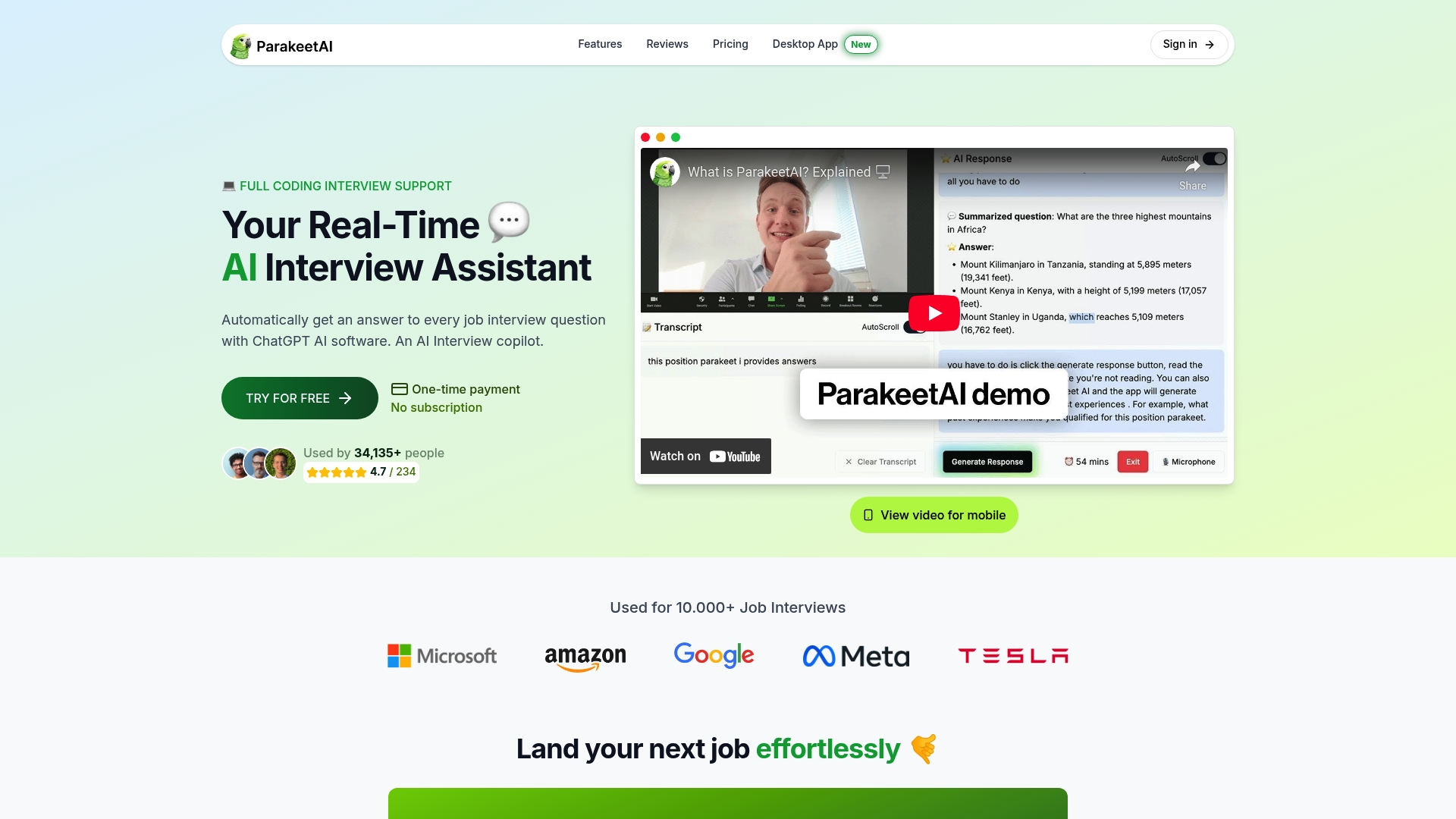
Transforming interview preparation from theoretical study into practical skill-building requires realistic practice with immediate feedback. Parakeet AI delivers AI-powered interview coaching specifically designed for sales professionals preparing for high-stakes opportunities.
The platform simulates actual sales interviews with role-specific questions covering traditional selling, AI proficiency, behavioral scenarios, and consultative approaches. You practice answering in real time while the AI analyzes your responses, identifies improvement opportunities, and suggests ways to integrate metrics more effectively using the STAR framework. This hands-on practice builds the confidence and polish that separate compelling candidates from nervous, unprepared ones.
Parakeet AI helps you refine your delivery, eliminate verbal fillers, and structure answers for maximum impact. The technology adapts to your target role, emphasizing the question types most relevant to inside sales, account executives, or management positions. Regular practice sessions ingrain the preparation strategies recommended throughout this guide, transforming knowledge into natural, confident performance during actual interviews.
FAQ
What are the most common sales interview questions in 2026?
The most frequent questions blend traditional sales process topics with modern AI and behavioral assessments. Expect inquiries about your sales methodology, lead generation approach, objection handling techniques, and closing strategies. AI readiness questions about tool usage and data-driven decision making now appear in most interviews. Behavioral questions on rejection resilience, motivation sources, and remote collaboration skills round out the common topics across industries and experience levels.
How can I demonstrate AI proficiency in my sales interview?
Describe specific AI-powered tools you’ve used with quantified results showing improved efficiency or quota attainment. Name platforms like sales intelligence software, automated prospecting systems, or conversation intelligence tools, then explain exactly how they enhanced your performance. Prepare a concise story about a situation where AI insights led directly to winning a deal or identifying a high-value opportunity. Include precise metrics like time saved, additional pipeline generated, or win rate improvements attributable to AI assistance.
What is the STAR method and how does it help in sales interviews?
STAR is a framework for structuring interview answers: Situation, Task, Action, Result. You briefly describe the context and challenge, detail the specific actions you took, then quantify the outcomes you achieved. This method keeps your answers concise and memorable while providing concrete evidence of your capabilities. In sales interviews, combining STAR with specific metrics like quota attainment percentages and revenue figures creates highly compelling responses that differentiate you from candidates offering vague, unmeasurable claims.
Which sales interview questions should I prioritize based on my role?
Entry-level candidates should focus on traditional sales process and behavioral questions demonstrating coachability and resilience. Experienced professionals must prepare heavily for AI fluency and consultative selling questions alongside behavioral scenarios. Sales managers need to emphasize leadership, coaching, and conflict resolution questions over individual selling tactics. Always customize preparation based on the job description’s language, weighting question categories that appear most frequently in the posting and company research.
How do I quantify my sales achievements if I’m new to sales?
Identify any experiences involving persuasion, relationship building, or goal achievement, then extract relevant metrics. Quantify fundraising results, volunteer recruitment numbers, academic project outcomes, or customer service satisfaction scores. Highlight percentage improvements, before-and-after comparisons, or competitive rankings that demonstrate your impact. Even without direct sales experience, metrics from adjacent activities provide objective evidence of your potential and results-oriented mindset that resonates with sales hiring managers.