
Satisfied Customer Synonym: Words to Use and Avoid

If a customer gives you a 4 out of 5, have you earned the right to call them delighted?
Most synonym lists treat pleased, happy, contented, delighted and loyal as swaps for one idea. They are not. A satisfied customer synonym only works when the word matches the claim you are making and the evidence you can show. A feeling is not the same as coming back. Coming back is not the same as telling a friend.
Writers miss in two directions. They inflate a middling score into enthusiasm, or they flatten a strong comment into a bland label. The fix is a ladder. Decide what the sentence claims, check the rating, the comment and any behaviour, then pick the lowest word the evidence fully supports.
Satisfied Customer Synonyms by Intensity
A satisfied customer is pleased or content with what they received or experienced. Merriam-Webster defines the phrase that way, which is why it works as the default in survey reporting. Merriam-Webster's thesaurus lists pleased, happy, contented, gratified, content, delighted and thrilled among the synonyms, and it separates them by strength. Content and contented suggest calm acceptance. Pleased signals enjoyment or approval. Gratified stresses fulfillment. Delighted and thrilled communicate stronger enthusiasm.
Each of those words makes a different-sized claim about feeling, and none of them claim behaviour. Satisfaction evaluates one experience; loyalty and advocacy claim repeat purchases or recommendations. That distinction is why researchers built instruments to measure satisfaction on its own. According to a California Management Review analysis, researchers at the University of Michigan, the American Society for Quality and CFI Group created the American Customer Satisfaction Index in 1994, drawing on a model first used in Sweden in 1989. The index published its first results in October 1994 and now tracks satisfaction across 10 economic sectors and more than 40 industries on a 0–100 scale. The initial U.S. national score was 74.8 in summer 1994. An index built that carefully is the reason "highly satisfied" belongs next to a number, while loyal and advocate belong next to purchase records and referrals.
The ladder, from calm to verified action
Read neighbouring rows together. The first seven describe feeling. The last three describe behaviour.
| Term | Intensity | Best used for | Avoid when |
|---|---|---|---|
| Satisfied customer | Neutral | Survey results, reports and default copy | Describing emotion or enthusiasm |
| Pleased customer | Moderate | Approval of a product or service, friendly support messages | Implying the customer is enthusiastic or loyal |
| Content or contented customer | Low, calm | Understated professional wording where outcomes were met | Marketing copy that needs energy |
| Gratified customer | Moderate | Needs fulfilled, formal letters and case studies | Casual or everyday copy |
| Happy customer | Moderate, emotional | Informal blogs and social posts | Research reports, metrics and B2B documents |
| Delighted customer | High | Results above expectations, supported by a quote or a defined top score | Only adequate fulfilment was measured |
| Thrilled customer | Very high | Rare, clearly enthusiastic customer quotes | Almost any formal or measured context |
| Loyal customer | Behavioural | Repeat purchase or retention has been shown | No repeat-purchase data exists |
| Retained customer | Behavioural | Continued use observed over a period | Describing attitudes only |
| Customer advocate | Behavioural | Verified referral or recommendation | Positive sentiment without any referral data |
The jump in the middle of the table is the one writers miss most. The seven feeling rows differ only in how much enthusiasm you claim. The three behaviour rows change what you claim entirely, from an attitude the customer reported to an action you have to verify. Moving up within the feeling rows needs a stronger comment. Moving across into the behaviour rows needs a different kind of proof altogether.
Two cases that settle the word
Say onboarding is rated 4 out of 5. "Our customers are pleased with onboarding" matches the evidence. Delighted overstates a score that still left a point unused. The respondent approved the experience; nothing in the rating says it beat what they expected.
Now say the comment is "this saved me a week of work." Pleased is too weak for that. The note shows a result past routine approval, so delighted can fit if you quote their words instead of inventing the emotion. Thrilled still needs language that is clearly excited, not merely grateful.
Check the rating, the free-text comment and any behaviour, then choose the lowest word the evidence fully supports.
Where the ladder gets misread
Happy can sound childish in B2B copy. A facilities manager who scored a vendor 4 out of 5 is pleased or satisfied in a board paper, not a happy customer.
Translations often intensify delighted. A moderate English line can land as excitement in German, French or Spanish. Do not let a translator upgrade the claim.
A neutral score must never become an emotional quote. If the survey says 3 out of 5, you do not write "thrilled with the rollout" and attribute it to that respondent.
Before you publish, ask three questions. Which claim does the sentence make? What evidence do I hold? Would the word still hold if a reader saw the score?
Attitude, Behaviour, Advocacy and NPS Are Different Claims
Sort every satisfied customer synonym into the claim it makes. Blending them is how a feedback form turns into a loyalty story nobody measured.

Attitude terms, such as satisfied, pleased and content, evaluate an experience against expectations. Behaviour terms, such as loyal and retained, describe what the customer keeps doing, including repeat purchases or continued use. Advocacy terms, such as customer advocate, describe active recommendation. One person can fit more than one claim. State each claim in its own sentence.
Two people, two different sentences
A user rates an AI interview tool highly on a feedback form and never opens it again. That person is satisfied. They are not loyal, because nothing shows a return visit.
A buyer orders every quarter and has never recommended the company. That person is loyal or retained. They are not an advocate. Repeat revenue is not a referral.
Use a sentence test. Remove the behaviour evidence and reread the line. If it is still true, an attitude word is the right one. If the line collapses without the order history, you needed loyal or retained, not pleased.
Why a recommendation score is not a satisfaction rate
Net Promoter Score is not a synonym list and not a direct percentage of satisfied customers. Merriam-Webster's thesaurus treatment of pleased sits on the feeling side of the language, while NPS is a defined loyalty measure built on one question: "How likely are you to recommend us to a friend or colleague?" Answers use a 0-to-10 scale. Scores of 9 or 10 are promoters, 7 or 8 are passives, and 0 through 6 are detractors. NPS subtracts the percentage of detractors from the percentage of promoters.
Work a round number so the arithmetic stays visible. If 40 of 100 respondents score 9 or 10 and 15 score 0 through 6, NPS is 25 points. The other 45 scored 7 or 8. They drop out of the subtraction. A customer who is satisfied and scores 8 is a passive, not an advocate, and that response does not raise NPS.
A high satisfaction rate with a low NPS means customers are content and not recommending. Report the survey result and the NPS figure separately, each with its own label. Never write "our advocates scored us highly" when the file only shows passives.
Client, User, Shopper or Account
The noun has to change with the audience, and the adjective still has to change with the evidence. Swapping customer for a fancier noun does not upgrade the claim.
Customer fits consumer and retail copy, where buyers are the audience. Client fits professional services, where the relationship is advisory and contracted. User fits software and product UX, where the person operates the product rather than completing a one-off purchase. Shopper fits retail moments such as checkout and in-store feedback. Account holder fits subscription billing and account-level messages.
Pairs that stay honest
- Satisfied client: Use this in a survey report for a contracted engagement. It states an evaluation, not a renewal.
- Pleased user: Use this in a support reply after a fix. It acknowledges approval without claiming they will stay.
- Returning shopper: Use this in a loyalty email only when repeat visits are recorded. The adjective is behavioural, so the inbox data has to show the return.
Avoid happy user in a research report. A different noun changes the register. It does not lower the evidence standard. Happy is still an emotional word, and a metrics memo is the wrong place for it.
A satisfied user who has never paid can still be a valid survey respondent. Do not count that person as a customer in revenue reporting. The survey label and the finance label answer different questions.
Before you publish, confirm two matches. The noun matches the audience. The adjective matches the data you can point to.
Satisfaction Benchmarks and What the Numbers Show
The American Customer Satisfaction Index puts satisfied on a 0–100 scale, which turns a loose adjective into a measured claim. That matters for synonym choice: a number gives the word an evidence floor, and every stronger alternative has to clear the same floor before it earns a place in your sentence. For a wider set of service figures you can pair with these scores, customer service statistics from Convot are a useful companion when you are deciding which number belongs in the sentence.
| Measure | Period | Value | Wording implication |
|---|---|---|---|
| Initial national score (summer) | 1994 | 74.8 | Baseline for describing early satisfaction |
| First quarterly reading | 1994 | 74.2 | Fourth-quarter score after the summer baseline |
| Low point | 1999 | 72.8 | Avoid delighted when results were at a low |
| High point | 2018 | 77.0 | Highest reading; still only a moderate score |
| Recent reading | 2022 | 73.2 | Use satisfied with the number attached |
| Average customer expectations | 1994–2022 | 78.3 | Expectations sit above delivery |
| Average delivered satisfaction | 1994–2022 | 74.5 | Core evidence for the word satisfied |
| Average expectation gap | 1994–2022 | 3.8 points | Gap that limits enthusiastic claims |
| Smallest gap | 2009 | 2.4 points | Closest year to expectations being met |
| Largest gap | 1999 | 5.6 points | Weakest case for delighted wording |
What the gap does to the adjective
According to California Management Review's review of ACSI, U.S. customer satisfaction stood at 74.8 in the summer of 1994 and 74.2 in the fourth quarter, then fell to 72.8 in 1999, reached a high of 77.0 in 2018, and measured 73.2 in 2022. Even the peak is a moderate score on a 100-point scale. Describing that year as a nation of delighted customers would oversell the reading.
Across 1994–2022, customer expectations averaged 78.3 while delivered satisfaction averaged 74.5, a 3.8-point gap. Expectations exceeded satisfaction in every year of that period, with the smallest gap at 2.4 points in 2009 and the largest at 5.6 points in 1999.
That gap works like a ceiling on your wording. When delivery trails expectations, delighted overstates the result, while satisfied or a plain "needs were met" stays accurate. Delighted becomes defensible only when a company closes the gap and the survey measures delivery above expectations. Happy and pleased claim a feeling and nothing more. Loyal claims a behavior, so it needs demonstrated retention behind it. Customer advocate claims advocacy, so it needs an active recommendation on record.
When you report a result, quote the number and the scale, then use the adjective that matches the number.
Phrase Alternatives for Marketing, Support and UX Copy
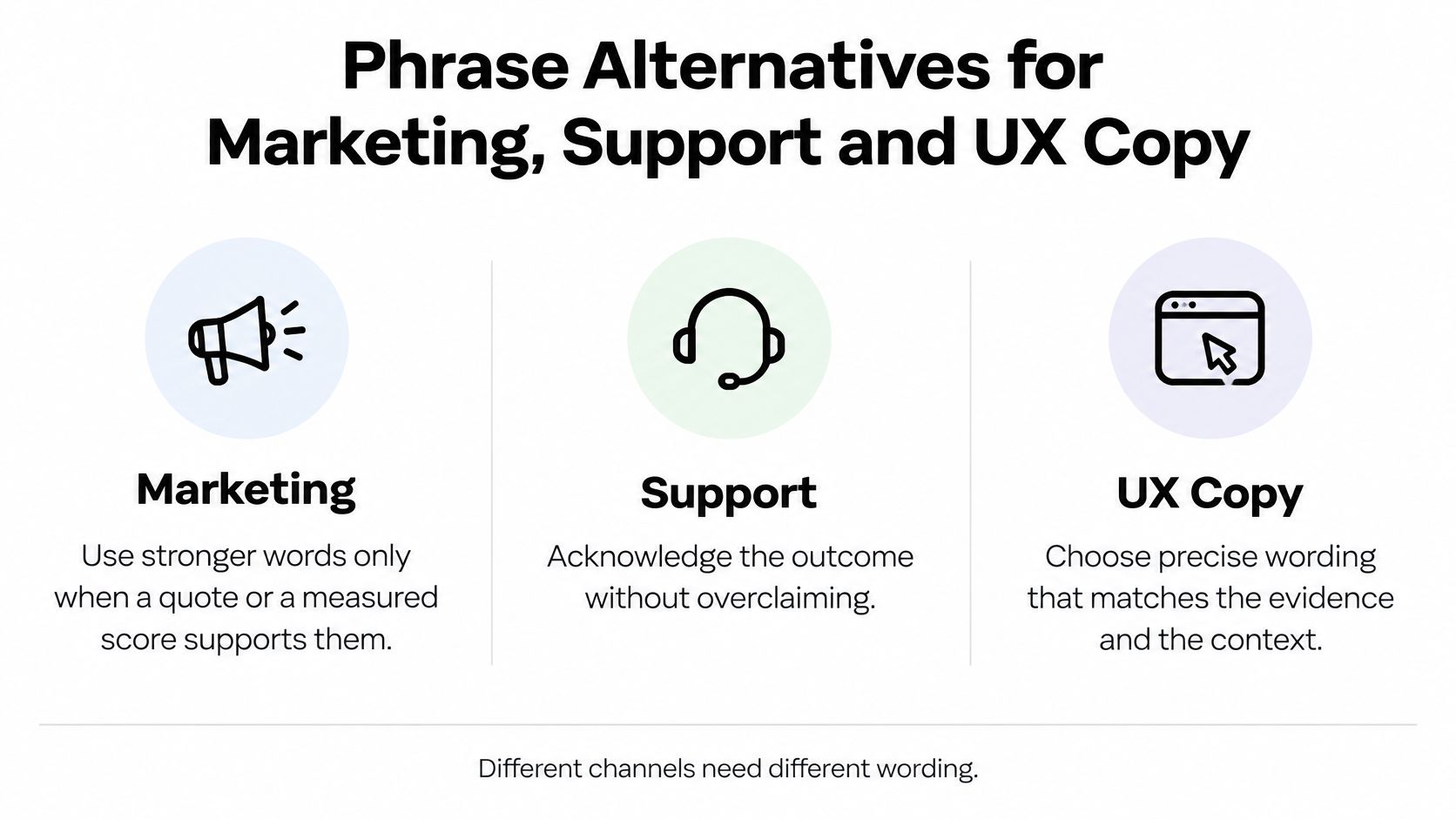
Each channel asks for a different strength of satisfied customer synonym, and the sample line should sound like that channel.
Marketing copy can use a stronger word only when a quote or a measured score supports it. Support replies should acknowledge the outcome without praising the customer's feelings for them. UX copy should name the state the person has reached, not their emotion. A good primer on writing useful content that ranks from Rankira is worth reading beside this table, because precise lines also tend to be the lines a reader can trust.
| Context | Avoid | Use instead | Sample line |
|---|---|---|---|
| Case study headline | Satisfied customers | Customers whose needs were met | Customers whose needs were met within the agreed deadline |
| Testimonial introduction | Delighted customer | Customer quote with a measured result | Quote the customer's own words and the result |
| Survey report | Happy users | Satisfied respondents | Respondents rating delivery 4 or 5 out of 5 |
| Support follow-up after a fix | Glad to hear our customer is happy | Pleased to hear the fix worked | Pleased to hear the fix worked. Let us know if anything else comes up |
| Support survey request | Rate how satisfied our customer is | Did this resolve your issue? | Did this resolve your issue? Yes or no |
| UX success message | Customer delighted | Your state, stated plainly | You are all set. Your order is confirmed |
| Onboarding screen | Happy user | Ready to start | You are ready to start your first session |
| Loyalty email | Loyal customer | Customers who return | Thanks for coming back. Here is what changed since your last order |
| Referral request | Customer advocate | Invite to refer | If you found this useful, you can share it with a colleague |
| Internal report | Advocates | Referral-tracked customers | Only customers with a logged referral this quarter |
One line per channel
A case study headline that says "satisfied customers love us" hides the result. "Customers whose needs were met within the agreed deadline" tells a buyer what happened.
A survey report that says "happy users" imports a mood the instrument may not have asked about. "Respondents rating delivery 4 or 5 out of 5" stays inside the scale.
A support follow-up after a fix should not declare the customer happy. "Pleased to hear the fix worked" reports what you heard.
A checkout success message should not announce delight. "You are all set. Your order is confirmed" states the state.
An onboarding screen that says "happy user" talks about a feeling the product cannot see. "You are ready to start your first session" talks about progress.
A loyalty email may say "thanks for coming back" when the account shows a return. It may not say loyal customer as a greeting for a first-time buyer.
Three checks before the line ships
- Name the channel: marketing, support or UX.
- Take the alternative from the row, not from a thesaurus dump.
- Confirm the evidence matches the term. Intensity tells you how strong the feeling word is. The evidence test tells you whether you may use it.
Checking Wording Across Languages and Reading Level
A translation can raise the volume without anyone intending to exaggerate. A moderate English term can become an overstated claim in German, French or Spanish. Check the translated word against the intensity of the English original before the page goes live.
Run a back-translation first
Translate the sentence into the target language. Hand that version to someone who has not seen the English, and ask them to translate it back. If the intensity moved up or down, choose a lower-intensity term and run the test again. Idioms fail this test quickly. "Thrilled to bits" does not carry, and a literal equivalent often sounds louder than the source.
Keep the claim stable
- Survey reports: Keep satisfied across languages. It maps to the measured construct. Do not let a localiser swap in a word that means thrilled.
- Loyalty and advocacy: Keep loyal or advocate only in markets where you hold repeat-purchase or referral data. A warm translation is not that data.
- Consumer copy: Content and gratified are less familiar to general readers. Prefer pleased, or happy on an informal channel, when clarity matters more than a formal tone.
- Channel lines: Read each sample line aloud after translation. If the spoken version praises an emotion you did not measure, cut it back.
A translated term must carry the same claim and the same evidence as the source, never a stronger emotion.
Matching Wording to the Evidence You Have
An adjective is a claim, and every claim needs a receipt. "Satisfied" reports how a customer scored the experience. "Loyal" reports that they came back. "Advocate" reports that they recommended you to someone else. A warmer adjective buys more meaning, and the file you hold decides how much you can spend.

The ISO 10004 guidelines ask organizations to identify customer expectations, gather relevant satisfaction data, analyze it, communicate results accurately and monitor satisfaction continuously. That sequence doubles as a writing rule. Survey responses measure the feeling directly. Complaints, repeat purchases and retention figures measure something else. A complaint trend hints at trouble, yet it can never prove that the customers who stayed are delighted.
Sorting synonyms by what they claim makes the choice easier.
Feeling words. Satisfied, pleased, happy and delighted all report an evaluation. Use satisfied customer when you report survey outcomes, pleased customer for a positive service rating, and happy customer when all you hold is a positive comment. High-satisfaction customer fits respondents who cleared a documented cut-off, and delighted customer only when the survey instrument defines and measures that level. A positive reviewer is still a reviewer, and a warm comment is not a score.
Behaviour words. Use retained customer for observed continuation over a defined period, and loyal customer for repeat purchases or continued use visible in account history.
Advocacy words. Customer advocate stands only when referral or recommendation behaviour has been measured.
For interview-preparation research, a neutral label such as satisfied interview-preparation user fits a survey result, while customer advocate fits only someone who has recommended the tool. Comments left on a customer reviews page record sentiment, and sentiment is not a referral count.
| Term | Evidence required | Typical source | Fallback wording |
|---|---|---|---|
| Satisfied customer | Survey item measuring evaluation against expectations | Post-purchase or post-session survey | Positive-experience customer for open feedback |
| Delighted customer | A defined top-box or score threshold in the survey | Survey instrument with a documented cut-off | Satisfied customer |
| Pleased customer | Positive rating on service quality | Support or service rating | Satisfied customer |
| Happy customer | Qualitative positive comment | Free-text feedback | Positive-experience customer |
| Loyal customer | Repeat purchase or continued use over time | Account or order history | Customer who responded positively |
| Retained customer | Observed continuation over a defined period | Usage or subscription data | Customer who responded positively |
| Customer advocate | Verified referral or recommendation | Referral tracking or a recommendation question | Satisfied customer |
When the file is thinner than the headline
A positive free-text comment supports positive-experience customer and nothing higher. Quote the comment if you want its warmth on the page, and keep your own sentence at the level you measured.
If the survey has no top-box rule, do not invent one in the headline. Write satisfied customer. If you hold a kind reply and no order history, write "customer who responded positively," because loyal needs the orders behind it. The honest fallback is the default whenever the file is incomplete.
Before you lock a label, this walkthrough shows how a measured score differs from the story built around it.
Pick the Right Synonym Before You Publish
Run this once per sentence, not once per campaign. A homepage, a support macro and a quarterly report can each need a different word for the same account.
- Decide which claim the sentence makes, attitude, behaviour or advocacy, using the three claim types in section 2.
- Check the evidence you hold against the evidence table in section 7.
- Match the intensity to the customer's real reaction using the ladder in section 1.
- Pick the term from the table in section 1 and read its "avoid when" cell before you paste it.
- Test the sentence in its channel using the rows in section 5.
- Keep the number visible wherever you can: report the score and the scale, then the adjective, and ask whether you could point to the evidence if a reader requested it.
That last question is the whole test. If you cannot point to the rating, the comment, the orders or the referral, the sentence is not ready.
ParakeetAI is an interview assistant that listens to the interviewer's questions and shows suggested answers on your screen in real time, and it never joins the call. The same standard you would use for a satisfied customer synonym applies when you describe people who practice with it: match the word to the feedback you have. Visit ParakeetAI to try a mock interview and prepare before the conversation that counts.