Thank You Note for Job Offer: 7 Examples That Work
An offer has arrived, and you're deciding what to say before the excitement wears off or the response deadline gets close. The note you send now can confirm what you've heard, clarify whether you're accepting, and set expectations for your next steps. It doesn't need to be elaborate. It does need to match your decision.
A thank-you note for a job offer works best when it's prompt, specific, and clear about your status. Employer surveys suggest that post-interview messages can influence hiring decisions, though they don't guarantee an offer or acceptance outcome (CNBC's coverage of the survey findings). Below, you'll find seven ready-to-adapt examples for acknowledging a verbal offer, accepting, sorting out logistics, negotiating, declining, sending a card, or taking time to review. For other decisions that follow a career milestone, this guide to steps toward airline eligibility offers a separate example of planning ahead.
1. Thank-You Email After a Verbal Job Offer
A recruiter calls to offer you a role, but the written offer hasn't arrived yet. Send a brief email that thanks them, confirms the position discussed, and asks for the written terms. Keep your enthusiasm genuine without implying you've accepted details you haven't seen.
The University of Virginia Career Center recommends sending a thank-you after each employer interview, and says email is now more common and acceptable than a handwritten letter. Its guidance recommends sending an interview thank-you within 24 hours, a useful timing model for prompt professional follow-up (University of Virginia Career Center).

Subject: Thank you for the offer, [Job Title] role
Thank you for calling today to offer me the [Job Title] position. I'm excited about the possibility of joining [Company]. Could you please send the written offer so I can review the details? I look forward to hearing from you.
Timing, tone, and details to check
Reply within 24 hours of the call when possible. Mention only details the employer shared, and ask for a response deadline if they didn't give one. Don't write “I accept” before you've reviewed the written terms.
If you'd like to practice responding to interview questions before a later hiring conversation, ParakeetAI's Mock Interview tool lets you rehearse with an AI interviewer. For this email, though, the priority is to acknowledge the call and request the formal offer.
2. Formal Acceptance Thank-You Email
Once you've reviewed the written offer and decided to accept, make your decision unmistakable. Thank the employer, name the role, and confirm the start date exactly as it appears in the offer. If compensation or another important term needs confirmation, check that it matches the written document before you send your acceptance.
The University of Maryland advises candidates to obtain an offer in writing and review its details before responding. A formal acceptance can confirm the start date, salary, and other relevant terms (University of Maryland).
Subject: Accepting the [Job Title] offer
Thank you for the offer. I'm pleased to accept the position of [Job Title], starting on [Date]. I appreciate your support throughout the hiring process and look forward to working with the team. Please let me know what I should prepare before my first day.
Make the acceptance easy to process
Reply in the offer letter's email thread so the recruiter can see the context. Use the exact title and start date from the written offer, and ask about any remaining pre-employment steps.
Before sending, make sure your wording says you accept, not merely that you're excited. “I'm looking forward to joining” expresses enthusiasm, but pairing it with “I accept the position” removes doubt about your decision.
3. Thank-You Note That Confirms Start Date and Logistics
After accepting, your questions may shift from the offer to the first day. A remote employee might need to ask about equipment delivery and IT setup; someone working on-site may need to confirm arrival time, office location, or onboarding documents.
Thank the employer first, then group practical questions so the recipient can answer them together. Indeed recommends combining appreciation with questions about next steps and required paperwork when accepting an offer (Indeed's job-offer guidance).

Practical rule: Send this after your formal acceptance. It's a logistics follow-up, not a substitute for confirming that you accept the role.
Subject: Preparing for my first day
Thank you again for the warm welcome. To prepare for my start on [Date], could you confirm the expected office hours, whether I should bring identification for onboarding, and who I should contact about IT setup? Thank you for your help.
Keep the questions useful
Include only details you need to plan for, such as the schedule, equipment, paperwork, or contact person. Save the reply somewhere easy to find so you can check it before your first day.
For a role that involves travel or licensing, it can also help to review relevant requirements in advance, such as this job offer checklist for local drivers. Keep your email focused on your own role and the next steps your employer needs to confirm.
4. Thank-You Note After a Negotiated Offer
You've discussed compensation, benefits, schedule, or another term, and the employer has agreed to revise the offer. Your note should thank them for considering your request and confirm the points you understood. Don't use the message to reopen settled negotiations.
Negotiation should be complete before you formally accept, according to the University of Nebraska–Lincoln's offer guidance. The university also recommends confirming acceptance verbally and in writing (University of Nebraska–Lincoln).
Subject: Thank you for confirming the updated offer
Thank you for working with me on the final terms. I appreciate the adjustment to the base salary and the flexibility on my start date. I look forward to receiving the updated offer letter and joining the team on [Date].
Check the final document
Use this message when the employer has confirmed the revised terms, not while you're still negotiating. Compare the updated letter with what you discussed before accepting, and keep the relevant emails for your records.
If the new letter differs from your understanding, ask for clarification before sending a formal acceptance. A calm, specific question helps both sides resolve the mismatch without turning a thank-you note into another negotiation.
5. Gracious Thank-You Note When Declining an Offer
Declining an offer can feel uncomfortable, especially after a positive interview process. A short, courteous email is enough: thank the employer, state your decision clearly, and, if you mean it, express interest in staying connected.
Subject: Thank you for the [Job Title] offer
Thank you for offering me the [Job Title] position. After careful consideration, I've decided to decline. I appreciated meeting the team and learning about [Company]. I hope our paths cross again, and I'd welcome staying in touch.
Be direct and considerate
Send the note once you've made your decision so the employer can move forward. If you have a close relationship with the recruiter or hiring manager, consider speaking with them first, then follow up by email to document your decision.
You don't need to give a lengthy explanation or disclose a competing offer's salary. If you want to share a reason, keep it brief and respectful, such as “I've decided to pursue an opportunity that's a closer fit for my current goals.” Avoid wording that suggests you might accept later if that isn't true.
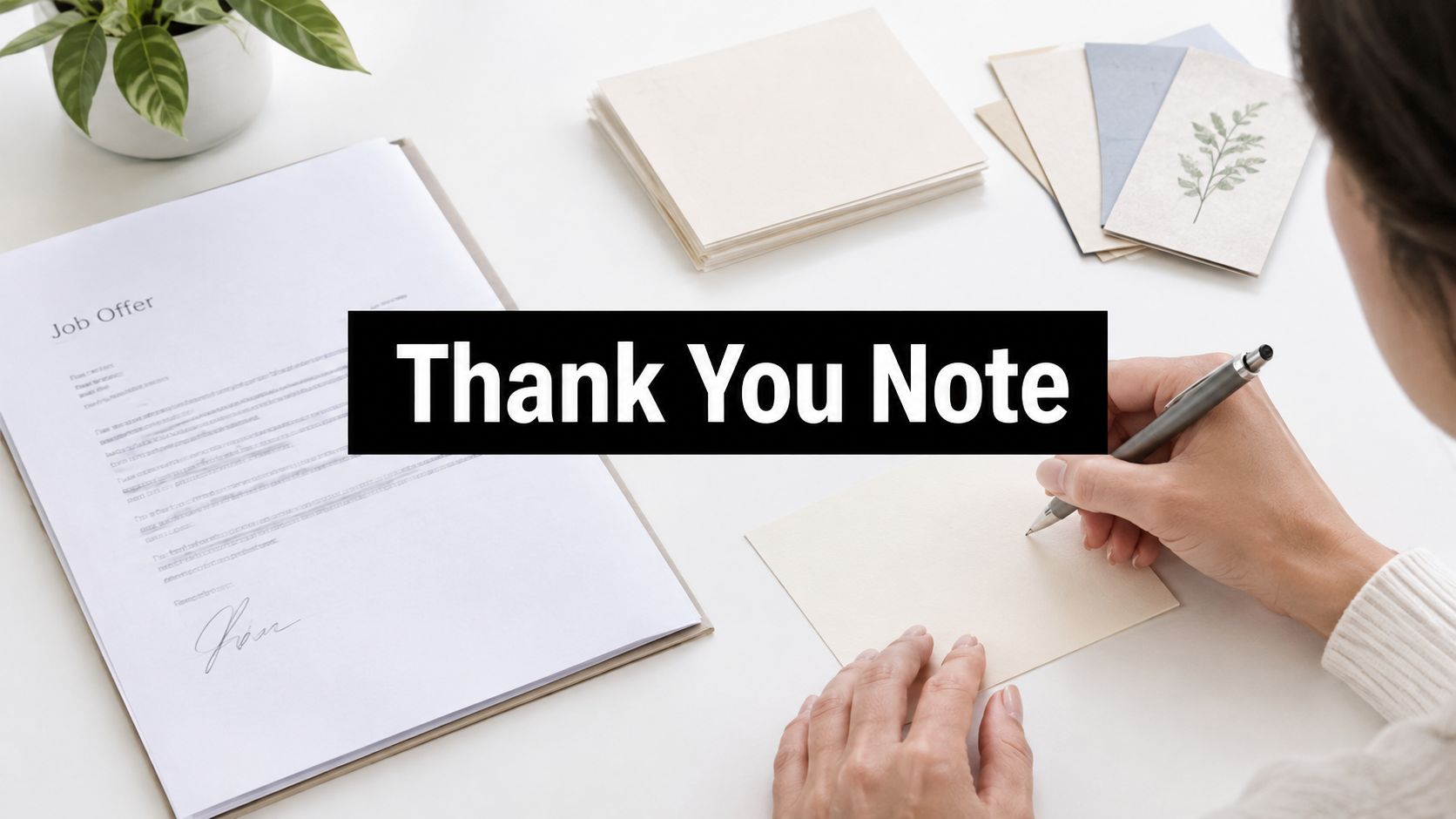
6. Handwritten Thank-You Card to the Hiring Manager
A handwritten card can add a personal touch after you accept an offer, but it shouldn't replace a timely email. Send the email first so the employer has your decision in writing, then use the card to thank the hiring manager for a specific conversation or welcome.

Dear [Name],
Thank you for the offer to join [Team]. Our conversation about [specific topic] made me even more excited to start. I look forward to working with you.
Warm regards, [Your Name]
Make it personal, not elaborate
Keep the message short and sincere. The detail you add should come from a real conversation, such as a project the team described or a shared point of interest. Don't include confidential information or a long repeat of your acceptance email.
Use the company's official mailing address or ask the HR contact where to send it. Email remains the practical way to confirm your decision promptly, while the card can follow as a separate gesture.
This video offers another perspective on writing a thoughtful thank-you message:
7. Short Follow-Up to the Recruiter While Reviewing the Offer
You've received the written offer, but you're not ready to accept or decline. A prompt acknowledgment lets the recruiter know the document arrived and gives them a realistic date for your decision. It also keeps your interest clear without committing you prematurely.
The University of Cincinnati recommends acknowledging an offer within 24–48 hours. Its guidance suggests thanking the employer, expressing enthusiasm, asking for time to review, and proposing a specific follow-up date; it notes that response deadlines vary (University of Cincinnati).
Subject: Thank you for the [Job Title] offer
Thank you for sending the offer for the [Job Title] role. I've received it and am reviewing the details. I expect to respond by [Date]. Please let me know if there's anything you need from me in the meantime.
Set a timeline you can meet
If the offer doesn't state a deadline, ask when the employer needs your decision. Choose a date that gives you enough time to review the terms, prepare questions, and consider whether you want to negotiate. Then follow up when you said you would, even if you need to explain that one question remains.
Preparing your questions or rehearsing a negotiation conversation can help you communicate calmly. Keep this note focused on receipt and timing; save detailed questions about compensation, benefits, or other terms for a separate discussion.
7 Job Offer Thank-You Note Examples Compared
| Example | When to Send | 🔄 Effort & Resources | 📊 Expected Outcome | ⭐ Key Advantage | 💡 Ideal Use Case |
|---|---|---|---|---|---|
| Thank-You Email After a Verbal Job Offer | After a verbal offer, before receiving the written offer | Low effort; send by email within 24 hours | Records discussed terms and requests the written offer | ⚡ Fast, professional follow-up that clarifies next steps | Candidates awaiting a formal offer letter |
| Formal Acceptance Thank-You Email | After deciding to accept a written offer | Low effort; reply by email with confirmed details | Clearly accepts the role and supports onboarding | ⭐ Creates an unambiguous written record | Candidates ready to accept final terms |
| Thank-You Note That Confirms Start Date and Logistics | After formal acceptance | Low-to-moderate effort; gather questions and send a concise email | Clarifies schedule, equipment, or other first-day arrangements | 📊 Helps prevent onboarding delays and misunderstandings | Candidates coordinating logistics, relocation, or remote setup |
| Thank-You Note After a Negotiated Offer | After final salary or benefits terms are agreed | Moderate care; verify terms and request an updated letter if needed | Documents agreed changes and supports a positive transition | ⭐ Reduces the risk of mismatched expectations | Candidates who negotiated compensation or benefits |
| Gracious Thank-You Note When Declining an Offer | Once the decision to decline is final | Low effort; send promptly by email, optionally call first | Communicates a clear decline and gives the employer closure | 💡 Preserves professional relationships | Candidates choosing another opportunity |
| Handwritten Thank-You Card to the Hiring Manager | After receiving or accepting an offer; supplement an email | Moderate effort; write and mail a short card | Adds a personal gesture, but arrives more slowly than email | ⭐ Memorable and distinctive | Candidates seeking a personal touch, especially at smaller companies |
| Short Follow-Up to the Recruiter While Reviewing the Offer | After receiving a written offer that needs review | Low effort; provide a realistic response date by email | Confirms receipt and sets expectations for a decision | ⚡ Keeps communication open while allowing review time | Candidates evaluating offer terms or comparing options |
Pick Your Template and Personalize It Today
Start by identifying your decision status: have you received only a verbal offer, accepted the written offer, reached revised terms, or decided to decline? Choose the matching example, then replace every placeholder with the correct name, role, date, and company. One specific detail from a real conversation can make the message sound personal without adding unnecessary length.
Before sending, check that your wording matches what you've decided. If you're still reviewing, don't use language that could sound like unconditional acceptance. If you are accepting, state that directly and confirm the terms that matter, especially your role and start date. If you're negotiating, wait to formally accept until you and the employer have settled the terms.
Timing depends on the situation. A prompt acknowledgment can keep communication moving while you review an offer, while a logistics note belongs after acceptance. For interview thank-yous, the University of Virginia Career Center recommends email within 24 hours; for an offer, follow the employer's stated deadline and promptly confirm receipt if you need more time. When no deadline is provided, ask for one rather than guessing.
Keep the tone warm, professional, and straightforward. Avoid unnecessary apologies, vague enthusiasm, or details you haven't confirmed. Read your message once as the recruiter would: can they tell whether you're accepting, still considering the offer, or declining? If the answer is clear, send it and save the reply with your offer documents. A thoughtful note won't replace careful review, but it can help you move from offer to first day with fewer misunderstandings.
Preparing for the conversations that lead to an offer can make it easier to communicate with confidence when a decision arrives. ParakeetAI offers a Mock Interview tool for practicing interview responses with an AI interviewer. Visit ParakeetAI to explore it.