Accounts Payable Questions and Answers: Prep Guide 2026

You're in the first few minutes of an interview when the hiring manager asks you to walk through the invoice-to-payment cycle. You know the work, but suddenly you're deciding whether to start with invoice capture, purchase orders, or supplier setup. Your answer needs a clear sequence, not a list of everything you know.
AP interviews test whether you can move invoices forward without losing control of the payment. A convincing candidate explains what they check, who approves an exception, and what evidence they retain. Saying you're accurate isn't enough. Describing how you stop a duplicate payment or resolve a missing receipt makes that accuracy believable.
These accounts payable questions and answers give you sample responses, common traps, and guidance for entry-level, mid-level, and senior interviews. Treat the answers as models, not scripts. Replace hypothetical language with your own experience only when you can explain the details under follow-up questioning.
- Early-career candidates should demonstrate a reliable sequence and sensible escalation.
- Experienced processors should explain exception handling, reconciliations, and follow-through.
- Senior candidates should connect daily processing to access controls, cash planning, and measurable performance.
For broader context on how accounting firms organize and improve their operations, explore Workflowcon insights for accounting firms. In the interview itself, keep your answers closer to the desk: the invoice, the supporting records, the system status, and the person responsible for the next action.
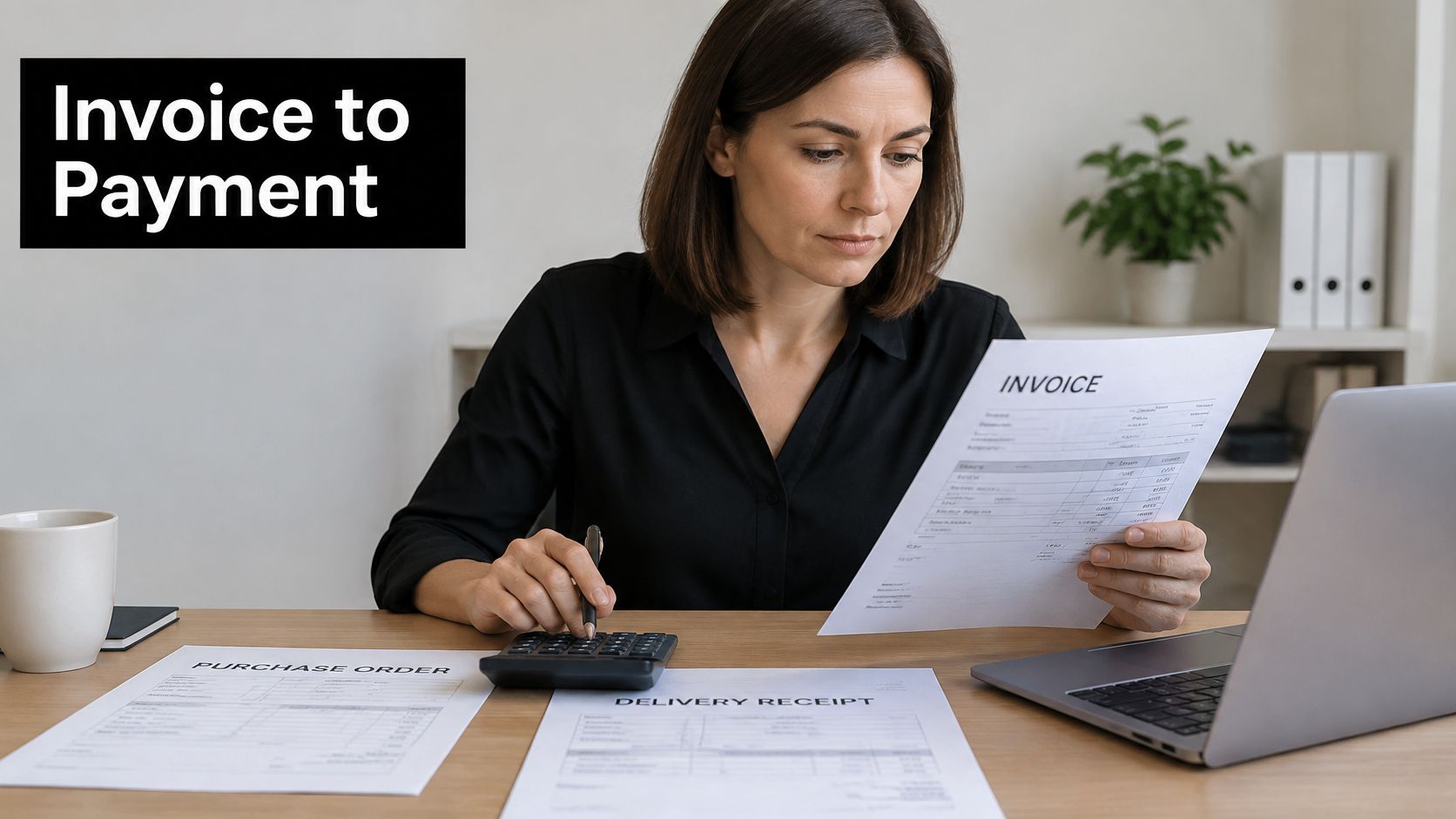
1. Walk me through the accounts payable process from invoice receipt to payment
Start with the invoice entering a controlled intake channel. Don't jump straight to payment, and don't suggest that AP approves every purchase itself.
Sample answer
“An invoice first enters the approved intake channel, where I record its receipt and check the supplier, invoice reference, dates, currency, tax details, and possible duplicates. For a purchase-order invoice, I compare it with the PO and receipt record. For a non-PO invoice, I obtain the appropriate coding and business approval.
“I route discrepancies to the responsible buyer, receiver, or budget owner rather than forcing the invoice through. Once the invoice is validated and approved, I check payment terms, holds, credits, and the scheduled payment method. An authorized person releases the payment under the company's approval controls.
“Afterward, I confirm the payment status, send remittance information where appropriate, and reconcile supplier statements and outstanding balances. Throughout the process, I retain supporting documents and a clear audit trail.”
What depth should you give?
- Entry: Explain the sequence and distinguish checking an invoice from approving expenditure.
- Mid: Describe how you manage blocked invoices, missing approvals, and supplier inquiries.
- Senior: Discuss ownership, system integration, and how you measure delays without weakening controls.
What the interviewer is evaluating: Whether you understand the entire workflow, including what happens after approval. APQC's accounts payable benchmarks define cycle time from invoice receipt until payment is transmitted, not just until data entry is finished.
Avoid: Claiming experience with SAP, Oracle NetSuite, or Microsoft Dynamics 365 because you recognize the names. Identify the system you used and the tasks you performed in it.
2. How do you handle a duplicate invoice?
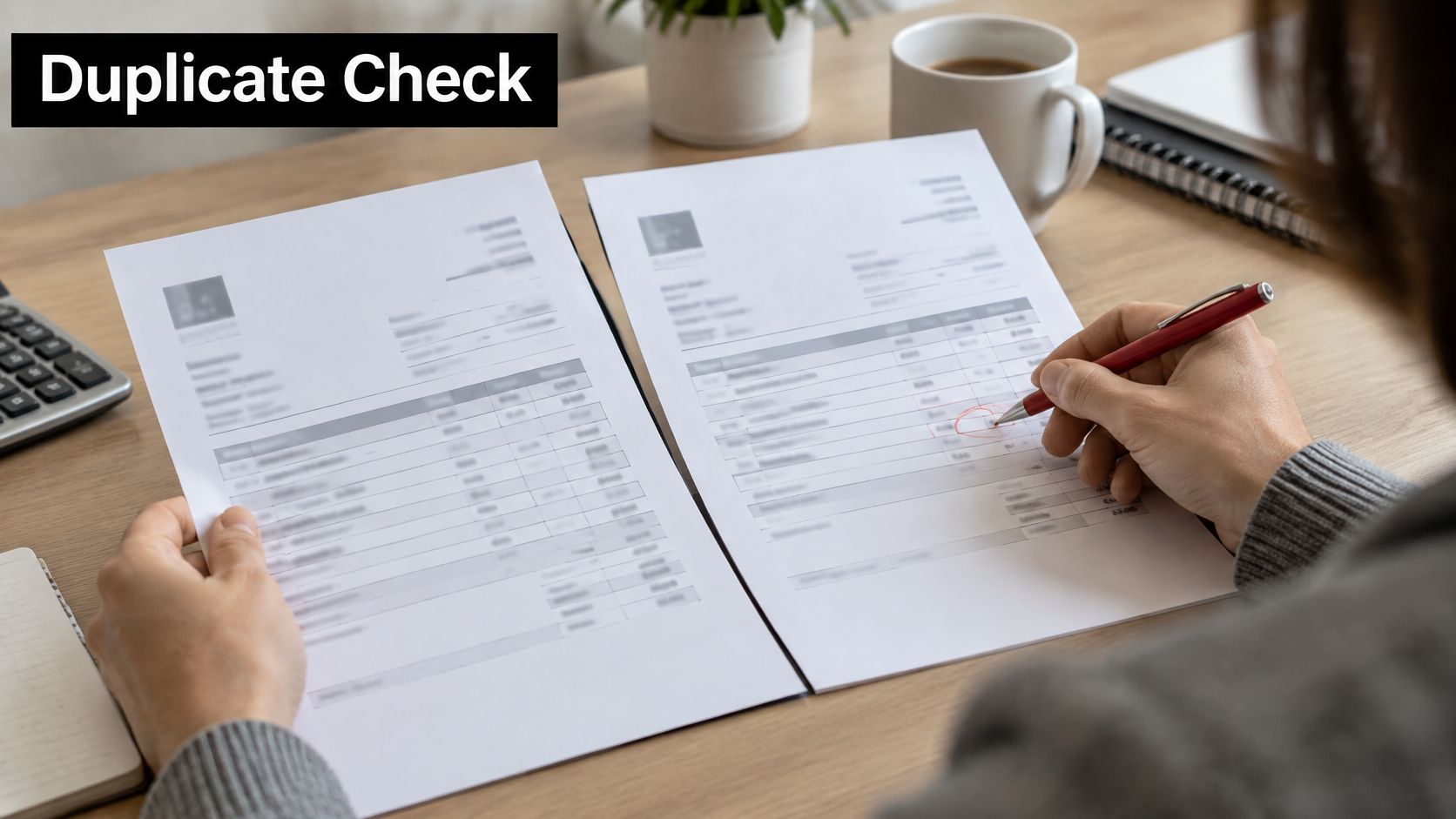
A supplier emails an invoice, then uploads it through a portal. The references look slightly different, but both documents relate to the same purchase. Your job is to establish whether the liability is duplicated before anyone pays it.
Sample answer
“I'd place the suspected duplicate on hold and compare the supplier record, invoice reference, date, amount, currency, PO, and supporting documents. I'd also check payment history and alternative supplier records, because a duplicate might already have been posted under another account.
“If both documents represent the same liability, I'd retain the valid invoice and cancel or block the duplicate through the approved process. I wouldn't delete evidence of what happened. If payment had already gone out, I'd confirm the overpayment with the supplier and agree an authorized refund or credit.
“I'd track the recovery until the refund cleared or the credit was applied and reconciled. Then I'd address the cause, such as duplicate intake channels, inconsistent invoice numbering, or duplicate supplier records.”
What the interviewer is evaluating: Attention to detail, prevention, and recovery ownership. Identifying an overpayment isn't the same as recovering it.
- Entry: Show that you'll hold, compare, document, and escalate.
- Mid: Explain how you distinguish genuine duplicates from legitimate recurring charges.
- Senior: Address duplicate-detection rules, supplier-master quality, and outstanding recovery reporting.
Practical rule: Keep the recovery open until the accounting records and the actual refund or applied credit agree.
Avoid: Saying the software catches everything. Reference formatting, separate supplier accounts, and repeated invoice amounts can require human review. Conversely, an identical amount alone doesn't prove duplication, especially for rent or recurring services.
3. What is a three-way match, and what do you do when it fails?
A three-way match compares the purchase order, receipt record, and supplier invoice. It checks whether the supplier billed for what the business ordered and received, at the agreed price.
Sample answer
“I compare the invoice with the PO and the goods receipt, checking quantities, prices, and relevant charges against company matching rules. If something falls outside an approved tolerance, I hold the affected invoice or line and identify who can resolve it.
“For example, say the supplier invoices the full order but the warehouse records only a partial delivery. I'd ask the receiving team whether the remaining goods arrived but weren't recorded. If they haven't arrived, I'd work with procurement and the supplier on the correct invoice or payment treatment.
“I wouldn't enter a receipt myself just to clear the exception. Once the responsible person provides the evidence or authorized correction, I'd reprocess the match and retain the resolution.”
The video below provides a visual companion to the matching workflow.
What separates a strong answer?
- Entry: Name the documents and explain why a mismatch blocks normal processing.
- Mid: Route price differences to procurement, receipt differences to receiving, and billing errors to the supplier.
- Senior: Explain tolerance governance, aged exceptions, and who may authorize an override.
What the interviewer is evaluating: Whether you resolve the underlying issue instead of editing records to manufacture a match.
Keep PO and non-PO workflows distinct. The Medius 2025 benchmark report reports average processing times of approximately 5.12 days for PO invoices and 7.36 days for non-PO invoices, illustrating why comparisons need a defined invoice population.
Avoid: Treating a tolerance as permission to ignore suspicious differences. An apparently small discrepancy can still require review when its nature is unusual.
4. How do you manage payment terms and capture early-payment discounts?
Paying everything immediately isn't good cash management. Paying everything at the last possible moment isn't reliable supplier management either.
Sample answer
“I check that payment terms in the supplier record agree with the approved contract or purchasing arrangement. I then schedule validated invoices around their due dates, allowing for payment-run cutoffs, bank processing, and any required release approvals.
“For an early-payment discount, I confirm that the invoice qualifies and that we can complete approval within the discount window. I compare the saving with the cost of using cash earlier and coordinate with treasury or finance before changing payment priorities.
“I also review critical suppliers, disputed balances, and overdue approvals. If a discount is repeatedly missed because invoices sit with an approver, I'd address that bottleneck rather than pressure AP to bypass checks.”
Explain the trade-off
Terms such as 2/10 net 30 mean a 2 percent discount if paid within 10 days; otherwise, the full amount is due in 30 days. If asked to annualize the discount's value, explain the method: divide the discount by the discounted amount payable, then adjust for how much earlier payment is required using the employer's day-count convention.
- Entry: Read terms correctly and identify the due date and discount deadline.
- Mid: Explain payment proposals, approval delays, supplier credits, and missed-discount tracking.
- Senior: Connect discount decisions to liquidity, funding costs, supplier importance, and treasury policy.
A discount is an opportunity to evaluate, not an instruction to release an unverified payment.
What the interviewer is evaluating: Whether you understand both the commercial benefit and the cash consequence. A useful scenario is an eligible invoice awaiting approval while treasury has restricted discretionary outflows. Your answer should involve the approver and treasury, not an unauthorized early payment.
Avoid: Presenting every available discount as automatically worthwhile. The business may need that cash for a more urgent obligation.
5. How do you protect the vendor master file and prevent payment fraud?
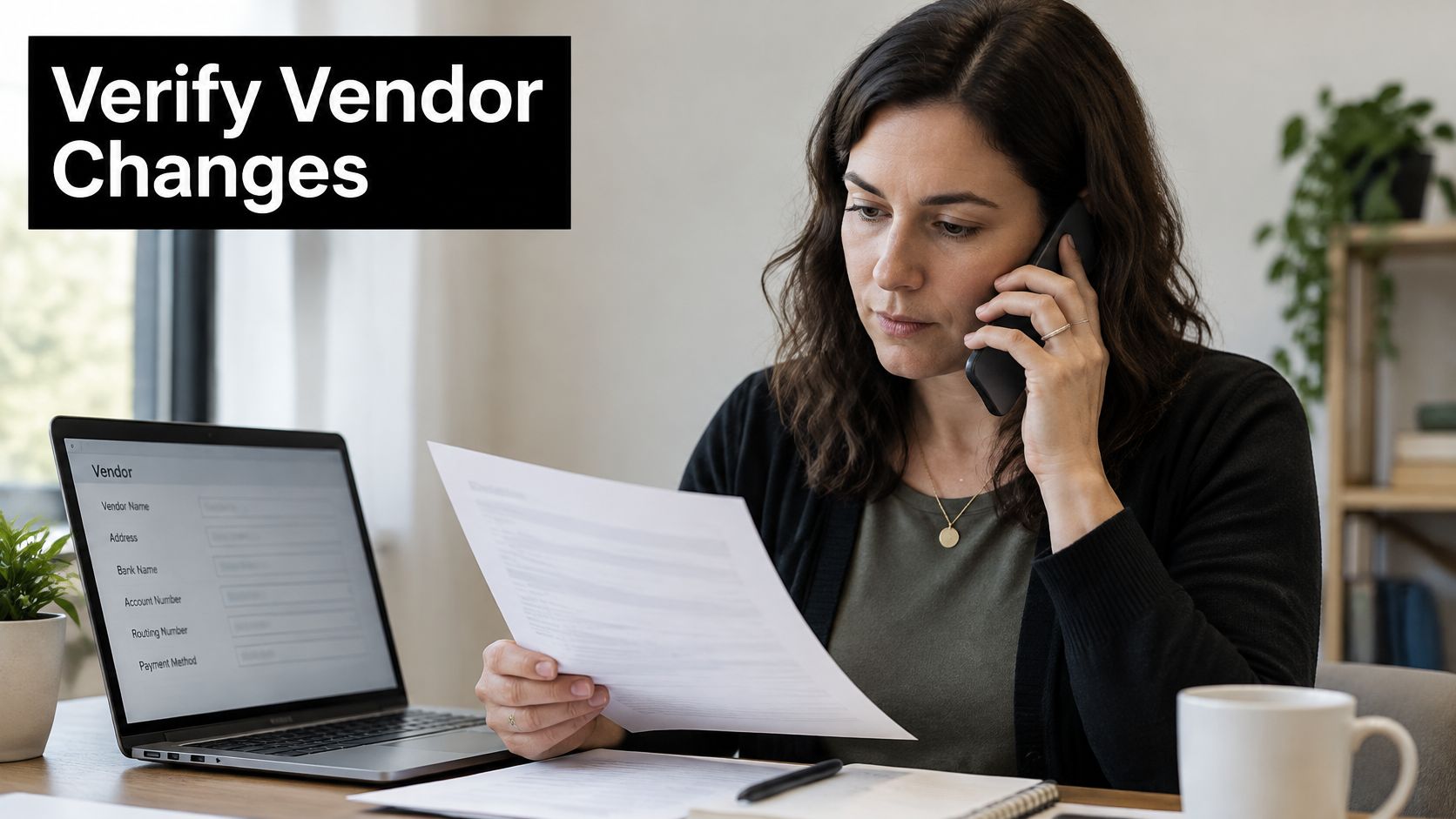
A convincing bank-change email isn't independent evidence. Start your answer with that distinction.
Sample answer
“I restrict supplier creation and amendments to authorized users, with independent approval and an audit trail. Before setting up a supplier, I check the required business documentation and look for existing records to avoid duplicates.
“For a bank-detail change, I verify the request through an established contact using contact information already held in trusted records. I don't rely on the telephone number or link in the change request. If the request appears suspicious, I hold the amendment and affected payment, preserve the evidence, and escalate through the fraud or security procedure.
“I also keep supplier maintenance separate from invoice approval and payment release. Where the team is small, I'd expect a documented independent review rather than unrestricted end-to-end access.”
What the interviewer is evaluating: Whether you can resist urgency, recognize business email compromise and fake invoices, and preserve independent verification.
- Entry: Explain why you won't act on an email alone.
- Mid: Describe callback evidence, change logs, and payment holds.
- Senior: Discuss access design, periodic reviews, and compensating controls.
The accounts payable controls course from CPE Store identifies supplier setup, invoice processing, invoice approval, and payment release as responsibilities that should be separated.
For a mission-driven organization, preventing payment fraud in ministry finance offers a relevant context for discussing stewardship and independent review.
Avoid: Confusing accurate invoice extraction with legitimate payment authorization. Software can correctly read bank details from a fraudulent document. In a scenario involving an urgent executive request, the same verification rules should still apply.
6. How do you handle month-end close for accounts payable?
The strongest answer follows a close checklist and explains cutoff, completeness, and reconciliation. Processing the visible inbox isn't enough.
Sample answer
“I work backward from the close timetable and confirm deadlines with procurement, budget owners, and the accounting team. I review unprocessed invoices, blocked items, unmatched receipts, and supplier statements for liabilities that may need attention.
“For goods or services received before period-end but not yet invoiced, I gather support for an accrual under the company's accounting policy. I check the service or receipt period rather than relying only on the invoice date, and I coordinate with the ledger owner to prevent double counting.
“I reconcile the AP subledger to the general ledger, investigate differences, and document each outstanding item with an owner and expected resolution. I also review unusual debit balances, unapplied credits, and payment-clearing items before submitting the close support for review.”

Show your level of ownership
- Entry: Explain the documents you prepare and when you escalate discrepancies.
- Mid: Walk through accrual support, reconciliations, and reconciling-item follow-up.
- Senior: Discuss review responsibilities, materiality under company policy, and recurring close failures.
What the interviewer is evaluating: Whether you can meet deadlines without hiding unresolved balances.
For example, a maintenance service completed before period-end may be invoiced afterward. Explain how you obtain evidence of completion, support the accrual, and ensure the later invoice doesn't duplicate the expense.
Avoid: Claiming that every open PO requires an accrual. An order alone doesn't establish that goods or services have been received. Also avoid plugging a reconciliation difference into an expense account just to make the ledger agree.
7. Tell me about a time you resolved a vendor dispute or payment error
Use a real example if you have one. If you're entering AP, explain that your example comes from coursework, an internship, or another role, and distinguish it from a hypothetical response.
Sample answer to adapt
For a scenario involving an allegedly unpaid invoice, a complete response could sound like this:
“The supplier said an outstanding invoice was putting future deliveries at risk. I'd first confirm the invoice, account, and payment status rather than promise another payment.
“If our records showed a completed payment, I'd compare the remittance, bank status, supplier account, and invoice allocation. If the supplier had applied the payment incorrectly, I'd send the supporting remittance through the approved channel and ask for an updated statement.
“I'd keep the buyer informed, document the agreed action, and follow up until the supplier corrected the allocation and confirmed the balance. I'd then check whether incomplete remittance information contributed to the dispute and recommend the appropriate correction.”
Make the result credible
- Entry: Demonstrate calm communication, evidence gathering, and appropriate escalation.
- Mid: Show ownership from the original complaint through to reconciliation.
- Senior: Explain how you reduced recurrence without damaging the supplier relationship.
What the interviewer is evaluating: Your ability to establish facts, communicate clearly, and finish the work. For a real story, replace the conditional wording with what happened and use a measurable result only if you can support it.
Supplier communication deserves preparation: Ardent Partners' 2024 State of ePayables report found that AP staff spent 21.8% of their time managing supplier inquiries.
Rehearse the follow-up questions with our Mock Interview tool, which lets you practice with an AI interviewer. Every account gets one free mock interview.
Avoid: Blaming the supplier or claiming a recovery you only initiated. Explain how you verified the final outcome.
8. How do you maintain internal controls and tax compliance in accounts payable?
Separate routine processing checks from decisions that require tax, treasury, procurement, or legal expertise. Strong candidates know their responsibilities and their escalation boundaries.
Sample answer
“I build controls into daily processing through approved supplier records, documented coding, authorization limits, restricted access, and retained supporting evidence. I check that the invoice meets the requirements for the relevant entity and jurisdiction, and I escalate uncertain tax treatment instead of guessing.
“For cross-border payments, I confirm which checks belong to AP and which require tax or treasury review. Depending on the transaction, that can include VAT or GST treatment, withholding, electronic-invoicing requirements, sanctions screening, and payment documentation.
“I retain evidence of approvals and exceptions so a reviewer can reconstruct the decision. If automation flags an unusual transaction, I don't override it just because the invoice fields were captured accurately. I obtain the required independent review before release.”
Match the answer to the role
- Entry: Identify missing documentation and explain when you'll stop processing.
- Mid: Describe exception handling, audit evidence, and coordination with specialists.
- Senior: Explain control ownership across entities, systems, and jurisdictions.
What the interviewer is evaluating: Whether compliance remains part of normal work under deadline pressure.
For a US role, prepare to discuss supplier tax documentation and 1099 information-reporting responsibilities relevant to the position. Don't guess reporting thresholds or assume the same rules apply internationally.
Tipalti's 2026 Global Finance Outlook Index announcement reports that regulatory and compliance complexity is prompting 61% of finance professionals to reconsider AP processes.
A valid invoice doesn't, by itself, settle every tax or cross-border payment requirement.
Worked example: An overseas supplier submits a commercially valid invoice with unfamiliar tax treatment. Explain who reviews the tax position, what evidence AP retains, and how you prevent payment before the required checks are complete.
AP Interview Questions at a Glance
| Question | Core Skill Tested | Question Type | Best Prep Focus |
|---|---|---|---|
| Walk me through the accounts payable process from invoice receipt to payment | Procure-to-pay knowledge and process controls | Process walkthrough | Review the steps from invoice intake through reconciliation, including approvals and controls |
| How do you handle a duplicate invoice? | Attention to detail and overpayment prevention | Situational | Prepare detection, hold, documentation, and recovery steps |
| What is a three-way match, and what do you do when it fails? | Matching controls and exception resolution | Technical and situational | Explain PO, receipt, and invoice checks, tolerance thresholds, and exception routing |
| How do you manage payment terms and capture early-payment discounts? | Cash management and payment prioritization | Technical | Review payment terms, discount deadlines, and cash-flow trade-offs |
| How do you protect the vendor master file and prevent payment fraud? | Fraud prevention and access controls | Technical and situational | Prepare examples of independent verification, segregation of duties, and escalation |
| How do you handle month-end close for accounts payable? | Accruals, cutoff, and reconciliation | Technical and process | Review unbilled liabilities, period cutoff, and AP subledger-to-GL reconciliation |
| Tell me about a time you resolved a vendor dispute or payment error | Communication, investigation, and problem-solving | Behavioral | Prepare a specific situation-action-result story with a clear outcome |
| How do you maintain internal controls and tax compliance in accounts payable? | Internal controls and tax compliance | Technical | Review approval limits, audit trails, segregation of duties, and applicable tax requirements |
Your 48-Hour Prep Plan Before the Interview
Start by writing a one-page version of your invoice-to-payment answer. Use the actual sequence, identify the controls, and mark the points where another person must approve or resolve something. Read it aloud, then put it aside and explain the process without looking.
Your preparation should make you more specific, not more scripted. A hiring manager can ask what you do when the approver is absent, the receipt is missing, or the supplier threatens to stop deliveries. You'll answer more confidently if you understand the decision behind each step.
First, build your evidence
- Choose real stories: Prepare a dispute or payment-error example and a close, reconciliation, or control example. Record the situation, your responsibility, your action, and the verified outcome.
- Inventory your systems: Note what you did in each ERP, spreadsheet, supplier portal, or AP application. Separate hands-on use from training or observation.
- Identify your boundaries: Be ready to say which decisions you owned, which needed approval, and when you involved tax, treasury, procurement, or security.
- Research the role: Read the job description for invoice types, entities, currencies, close responsibilities, and supplier-contact expectations.
Next, practice the questions in a mixed order. Don't rehearse only from process overview to compliance, because a real interviewer may start with a difficult supplier or a failed reconciliation. Ask a colleague to interrupt with practical follow-ups, especially about evidence and authorization.
For behavioral answers, check every outcome against what you can confidently defend. If you don't remember an exact saving or turnaround time, explain the verified result without inventing a number. A reconciled supplier account or a documented correction is stronger than an unsupported performance claim.
Then, run the full rehearsal
Deliver a complete mock interview aloud, including your introduction and questions for the employer. Listen for answers that become lists of terminology rather than explanations of action. Tighten them by naming the document, the check, the owner, and the next step.
Prepare questions of your own about exception ownership, supplier-master maintenance, payment release, and close expectations. Ask how the team distinguishes automated capture from touchless processing. These questions help you understand whether the role offers clear responsibilities or leaves AP chasing unresolved handoffs.
Finish with a short review, not another round of memorization. Know your examples, your systems, and your controls. You don't need to sound as though you've handled every possible AP issue; you need to show that you'll investigate carefully, protect the payment, and follow through.
ParakeetAI offers practice with an AI interviewer so you can rehearse your AP process explanation and behavioral examples aloud. Visit ParakeetAI and use your free mock interview to practice explaining exceptions, approvals, and payment controls before the conversation.