How Long Should STAR Interview Answers Be? a 2026 Guide
A complete STAR answer should run about 90 to 120 seconds, roughly 200 to 250 spoken words, and you should also prepare a 45 to 60 second short version for time-limited interviews. If most of those seconds describe the company, the project, or the team, have you proved anything about yourself?
That's the gap in the usual advice about How Long Should STAR Interview Answers Be. The clock matters, but evidence density matters more. A strong answer spends its time on your decisions, not on background, and it can shrink or expand without losing that proof.
The Right Length for Most STAR Answers
Start with 90 to 120 seconds as your default for a full behavioral answer. That window gives you room for context, a clear action sequence, and a measured result without turning the answer into a monologue. Simpler questions need less, and tight interviews need a prepared short version.
University guidance clusters in the same place. The University of Maryland, Baltimore County STAR guide states that answers can take “one to two minutes” while remaining descriptive and concise. The University of Arizona gives the same range and warns that answers longer than two minutes can become difficult for interviewers to follow, while Texas Tech University sets a stricter benchmark of no longer than 60 seconds for some questions while still recommending STAR or related structures such as SAR, SARA, and CAR.
Match the length to the question
Don't force every story into one duration. Use complexity as the deciding factor.
- Straightforward question: Aim for about 60 seconds when there's one clear decision and little setup.
- Complex example: Use 90 to 120 seconds when stakeholders, obstacles, or trade-offs affect what you chose.
- Time-limited interview: Keep a 45 to 60 second version ready so you don't have to improvise cuts under pressure.
| Answer type | Target time | Spoken words | Best use |
|---|---|---|---|
| Short version for time-limited interviews | 45-60 seconds | 100-135 | Tight time limits or a fast follow-up question |
| Straightforward question | About 60 seconds | 130-150 | A simple example with one clear decision |
| Complex example with context | 90-120 seconds | 200-250 | A story with stakeholders, obstacles and trade-offs |
| Live-interview draft to rehearse | 75-100 seconds | 165-220 | A working draft to time before trimming |
Word counts are planning aids, not scripts to memorize. Your natural pace decides the final count, so time yourself speaking aloud rather than reading in your head. If you're rushing to fit the words in, the answer is too long even if the timer looks fine.
Practical rule: Draft at 75 to 100 seconds, then cut a 45 to 60 second version from it. You'll know both the full story and the essential proof.
That two-version habit protects you in both directions. You won't pad a simple answer to fill two minutes, and you won't panic when an interviewer signals that time is short. Length serves the evidence. It doesn't replace it.
Sample STAR Answers at Three Lengths
Use this question as the test case: Tell me about a time you resolved a disagreement with a teammate. The facts stay the same in each version. Only the weight changes.
Version A, 45 to 60 seconds, about 110 words
Situation, 8 seconds: Two weeks before a release, a teammate and I disagreed on whether to rebuild a report or patch it.
Task, 7 seconds: I owned the deadline and had to get us to one workable plan.
Action, 30 seconds: I asked each of us to list the risks in writing, then I tested the patch against the three failures users reported most. The patch covered two, so I proposed shipping it and scheduling the rebuild.
Result, 10 seconds: We shipped on time, support tickets on that report dropped, and the rebuild stayed on the roadmap.
This works because it keeps two actions and their reasons. It doesn't explain the whole product.
Version B, 90 to 120 seconds, about 220 words
Situation, 20 seconds: Two weeks before a release, a teammate wanted to rebuild a customer report that kept failing. I worried a rebuild would miss a fixed client deadline and leave support handling the same errors.
Task, 10 seconds: I owned delivery, so I needed a decision we could both defend.
Action, 60 seconds: First, I separated preference from evidence. I pulled the last month of support tickets and grouped the failures. Then I built a quick patch and tested it against the top three causes. It fixed two and reduced the third. I showed my teammate the test results and the deadline risk, and I agreed the underlying design still needed work. We took the trade-off to our lead with a proposal: ship the tested patch now, log the remaining failure, and book the rebuild as the first task next cycle.
Result, 20 seconds: We shipped on time and report-related tickets fell noticeably in the following weeks. I learned to bring a small test to a disagreement earlier, before positions harden.
The evidence sits in three sentences: you grouped the failures, you tested the patch, and you proposed a trade-off another stakeholder could approve.
Version C, about three minutes, what goes wrong
An overlong version spends a minute on the company, the report's history, team meetings, and everyone's opinions before you act. It retells the disagreement twice, describes tools nobody asked about, and ends with general teamwork language. The interviewer hears process, not ownership.
Cut that version by deleting chronology that doesn't change your decision. Keep the constraint, your test, the trade-off, and the outcome.
Use this fill-in frame to build your own:
The situation was... My task was... I decided to... because... As a result...
Why Action Should Take Most of Your Time
Most long answers aren't long because the story is complex. They're long because background expands and Action shrinks. The interviewer learns where you worked and what the team faced, but not what you personally decided.
The University of Washington career center STAR resource presents a 20% Situation, 10% Task, 60% Action, and 10% Result split, emphasizing that Action should dominate because it shows what the candidate personally did. Carnegie Mellon's Tepper School gives the same 20/10/60/10 allocation and recommends keeping a STAR story around two minutes, with three minutes as an upper limit, while MIT describes the percentages as guidelines rather than rigid requirements and identifies Action as the longest section.
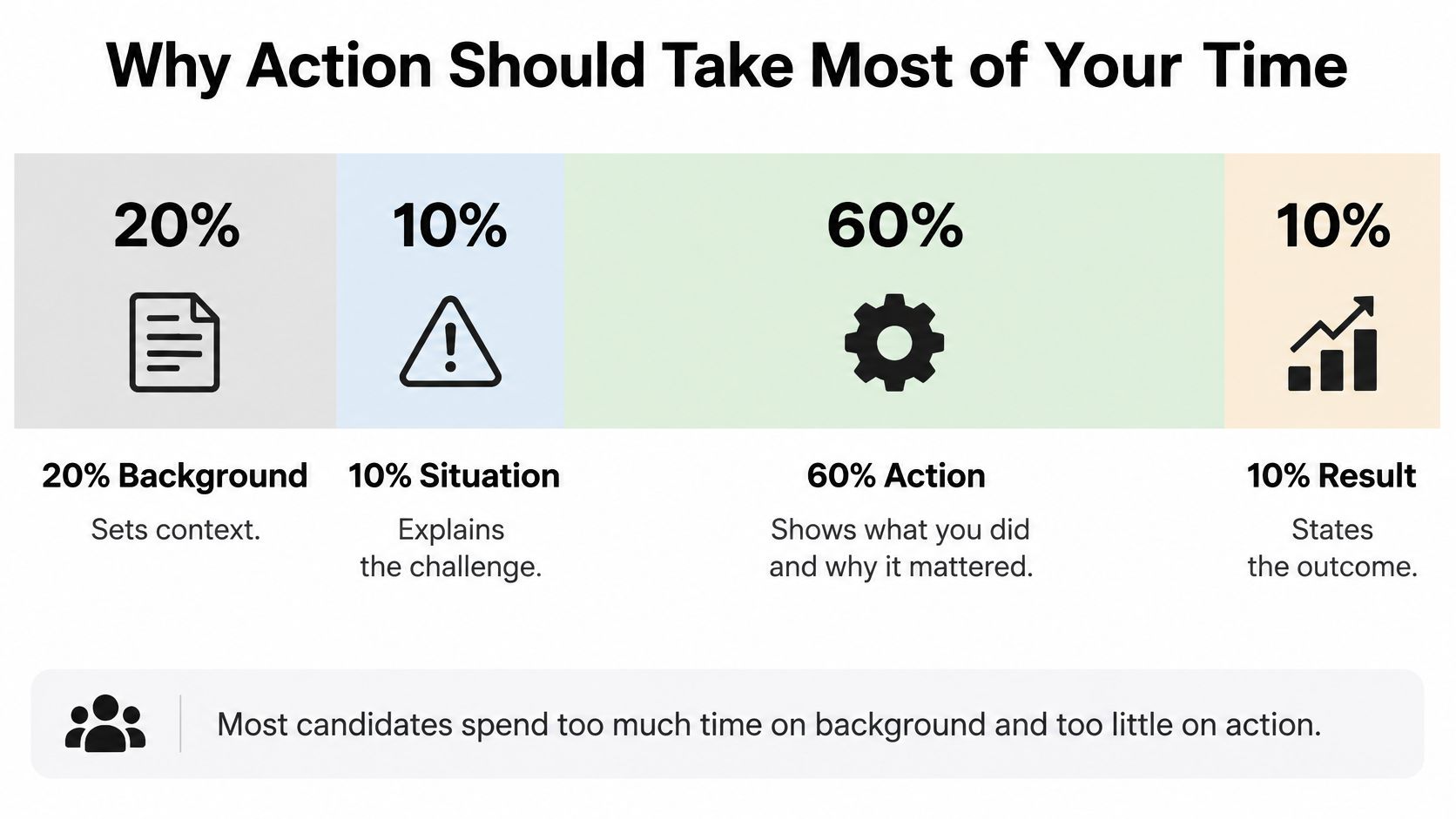
| Part | Share of time | 60 seconds | 90 seconds | 120 seconds |
|---|---|---|---|---|
| Situation | 20% | 12 | 18 | 24 |
| Task | 10% | 6 | 9 | 12 |
| Action | 60% | 36 | 54 | 72 |
| Result | 10% | 6 | 9 | 12 |
Treat that split as the default, not a cage. A metric-heavy role may justify a few extra seconds on Result. One variant from Interview Practice Lab's STAR breakdown uses approximately 10% Situation, 10% Task, 60% Action, and 20% Result, which gives a 90 second answer about 9, 9, 54, and 18 seconds respectively.
What belongs in Action
Name the sequence, rationale, tools, and constraints. Say what you checked first, what you rejected, and why you chose the path you took. Draw a clean line between your work and the team's work.
If a sentence describes what the team or company did rather than what you did, cut it or rewrite it around your decision.
How to Trim a Long Answer Without Losing Evidence
Trim in a fixed order so you don't delete the proof by accident. The common slip is cutting Action first because it contains detail. That's backwards. Context is compressable. Your decisions usually aren't.
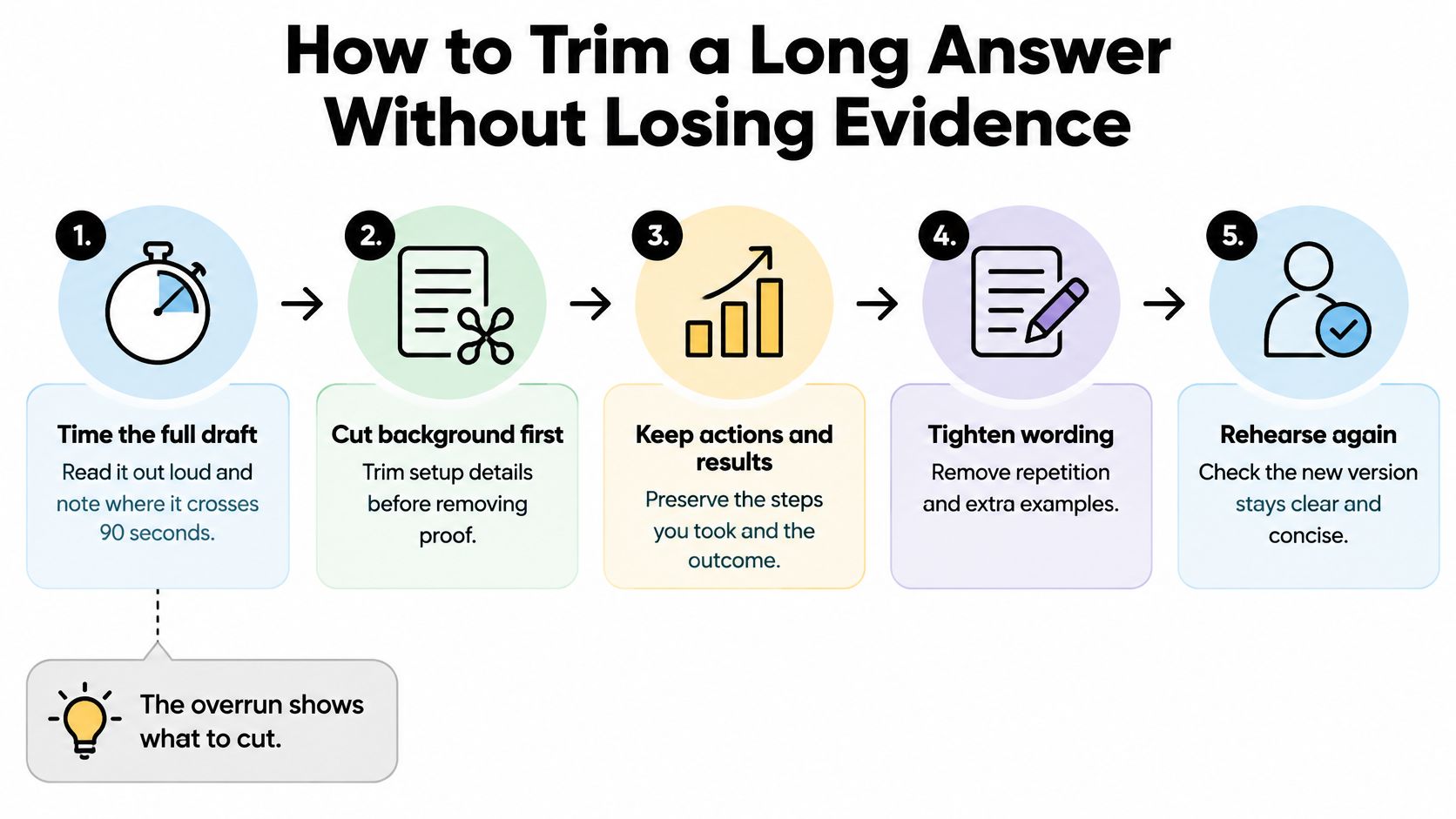
- Time the full draft aloud: Note where you cross 90 seconds. The part still running at that mark usually shows where the overrun started earlier.
- Reduce Situation to one or two sentences: Keep only the context needed to understand the challenge. Names, dates, org charts, and project history go first.
- Rewrite Task as one sentence: State the goal you owned. If your responsibility isn't clear in one sentence, the Action section will sound like a team summary.
- Keep decision-bearing Action steps: Merge repeated steps and delete team-level activity. Preserve the steps that show judgment, execution, and how you handled a constraint.
- Replace a vague outcome: Use one number or observable change, then add one lesson in a single sentence if it helps the competency being tested.
- Stop after the Result: Let the interviewer ask for depth. Extra explanation after a clear ending dilutes the point you just made.
This order follows a clear allocation from Orecci's STAR method speaking guide, which targets approximately 90 to 120 seconds, or about 200 to 250 spoken words, with only 15 to 30 seconds for Situation and Task combined, roughly 60 to 75 seconds for Action, and 15 to 30 seconds for a quantified Result and concise lesson. It also advises stopping after the result because extending beyond two minutes increases the chance of burying the competency signal in operational detail.
Retime before you rewrite again
Say the trimmed version once at normal pace. Don't judge it while reading. You're checking whether the cause and effect chain survives: problem, responsibility, intervention, outcome.
- Simple example: About 60 seconds can work if the action evidence stays intact.
- Complex example: Land between 90 and 120 seconds.
- Still over two minutes: Cut more setup before touching Action or Result.
A shorter answer isn't automatically weaker. It becomes weaker only when trimming removes the evidence that separates your performance from team activity. Protect the verbs attached to I decided, I tested, I built, I negotiated, and I changed. Those sentences earn their seconds.
Diagnose the Five Length Mistakes
Don't assume a weak answer needs a better story. Often it needs a better sequence. The facts may be strong, but they're arriving in the wrong order or carrying the wrong weight.
Background runs too long is the most frequent problem. You explain the product, the team, and the history, and the interviewer still doesn't know your role. Cap the setup at two sentences and move.
Action becomes a team story is next. Every sentence starts with "we," so nobody can tell who made the call. Rewrite around your decisions and tools, even when others helped execute them.
The result is missing or vague leaves impact unproven. "It went well" doesn't close an answer. Add one number, one observable change, or one concrete consequence.
| Common mistake | What it costs | Trim step |
|---|---|---|
| Background runs past 30 seconds before the action | Interviewer loses sight of your role | Step 2: cap Situation at two sentences |
| Action told as a team story with we throughout | Competency signal stays unclear | Step 4: name your own decisions and tools |
| Result is missing or vague | Impact is unproven | Step 5: add one number or observable change |
| Answer keeps going after the result | Core evidence gets buried | Step 6: stop after the result and wait |
| Under 60 seconds with several extra details | Depth disappears | Keep one strong action and drop the rest |
Continuing after the result is a quieter mistake. You land the outcome, then add caveats, extra context, and a second ending. Stop. A pause gives the interviewer room to probe what matters.
Rushing a packed answer creates the opposite problem. You squeeze several small actions into under a minute and none of them gets enough room to prove judgment. Keep one strong action line and drop the rest. Brevity helps only when the surviving detail is the right detail.
Adjusting Length for Panels and Video Interviews
A fixed script can backfire when several interviewers, captions, interpreters, or video delays are involved. Long context raises cognitive load and makes turn-taking harder, especially when people can't interrupt cleanly.
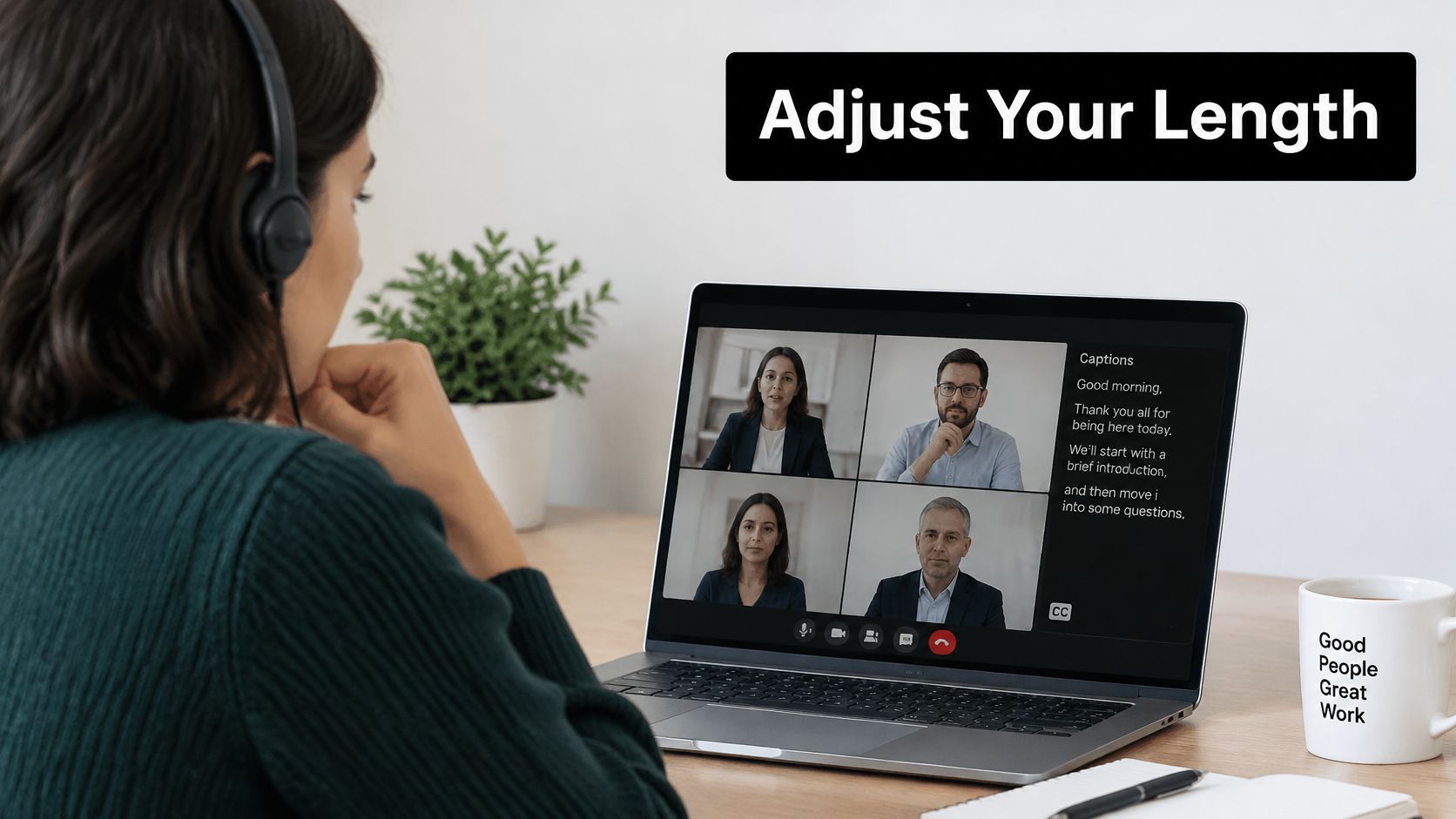
Use an adaptive structure instead. The UN Jobnet STAR method guide supports leading with a 10 to 20 second headline, providing a compact STAR version, and pausing before optional detail because a fixed 90 to 120 second script can increase cognitive load and make turn-taking harder with several interviewers, interpreters, captions, or video delays.
Three formats, three adjustments
- Panel interview: Address the person who asked, give the headline and compact version, then pause. Let follow-up questions carry the extra detail.
- One-way video: Rehearse a complete answer under two minutes so a platform cap doesn't cut off your Result.
- Second language or extra processing time: Use shorter sentences and clear pauses between the four parts. Don't speed up to meet a stopwatch.
Watch this example with the headline method in mind, and notice where a natural pause would let an interviewer redirect you.
Fairness matters here. A concise answer still has to show your own contribution. Shorten Situation and Task first, never Action or Result, and keep the modular detail ready if someone asks for it.
Practice Timed STAR Answers Before Your Interview
Set the target before you rehearse: 90 to 120 seconds for complex questions, about 60 seconds for simple ones. Deciding story by story in the room leads to drift, so make the shape automatic before you walk in.
Pick five stories covering leadership, conflict, failure, initiative, and a technical problem. Write each in three lengths: a 15 second headline, a 45 to 60 second short version, and a 90 to 120 second full version. The headline works like a trailer: it gives the interviewer a natural point to redirect you if they want a different angle. Say every version aloud against a timer. Speaking exposes tangled sentences that a silent read hides.
Now check the density. In each full version, roughly 60 percent of the seconds should sit on your own actions. A 120-second answer gives Action about 70 seconds, so if Situation and Task together pass 40 seconds, your evidence is being crowded out by context. Log each timing and trim anything that drifts past two minutes. A phone recording works well for this. A mock interview practice tool goes further: you practice out loud against an AI interviewer that answers back, then read the transcript and count where your seconds went. The first mock interview is free.
If your interviews are on video, your on-screen image carries part of the message too. business headshot advice can sharpen the photo on your applications so it matches the presence you bring on camera. The clock still comes first. Time your five stories this week and cut any that run past 120 seconds.
Keep that discipline after rehearsal ends. ParakeetAI offers mock interviews where you can rehearse out loud and review what you said, so you arrive with answers that fit the clock and prove your contribution.