
Engineering Intern Interview Questions: 2026 Guide
You've reviewed your coursework, polished your résumé, and built projects you can explain. Then the interviewer asks you to introduce yourself, and you freeze. You start listing classes, lose track of your point, and spend the next question thinking about how badly the opening went.
That's a preparation problem, not proof that you can't do engineering work. Engineering intern interviews aren't about delivering perfect answers. Interviewers need to understand how you communicate, reason through uncertainty, and respond when another person challenges your approach.
The opportunity matters beyond the placement itself. Employers extended full-time offers to an average of 62% of their 2024 interns, according to the NACE 2025 Internship & Co-op Report.
Prepare for the decision behind the question, not just the words the interviewer uses.
The same distinction appears in discovery conversations: ten questions to qualify technical deals are useful because of what the answers reveal, not because asking them completes a script.
These eight engineering intern interview questions pair that underlying evaluation with an answer structure, mistakes to avoid, and a follow-up to rehearse aloud. The technical examples lean toward software engineering, while the project, debugging, motivation, and teamwork structures also work for mechanical, electrical, and other engineering roles.
1. Tell me about yourself
What the interviewer is evaluating: Can you select relevant information, explain your technical direction, and give them a useful starting point for the conversation?
Your introduction should sound like a focused professional summary, not a narrated résumé. Start with what you're studying or building now, connect it to relevant experience, and finish with why this internship makes sense.

Use present, past, and future
- Present: State your engineering focus and the kind of work that interests you.
- Past: Choose a relevant project and explain what you personally contributed.
- Future: Connect that experience to work described in the internship posting.
For example, a computer engineering student applying for embedded work could introduce their interest in hardware-software integration, describe writing sensor-reading firmware for a rover, and explain that they want to develop their testing skills on physical devices. That gives the interviewer technical material to explore without requiring a complete project history.
Mistake to avoid: Don't lead with an apology about having no professional experience. Coursework, lab work, student teams, and personal projects are legitimate evidence when you explain your contribution accurately.
Practice with a recording, a friend, or a mock interview. Listen for unexplained acronyms, repeated background details, and an ending that trails off rather than connecting to the role.
Follow-up to rehearse: Which part of that project did you find most interesting, and why?
A strong opening leaves room for that follow-up. You don't need to squeeze every accomplishment into your introduction.
2. Why do you want this internship?
A company's reputation isn't enough of an answer. The interviewer is evaluating whether you understand the work, have a credible reason to pursue it, and can connect your learning goals to something useful for the team.
Start with a specific detail you can verify: a product feature, engineering article, open-source repository, or responsibility in the job description. Explain why that detail interests you technically, rather than repeating the company's marketing language.
Connect interest to contribution
Use this answer skeleton:
- The work: Identify a concrete problem the team appears to address.
- Your connection: Explain the project, course, or technical interest that makes it relevant.
- Your contribution: Name something you could help with while learning.
- Your growth: Describe a skill you want to develop through that work.
Say you're applying to a team building scheduling software. You could connect your database coursework and booking-app project to an interest in handling conflicting updates, then explain that you'd like to learn how engineers test those situations in a shared codebase.
That's stronger than saying you want exposure to cutting-edge technology. It gives the interviewer something specific to discuss and lets you show curiosity without pretending to know the team's internal architecture.
Mistake to avoid: Don't turn the answer into a list of benefits you expect. Mentorship matters, but pair what you hope to learn with work you're prepared to attempt.
Follow-up to rehearse: What would you want to understand about our product before starting a task?
Prepare an honest answer about users, constraints, or failure consequences. Don't invent familiarity with a product you haven't used.
3. Walk me through a project you built
Ownership matters more than a complicated technology stack. The interviewer wants to know whether you understand the problem, can defend your decisions, and can separate your contribution from the team's work.
Technical hiring assesses more than implementation alone. A study in ACM Transactions on Computing Education identifies programming, testing, databases, data structures, and software-development knowledge among the areas employers assess.

Explain a decision, not just a feature list
Build your answer around problem, approach, personal contribution, result, and revision. Name the constraint that shaped your approach, such as limited hardware, unreliable input, a deadline, or unfamiliar tooling.
For a rover project, explain that the robot needed to stop when sensor readings became unreliable. Describe the filtering or validation you implemented, how you tested it, and what happened under noisy conditions. Then identify what you'd change, perhaps separating sensor acquisition from control logic to make failures easier to isolate.
A useful trade-off might be choosing a simple rule-based controller because you could test its behavior reliably. A more advanced method isn't automatically better if you can't validate it within the project's constraints.
Mistake to avoid: Don't claim performance improvements you didn't measure. If your evidence was a successful demonstration or a reproducible test, say that precisely.
Ownership rule: Use “we” for the shared objective and “I” for the decisions, implementation, and testing you personally handled.
Follow-up to rehearse: What would break first if the project had to handle a substantially larger workload?
4. Describe a difficult bug you debugged
A debugging answer should show how you reduced uncertainty, not how long you stared at the code. The interviewer is evaluating your ability to reproduce a failure, test explanations, ask for useful help, and verify a fix.
In a scenario involving intermittent duplicate records, changing the database library immediately would be a guess. A stronger approach starts by capturing the request sequence and checking whether the application submitted the same operation again after a timeout.

Walk through the evidence
- Symptom: Explain what failed and what you expected instead.
- Reproduction: Describe the input, environment, or sequence that exposed it.
- Investigation: Name the hypotheses you tested and the evidence that ruled them out.
- Resolution: Explain the root cause, fix, and regression test.
For the duplicate-record scenario, a retry after an uncertain response might reveal that the operation wasn't idempotent. Your answer should distinguish preventing a duplicate request in the interface from making the server handle repeated requests safely.
Mistake to avoid: Don't describe random edits as a debugging strategy. Changing unrelated variables makes it difficult to know why the behavior changed.
A study of software-engineering interviews describes technical problem-solving and explanation as intertwined parts of the assessment. Make your investigation visible rather than jumping directly from symptom to solution.
Follow-up to rehearse: What would you do if you couldn't reproduce the failure locally?
Discuss useful logs, environment differences, sanitized inputs, and a focused request for help. Don't imply that access to production data is automatically appropriate.
5. Explain the time and space complexity of your solution
The interviewer is evaluating whether you understand the cost of your algorithm. Naming Big O notation isn't enough. You need to explain what grows, which operations repeat, and what assumptions your analysis depends on.
Start by defining the input. If n is the array length, say so before describing the work. Then separate runtime from auxiliary space, meaning additional storage beyond the input.
Reason from operations
Use this answer skeleton:
- Baseline: Describe the straightforward algorithm and its dominant work.
- Time: Explain how often the expensive operations execute.
- Space: Identify temporary collections, copied data, or recursive stack frames.
- Trade-off: Explain what an optimization saves and what it costs.
For example, checking every distinct pair in an array takes O(n²) time and can use O(1) auxiliary space. Tracking previously seen values with a hash map can give expected O(n) time while using O(n) auxiliary space, assuming expected constant-time map operations.
These are algorithmic properties you should derive from the implementation, not benchmark claims. Explain why they hold rather than reciting them.
Mistake to avoid: Don't count visible loops without examining their bodies. A membership check on a list can require scanning the list, so apparently simple code can still perform repeated linear work.
Also check whether your language creates copies through slicing or allocates a sorted result. Those details can change the space analysis.
Follow-up to rehearse: Would you still choose this approach if memory were tightly constrained?
A useful answer might favor an in-place approach or sorting, but it should acknowledge whether input mutation is permitted and whether original indices must be preserved.
6. Two Sum (hash map problem)
Given an array and a target, return the indices of distinct elements whose values add to that target. This question tests whether you can clarify requirements and exchange memory for faster lookup.
Before coding, ask whether duplicates are allowed, whether a valid pair is guaranteed, and what to return when no pair exists. Confirm that the interviewer wants indices rather than the values themselves.
Explain the improvement before implementing it
The brute-force approach checks pairs. The hash-map approach instead asks whether the complement of the current value has already appeared.
- Compute the complement: Subtract the current value from the target.
- Check previous values: Look for that complement in the map.
- Return distinct indices: Use the stored index and the current index when a match exists.
- Store afterward: Add the current value only after checking, so the element cannot match itself.
For a duplicate-value case where the target equals twice that value, the earlier occurrence belongs in the map before the later occurrence is processed. That explains why duplicates can work without reusing an index.
A remembered solution is fragile unless you can explain why the order of its operations matters.
Mistake to avoid: Don't start typing before settling the return contract. Returning an empty collection, a sentinel, or an error are different interface choices.
Test empty and single-element inputs, negative values, duplicate values, and a pair separated across the array. Broaden your practice with related lookup and counting tasks; Adaface's software-engineer-intern question set also covers data structures, APIs, object-oriented programming, and debugging.
Follow-up to rehearse: How would your approach change if the interviewer wanted every valid pair?
7. Explain what happens when you type a URL into a browser
The interviewer is evaluating breadth and organization, not asking you to recite every networking detail. Start with the main stages, then let the interviewer choose where to go deeper.
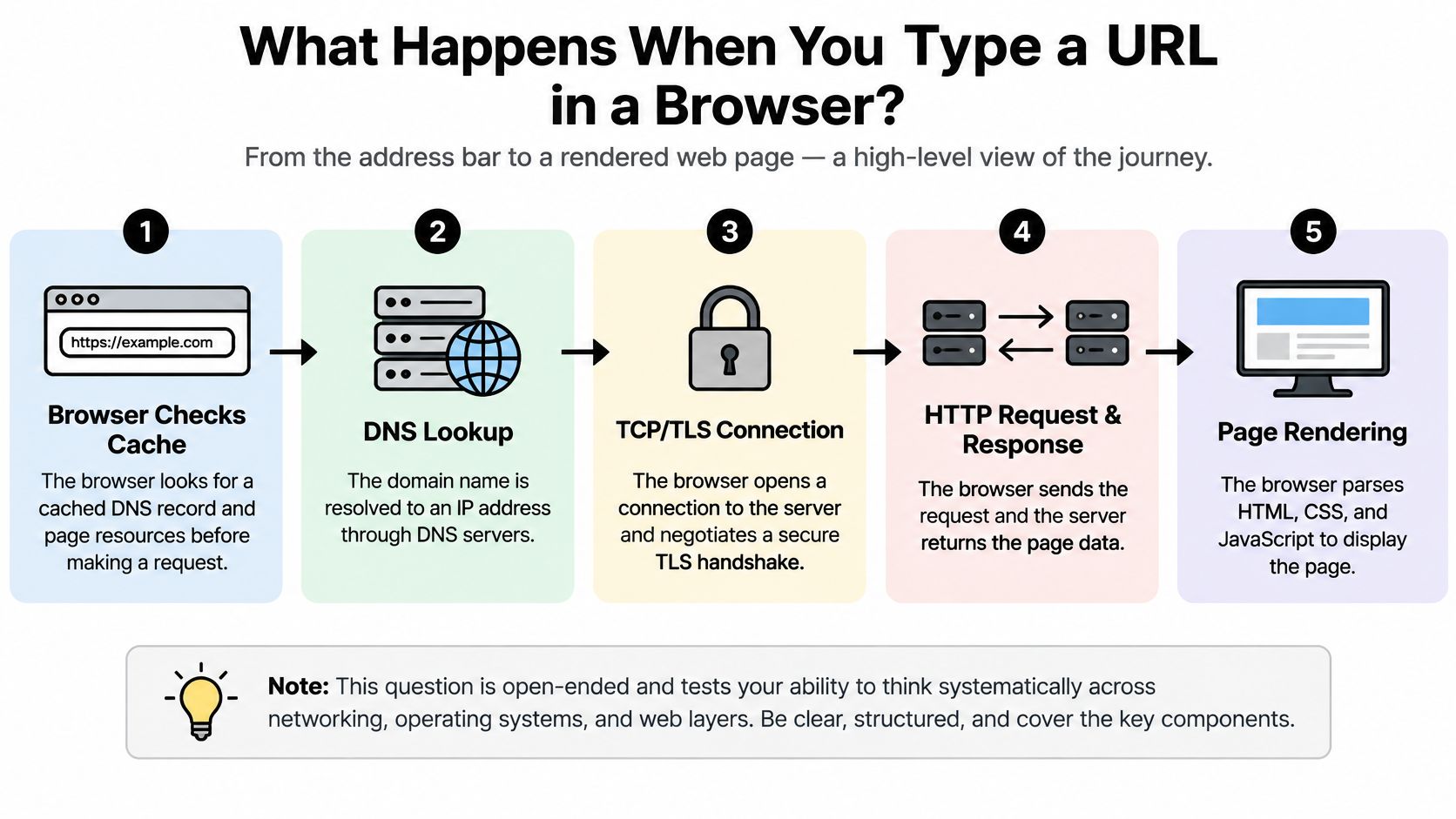
For a typical HTTPS navigation, explain that the browser interprets the URL, checks relevant caches, resolves the hostname when needed, establishes a connection, exchanges HTTP messages, and renders the response. State that connection reuse and protocol choices can alter the path.
Use this diagram to organize the explanation before adding exceptions.
Distinguish the stages
Your answer skeleton is address interpretation, name resolution, connection security, HTTP exchange, and rendering. For an uncached page, DNS helps find an address, the browser establishes the appropriate transport and secure session, and the server responds to the request.
For HTTP over TCP, discuss TCP connection establishment and TLS for HTTPS. Don't claim every modern HTTP connection uses TCP, because HTTP/3 uses QUIC.
Rendering then involves parsing HTML, obtaining referenced resources, applying CSS, and executing JavaScript as needed. Browser caching can avoid downloading reusable resources, while DNS caching can avoid repeating name resolution.
Mistake to avoid: Don't confuse DNS with fetching the page, or imply that a server always returns a complete rendered interface. Some applications retrieve additional data after the initial document loads.
This video offers another way to rehearse the request sequence.
Follow-up to rehearse: The page loads, but its styling is missing. Where would you investigate?
Start with the browser's Network and Console panels, checking stylesheet requests, response status, content types, and policy errors.
8. Tell me about a time you worked in a team and disagreed with someone
The strongest answer isn't a story about winning an argument. The interviewer is evaluating whether you can disagree productively, understand another engineer's constraints, and support a decision after the discussion ends.
Teamwork is a substantive hiring concern: 85% of employers look for teamwork skills on candidates' résumés, according to NACE's candidate-selection guidance.
Use STAR without making it sound rehearsed
The Arizona State University engineering interview guide recommends organizing experience-based answers through Situation, Task, Action, and Result. Keep the background brief and spend most of your answer on what you did.
- Situation and task: Explain the shared objective and the technical disagreement.
- Action: Describe how you understood the other person's concern and compared alternatives.
- Result: State the decision, its consequences, and what you learned.
Suppose a teammate wanted to adopt a new framework while you preferred extending the existing implementation. A useful response would compare compatibility, test effort, delivery risk, and maintainability, then propose a small prototype if the uncertainty justified it.
Explain how the team made the decision. If your preferred option wasn't selected, describe how you helped implement and validate the chosen approach.
Mistake to avoid: Don't disguise criticism as a teamwork story. Describing a teammate as careless or incapable leaves the interviewer wondering how you'll discuss future colleagues.
It's fine if the outcome was imperfect. A clear explanation of what you'd change is more credible than claiming that everyone immediately agreed.
Follow-up to rehearse: What would you do if you still believed the final decision created a safety or reliability risk?
Distinguish ordinary technical disagreement from a concern that needs documentation and escalation.
How the 8 Engineering Intern Interview Questions Compare
| Item | Question Type | When It Usually Comes Up | Core Skill Tested | Common Pitfall |
|---|---|---|---|---|
| Tell me about yourself | Introductory behavioral | Usually first, as a warm-up | Communication and prioritization | Rambling or giving a generic answer |
| Why do you want this internship? | Motivation and fit | When assessing interest in the role and company | Research and alignment | Offering vague praise or focusing only on what you hope to gain |
| Walk me through a project you built | Project deep dive | When exploring past technical work | Technical depth, ownership, and communication | Overcomplicating the explanation or obscuring your contribution |
| Describe a difficult bug you debugged | Behavioral and technical | When assessing problem-solving and debugging | Systematic diagnosis and persistence | Choosing a trivial bug or blaming others |
| Explain the time and space complexity of your solution | Algorithm analysis | During or after a coding exercise | Efficiency analysis and trade-off reasoning | Stating complexity without justification or missing auxiliary space |
| Two Sum (hash map problem) | Coding problem | Commonly as a coding-round warm-up | Problem decomposition and hash map use | Memorizing the solution without understanding edge cases |
| Explain what happens when you type a URL into a browser | Systems and web concepts | Often in software or web engineering interviews | Structured reasoning across networking and web layers | Losing focus or explaining one stage in excessive detail |
| Tell me about a time you worked in a team and disagreed with someone | Behavioral | When assessing collaboration and conflict resolution | Listening, compromise, and professionalism | Blaming a teammate or leaving out the resolution |
Turn These Answers Into Your Own Story
Memorized answers break when an interviewer changes the premise. Rehearsed structures adapt because you understand which evidence belongs in the answer and why it matters. You can shorten the background, expand a technical decision, or acknowledge a limitation without losing your direction.
Pick three questions from this list: an introduction, a technical explanation, and an experience-based question. Write a bullet skeleton for each rather than a paragraph you'll try to recite. Use project names, actual decisions, and outcomes you can defend.
Practice for clarity, then add pressure
- Answer aloud: Speak from the skeleton without reading complete sentences.
- Record yourself: Check whether you reach the main point promptly and explain unfamiliar terms.
- Add the follow-up: Have a partner challenge an assumption or ask why you rejected another approach.
- Repair the weak spot: Review the relevant code, calculation, or project notes before repeating the answer.
When reviewing the recording, ask whether someone could distinguish your contribution from the team's result. Check whether you explained the reason behind a decision rather than merely naming a tool. Remove background details that don't help the listener understand your actions.
You don't need a tool to do this. A voice recorder and a patient practice partner are enough. ParakeetAI's Mock Interview offers practice out loud against an AI interviewer, followed by a transcript you can review; its Question Bank lists real interview questions grouped by company and ranked by how often they come up.
Keep practice separate from assessment
Preparation tools and live interview assistance are different activities. A UK parliamentary evidence submission on AI in recruitment identifies undisclosed or unpermitted AI use during interviews as a recruitment-misconduct concern.
Before an assessment, clarify whether documentation, autocomplete, coding assistants, or other aids are permitted. If the rules are unclear, ask about the specific tool and activity rather than assuming general permission. Never present generated reasoning as an unaided demonstration of your own ability.
Your final rehearsal should include getting stuck. State what you know, identify the uncertainty, and propose a useful next step. That response gives an interviewer evidence of how you'll work when a task isn't fully specified and the answer isn't immediately available.
ParakeetAI offers mock interviews for spoken practice and a Question Bank organized by company to help you prepare for engineering intern interview questions. Visit ParakeetAI to rehearse a project explanation, review your transcript, and identify which reasoning needs a clearer explanation.