
7 Tax Interview Question Examples and Model Answers

You've reviewed the tax rules, refreshed your notes, and opened the interview call feeling prepared. Then the interviewer asks you to explain a deduction versus a credit to a client, and your answer becomes more complicated than the concept itself. You know the material, but explaining it under pressure is a different skill.
Interviewers return to foundational questions because they reveal more than recall. They listen for technical fluency, professional judgment, and clear communication, especially when a follow-up changes the facts. In a global survey, Deloitte found that data analytics was the most requested emerging capability among surveyed tax and finance leaders, at 45%. Knowing the rule matters, but so does explaining how you'd apply and verify it.
The useful preparation habit is to practice a conversation, not memorize a paragraph. That's also sound advice when you prepare for coding interviews: explain your reasoning, identify assumptions, and respond when the problem changes.
These seven tax interview question examples move from deductions versus credits to economic nexus. Each includes an answer structure, a difficulty signal, and a follow-up to rehearse. The examples lean toward U.S. tax practice, with jurisdictional caveats where applying a familiar rule too broadly would weaken your answer.
1. What is the difference between a tax deduction and a tax credit?
Difficulty signal: Foundational. The challenge isn't remembering the definitions. It's explaining them accurately without burying the listener in exceptions.
A deduction reduces taxable income. A credit reduces the tax liability itself. For a straightforward explanation of that distinction, understanding tax credits versus deductions is a useful preparation reference.
Model answer structure
Start with the mechanism, demonstrate the arithmetic, and finish with refundability. Use this hypothetical example: a $1,000 deduction at a 22% marginal rate saves $220, assuming the entire deduction reduces income taxed at that rate. A $1,000 credit reduces tax by $1,000, assuming the taxpayer qualifies and can use the full credit.
A second comparison helps if the interviewer changes the figures: a $5,000 deduction at a 24% marginal rate saves $1,200, while a $1,200 usable credit reduces liability by $1,200. These are illustrative calculations, not statements about a particular taxpayer's eligibility.
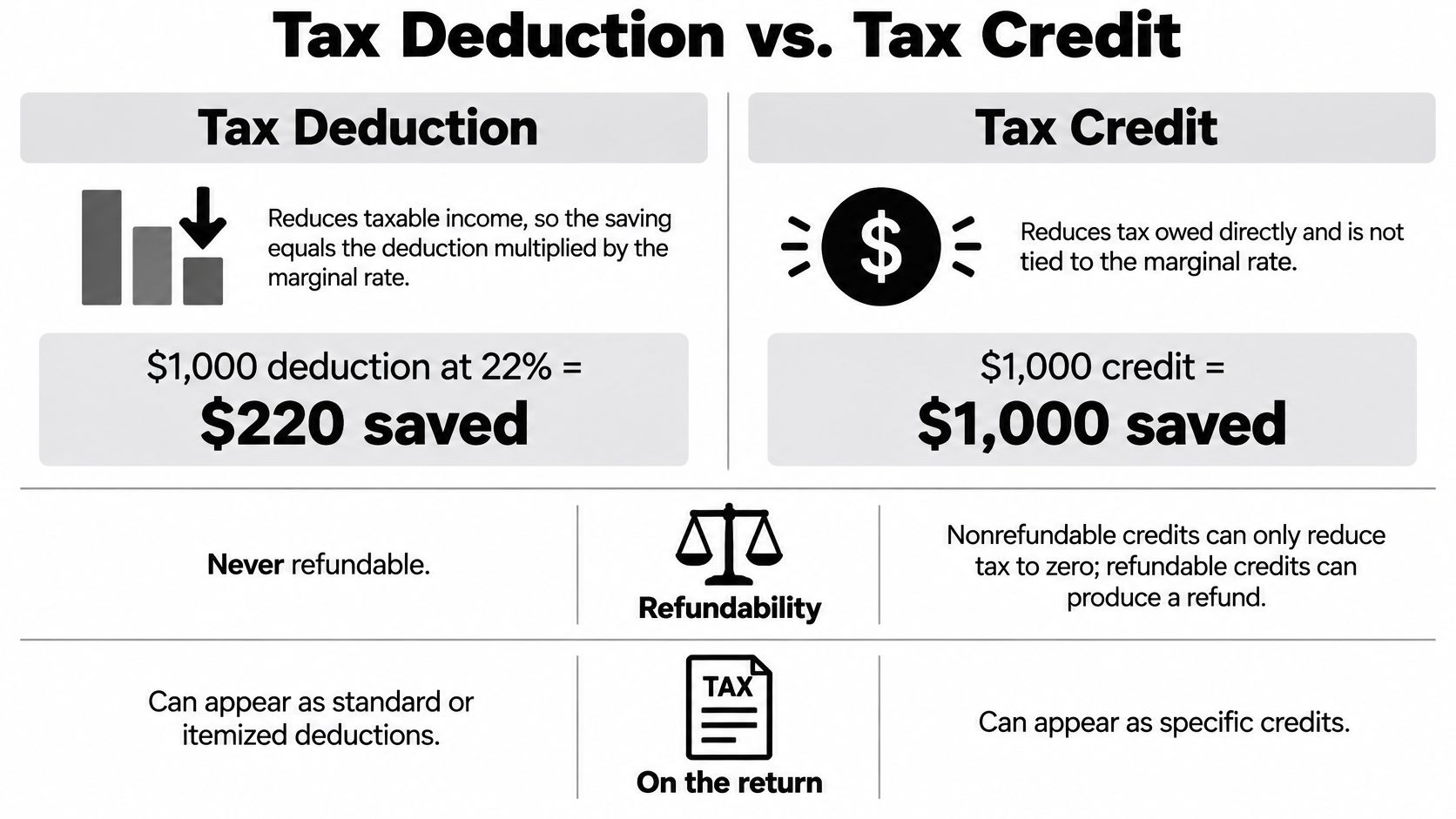
Follow-up to expect: Can a credit produce a refund? Explain that refundable credits can exceed the taxpayer's liability, subject to their rules; the Earned Income Tax Credit is a familiar U.S. example. Nonrefundable credits generally can't reduce liability below zero, although particular credits may have carryover provisions.
Practical rule: Deductions aren't themselves refundable, but a deduction can still increase a taxpayer's refund by reducing the final liability.
Don't say credits always deliver their face value regardless of circumstances. Eligibility, limitations, and refundability still matter. Practice this explanation through spoken interview rehearsal, keeping the distinction clear before adding exceptions.
2. What is the difference between tax avoidance and tax evasion?
Lawful planning and deliberate concealment aren't interchangeable. This question tests whether you can recognize the boundary and maintain it when a client pushes for a favorable answer.
Difficulty signal: Foundational definition, intermediate judgment. A candidate who stops at legal versus illegal hasn't yet demonstrated how they'd handle a questionable transaction.
Build the answer around conduct
Explain that tax avoidance means arranging affairs lawfully to reduce tax, while tax evasion involves deliberate misrepresentation or concealment to escape tax. Using an available tax-deferred retirement arrangement can be lawful planning; hiding business cash receipts is a clear evasion scenario.
Then address aggressive planning. A transaction isn't necessarily defensible because someone can describe a technical route to a deduction. Depending on the jurisdiction, general anti-abuse rules or an economic substance doctrine may challenge arrangements that don't satisfy the applicable requirements.
- Clarify the facts: Ask what happened, who benefited, and what commercial purpose supported the transaction.
- Check the authority: Identify the relevant law, disclosure obligations, and anti-avoidance provisions.
- Set the boundary: Decline to assist with a misleading filing and escalate unresolved concerns through the appropriate professional channels.
Follow-up to expect: What if the client insists everyone does it? Explain that other taxpayers' behavior doesn't establish a supportable filing position. You'd describe the exposure, explain lawful alternatives, and document your advice rather than negotiate away accuracy.
A useful scenario is a proposed transaction designed solely to generate a tax loss. Don't immediately declare it invalid under every country's law; explain which business-purpose and substance requirements you'd investigate.
The strongest answer stays calm. Interviewers need evidence that you can protect professional standards without becoming accusatory or giving an unsupported guarantee.
3. How would you determine whether a worker is an employee or an independent contractor?
Say a business calls someone a freelancer, but the person works fixed shifts, follows a manager's instructions, and uses company equipment. The contract label alone doesn't settle the classification.
Difficulty signal: Intermediate and fact-dependent. Interviewers listen for a structured investigation, not a shortcut based on invoices, payment frequency, or the worker's preference.

Organize the evidence before reaching a conclusion
For a U.S. federal tax discussion, structure your answer around behavioral control, financial control, and the nature of the relationship. Ask who directs the work, who provides equipment, whether the worker can experience a profit or loss, and whether the relationship is ongoing.
Contrast that with an independent consultant who sets their schedule, provides their own equipment, negotiates project terms, and serves unrelated clients. Those facts support an independent-business pattern, but they aren't a universal safe harbor.
- Gather records: Review the agreement, actual working practices, payment arrangements, and communications.
- Apply the right test: Federal tax, state employment, wage-and-hour, and foreign rules may differ.
- Document the conclusion: Record supporting facts, contrary evidence, and unresolved questions.
Follow-up to expect: What if the contract says contractor but actual practice suggests employee? Explain that you'd analyze the actual relationship under the applicable rules, rather than accept the label. Where uncertainty remains, consider specialist advice or an available official determination process.
A confident classification without a jurisdiction and a fact record is less persuasive than a provisional conclusion supported by evidence.
Don't recommend changing paperwork alone. If the business wants a different classification, the working relationship may need to change, and the proposed arrangement still needs review under the relevant law.
4. What is the difference between cash-basis and accrual-basis accounting for tax purposes?
Difficulty signal: Foundational mechanics, intermediate application. A good answer distinguishes timing clearly, then acknowledges that tax recognition rules can modify the accounting shorthand.
Under the cash method, income is generally reported when received and expenses when paid. Under the accrual method, income is generally recognized when earned and expenses when incurred, subject to the applicable tax requirements.
Walk through an invoice
Consider a consultant who invoices $10,000 in December and receives payment in January. In this simplified example, cash-method recognition generally falls in January; accrual-method recognition generally falls in December if the relevant recognition requirements were satisfied then.

Explain why this matters: the method affects when taxable income arises, not just how the invoice appears in the bookkeeping system. Don't imply that sending an invoice always establishes accrual recognition or that delaying a bank deposit necessarily delays cash-method income.
Follow-up to expect: Can the business switch methods to reduce this year's tax? Your answer should distinguish a permitted method change from opportunistically mixing methods. Method changes usually require a formal process or approval, and transition adjustments may be necessary.
- Check eligibility: Verify current gross-receipts thresholds and any restrictions relevant to the entity and activity.
- Review special items: Inventory, advance payments, prepaid expenses, and related-party transactions may require additional analysis.
- Reconcile the records: Explain how you'd connect the general ledger to the tax computation.
A small retailer may be eligible for the cash method, while a larger manufacturer may face accrual requirements. Avoid treating those business descriptions as definitive rules; the applicable jurisdiction, eligibility tests, and accounting provisions control.
5. How do passive activity loss rules limit the use of losses?
A rental property has generated a loss, and the taxpayer wants to deduct it against salary. Your first response shouldn't be an automatic yes or no: classify the activity and test the applicable limitations first.
Difficulty signal: Intermediate to advanced U.S. individual tax. Interviewers want you to distinguish participation concepts, recognize suspended losses, and avoid treating every rental loss identically.
Explain the restriction and the timing
Under Section 469 of the U.S. Internal Revenue Code, passive activity losses generally offset passive income rather than wages or portfolio income. Disallowed losses are generally suspended and carried forward, subject to the relevant rules.
A passive business activity generally involves a taxpayer who doesn't materially participate. Rental activities are generally passive, subject to exceptions; active participation is a different, less demanding concept associated with the limited rental real estate allowance.
Consider a simplified rental scenario with a $12,000 loss, no passive income, and no applicable exception. The loss is generally suspended rather than deducted against wages immediately, assuming other loss limitations have also been considered.
Follow-up to expect: When can the taxpayer use the suspended loss? Discuss future passive income and a qualifying disposition, rather than promising that any sale automatically releases every loss. The transaction's form and the remaining statutory conditions matter.
- Rental allowance: Active participation may permit a limited allowance, subject to income limits and other conditions.
- Real estate professional rules: Meeting the statutory requirements can change the analysis, but material participation still matters.
- Other limitations: Basis and at-risk restrictions may also affect deductibility.
Interview distinction: A suspended loss is a timing issue, not necessarily a permanently lost deduction.
Don't quote participation-hour tests or income limits from memory unless you've verified them. Explain that you'd review current IRS guidance, participation records, prior-year suspended-loss schedules, and any relevant elections before finalizing the return.
6. What is the arm's length principle in transfer pricing?
Related companies should price their transactions as independent parties would under comparable circumstances. Lead with that sentence before naming methods or documentation files.
Difficulty signal: Intermediate international tax, advanced when comparables are imperfect. The interviewer is testing whether you can move from a principle to a defensible analysis.
For example, a parent company sells goods to a subsidiary below the price charged to unrelated customers. That difference warrants investigation, but it doesn't automatically prove the transfer price is wrong: volume, contractual terms, market conditions, and functions may explain it.

Move from principle to method
Structure the model answer around the transaction, the functional analysis, the method, and the supporting evidence. Identify what each entity does, which assets it uses, and which risks it controls before deciding how to test the pricing.
Name the comparable uncontrolled price method and transactional net margin method, but explain why you'd choose between them. A direct price comparison can be compelling when reliable comparables exist; a margin-based method may be more appropriate when direct price comparability is weak.
Follow-up to expect: What would you do if there are no exact comparables? Explain the search strategy, comparability adjustments, method selection, and limitations. Don't manufacture precision or suggest that a database output replaces judgment.
The OECD Transfer Pricing Guidelines are a common international reference, but domestic law and local documentation requirements still control. A master file and local files may support the analysis where required or appropriate.
Communication matters here: EY reports that 78% of surveyed tax and finance leaders cite communication and collaboration as important for future tax professionals. Translate your technical conclusion into the business decision, documentation needed, and remaining uncertainty.
7. What is economic nexus, and why does it matter for state sales tax?
Physical nexus arises from an in-state physical connection; economic nexus can arise from economic activity without that physical presence. Start with the distinction, then explain how you'd assess a seller's obligations.
Difficulty signal: Intermediate multistate compliance. The challenge is recognizing that nexus, product taxability, and collection responsibility are separate questions.
Turn the definition into a compliance process
For U.S. sales tax, South Dakota v. Wayfair in 2018 established the basis for requiring collection without the previously required physical presence. Many states adopted economic nexus rules tied to sales volume or, in some cases, transaction counts, but current requirements must be checked state by state.
Consider an online seller with no employees or premises in a state but substantial sales to customers there. You'd investigate whether it has crossed the state's applicable threshold, how that state measures sales, and when any collection obligation begins.
- Reconcile sales: Compare ERP or storefront records with marketplace reports, credits, and destination information.
- Check the rules: Confirm the measurement period, included sales, current thresholds, and treatment of marketplace transactions.
- Implement compliance: Determine registration, product taxability, collection settings, filing obligations, and potential historical exposure.
Follow-up to expect: Does crossing a threshold mean every sale is taxable? No. Nexus establishes a connection that may create obligations; the taxability of the product, customer exemptions, sourcing rules, and marketplace collection provisions require separate analysis.
A subscription software business illustrates the difficulty. It may have customers across several states, but the sales tax treatment of its offering can differ by jurisdiction, so copying a single tax setting across every state isn't a defensible process.
Use the video below as a supplementary explanation, then practice describing the actual records and state guidance you'd review.
How the Seven Tax Interview Questions Compare
| Item | Core Concept | Typical Roles | Main Pitfall |
|---|---|---|---|
| Tax deduction vs. tax credit | Deductions reduce taxable income; credits reduce tax owed directly. | Tax preparers, accountants, tax advisors | Confusing the tax savings from a deduction with a dollar-for-dollar credit |
| Tax avoidance vs. tax evasion | Avoidance uses lawful tax planning; evasion involves illegal concealment or misrepresentation. | Tax advisors, accountants, compliance professionals | Treating aggressive planning as automatically lawful or overlooking professional duties |
| Employee vs. independent contractor | Classification depends on behavioral control, financial control, and the working relationship. | Payroll specialists, tax compliance professionals, small-business advisors | Relying on one factor or ignoring jurisdiction-specific tests |
| Cash-basis vs. accrual-basis accounting | Cash accounting records income and expenses when paid or received; accrual accounting records them when earned or incurred. | Accountants, bookkeepers, tax preparers | Overlooking timing rules, eligibility limits, or special industry requirements |
| Passive activity loss rules | Passive losses generally offset passive income; unused losses are typically carried forward. | Tax accountants, real estate tax advisors, partnership tax professionals | Misstating exceptions or failing to explain suspended loss carryforwards |
| Arm's length principle in transfer pricing | Related-party transactions should be priced as if the parties were independent. | International tax specialists, transfer pricing analysts, corporate tax advisors | Applying methods without suitable comparables or overlooking documentation requirements |
| Economic nexus and state sales tax | Sales into a state can create tax obligations even without physical presence. | Sales tax professionals, e-commerce tax advisors, tax compliance specialists | Assuming rules or thresholds are uniform across states or remain unchanged |
Turn These Seven Answers Into a Practice Routine
Pick two questions per day and draft a one-minute spoken answer for each. Include a numerical or dated example, identify the jurisdiction, and finish with the fact you'd need to verify before advising a taxpayer. Treat that timing as a practice constraint, not a reason to omit an important qualification.
Rehearse aloud without reading the draft. Listen for places where you confuse the tax base with the liability, treat an exception as the rule, or give a definitive conclusion before gathering facts. Shorten the introduction before cutting the explanation that makes your answer defensible.
Practice the follow-up, not just the opening
Ask a practice partner to change a relevant fact after your initial answer. A refundable credit, a worker serving additional clients, or a rental owner with different participation records should prompt a fresh analysis, not a repetition of your original response.
- Refundability: Explain whether the credit can exceed liability and what conditions you'd verify.
- Carryforwards: Distinguish a suspended deduction from a permanently disallowed amount.
- Jurisdiction: State which rules you're applying and where another regime could produce a different result.
- Evidence: Name the records, authority, and review steps needed to support the conclusion.
Build a short source note beside each answer. Record the authority you'd consult, the facts that change the outcome, and the point at which you'd seek specialist review. That preparation helps you respond when an interviewer moves beyond your current knowledge.
Don't overlook technology questions. In PwC's 2025 global survey of 1,205 respondents, 95% reported a skills gap in their tax function. Practice explaining how you'd use spreadsheets, tax software, or AI-assisted research while validating inputs, protecting confidential information, and checking conclusions against authoritative guidance.
For an unfamiliar technical follow-up, use a disciplined response: state what you know, identify the uncertainty, and describe the verification process. Don't bluff a threshold or statutory exception merely to keep talking. An interviewer can assess your judgment more clearly when you separate established facts from provisional assumptions.
If you want to rehearse out loud against an AI interviewer and read the transcript afterward, ParakeetAI's Mock Interview lets every account try one mock interview for free. Use the transcript to revise unclear explanations and practice the follow-ups that exposed gaps in your reasoning.
ParakeetAI offers AI interview practice with spoken responses and a transcript you can review afterward. Visit the site to rehearse these tax questions, test your explanations under follow-up pressure, and refine the answers that need clearer reasoning.