
Advantages of AI Interview Tools for Job Seekers

Over 85 percent of American companies now use Artificial Intelligence to screen and evaluate job candidates, reshaping how interview success is measured around the world. For job seekers and recent graduates, this shift means the competition is tougher and expectations are higher. Understanding how these advanced tools work can help you stand out with personalized, real-time feedback and prepare you to meet the cutting-edge standards employers demand today.
Table of Contents
- What Are AI Interview Tools And How They Work
- Real-Time Feedback And Automated Insights
- Personalized Practice For Any Job Role
- Boosting Confidence And Reducing Interview Anxiety
- Comparing AI Tools With Traditional Preparation
Key Takeaways
| Point | Details |
|---|---|
| AI Interview Tools Improve Candidate Evaluation | These tools analyze verbal and non-verbal cues to provide objective assessments, reducing biases often present in human interviews. |
| Real-Time Feedback Enhances Preparation | Candidates receive instant analysis and actionable insights, promoting continuous self-improvement in communication skills. |
| Personalized Practice for Diverse Roles | AI tools simulate industry-specific scenarios, tailoring interview questions to match the requirements of various job roles. |
| Confidence Building Through Safe Environments | By allowing repeated practice in controlled settings, these platforms help candidates manage anxiety and improve their interview performance. |
What Are AI Interview Tools and How They Work
Artificial Intelligence interview tools represent a groundbreaking technological approach to streamlining the job candidate evaluation process. These sophisticated systems leverage advanced machine learning and natural language processing technologies to conduct automated candidate assessments that go far beyond traditional interview methods.
At their core, AI interview tools analyze candidate responses through multiple dimensions. They examine not just the verbal content of answers, but also non-verbal communication signals such as tone, facial expressions, and body language. This comprehensive evaluation provides employers with a more nuanced understanding of a candidate’s communication skills, emotional intelligence, and potential job fit. Unlike human interviewers who might unconsciously introduce personal biases, these AI systems aim to deliver more consistent and objective candidate assessments.
The technical mechanics of AI interview tools involve complex algorithms that dynamically generate job-relevant questions based on the specific role and candidate profile. These tools can operate asynchronously, allowing candidates to complete interviews at their convenience while providing real-time analysis. By processing verbal responses, detecting speech patterns, and cross-referencing answers against predefined criteria, AI interview platforms can rapidly rank and recommend candidates for further consideration.
Pro tip: When participating in an AI interview, speak clearly, maintain good eye contact with the camera, and practice responding to common behavioral questions to improve your algorithmic assessment scores.
Real-Time Feedback and Automated Insights
AI interview tools have revolutionized candidate preparation by offering immediate performance analysis that goes beyond traditional coaching methods. These advanced systems provide job seekers with a comprehensive, instant assessment of their communication skills, allowing for unprecedented levels of self-improvement and strategic interview preparation.
The core strength of real-time feedback lies in its ability to analyze multiple dimensions of communication simultaneously. AI tools meticulously examine speech patterns, detecting subtle nuances such as tone variation, vocabulary complexity, and nonverbal cues. By identifying communication strengths and weaknesses instantly, these platforms help candidates refine their responses with unprecedented precision. The technology goes beyond simple speech recognition, offering insights into emotional intelligence, confidence levels, and contextual communication effectiveness.
Unlike human coaches who might provide subjective feedback, AI-driven interview tools deliver objective, data-driven insights. They can track specific metrics like filler word frequency, speaking pace, response clarity, and thematic coherence. Candidates receive actionable recommendations that help them incrementally improve their interview performance. These automated insights enable job seekers to practice strategically, understanding exactly which communication aspects need refinement and how to address them effectively.
Pro tip: Record multiple practice interviews using AI tools and compare the feedback to track your communication skill progression systematically.
Personalized Practice for Any Job Role
AI interview preparation tools have transformed professional training by offering adaptive interviewing simulations that cater to diverse career paths and skill levels. These intelligent systems create customized practice environments that meticulously simulate real-world interview scenarios across multiple industries, from technology and healthcare to finance and creative fields.
The remarkable versatility of AI interview tools lies in their ability to generate job-specific interview experiences. These platforms use advanced algorithms to craft interview questions that precisely match the technical requirements and behavioral expectations of different professional roles. For instance, a software engineering candidate might encounter complex coding scenario questions, while a marketing professional would receive queries focused on strategic communication and brand management. This role-specific approach ensures that job seekers receive targeted preparation that directly reflects the nuanced demands of their desired position.
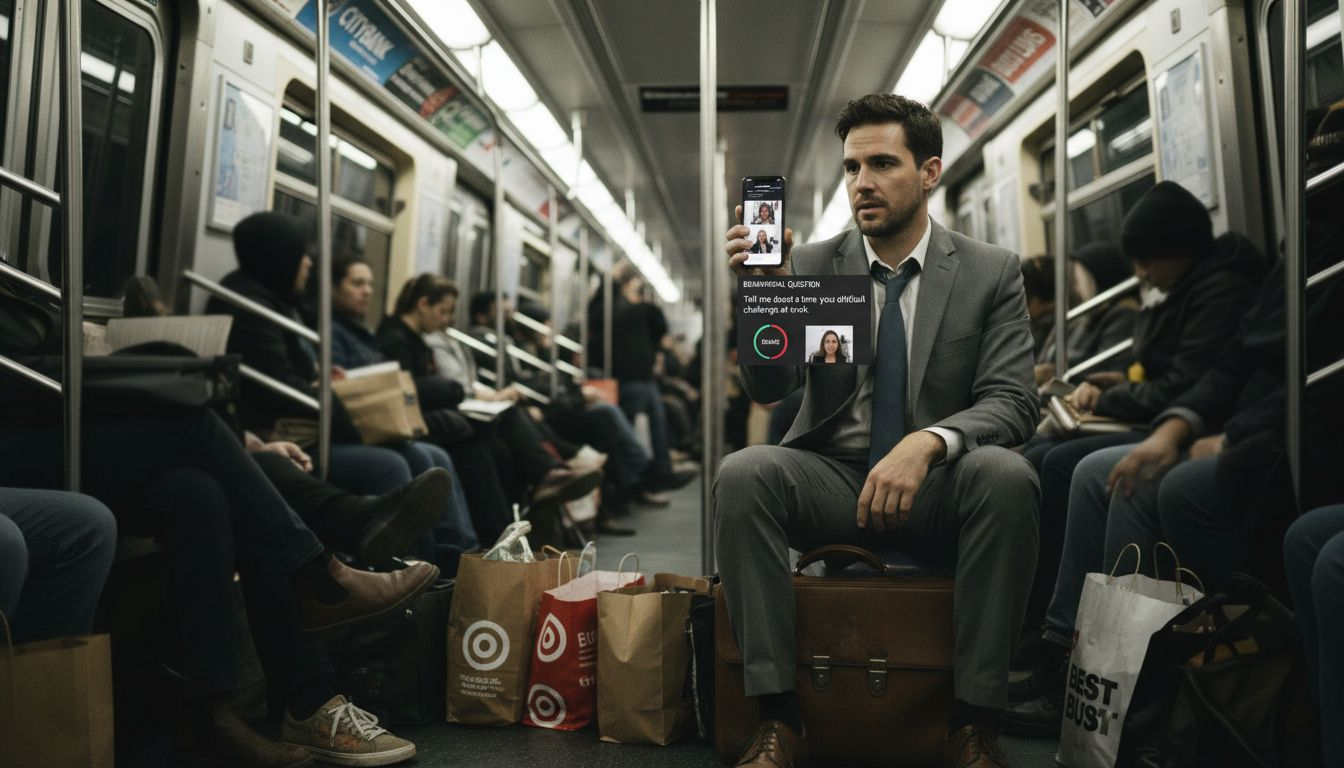
Beyond question customization, these AI systems provide intelligent feedback mechanisms that adapt to individual learning styles and skill gaps. By analyzing a candidate’s performance across multiple mock interviews, the technology identifies specific areas of improvement, whether they relate to technical knowledge, communication skills, or emotional intelligence. The result is a highly personalized training experience that helps job seekers progressively enhance their interview capabilities, building confidence and competence across different professional contexts.
Pro tip: Experiment with practice interviews across multiple job roles to develop versatile communication skills and expand your professional adaptability.
Boosting Confidence and Reducing Interview Anxiety
Modern job seekers face significant psychological challenges during interviews, but AI interview coaching platforms are revolutionizing how candidates manage performance anxiety. These innovative tools create safe, controlled environments where individuals can practice and refine their interview skills without the paralyzing fear of real-world judgment, transforming nervousness into constructive preparation.
The strategic approach of AI interview tools involves systematic desensitization of interview-related stress. By providing repeated exposure to realistic interview scenarios, these platforms help candidates develop muscle memory for communication techniques, reducing the overwhelming psychological barriers that traditionally impede interview success. Candidates can practice responses to challenging questions, receive instantaneous feedback on verbal and non-verbal communication, and progressively build confidence through incremental improvements in their interview performance.
Unlike traditional preparation methods that rely on subjective advice, AI interview technologies offer data-driven insights into communication patterns. These tools analyze speech patterns, emotional tone, response clarity, and body language with unprecedented precision. By breaking down interview performance into measurable components, candidates can systematically address specific areas of weakness, transforming anxiety into a structured opportunity for personal and professional growth. The objective, unbiased nature of AI feedback creates a supportive learning environment that empowers job seekers to approach interviews with renewed self-assurance.
Pro tip: Schedule multiple AI-powered mock interviews in different simulated scenarios to progressively build your confidence and reduce interview-related anxiety.
Below is a summary of key features provided by AI interview tools and their impact:
| Feature | Description | Impact on Candidate |
|---|---|---|
| Real-Time Analysis | Evaluates speech and nonverbal cues instantly | Allows fast self-improvement |
| Adaptive Simulations | Adjusts questions to job role | Delivers focused practice |
| Automated Insights | Provides actionable recommendations | Improves communication precision |
| Stress Reduction | Offers repeated, safe practice | Increases interview confidence |
Comparing AI Tools With Traditional Preparation
Traditional interview preparation has long been characterized by its limitations, but modern AI interview technologies are fundamentally transforming the candidate preparation landscape. Unlike conventional methods that rely on sporadic coaching sessions and inconsistent feedback from friends or mentors, AI tools offer a comprehensive, data-driven approach to interview readiness that adapts to individual learning needs and professional contexts.
The key differentiators between traditional and AI-powered interview preparation are profound. Traditional methods typically involve time-consuming practices like role-playing with limited feedback, reviewing generic interview guides, and attending workshops with fixed curricula. In contrast, AI interview tools provide dynamic, personalized experiences that simulate real-world interview scenarios with unprecedented accuracy. These intelligent platforms can generate industry-specific questions, analyze communication patterns in real-time, and offer nuanced feedback that goes far beyond the capabilities of human coaches.
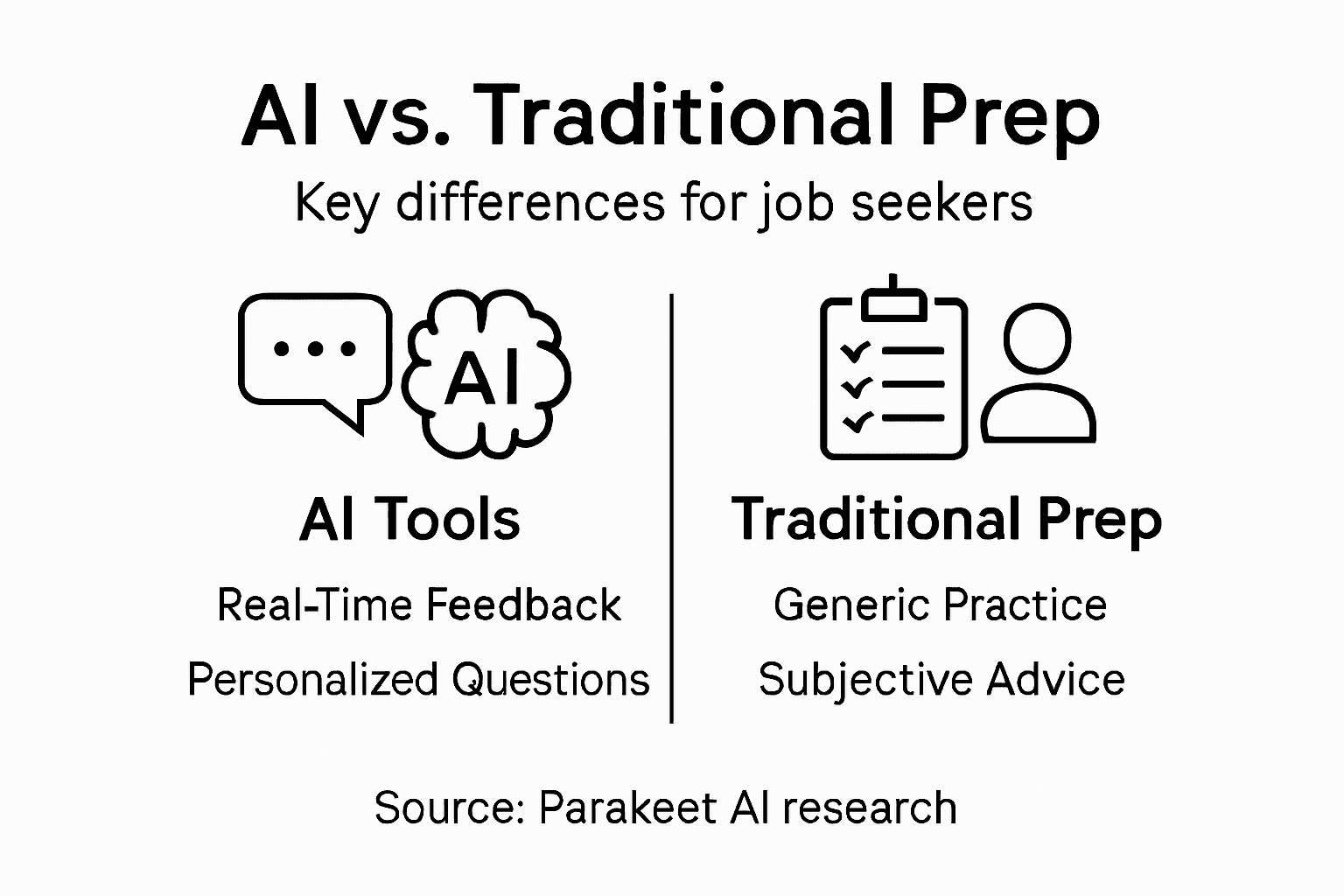
Moreover, AI interview tools eliminate many inherent biases present in traditional preparation methods. Human coaches often bring subjective perspectives and unconscious biases that can skew feedback and preparation strategies. AI systems, designed with advanced machine learning algorithms, deliver objective, consistent assessments that focus purely on communication effectiveness, content quality, and professional presentation. This approach ensures that candidates receive fair, data-driven insights into their interview performance, helping them improve systematically without the limitations of human perception.
Here’s a comparison of AI interview tools versus traditional interview preparation methods:
| Criteria | AI Interview Tools | Traditional Preparation |
|---|---|---|
| Feedback Delivery | Instant, data-driven | Delayed, subjective |
| Bias Reduction | Minimizes bias automatically | Subject to human bias |
| Question Customization | Tailored to each role | Generic or role-play based |
| Accessibility | Available anytime, anywhere | Scheduled, location-based |
| Progress Tracking | Tracks skill improvement over time | Manual, often inconsistent |
Pro tip: Combine AI interview tools with traditional preparation techniques to create a comprehensive, multifaceted approach to interview readiness.
Elevate Your Interview Skills with Real-Time AI Assistance
The article highlights how AI interview tools tackle common challenges like interview anxiety, bias in feedback, and the need for personalized, role-specific practice. If you want to master clear communication, gain instant insights, and reduce stress while preparing, our real-time AI job interview assistant is made exactly for those goals. It listens carefully to your responses and immediately provides tailored answers, helping you improve faster and with more confidence.
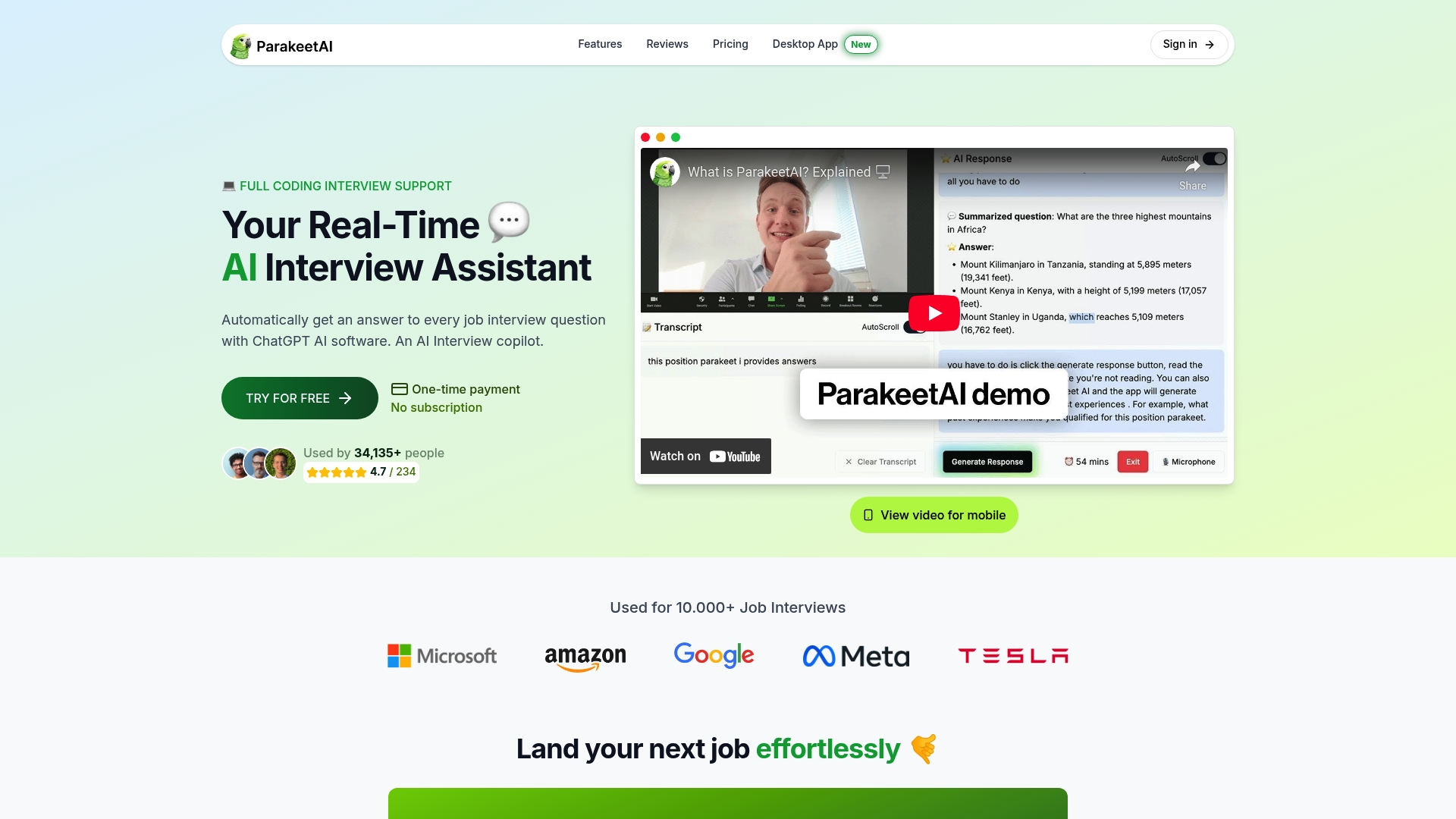
Unlock personalized, unbiased, and on-demand guidance with Parakeet AI. Experience how adaptive interview coaching can sharpen your answers and boost your confidence today. Visit our landing page to start practicing smarter and take control of your interview success now.
Frequently Asked Questions
What are AI interview tools?
AI interview tools are sophisticated systems that use artificial intelligence and machine learning technologies to automate candidate assessments during the interview process. They analyze verbal responses, non-verbal cues, and generate job-specific questions.
How do AI interview tools help improve my interview skills?
These tools provide real-time feedback, assess communication patterns, and deliver personalized insights that help you identify strengths and weaknesses, allowing for targeted practice and enhancement of your interview performance.
Can AI interview tools reduce interview anxiety?
Yes, AI interview tools create controlled environments for practice, allowing candidates to refine their skills without the pressure of real-world judgment. This repeated exposure can help build confidence and reduce anxiety over time.
How do AI interview tools compare to traditional preparation methods?
AI interview tools offer instant, data-driven feedback and personalized question customization, whereas traditional methods often rely on subjective, delayed feedback, generic question frameworks, and manual progress tracking.
Recommended
- benefits of interviewing with ai - ParakeetAI
- benefits of ai in job search - ParakeetAI
- why use ai for interviews - ParakeetAI
- why use ai job interview assistant - ParakeetAI
- Artificial intelligence: Teaching English online in the age of AI - EBC Trinity CertTESOL and TEFL courses
- Why Adopt New Scheduling Tools: Complete Guide - WhenNOT Blog
- Futuro Intelligente? Come tutelare l’Intelligenza Artificiale negli Emirati Arabi Uniti – Avvocato Carmine Coviello