
Final Interview Advice: 10 Ways to Close the Offer

To win the final round, lead with a 30-second positioning statement, deliver three tight STAR stories tied to the role, and close by asking one question that surfaces any remaining concerns. That sequence alone separates candidates who get offers from those who finish second.
Here is your immediate action checklist:
- Write your positioning statement today. One sentence: who you are, what you deliver, and why this role specifically.
- Lock in three STAR stories. Each one should map to a job requirement and demonstrate a relevant outcome.
- Prepare your 30-60-90 plan. A spoken paragraph showing how you ramp in the first three months signals low hiring risk.
- Keep answers to 60-90 seconds. Experts recommend this window for final-round brevity.
- Use Parakeet-ai to rehearse. The real-time AI coach listens to your practice answers and gives instant feedback before the real conversation.
Key Takeaways
The single highest-impact action in a final round is pairing a clear positioning statement with three tight STAR stories, each mapped to a specific job requirement and delivered in 60-90 seconds.
| Point | Details |
|---|---|
| Position yourself first | Open with a one-sentence statement: who you are, what you deliver, and why this role. |
| Use STAR at 60-90 seconds | Give the headline situation, focus on action and result, and stop before you over-explain. |
| Prepare a 30-60-90 plan | A spoken paragraph on your ramp plan reduces perceived hiring risk for every senior interviewer. |
| Ask a concern-surfacing question | “Is there anything about my background that gives you pause?” lets you handle objections before the decision. |
| Send a thank-you within 24 hours | Reference one specific conversation point to reinforce fit and keep your name top of mind. |
Table of Contents
- What is a final interview, and why does it matter?
- What are interviewers actually looking for in a final round?
- Common final interview questions and how to answer them well
- How to prepare for a final interview in 7 days
- How to handle salary and offer questions confidently
- Day-of logistics: what to do before you walk in (or log on)
- How to stand out and close the conversation toward an offer
- What to do after the final interview
- How modern practice tools speed up your final-round readiness
- The mindset that actually gets you through a final round
- Sources
What is a final interview, and why does it matter?
A final interview is the last formal conversation before a company makes a hiring decision. You are typically among 2 to 5 candidates at this stage, and the team has already confirmed you can do the job. The question now is whether you are the right person for it.
The attendees shift at this stage. Earlier rounds usually involve a recruiter and a hiring manager. Final rounds often bring in senior leaders, department heads, a panel of peers, or sometimes a VP or CEO. Each person is assessing something slightly different: the hiring manager wants execution confidence, senior leaders want strategic alignment, and peers want to know if you will make their work easier or harder.
What decides offers here is rarely a new technical test. It is the small signals: how you frame your past, whether your narrative closes cleanly, and whether you leave the room having reduced their perceived hiring risk.
What are interviewers actually looking for in a final round?
Final interviews probe alignment with company values and long-term contribution more deeply than earlier rounds. Interviewers are scanning for five specific things:
- Culture fit. Not just “do you seem nice” but “will you make decisions the way we make decisions?” Show this by referencing the company’s stated values in your answers, not generically, but tied to a specific story.
- Judgment under ambiguity. Strong candidates choose stories that show tradeoffs, not just wins. “I had two competing priorities and here is how I decided” lands better than a clean success narrative.
- Stakeholder management. Can you influence people who do not report to you? One story showing cross-functional alignment is worth more than three solo-hero examples.
- Ramp speed and ownership. Hiring managers worry about how long it takes a new person to contribute. A one-line ramp statement (“In the first 30 days, I would focus on X; by 60 days, Y”) signals you have thought about this and reduces their risk.
- Compensation and availability clarity. Final rounds often surface start date, notice period, and salary. Vague answers here create friction. Know your numbers before you walk in.
Pro Tip: Surface your ramp signal early. In your opening positioning statement, drop one sentence: “I typically reach full contribution within 60 days by prioritizing stakeholder mapping and one early win.” That one line answers the question every hiring manager is quietly asking.
Common final interview questions and how to answer them well
The STAR method (Situation, Task, Action, Result) is the standard structure for behavioral answers. In a final round, compress it: skip the long setup, give the headline situation in one sentence, spend most of your time on the action and the result, and stop at 60-90 seconds. That timing is not arbitrary. Experts link it directly to executive-level clarity, the quality interviewers are specifically evaluating at this stage.
60-90 seconds. That is the target window for every behavioral answer in a final round. Give the headline, one specific evidence detail, and stop.
For behavioral questions in senior or strategic roles, strong candidates pick stories showing tradeoffs, influence without authority, failure recovery, and measurable outcomes.
Conflict sample answer
“Tell me about a time you disagreed with a colleague or manager.”
“My team and I disagreed on the launch timeline for a product feature. I believed we needed two more weeks for QA; the PM wanted to ship. I pulled the defect data, mapped the customer-impact risk, and proposed a phased rollout that let us ship the core feature on time while holding the riskier component. The PM agreed. We hit the deadline, and the defect rate was significantly lower than our previous launch.”
Failure and recovery sample answer
“Tell me about a time you failed.”
“I underestimated the onboarding complexity for a new enterprise client and missed our 30-day activation target by two weeks. I owned the miss directly with the client, rebuilt the timeline with a daily check-in cadence, and we recovered to full activation in week six. That client renewed at a higher tier. I now build a complexity buffer into every onboarding plan.”
High-impact delivery sample answer
“What is the highest-impact project you have delivered?”
“I led the migration of our data pipeline from a legacy system to a cloud-based architecture. The project ran several weeks, involved multiple teams, and substantially reduced processing time. The bigger outcome was that it unblocked two product features that had been stalled for six months.”
Leadership and vision sample answer
“Where do you see this function in three years?”
“I see it shifting from reactive support to a proactive driver of revenue. The teams I have led have made that transition by building tighter feedback loops with sales and product. In this role, I would start by mapping the current gaps between what the function delivers and what the business actually needs, then prioritize the two or three changes with the highest leverage.”
Salary response template
When asked about compensation before you are ready to negotiate: “I have been researching the market for this role in [city/region] and I am targeting a range of $X to $Y, depending on the full package. Can you share the band for this position?” Anchoring to a researched range and immediately asking for the band keeps you informed and in control.
How to prepare for a final interview in 7 days
A 7-day sprint covering signature stories, a 30-60-90 plan, interviewer research, and practice is the most efficient way to get ready. Here is how to run it:
- Days 7-5: Research each interviewer on LinkedIn. Note their background, tenure, and any public writing. Pull the company’s recent earnings calls, press releases, or product announcements. Identify two or three strategic priorities you can reference.
- Days 4-3: Refine your six signature stories. Each one should map to a specific job requirement. Write the STAR skeleton for each, then time yourself telling it aloud. Cut anything that pushes past 90 seconds.
- Day 2: Draft your 30-60-90 plan. Write it as a spoken paragraph, not a slide. Practice it until it sounds natural, not rehearsed.
- Day 1: Confirm logistics (location, virtual link, parking, dress). Do one full mock run with a peer or with Parakeet-ai. Sleep.
Story-to-requirement mapping
Use this framework to make sure your stories cover the role’s actual requirements. Fill in the right column before your prep sprint:
| Job requirement | Your best story (one sentence) |
|---|---|
| Cross-functional leadership | Led four-team pipeline migration, delivered on time |
| Stakeholder influence | Resolved launch disagreement with data-backed proposal |
| Failure recovery | Missed onboarding target, recovered with daily cadence |
| Strategic thinking | Proposed phased rollout that balanced risk and deadline |
| Ramp speed | Reached full contribution in 60 days at previous role |
Expert prep guidance consistently points to this kind of deliberate story mapping as the difference between candidates who answer questions and candidates who close offers.
How to handle salary and offer questions confidently
If salary expectations have not come up in earlier rounds, they almost certainly will in the final. Final-round interviewers often ask about start date, notice period, and references because the conversation feeds directly into an offer decision.
A few practical rules:
- Anchor to a range, not a number. A single number gives the employer a ceiling. A range keeps the conversation open. Use Glassdoor, Levels.fyi (for tech roles), LinkedIn Salary, or the Bureau of Labor Statistics to build a defensible range for your specific role and metro area.
- When asked first, give your range and ask for theirs. The template from the previous section works here: state your researched range, then ask for the band. Most companies have one.
- Notice period and start date. Be honest. If you need four weeks, say four weeks. Trying to compress it and then failing to deliver damages trust before day one.
- References. Have three ready. Warm them up before the final round so they are not surprised by a call.
Pro Tip: Do not negotiate in the room unless you have the full offer in writing. “I would love to review the complete package before we discuss specifics” is a professional, expected response that protects your leverage.
Day-of logistics: what to do before you walk in (or log on)
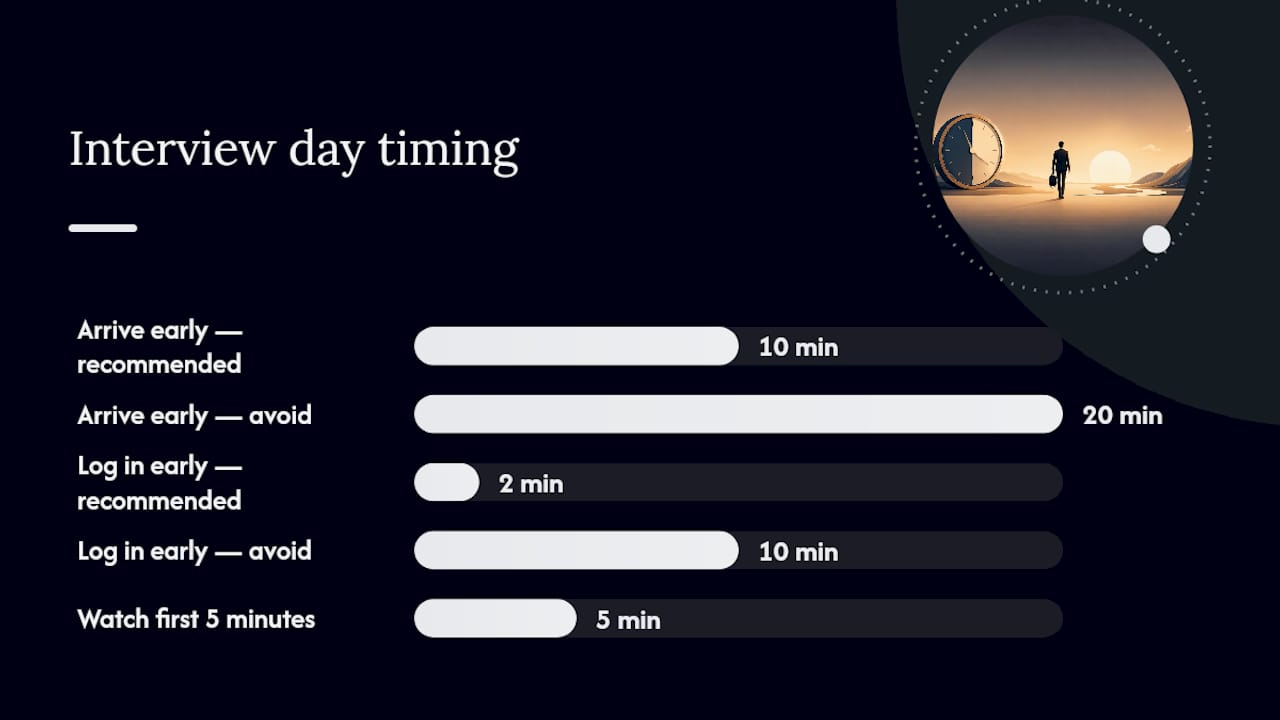
Arriving calm and technically prepared is its own form of interview preparation. Friction on the day of the interview, whether a dead laptop battery or a wrong entrance, costs you mental bandwidth you need for the conversation.
In-person checklist:
- Arrive 10 minutes early, not 20. Twenty minutes creates awkwardness for the receptionist and signals anxiety.
- Bring two printed copies of your resume, a notepad, and a pen.
- Dress one level above the company’s stated culture. When in doubt, business professional over business casual.
- Silence your phone completely before you enter the building.
Virtual checklist:
- Test your camera, microphone, and internet connection the night before, not 10 minutes before the call.
- Use a headset. Built-in laptop microphones pick up room noise and make you sound distant.
- Set a neutral, uncluttered background. A plain wall or a simple bookshelf works. Avoid virtual backgrounds unless your environment gives you no choice.
- Log in two minutes early. Not ten. Two.
Pro Tip: Watch the interviewer’s pace and energy in the first five minutes. If they are moving fast and asking short questions, match that rhythm. If they are reflective and slow, slow down. Mirroring communication style is one of the fastest ways to build rapport.
How to stand out and close the conversation toward an offer
The final round is a closing conversation, not another screening. Your job is to reduce hiring risk, surface any remaining concerns, and leave no doubt about your interest.
Questions that differentiate you:
- “What would make someone struggle in this role in the first six months?” This shows self-awareness and gives you a chance to address the concern directly.
- “What does success look like at the 12-month mark, beyond the job description?” This signals long-term thinking.
- “Is there anything about my background that gives you pause?” Uncomfortable to ask, but it lets you handle objections before the decision is made.
- “What is the one thing the team needs most from whoever takes this role?” The answer tells you exactly what to emphasize in your thank-you note.
Your 30-60-90 spoken template:
“In my first 30 days, I would focus on listening: meeting the key stakeholders, understanding the current state of the team’s priorities, and identifying any quick wins. By day 60, I would have a clear picture of the two or three highest-leverage changes I can make and would be executing on the first one. By day 90, I would expect to be operating independently and delivering measurable progress on at least one priority.”
Closing lines:
- Direct close: “I want to be straightforward: I am very interested in this role and I would be excited to join the team. What are the next steps?”
- Concern-surfacing close: “Before we wrap up, is there anything about my background or experience that I can address?”
- Timeline close: “I want to be respectful of your process. Is there a timeline I should be aware of for the decision?”
Use the direct close when you are confident the conversation went well. Use the concern-surfacing close when you sensed hesitation. Use the timeline close when you have a competing offer or a deadline.
What to do after the final interview
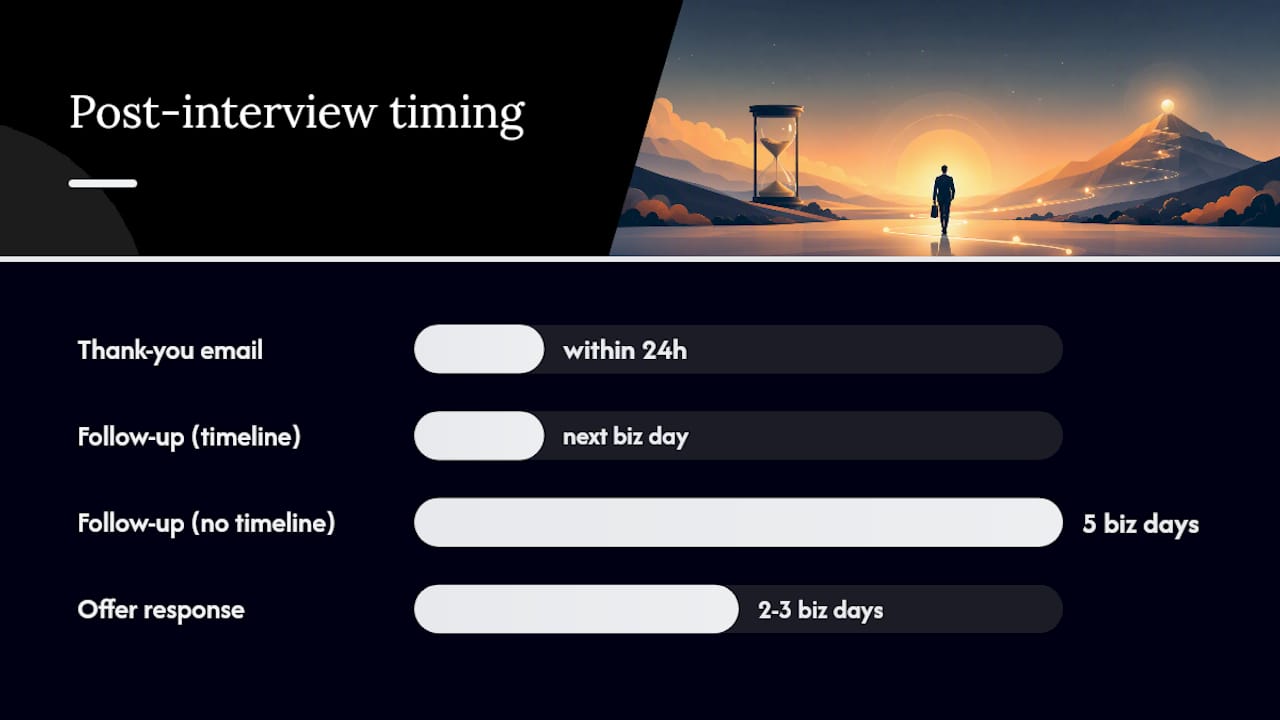
Send your thank-you email within 24 hours, ideally the same evening. A thank-you note is not a formality; it is a second chance to reinforce your fit.
Thank-you email template:
Subject: Thank you — [Role Title] conversation
Hi [Name],
Thank you for the time today. I left the conversation more excited about the role, particularly [one specific thing discussed]. My background in [relevant area] maps directly to [the challenge or priority they mentioned], and I am confident I can contribute quickly.
I look forward to hearing about next steps. Please let me know if there is anything else I can provide.
[Your name]
Follow-up timeline:
- Send the thank-you note within 24 hours.
- If you have not heard back within the timeframe they gave you, send one polite follow-up email on the next business day after that window closes.
- If no timeline was given, wait five business days before following up.
Offer response:
When the offer comes, you do not have to accept on the spot. “Thank you so much. I am genuinely excited. Can I have [two to three business days] to review the full package?” is a professional and expected response. Get the offer in writing before you negotiate. Review base salary, bonus structure, equity, benefits, and start date as a package, not line by line.
How modern practice tools speed up your final-round readiness
Three tool categories are worth knowing before your prep sprint:
- Live mock interviews with a human coach or peer. Best for judgment stories and nuanced feedback on tone, pacing, and whether your narrative actually lands. Use these for your most complex behavioral answers.
- Recorded practice platforms with AI scoring. Tools like Iteration let you record an answer, get instant feedback on structure and timing, and compare your performance against benchmarks. Useful for the polish phase of prep.
- Real-time AI coaches. Parakeet-ai sits in this category. It listens to your live practice session and surfaces answer suggestions in real time, which is particularly useful when you blank on a question or want to see how a stronger answer is structured. The key rule: always rewrite any AI-generated output in your own voice before you use it.
The best approach combines all three. Start with human sparring for your judgment and leadership stories, where nuance matters most. Then use AI tools for timing, structure, and the questions you are least confident about. This combination of human and AI practice gives you both the depth and the polish a final round demands.
Pro Tip: For consulting-style or case-based final rounds, behavioral frameworks specific to that format are worth reviewing separately. The STAR structure still applies, but the framing shifts toward structured problem-solving.
The mindset that actually gets you through a final round
Here is what most prep guides skip: the final round is not a test. It is a conversation between two parties who are both trying to reduce risk. The company wants to know if hiring you is a safe bet. You want to know if this role is worth your next two or three years. When you walk in with that frame, the pressure shifts.
Sixty minutes before the interview, do a light review of your three strongest stories, not all six. Check your posture. Take three slow breaths. Then put the notes away. You have done the work. The review is just a warm-up, not a cram session.
The one habit that consistently helps candidates stay calm in the room: before you answer any question, pause for two full seconds. It feels long to you. To the interviewer, it reads as thoughtful. That pause also gives you time to choose the right story instead of defaulting to the first one that comes to mind.
Anxiety in a final round is almost always a signal that you care. That is not a problem to fix. Channel it into specificity: the more concrete your answers, the more confident you feel, and the more confident you sound.
Sources
The sources below back the guidance in this article and are worth bookmarking for additional sample questions, market pay research, and deeper prep frameworks:
- Tips on nailing a final interview?
- Mastering the Final Interview (With Sample Answers)
- 5 expert interview prep tips for your final interview
- How to Prepare for a Final Interview (2026 Guide) | AiApply Blog