
8 Killer Interview Questions to Ask Employers

The best questions you can ask an employer aren’t just polite conversation fillers. They reveal expectations, surface red flags, and tell the interviewer you’ve done real homework. Here are the eight killer interview questions to ask employers that consistently deliver the most useful information, plus exactly when to use each one.
- “What does success look like in the first 30, 60, and 90 days?” (Ask early, first half) Forces the employer to name concrete deliverables instead of vague expectations.
- “What’s the biggest challenge the team is facing right now?” (Ask mid-interview) A great employer answers honestly; evasion is itself a red flag.
- “How would you describe the management style of the person I’d report to?” (Ask mid-interview) Reveals whether the culture matches how you work best.
- “What does a typical career path look like for someone in this role?” (Ask mid-interview) Shows you’re thinking long-term and surfaces whether growth is real or just promised.
- “What do you enjoy most about working here?” (Ask the interviewer directly, closing) Builds rapport and gives you unscripted, honest insight into day-to-day culture.
- “How does this team collaborate with other departments?” (Ask mid-interview) Uncovers cross-functional friction or alignment before you accept.
- “Is there anything about my background that gives you pause?” (Ask near the close) Rare, bold, and gives you a live chance to address objections.
- “What are the next steps in the hiring process, and when should I expect to hear back?” (Ask at the close) University career advisors recommend this as a non-negotiable closing question.
Key Takeaways
Asking 3–5 tailored, specific questions with prepared follow-ups is the single most effective way to stand out and assess fit in any job interview.
| Point | Details |
|---|---|
| Ask 3–5 tailored questions | Prepare 8–10, then prioritize the ones most relevant to this specific role and company. |
| Follow-ups outperform lists | Mirror the interviewer’s exact words to build rapport and signal active listening. |
| Avoid compensation questions early | Hold salary and benefits questions until the employer raises them or extends an offer. |
| Always close with next steps | Ask “What are the next steps, and when should I expect to hear back?” at every interview. |
| Parakeet-ai for live practice | Use Parakeet-ai’s real-time prompts to rehearse follow-ups and build confidence before the interview. |
Table of Contents
- Why the questions you ask change how interviewers see you
- Your full question bank: phrasing, follow-ups, and when to use them
- Questions that backfire (and what to ask instead)
- How to interpret answers and spot red flags
- Research-backed tactics for asking better questions
- What most candidates miss in the room
- Real-time practice that sharpens your delivery
- Sources
Why the questions you ask change how interviewers see you
Asking thoughtful questions isn’t just good manners. It’s a signal. Interviewers form impressions of candidates based on the quality of the questions they ask, not just the answers they give.
Research from Science of People confirms that asking thoughtful questions, and especially follow-up questions, increases likability and signals genuine engagement. When you ask a follow-up based on something the interviewer just said, you demonstrate that you’re actually listening, not just waiting for your turn to talk. That distinction matters to hiring managers more than most candidates realize.
Stat to know: According to HBR’s 2022 research-informed question guide, prepared, strategic questions signal preparation and help candidates evaluate employer fit, two things that directly influence hiring decisions.
The flip side is equally true. Asking no questions, or asking something you could have Googled in 30 seconds, signals low interest. Interviewers notice. A candidate who asks sharp, specific questions about the role and team leaves a fundamentally different impression than one who says, “No, I think I’m good.”
Your full question bank: phrasing, follow-ups, and when to use them
The goal isn’t to memorize 20 questions. WVU Career Services recommends tailoring 3–5 questions to the specific role and interviewer’s perspective. The categories below give you a deep bench to draw from.
Role expectations
“What does success look like in the first 30, 60, and 90 days?”
This is the single most useful question you can ask. It converts a vague job description into a concrete deliverable list. If the interviewer can’t answer it, that tells you something important about how organized the onboarding process is.
Follow-up template: “You mentioned [X milestone] — is that typically driven by the individual or the team?”
Pro Tip: Write down the specific milestones the interviewer names. Reference one of them in your thank-you note after the interview. It shows you were listening and already thinking about execution.
Team and manager dynamics
“How would you describe the management style of the person I’d report to?”
Ask this in the middle of the interview, after you’ve established some rapport. The answer tells you whether you’re walking into a micromanager, a hands-off leader, or something in between.
Follow-up: “You mentioned [word they used, e.g., ‘collaborative’] — how does that show up day-to-day?”
For questions to ask a hiring manager specifically, you can also try: “What’s the best way to communicate with you when something isn’t working?”
Company strategy and growth
“Where do you see the company in three years, and how does this team contribute to that?”
Best asked mid-interview, once the conversation has moved past the basics. A confident, specific answer signals a company with a clear direction. Vague or contradictory answers about strategy are worth noting.
Follow-up: “You mentioned [specific initiative] — is that something this role would be directly involved in?”
Culture and psychological safety

“What’s the biggest challenge the team is facing right now?”
This question separates companies that talk about transparency from ones that actually practice it. A good employer gives you a real answer. A deflecting answer (“We’re really in a great place right now”) is a signal worth taking seriously.
“How does the team handle disagreement or pushback on ideas?”
For remote or hybrid roles, add: “How does that work when the team is distributed?”
Development and promotion

“What does a typical career path look like for someone in this role?”
Ask this after you’ve established genuine interest in the position. The answer reveals whether promotions are structured and merit-based or informal and unpredictable.
Follow-up: “Can you give me an example of someone who started in this role and moved up?”
Interviewer-focused questions (rapport builders)
“What do you enjoy most about working here?”
Save this for the closing phase. It’s personal, it’s direct, and it almost always generates an honest, unscripted answer. People light up when asked what they genuinely like about their work. That reaction, or the absence of one, tells you a lot.
“Is there anything about my background that gives you pause?”
Bold, but effective. It opens the door to address concerns you didn’t know existed. Most candidates never ask this. The ones who do often walk away with a clearer picture of where they stand.
Questions that backfire (and what to ask instead)
Some questions kill your candidacy before the offer stage. These are the ones to avoid, and what to ask instead.
Avoid: “What’s the salary for this position?” (before they bring it up) Why it backfires: It signals that compensation is your primary concern before you’ve demonstrated value. Ask instead: “Can you share the compensation range for this role?” Only after they’ve expressed strong interest or extended an offer. Career center guidance is consistent: hold compensation questions until the employer raises the topic or you receive an offer.
Avoid: “What does your company do?” Why it backfires: You could have found this in two minutes on their website. It signals zero preparation. Ask instead: “I read that you recently [specific initiative or news] — how is this team involved in that?”
Avoid: “How quickly can I get promoted?” Why it backfires: It sounds entitled before you’ve proven yourself. Ask instead: “What does a typical career path look like for someone in this role?” Same information, completely different framing.
Avoid: “Do you offer remote work / flexible hours?” (in the first round) Why it backfires: Raises concerns about commitment before you’ve established fit. Ask instead: Save it for a second-round conversation, or frame it around the team: “How does the team typically structure its workweek?”
A simple rule: if the question is primarily about what the company gives you rather than what you can contribute, it’s too early to ask it.
How to interpret answers and spot red flags
Good answers are specific. They name timelines, outcomes, and trade-offs. Bad answers are vague, defensive, or redirect the question back to you.
Here’s a quick scoring framework:
- Specific answer: The interviewer names a concrete outcome, timeline, or example. Follow up with: “How was that measured?” to go deeper.
- Vague answer: The interviewer gives a general statement with no detail (“We really value growth here”). Follow up with: “Can you give me a recent example of that?”
- Evasive answer: The interviewer deflects, changes the subject, or says “That’s a great question” without actually answering. Follow up with: “I want to make sure I understand — could you walk me through a specific situation?”
Red flags to watch for:
- No clear onboarding plan when you ask about the first 90 days
- Inconsistent answers about team structure or reporting lines
- Visible discomfort when asked about challenges or turnover
- “We’re like a family here” with no concrete examples of what that means
- An interviewer who claims the role has no real challenges
Pro Tip: Take brief notes during the interview. Jot down one or two specific words the interviewer uses. Mirroring that language in your follow-up questions (“You mentioned ‘ownership’ — what does that look like for someone new to the team?”) signals active listening and builds rapport fast.
Research-backed tactics for asking better questions
Follow-up questions are the highest-return technique available to you in an interview. Harvard Business Review’s research on question dynamics identifies four question types: introductory, mirror, full-switch, and follow-up. Follow-ups consistently outperform the others for likability because they make the speaker feel genuinely heard.
Key finding: HBR’s research shows that people who ask more follow-up questions are rated as more likable and more engaged by the people they’re talking with, a dynamic that applies directly to job interviews.
The practical implication: don’t recite your list of prepared questions like a checklist. Listen to what the interviewer says, then ask one specific follow-up before moving to your next prepared question. That rhythm feels like a real conversation, not an interrogation.
A short practice plan before your interview:
- Write down 8–10 questions across the categories above
- Highlight the 3–5 most relevant to this specific role and company
- For each, write one follow-up template using a blank: “You mentioned [X] — can you tell me more about [Y]?”
- Rehearse saying them aloud, not just reading them silently
Indeed’s guidance recommends preparing 6–8 questions and planning to ask 3–4, which gives you flexibility if the interviewer covers some of your questions during the conversation.
Pro Tip: If the interviewer answers one of your prepared questions before you ask it, don’t skip it entirely. Say: “You touched on this earlier, but I’d love to go deeper — when you mentioned [X], what did you mean by [Y]?” It shows you were listening the whole time.
For unique questions that help you stand out, the follow-up is often more memorable than the original question.
What most candidates miss in the room
The single biggest mistake candidates make isn’t asking the wrong questions. It’s failing to follow up on the clues the interviewer drops.
When an interviewer says something like “this role has evolved a lot over the past year,” that’s an opening. A candidate who catches it and asks “What drove that evolution?” learns something no prepared question could have surfaced. The interviewer who answers that question honestly is telling you exactly what the job really is, not what the job description says it is.
Most candidates are so focused on their next prepared question that they miss these moments entirely. The ones who don’t are the ones who walk out of the interview knowing whether the role is actually right for them.
Real-time practice that sharpens your delivery
Knowing the right questions is one thing. Saying them confidently under pressure is another. Parakeet-ai is a real-time AI interview assistant that listens to your interview and surfaces suggested responses and follow-up prompts as the conversation unfolds, so you’re never caught flat-footed when an interviewer says something unexpected.
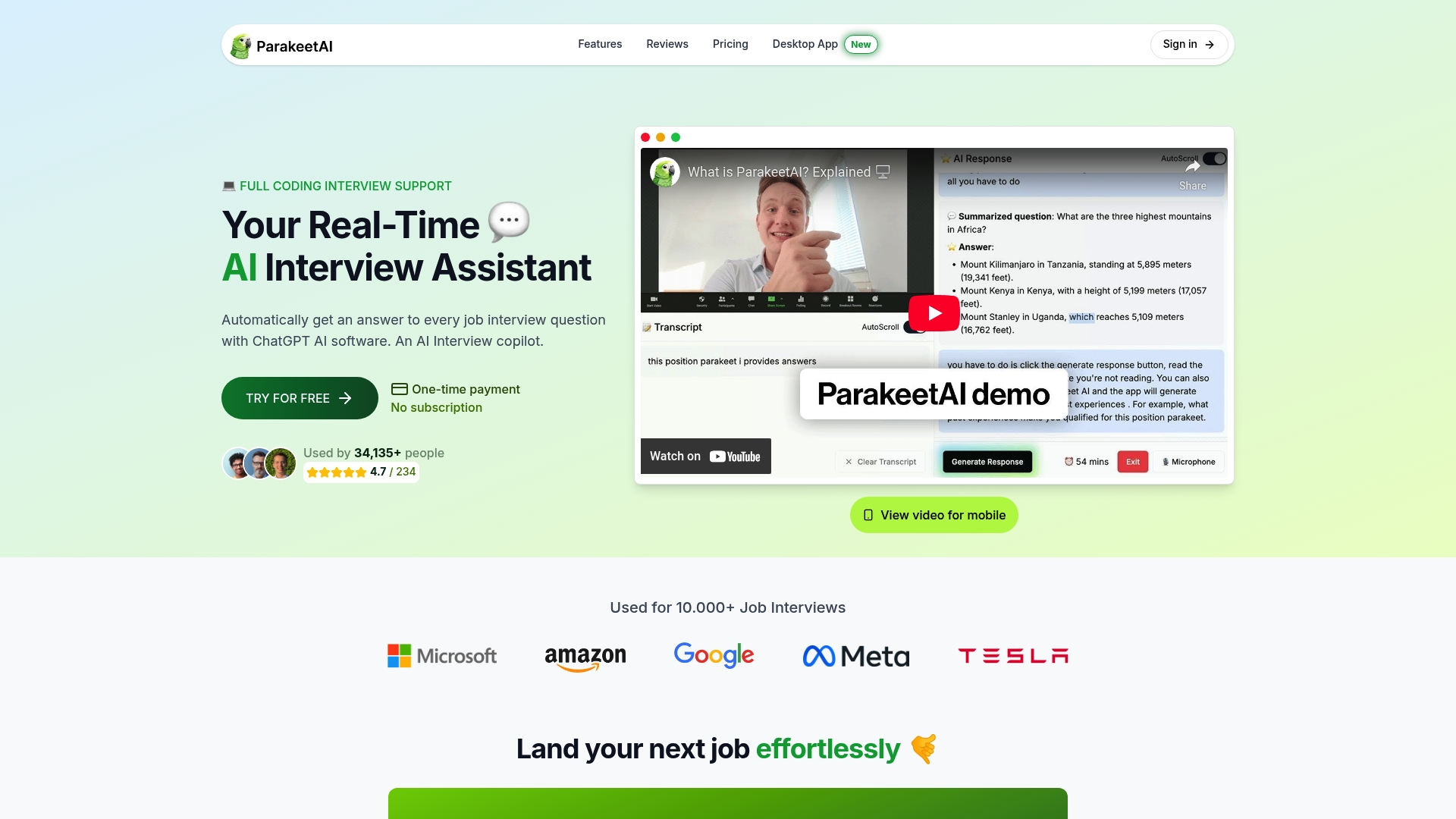
For candidates who want to rehearse their questions in realistic conditions, Parakeet-ai gives you live prompts, suggested follow-ups, and the kind of repetition that builds genuine confidence before the actual interview. Try it at Parakeet-ai before your next interview.
Sources
- 45 Questions to Ask an Interviewer (Backed by Research)
- 38 Smart Questions to Ask in a Job Interview
- Interview Questions and How to Prepare | Career Center
- 25 questions to ask about the company during an interview