
Best Alternatives to BrouseAI for Live Interview Help

For candidates who want real-time AI answer suggestions during a live interview, Parakeet-ai is the clearest reference point in 2026. The practical shortlist breaks into three categories: live answer assistants (Parakeet-ai being the leading example), live-scoring platforms like HireVue and TrueVoice HQ, and human-coach hybrids like Interviewing.io and Pramp. If your goal is to get suggested answers while the interviewer is still talking, live answer assistants are the only category that actually delivers that. The others are genuinely useful, but for a different job.
- Live answer assistants respond in real time using streaming speech-to-text plus fast LLM generation with low latency suitable for natural interaction.
- Live-scoring platforms analyze your performance as you speak but surface results to an interviewer dashboard, not to you.
- Human-coach hybrids (Rehearsal, Pramp, Interviewing.io) give you structured mock sessions with a real person or peer, which no AI can fully replicate for soft-skill feedback.
According to Parakeet-ai’s research, candidates using real-time AI assistants report meaningfully better offer rates. The category is worth taking seriously.
Table of Contents
- What are the best brouseai.com alternatives for interview candidates?
- How do these tools actually differ when you’re in the hot seat?
- Privacy, fairness, and legal considerations you need to know
- How real-time interview AI works under the hood
- ParakeetAI and the realistic US shortlist
- Key Takeaways
- The gap between what AI interview tools promise and what actually matters
- Parakeet-ai gives you live answers when it counts most
- Sources and further reading
What are the best brouseai.com alternatives for interview candidates?
| Feature | Live answer assistants | Live-scoring platforms | Async practice platforms | Human-coach hybrids |
|---|---|---|---|---|
| Real-time suggested answers | Yes | No | No | No |
| Live scoring / interviewer dashboard | No | Yes | No | Partial |
| Mock interview / practice mode | Yes (some) | Yes | Yes | Yes |
| Human coaching availability | No | No | No | Yes |
| Post-interview reports / synthesis | Yes | Yes | Yes | Yes |
| Privacy & compliance | Varies; ask about data retention and consent | Employer-controlled; candidate data shared with hiring team | Usually lower risk; async and opt-in | Low risk; human-led |
| Pricing model | Freemium to subscription | Enterprise licensing | Free tiers common | Free (peer) to paid coaching |
| Best for | Candidates who need live answer support | Employers assessing candidates | Solo practice before interviews | Soft skills, behavioral prep |
Parakeet-ai sits firmly in the live answer assistant column. It listens to your interview audio and surfaces suggested answers before you need to pause and think.
Live-scoring platforms like HireVue and TrueVoice HQ are primarily employer tools. You may encounter them as a candidate, but you cannot use them to assist yourself.
Async platforms like Pramp and Rehearsal let you record responses and review feedback afterward. Great for building fluency; useless if you need help mid-answer.
Human-coach hybrids like Interviewing.io pair you with engineers or domain experts for realistic mock sessions. The feedback quality is high, but sessions require scheduling and cost more time.
How do these tools actually differ when you’re in the hot seat?
The difference that matters most is when the tool helps you. Live answer assistants work during the call. Everything else works before or after.
A streaming real-time assistant captures your audio, transcribes it in under a second using services like Deepgram, then generates a suggested answer in roughly 1–2 more seconds. Candidate-facing projects targeting sub-3-second perceived response times combine fast speech-to-text with short, cached LLM generation cycles. That 1.5–2.5 second window is tight enough to feel natural if you pace yourself, but it does require practice to use without sounding robotic.
Live-scoring platforms process the same audio stream but push results to an interviewer dashboard, not your screen. As a candidate, you get a post-interview report at best.
Async platforms record your answer to a preset question and analyze it after you finish. The feedback loop is hours or days, which makes them excellent for drilling behavioral questions but irrelevant during a live screen.
Human mock interviews, by contrast, give you something no pipeline can: a real person who notices when you trail off, interrupts naturally, and asks follow-ups that expose gaps in your reasoning. For behavioral and culture-fit rounds, that is hard to replace.
Pro Tip: Before your first live interview with an AI assistant, run three practice sessions where you deliberately pause 2 seconds after each question before speaking. This trains your pacing to match the tool’s response window without awkward silence.
Privacy, fairness, and legal considerations you need to know
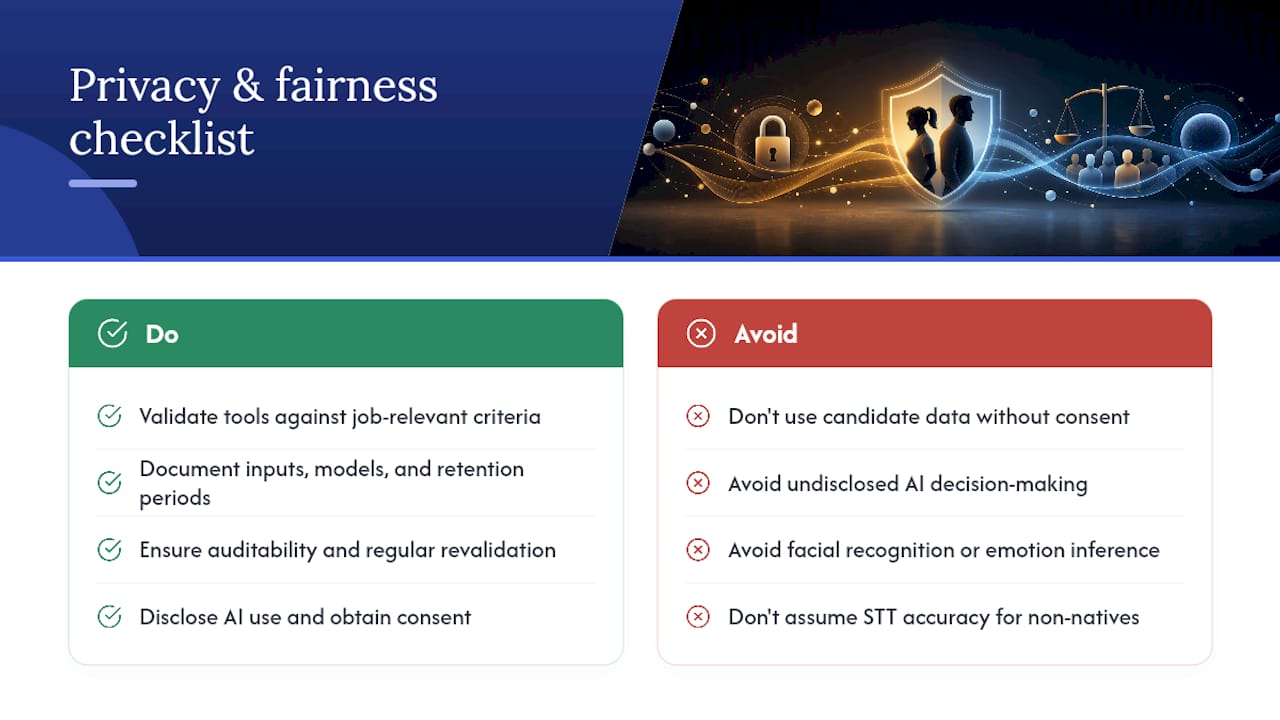
SIOP’s guidance on AI-based assessments is clear: AI selection tools must be validated against job-relevant criteria, and documentation must be more detailed than for traditional assessments because inputs now include unstructured audio and video. Rapidly evolving models can make prior validation outdated quickly, which is why auditability matters.
SIOP practitioners also flag “stealth” data as a core concern: using candidate data without explicit knowledge or consent is broadly regarded as unacceptable. Transparency about what is collected, how it is used, and how long it is retained is both an ethical standard and a practical differentiator when choosing a platform.
A Canadian HR Reporter survey found that 63% of job seekers had experienced an AI-led interview, and 70% said that AI use was not clearly disclosed beforehand. That disclosure gap creates real legal exposure for employers and real uncertainty for candidates.
UK government guidance on responsible AI in recruitment also warns that facial-recognition and some video analytics show uneven error rates across demographic groups, and that emotion inference from video has weak validity evidence. Non-native English speakers face additional accuracy gaps in some STT systems.
Pro Tip: If you are asked to complete an AI-screened interview and want to know more, you can say: “Could you share what AI tools are used in this process and how my data will be handled?” Most recruiters will answer. It signals professionalism, not suspicion.
How real-time interview AI works under the hood
Understanding the pipeline helps you judge a demo accurately and set realistic expectations.
A chunk-based streaming architecture processes transcript segments as they arrive rather than waiting for the full answer. A typical stack: LiveKit handles the audio/video stream, Deepgram Nova-2 transcribes in real time, an edge function scores each chunk, and a vector search retrieves resume context before the LLM generates a suggestion. Results push to the candidate’s screen via a real-time database subscription.
| Pipeline component | Typical latency |
|---|---|
| Speech-to-text transcription | Very low latency |
| LLM answer generation | Low latency |
| Total end-to-end pipeline | Typically designed to be under a few seconds |
Moving the STT connection server-side rather than running it in the browser cuts one network round trip and reduces dropped chunks on poor connections. Chunk overlap at segment boundaries smooths transcription errors. These are the architecture details worth asking about during a vendor demo.
Practically: pace your answers to allow a 2-second window after each question. That gap feels natural in conversation and gives the pipeline time to surface a useful suggestion before you commit to a direction.
ParakeetAI and the realistic US shortlist
For U.S. candidates in 2026, the shortlist looks like this:
Parakeet-ai is the reference for live answer assistance. It listens to your interview in real time and surfaces suggested answers as questions arrive, with resume-aware personalization. Read more about how AI assistants integrate with live interviews to understand what to expect before your first session.
TrueVoice HQ positions itself as a live-scoring platform with an interviewer dashboard. Useful if you are on the hiring side or want to understand how your answers are being scored, but it does not give you real-time suggestions as a candidate.
HireVue is the dominant enterprise video interview platform in the U.S. You will encounter it as a candidate, not choose it. It scores your responses after the fact.
Interviewing.io offers anonymous mock interviews with engineers from top companies. Excellent for technical rounds where realistic pressure and peer feedback matter more than AI suggestions.
Pramp provides free peer-to-peer mock interviews, particularly strong for coding and data science screens. No AI suggestions, but the practice quality is high.
Rehearsal focuses on async video practice with structured feedback. Best used in the weeks before a campaign, not the night before a screen.
Key Takeaways
Real-time live answer assistants like Parakeet-ai are the only category that helps you during an interview, not just before or after it.
| Point | Details |
|---|---|
| Live assistants are unique | Only real-time answer tools surface suggestions while the interviewer is still on the call. |
| Target 1.5–2.5 second latency | Well-built pipelines hit this window; test it yourself during any free trial. |
| Disclosure gaps are common | 70% of candidates in one survey said AI use was not disclosed before their interview. |
| Ask three vendor questions | Ask about data retention, third-party STT engines, and whether live mode is included in the trial. |
| Parakeet-ai is the reference | For live answer assistance with resume personalization, Parakeet-ai is the starting point to evaluate. |
The gap between what AI interview tools promise and what actually matters
The marketing around real-time interview AI tends to oversell the “autopilot” angle and undersell the preparation it still requires. A tool that surfaces a suggested answer in 2 seconds is only useful if you have practiced reading and adapting suggestions quickly enough to sound natural. Candidates who treat these tools as a crutch without building that skill tend to sound stilted. The ones who use them as a confidence scaffold, knowing the answer is there if they blank, perform noticeably better.
The privacy picture is also more complicated than most vendor pages admit. SIOP’s documentation standards and the disclosure gap data from HR Reporter both point to an industry that is moving faster than its governance. As a candidate, you are not powerless: asking about data use signals sophistication and often prompts more honest answers from recruiters than you’d expect.
The shortlist I’d give any candidate: start with Parakeet-ai for live sessions, use Pramp or Interviewing.io for realistic mock pressure, and treat HireVue and TrueVoice HQ as employer tools you should understand but cannot control.
Parakeet-ai gives you live answers when it counts most
Most interview prep tools help you get ready. Parakeet-ai helps you perform. It listens to your live interview, processes each question in real time, and surfaces a suggested answer tailored to your resume before you need to fill the silence. No post-session report, no async feedback loop. The help arrives when you actually need it.
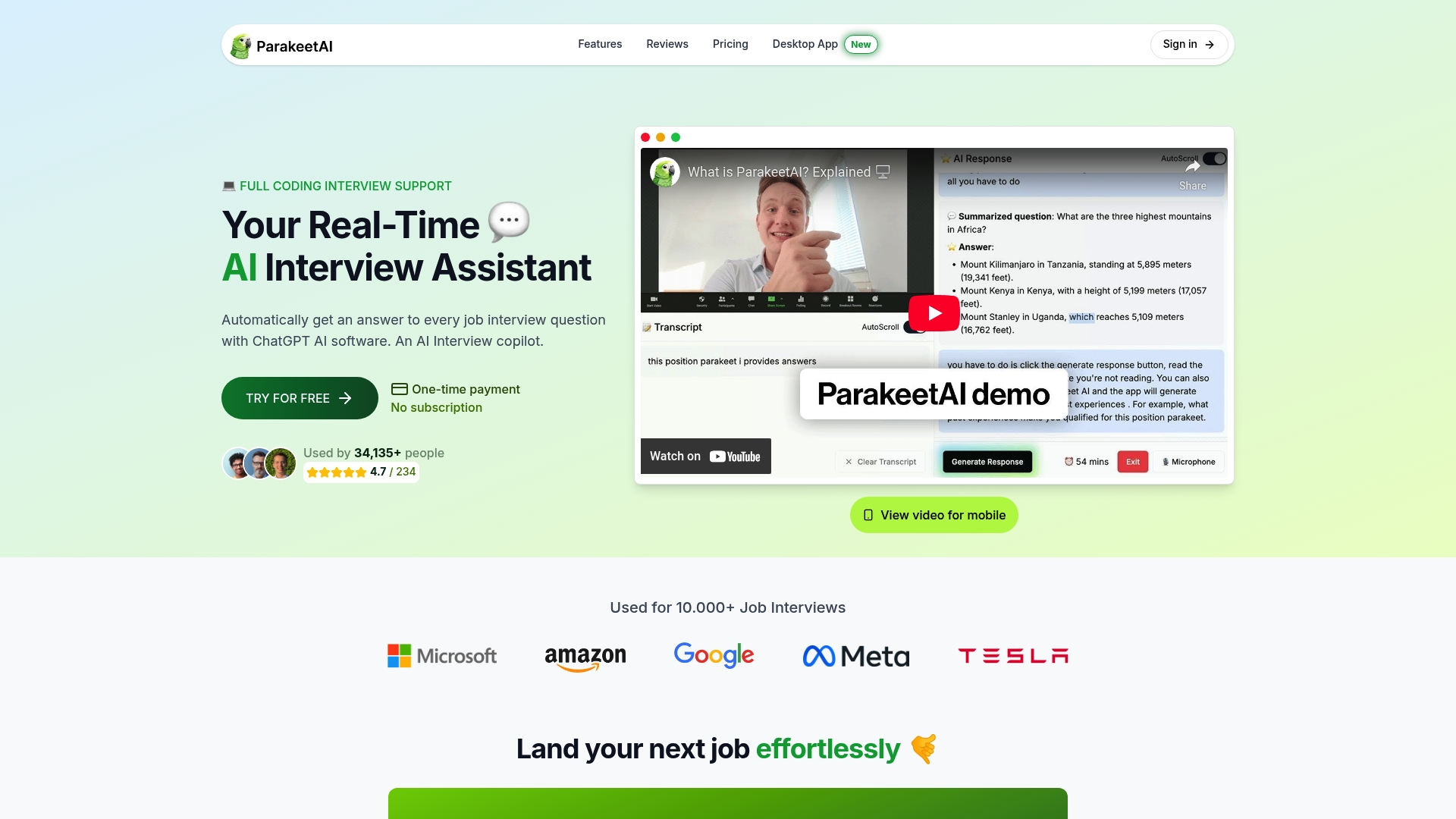
Before your next interview, run a demo session and check four things: how fast suggestions appear on your actual network, whether the tool references your specific resume, which video platforms it supports, and what the privacy policy says about data retention. Those four checks take under 20 minutes and tell you everything you need to know.
Start your free trial at Parakeet-ai and run a live practice session before your next screen.
Sources and further reading
- JO-HEEJIN/interview_mate
- Building a real-time AI interview analysis pipeline with LiveKit, Deepgram and Grok
- Considerations and Recommendations for the Validation and Use of AI-Based Assessments for Employee Selection
- Navigating the Open Seas of AI-Based Hiring Technologies: An Open Fishbowl Discussion — Society for Industrial and Organizational Psychology
- Responsible AI in Recruitment — GOV.UK
- Job interview bots? The hidden legal risks of AI job interviews | Canadian HR Reporter
- Real-time AI interview assistants: 40% more job offers