
Automated Interview Feedback: Transforming Job Prep

Facing interview rounds with AI-driven systems can leave even the most skilled Canadian or American technologist searching for reliable, actionable feedback. As AI-powered hiring gains ground across North America, understanding automated interview feedback is now a crucial edge in the competition for top technical roles. This guide lays out how these systems actually work, reveals their strengths and pitfalls, and provides practical tips for using AI-based feedback tools to sharpen your performance with confidence.
Table of Contents
- Automated Interview Feedback Defined and Debunked
- Key Types and Methods of AI Feedback
- How Real-Time Feedback Systems Work
- Benefits for Tech Job Seekers in 2026
- Limitations, Risks, and Bias Concerns
Key Takeaways
| Point | Details |
|---|---|
| Automated interview feedback enhances evaluations | AI systems analyze candidate responses to provide faster and more objective performance assessments. |
| Supplement, don’t substitute, human evaluation | AI tools are designed to complement human judgment, not replace it, by offering consistent feedback. |
| Be aware of biases and limitations | AI feedback systems can perpetuate biases and may not capture emotional intelligence, requiring careful interpretation. |
| Integrate insights for improvement | Use AI-generated feedback as a tool for ongoing development, aligning it with personal reflection and human insights. |
Automated Interview Feedback Defined and Debunked
Automated interview feedback represents a sophisticated technological approach where artificial intelligence systems analyze candidate responses and generate personalized performance assessments. These advanced systems leverage natural language processing to evaluate communication skills, content relevance, and overall interview effectiveness. Systematic reviews of AI-based feedback research demonstrate that while initially developed for educational contexts, these tools are rapidly expanding into professional recruitment environments.
At its core, automated interview feedback deconstructs candidate responses using complex algorithms that assess linguistic patterns, semantic coherence, and contextual appropriateness. Unlike traditional human evaluations, these AI systems can process multiple dimensions simultaneously - analyzing verbal content, tone, confidence levels, and structural elements of communication. The generative AI technologies underlying these platforms aim to provide timely, objective insights that complement rather than completely replace human judgment.
However, significant misconceptions persist about the capabilities of these automated feedback mechanisms. Generative AI technologies are not designed to entirely substitute human evaluation but instead serve as powerful supplementary tools. They excel at providing consistent, scalable assessments that can help candidates understand their performance nuances. Key limitations include potential algorithmic biases, contextual misunderstandings, and the inability to fully capture the emotional intelligence critical in professional interactions.
Pro Tip: When using automated interview feedback tools, treat them as diagnostic resources rather than absolute judgments, and always cross-reference their insights with human perspectives and personal reflection.
Key Types and Methods of AI Feedback
AI feedback systems represent a sophisticated approach to performance evaluation, utilizing multiple methodological frameworks to analyze and assess candidate responses. Diverse AI feedback methodologies include automated writing evaluation, essay scoring, and natural language processing-based analytic feedback. These systems employ complex techniques ranging from machine learning models to rule-based algorithms, each designed to provide nuanced insights into communication effectiveness.
The primary categories of AI feedback encompass formative, corrective, and summative assessment approaches. Formative feedback focuses on ongoing performance improvement, offering real-time suggestions and guidance. Corrective feedback identifies specific areas of linguistic or communication weakness, while summative feedback provides comprehensive performance evaluations. Generative language models have emerged as particularly powerful tools, capable of producing context-aware comments that adapt to individual communication styles and professional contexts.

Technical implementations of AI feedback systems leverage advanced linguistic analysis techniques, including semantic evaluation, discourse analysis, and contextual understanding. These systems can process multiple communication dimensions simultaneously - examining verbal content, structural coherence, emotional tone, and professional appropriateness. By integrating complex algorithmic approaches, AI feedback tools can generate multilayered assessments that go beyond traditional evaluation methods, providing candidates with granular insights into their interview performance.
Here’s how different AI feedback types function alongside their practical strengths and limitations:
| Feedback Type | Main Function | Key Strength | Notable Limitation |
|---|---|---|---|
| Formative | Real-time suggestions for skill growth | Supports ongoing improvement | May overlook nuanced communication |
| Corrective | Identifies specific weaknesses | Offers targeted recommendations | Can misinterpret context |
| Summative | Overall performance review | Provides comprehensive overview | May lack emotional insights |
Pro Tip: When interpreting AI-generated feedback, focus on identifying recurring patterns and specific actionable recommendations rather than treating individual suggestions as absolute judgments.
How Real-Time Feedback Systems Work
Real-time feedback systems represent a cutting-edge technological approach to job interview assessment, leveraging advanced data integration and artificial intelligence to transform candidate evaluation processes. Applicant tracking systems capture and analyze interview data instantaneously, enabling recruiters to collect comprehensive insights about candidate performance in real-time. These sophisticated platforms seamlessly integrate multiple talent management tools, creating a dynamic ecosystem of continuous performance evaluation.
The technical architecture of these systems relies on sophisticated natural language processing and machine learning algorithms that can decode complex verbal and non-verbal communication signals. By analyzing linguistic patterns, emotional tone, and contextual responses, these tools generate immediate, nuanced feedback that goes beyond traditional assessment methods. Generative AI technologies enable dynamic response adjustment, allowing the feedback mechanism to evolve continuously throughout the interview process, providing candidates with increasingly precise and personalized insights.
Critical to the effectiveness of real-time feedback systems are robust ethical frameworks that ensure fairness, relevance, and respect for candidate diversity. These systems are designed to provide constructive, actionable recommendations without introducing bias, using advanced algorithmic techniques to maintain objectivity. By synthesizing multiple data points and communication dimensions, real-time feedback tools offer a holistic view of candidate performance, helping both recruiters and job seekers understand communication strengths and areas for potential improvement.
Pro Tip: Treat real-time feedback as a developmental tool, focusing on pattern recognition and consistent improvement rather than viewing individual suggestions as definitive judgments.
Benefits for Tech Job Seekers in 2026
The landscape of technical job preparation is undergoing a revolutionary transformation, with AI-powered automated feedback systems emerging as game-changing tools for tech professionals. These advanced platforms provide unprecedented opportunities for candidates to refine their interview skills, offering detailed, personalized insights that were previously unavailable. By enabling iterative practice and immediate performance correction, these systems dramatically accelerate skill development and build candidate confidence across complex technical domains.
For technology professionals, automated feedback tools deliver multiple strategic advantages. They enable rapid identification of communication strengths and potential weaknesses, helping candidates develop more nuanced interview techniques. Technical problem-solving scenarios can now be simulated with extraordinary precision, allowing job seekers to practice complex technical communications in a controlled, analytically driven environment. This approach helps candidates better demonstrate their technical expertise while simultaneously improving their interpersonal communication skills.
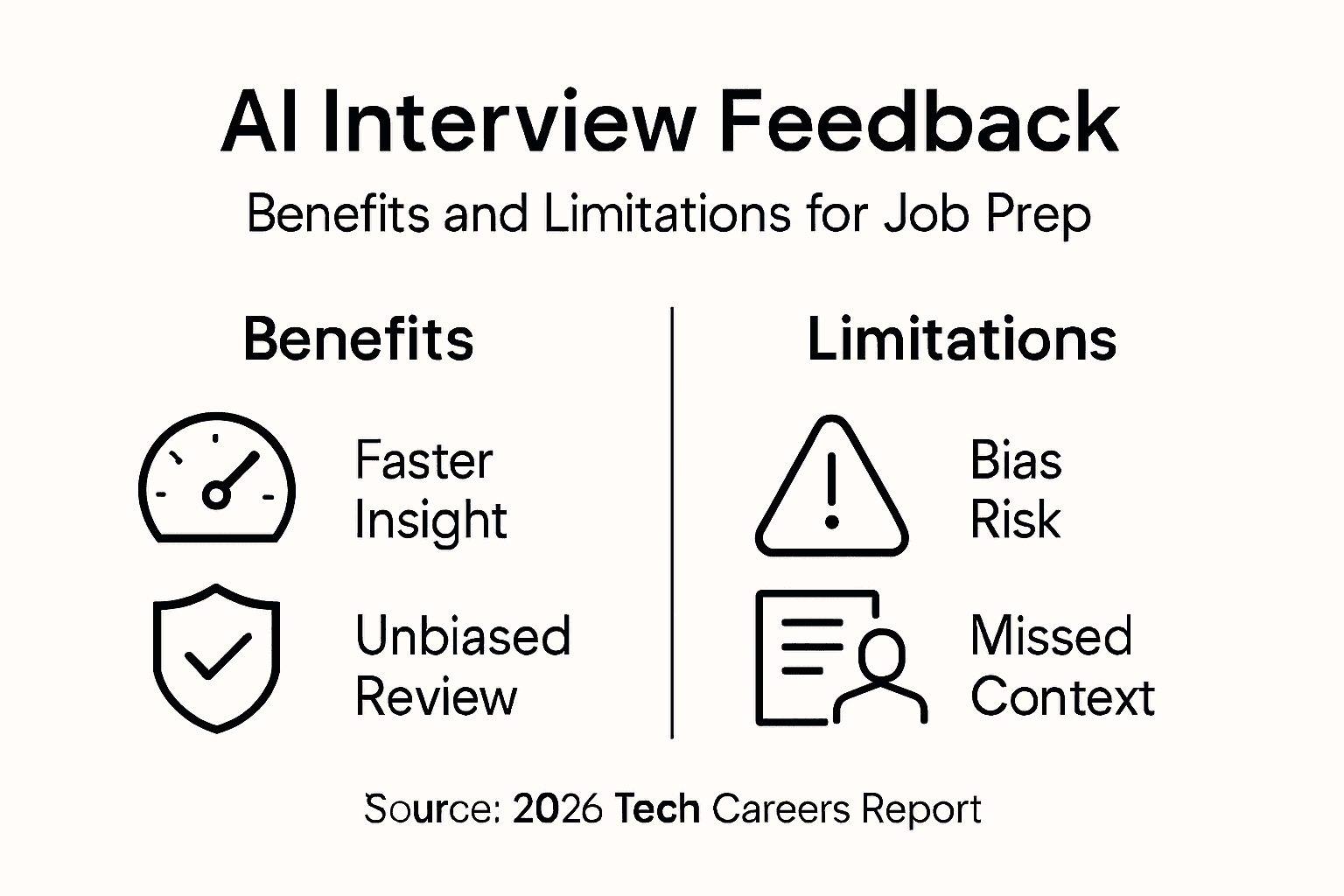
In 2026, generative AI technologies will provide even more sophisticated, context-sensitive feedback mechanisms. These tools will go beyond traditional assessment methods, offering granular insights into verbal communication, problem-solving approaches, and technical articulation. By reducing inherent self-assessment biases and providing objective, data-driven recommendations, automated feedback systems will become an essential component of professional development for tech job seekers looking to stand out in increasingly competitive job markets.
Pro Tip: Integrate automated feedback insights into your regular interview preparation routine, treating each recommendation as a strategic opportunity for incremental improvement.
Limitations, Risks, and Bias Concerns
Algorithmic bias represents a significant challenge in automated interview feedback systems, with potential systematic discrimination embedded in their design and implementation. These AI-driven tools can inadvertently perpetuate existing social inequities by reflecting biases present in their training datasets, potentially disadvantaging candidates from underrepresented backgrounds. The risk emerges when machine learning models are trained on historical data that may contain inherent demographic prejudices, leading to skewed assessments that do not genuinely reflect individual candidate potential.
The technical limitations of AI feedback mechanisms extend beyond bias concerns into deeper issues of contextual understanding and emotional intelligence. AI feedback systems struggle to comprehend nuanced communication subtleties, often producing generic responses that fail to capture the complexity of human interaction. These systems frequently struggle with interpreting emotional states, cultural communication differences, and the subtle interpersonal dynamics that human recruiters naturally understand. The inability to fully grasp psychological and contextual factors means that AI-generated feedback can sometimes miss critical qualitative aspects of candidate performance.
Mitigating these risks requires a multifaceted approach that combines technological innovation with rigorous ethical oversight. Organizations and developers must prioritize diverse, representative training datasets, implement transparent algorithmic auditing processes, and maintain human supervision to counterbalance AI limitations. This means continuously refining machine learning models, introducing diverse perspectives in development teams, and creating feedback mechanisms that can detect and correct potential biases. The goal is not to eliminate AI tools but to make them more sophisticated, empathetic, and truly inclusive.
Below is a summary of major benefits and risks tied to automated interview feedback for tech job seekers:
| Aspect | Benefit Example | Risk or Concern |
|---|---|---|
| Skill Development | Immediate performance insights | Bias from training data |
| Practice Efficiency | Fast feedback for interview prep | Misreading of context |
| Objectivity | Reduces self-assessment errors | Misses human subtleties |
Pro Tip: Always cross-reference AI-generated interview feedback with human perspectives, using the automated insights as a supplementary tool rather than an absolute evaluation.
Unlock Your Full Potential with Real-Time AI Interview Feedback
The article highlights the challenge many tech job seekers face in understanding and improving their interview performance through automated interview feedback. With concerns about bias, limited emotional insight, and the need for real-time, actionable guidance, candidates often struggle to pinpoint exactly how to enhance their communication and technical presentation. That is why harnessing advanced AI tools that listen actively and generate tailored feedback can transform your job preparation journey.
Experience a new era of interview practice with Parakeet AI, a real-time AI job interview assistant designed to provide instant, context-aware answers and feedback. This sophisticated platform addresses the pain points of delayed or generic responses by offering personalized coaching as you practice. It helps you identify recurring patterns, correct weaknesses immediately, and build confidence with every simulated interview.
Ready to revolutionize your interview preparation and overcome the limitations of traditional feedback methods?
Discover how Automated Interview Feedback combined with real-time AI insights can accelerate your growth today.
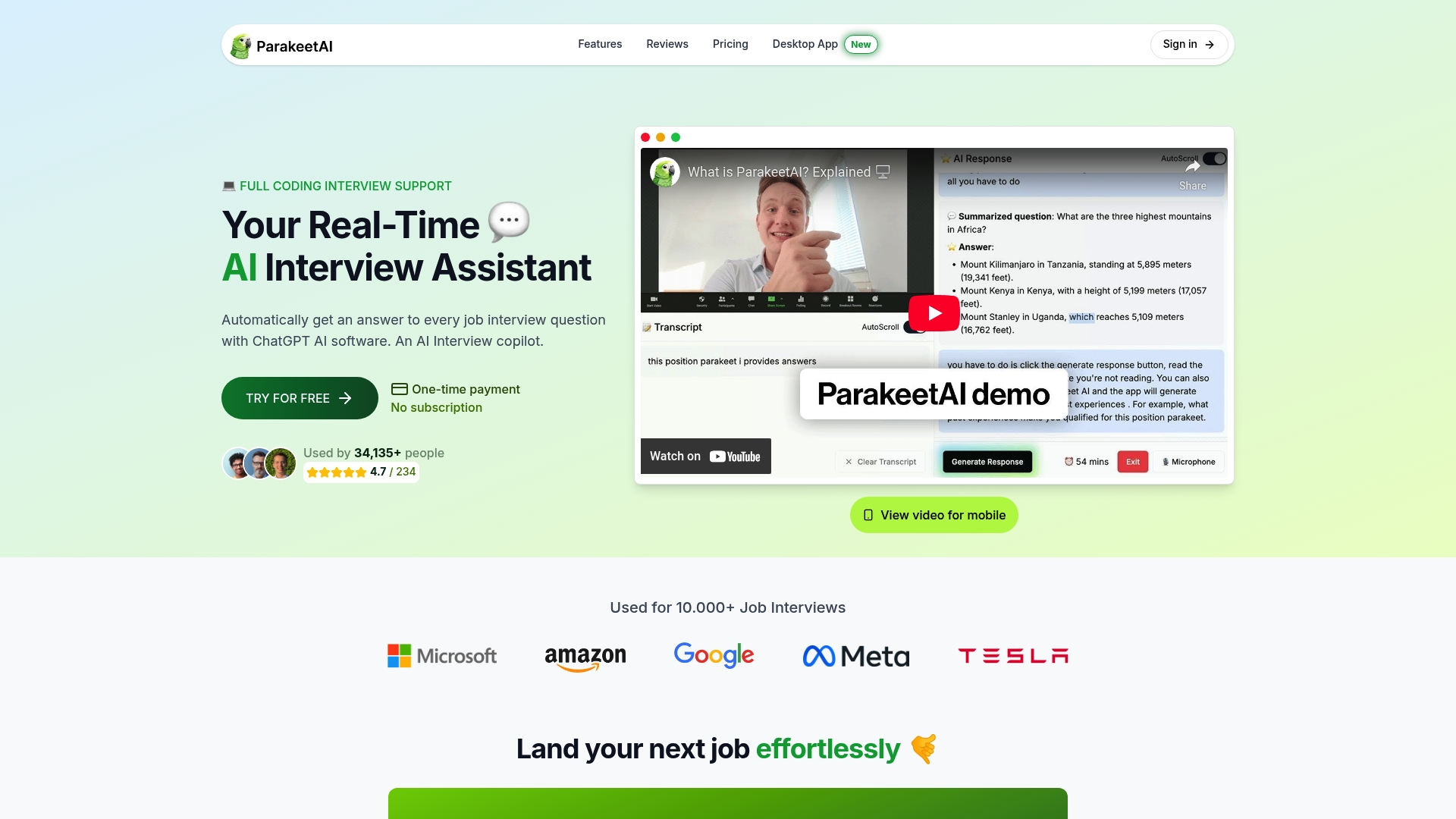
Take the first step toward mastering your next interview with Parakeet AI. Start practicing smarter and get the objective, scalable feedback you deserve now.
Frequently Asked Questions
What is automated interview feedback?
Automated interview feedback is a technology-driven approach where AI systems analyze candidate responses to generate personalized performance assessments, focusing on aspects like communication skills and interview effectiveness.
How does AI feedback improve interview preparation for tech job seekers?
AI feedback provides detailed, personalized insights that allow candidates to refine their interview skills, identify strengths and weaknesses, and practice complex technical communications in a dynamic environment.
What are the limitations of automated interview feedback systems?
Key limitations include algorithmic bias, context misunderstandings, and difficulties in capturing emotional intelligence, which can lead to generic responses that miss critical qualitative aspects of communication.
How can candidates effectively use automated feedback tools in their job preparation?
Candidates should treat automated feedback as a diagnostic resource, integrating insights into their regular preparation routines while cross-referencing AI-generated feedback with human perspectives for a comprehensive evaluation.