Best Coding Interview Practice in 2026: 7 Tools Compared
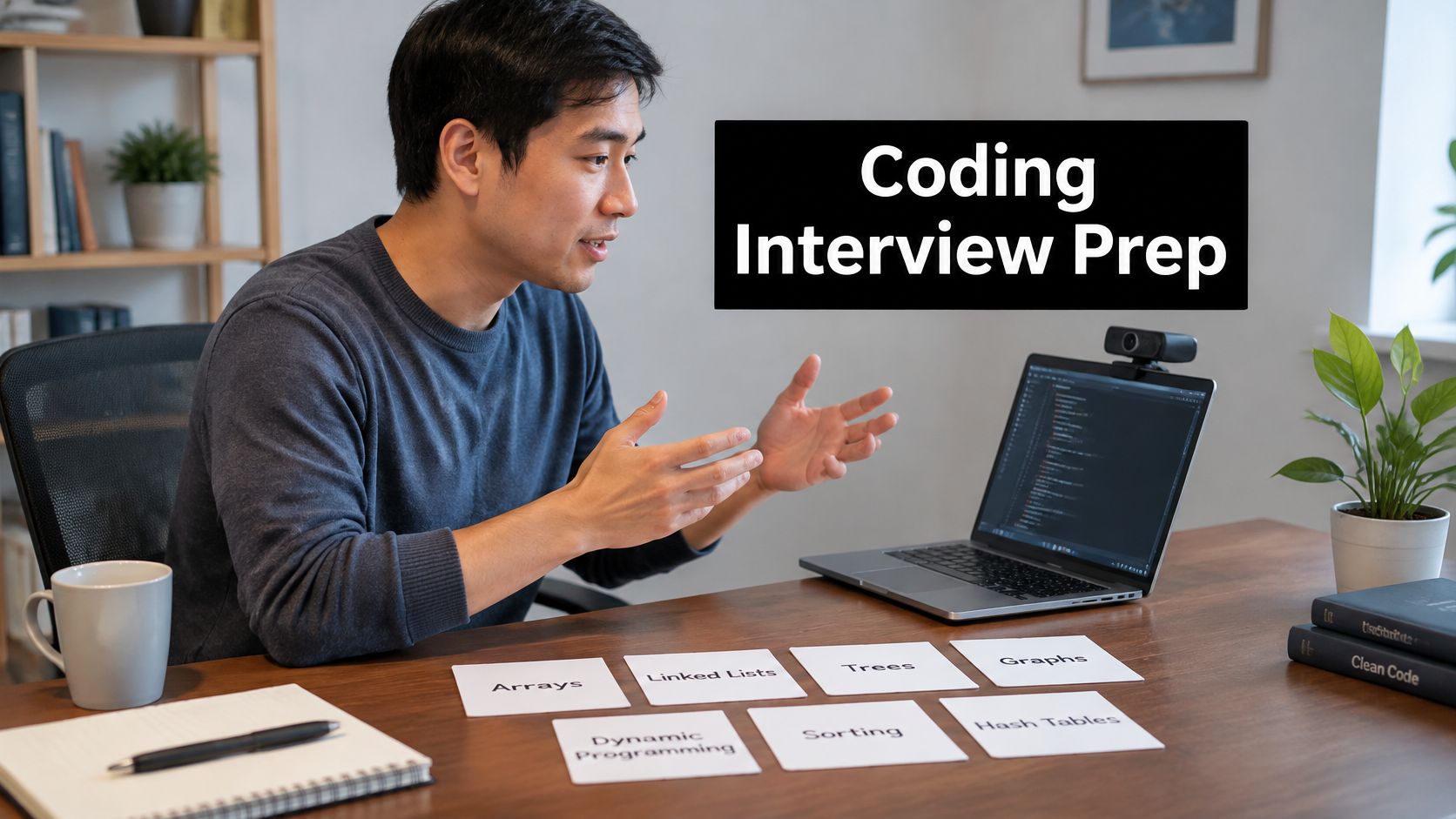
Solving more problems isn't always the best coding interview practice. You can spend months getting accepted submissions and still freeze when someone asks why you chose a hash map, whether your approach handles duplicates, or how you'd reduce memory use.
The mismatch matters because interviews aren't silent programming contests. In the 2024 CoderPad State of Tech Hiring survey, recruiters and developers rated live coding, defined as discussion combined with code, the most effective assessment format among those listed.
Practice the skill you're missing, not just the activity you can count. A problem bank helps you choose exercises. A roadmap helps you sequence concepts. A conversational mock helps you explain decisions while someone challenges them.
- Problem selection: Choose representative exercises instead of chasing an ever-growing completion total.
- Structured sequencing: Learn prerequisites before attempting problems that combine unfamiliar techniques.
- Spoken explanation: Rehearse clarification, trade-offs, debugging, and recovery under observation.
These options are ranked around those needs, rather than catalog size alone. For broader interview preparation for competitive engineering roles, pair coding preparation with project discussions and clear explanations of your engineering decisions.
1. ParakeetAI Mock Interview
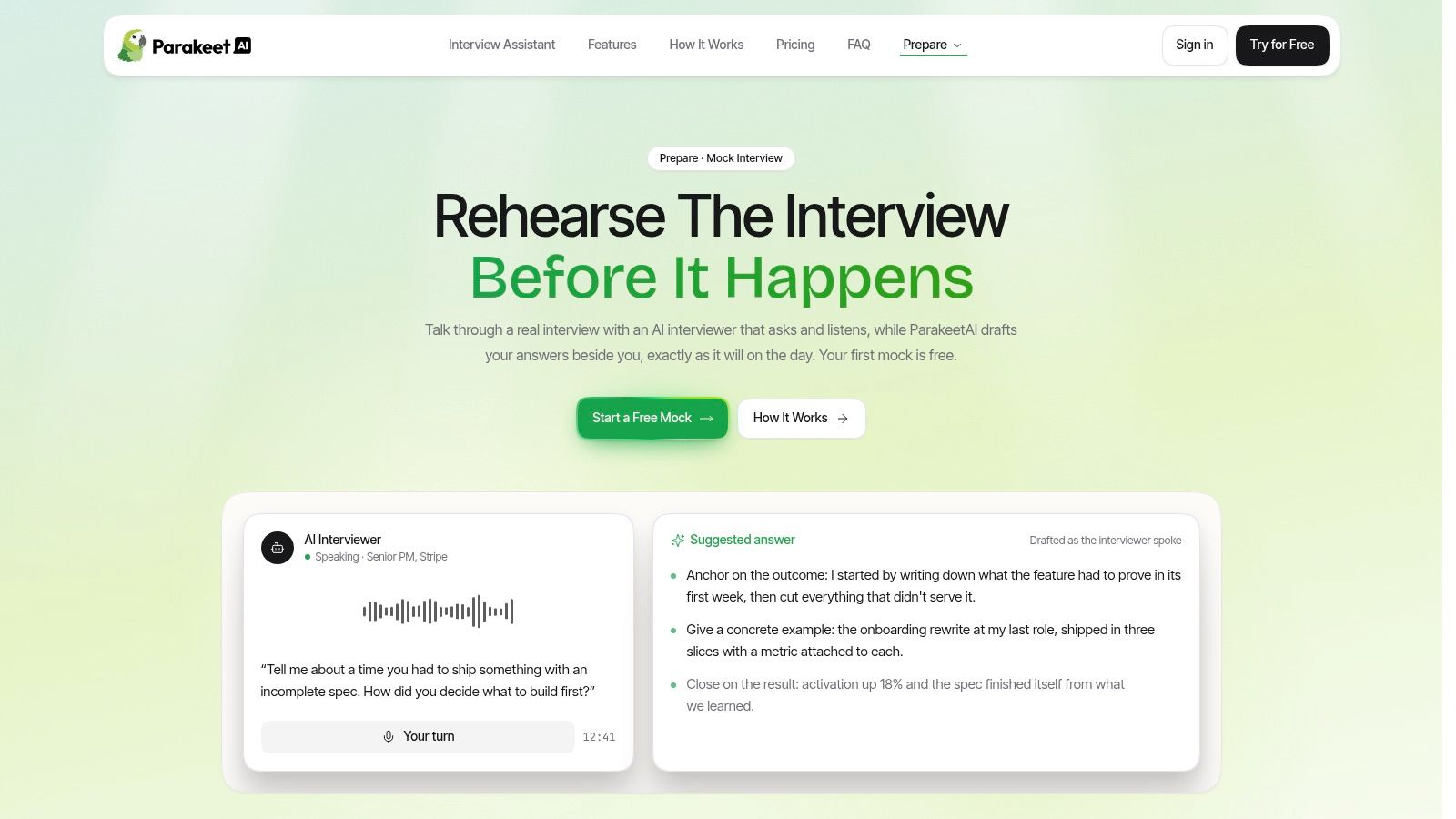
A coding solution can be correct and still be hard to follow when you explain it under pressure. ParakeetAI's Mock Interview trains that spoken skill: practice aloud with an AI interviewer that responds, asks follow-up questions, and provides a transcript to read afterward.
The exchange makes you listen and respond rather than recite a prepared explanation. Use it to rehearse how you clarify an assumption, explain a decision, and adjust your answer after a follow-up.
Use the Transcript to Find Specific Weaknesses
Review whether you stated the input constraints, explained your approach before coding, and distinguished an implementation bug from a mistaken algorithm. Notice where you named a technique without explaining why it applied.
For example, saying you'll use a sliding window is only the start. Explain what the window represents, when its boundary moves, and why that movement preserves correctness.
- Strengths: Spoken rehearsal, follow-up questions, and a transcript to review help you identify gaps in how you explain your thinking.
- Limits: An AI interviewer cannot fully reproduce a human interviewer's judgment, interruptions, or unpredictability.
- Access: The first mock interview is free, and trying the product requires no credit card. Further practice may require credits or an Unlimited subscription. See the pricing page for current options.
Use the mock between solo practice and a human interview. Rehearse an explanation, review the transcript, then solve a related problem independently to check whether your reasoning holds.
Practical rule: Check correctness and clarity separately. Fluent delivery does not make an incorrect complexity analysis correct.
2. LeetCode
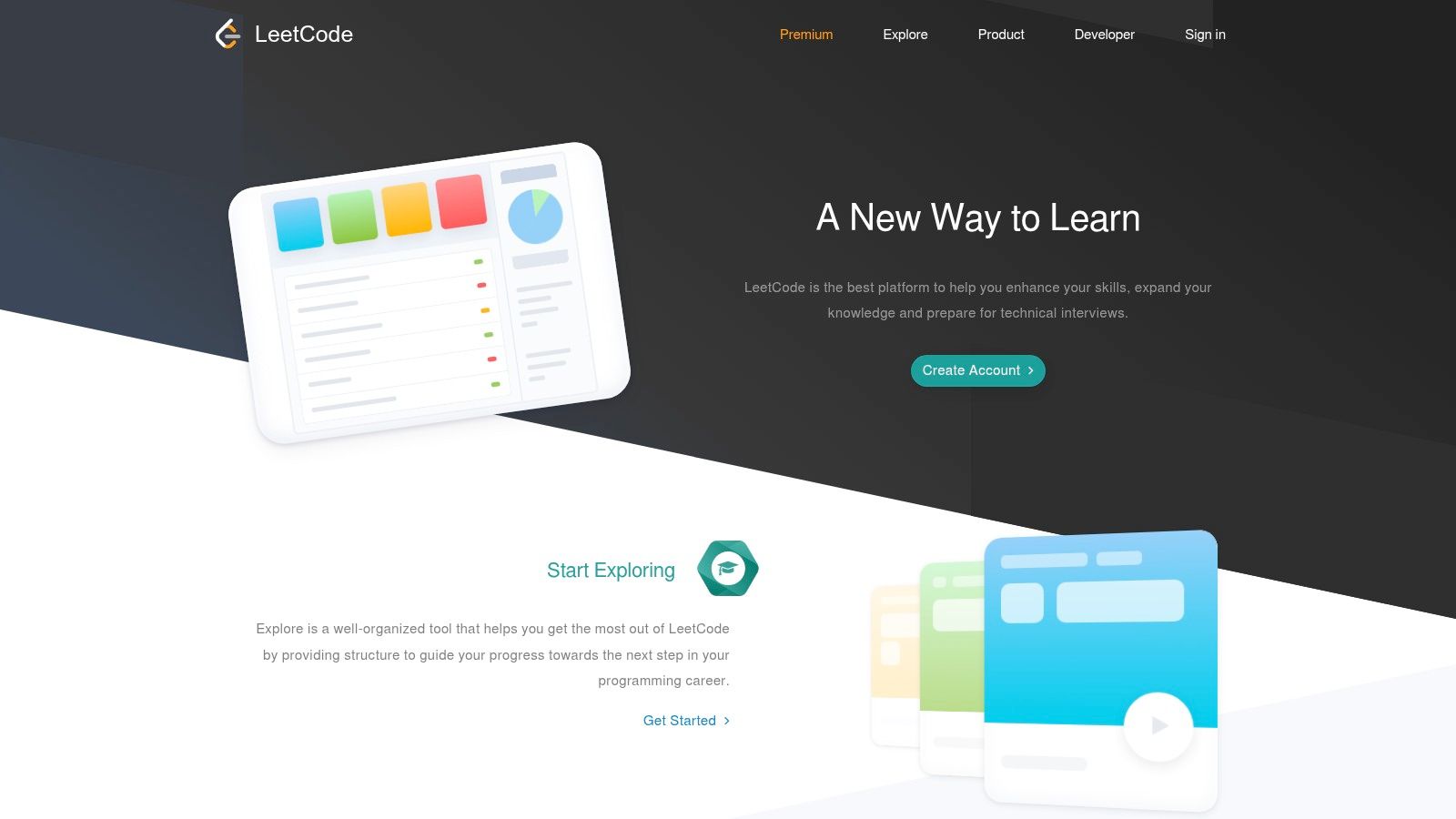
Choose LeetCode for problem selection and broad algorithm practice. Its catalog covers common data structures and difficulty levels, while study plans, discussion solutions, and contests provide different ways to work through the material.
The strongest reason to choose it is also its main drawback: breadth. You can find exercises targeting arrays, strings, trees, graphs, or dynamic programming, but browsing for the perfect next question can replace actual practice.
Use a Study Plan, Not the Entire Catalog
Start with a curated plan such as LeetCode 75, then select additional problems based on mistakes. If you repeatedly mishandle duplicate values, choose exercises that expose that weakness instead of switching to an unrelated topic.
Discussion pages are useful after a serious independent attempt. Compare why different approaches work, not just which submission looks shortest, and reimplement the solution without copying.
- What works: Many free problems, curated study plans, and multiple explanations support focused repetition.
- Paid additions: Premium includes company-question filters, a debugger, and timed interview simulations. Check current terms at checkout rather than relying on old price comparisons.
- What doesn't: An accepted submission doesn't demonstrate that you can explain your invariant, defend your complexity analysis, or respond to an interviewer.
A study of computer-science students' preparation found that 19 of 20 participants used LeetCode or a similar bank, while participants also raised concerns about prioritizing pattern recognition over deeper problem solving.
The fix isn't abandoning problem banks. Before submitting, explain why your chosen pattern applies and what would make it fail.
3. NeetCode
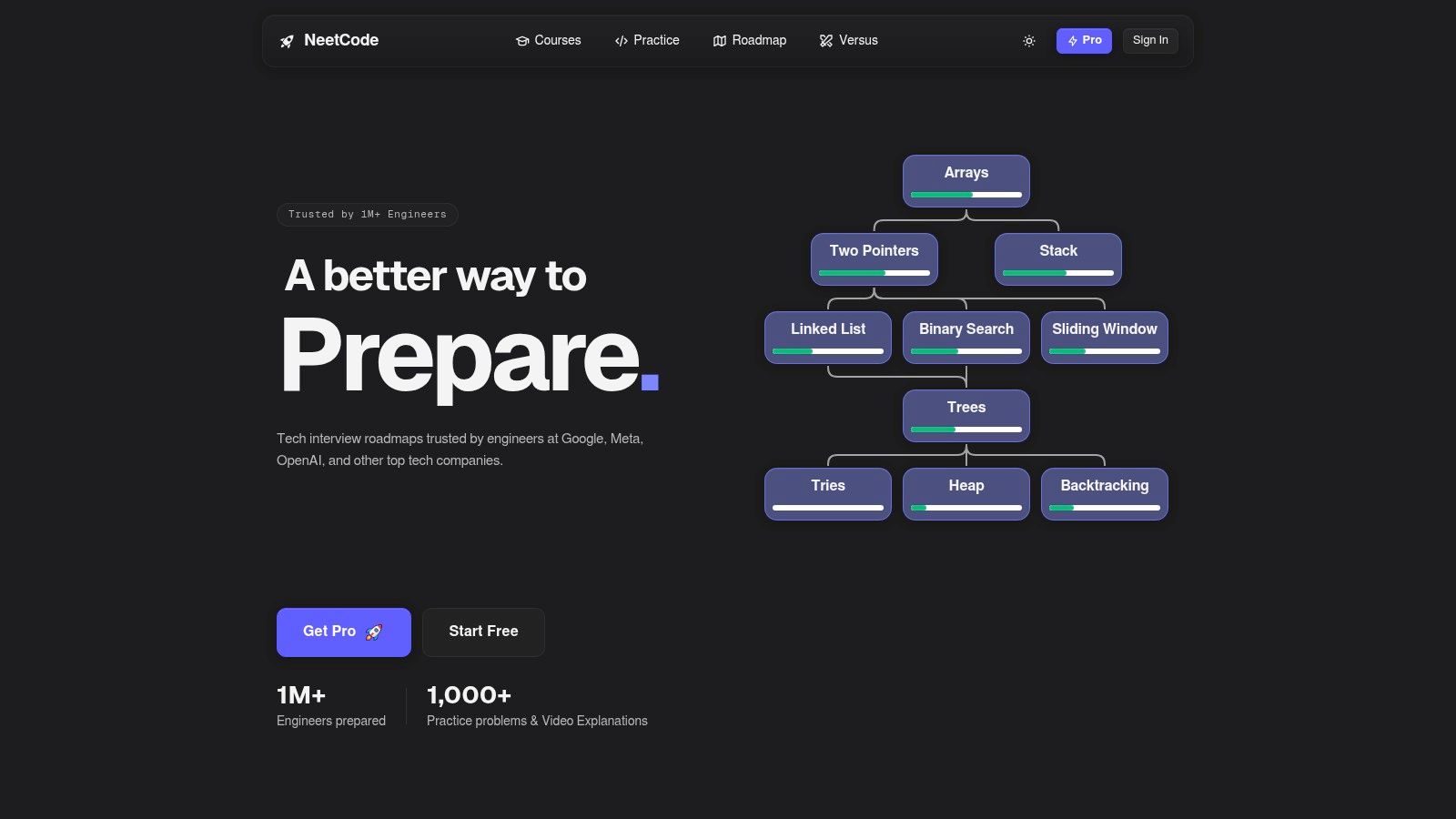
If you keep asking what to study next, NeetCode is the stronger fit for structured sequencing. Its curated roadmaps pair representative problems with video explanations, written guides, and worked code solutions.
Options include Blind 75, NeetCode 150, and NeetCode 250. Treat those as alternative scopes for preparation, not consecutive obligations you must finish before applying.
- Free starting point: Roadmap material helps you move through topics without building a curriculum yourself.
- Pro additions: An in-browser editor, progress tracking, hints, debugging help, and company-tagged problems support a more integrated workflow.
- Main limitation: The emphasis is data structures and algorithms. You'll need separate practice for behavioral answers, project discussions, and live interaction.
Attempt Before Watching
The danger is passive familiarity. A clear video can make a solution feel obvious even when you couldn't derive it independently.
Try the problem first and write down the exact obstacle before opening an explanation. Perhaps you can't define the recursive state, don't understand when to update a pointer, or can't justify a greedy choice.
After reviewing the explanation, close it and rebuild the solution. Then change a constraint, such as allowing negative values or requiring stable output order, and explain whether the original approach still works.
Watching someone derive a solution trains recognition. Reconstructing it without the explanation tests understanding.
I recommend NeetCode over an unstructured bank for candidates whose preparation consists of disconnected attempts. Once you can solve representative problems independently, move beyond the roadmap and test whether you can select the right approach without a topic label.
4. HackerRank
HackerRank suits candidates who need timed assessment practice alongside topic review. Its Interview Preparation Kit groups challenges by subjects such as arrays, hash maps, sorting, trees, and graphs.
The Software Engineer Prep Kit adds timed mock tests, AI-supported interviews, and a shareable role certification. Free practice challenges provide a starting point, while some preparation features require a subscription or credits.
Practice the Entire Submission Workflow
Use timed work to rehearse reading requirements, choosing an approach, implementing it, and checking edge cases. Don't stop your review at whether the platform accepted the answer; identify whether you lost time understanding input conventions, debugging syntax, or replacing an unsuitable algorithm.
A HackerRank analysis of more than 2,000 developers associated about 20 practice challenges among experienced developers with an approximately 35% rate of advancing directly to onsite interviews, compared with 24% among those who solved none. The analysis was observational, so it doesn't establish that completing that volume causes the improvement.
- Best use: Topic-based review followed by timed tests, especially when your upcoming assessment uses a similar format.
- Trade-off: The broader catalog still requires judgment about what to study, and platform familiarity isn't the same as general interview readiness.
- Paid features: AI Tutor and AI mock-interview access depend on the preparation offering you choose.
For the employer perspective, developer screening insights from MyCulture.ai provide context on assessment platforms. As a candidate, keep your own review focused on independently correct solutions, clear reasoning, and avoidable mistakes rather than certification alone.
5. CodeSignal Learn
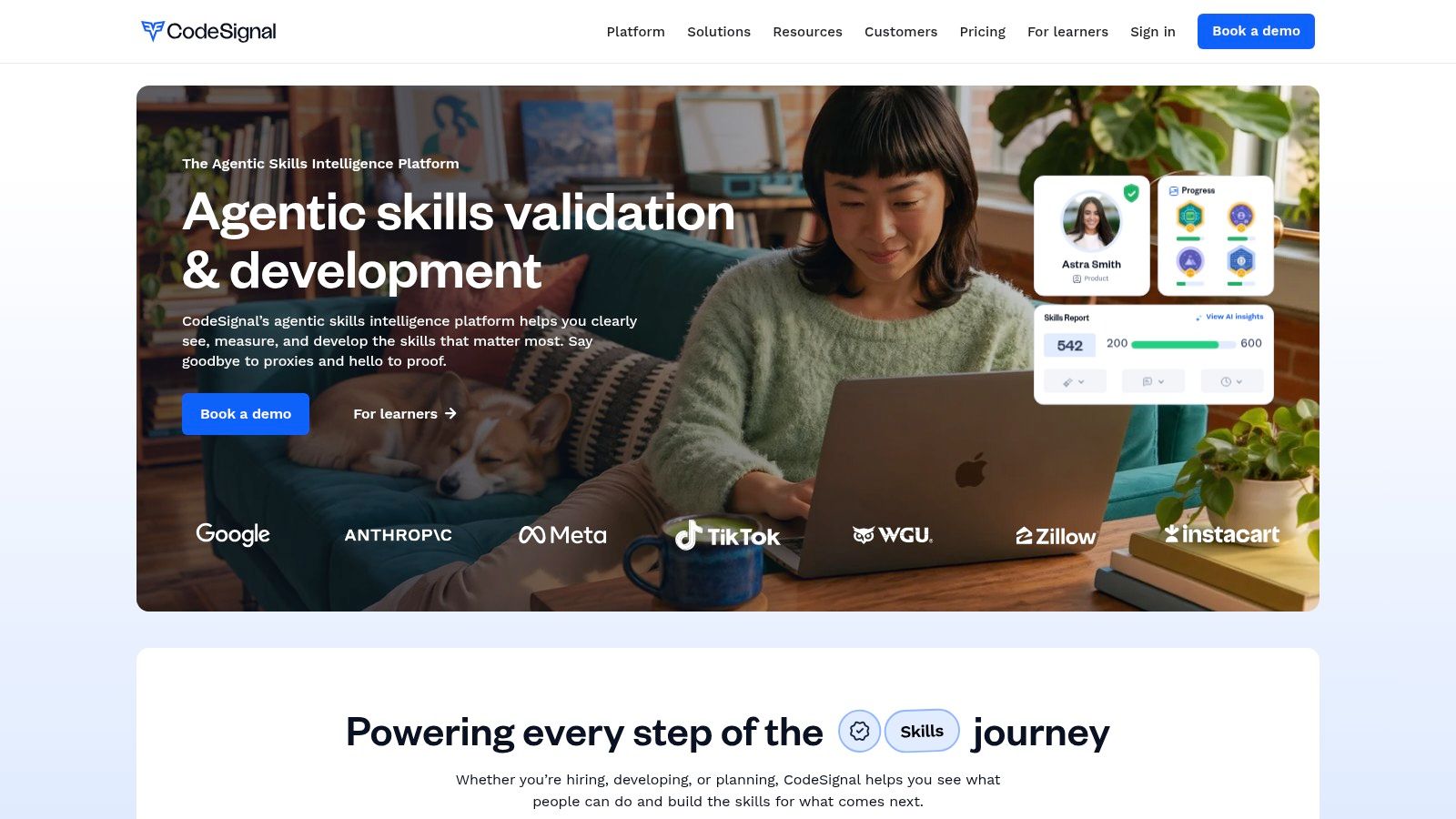
An unfamiliar editor is an avoidable distraction. CodeSignal Learn is most useful for assessment familiarity, particularly when you've confirmed that a prospective employer uses CodeSignal.
Its practice-based learning paths, built-in tutor, and assessment-style questions offer a more guided experience than selecting random exercises. Individual users can start free, with an optional paid upgrade for expanded access and benefits.
- Problem selection: Practice questions reflect assessment and coding-interview formats.
- Structured sequencing: Learning paths help organize practice instead of leaving every choice to you.
- Spoken explanation: Completing platform exercises still needs to be supplemented with verbal walkthroughs or mocks.
Separate Interface Friction From Knowledge Gaps
During practice, note whether you struggled with the algorithm or the environment. Problems with running tests, navigating code, or interpreting the task interface call for platform rehearsal; difficulty deriving an approach calls for foundational study.
This distinction prevents a common mistake: repeating familiar exercises because they feel productive while avoiding the topic you don't understand. Use the tutor to clarify a concept, then attempt a related problem without assistance.
Environment-specific practice has a sound practical basis. Google's technical-interview preparation guide recommends practicing with formats such as paper, a whiteboard, or an interview coding document, while checking readability and bugs before finishing.
That guidance doesn't describe CodeSignal's product or imply that Google uses it. The useful principle is to match your practice mechanics to the interview format you've been given.
I wouldn't choose CodeSignal Learn solely for its editor familiarity if your target process uses something else. Its distinctive value is strongest when guided learning and relevant assessment practice solve the same preparation gap.
6. Aced Practice
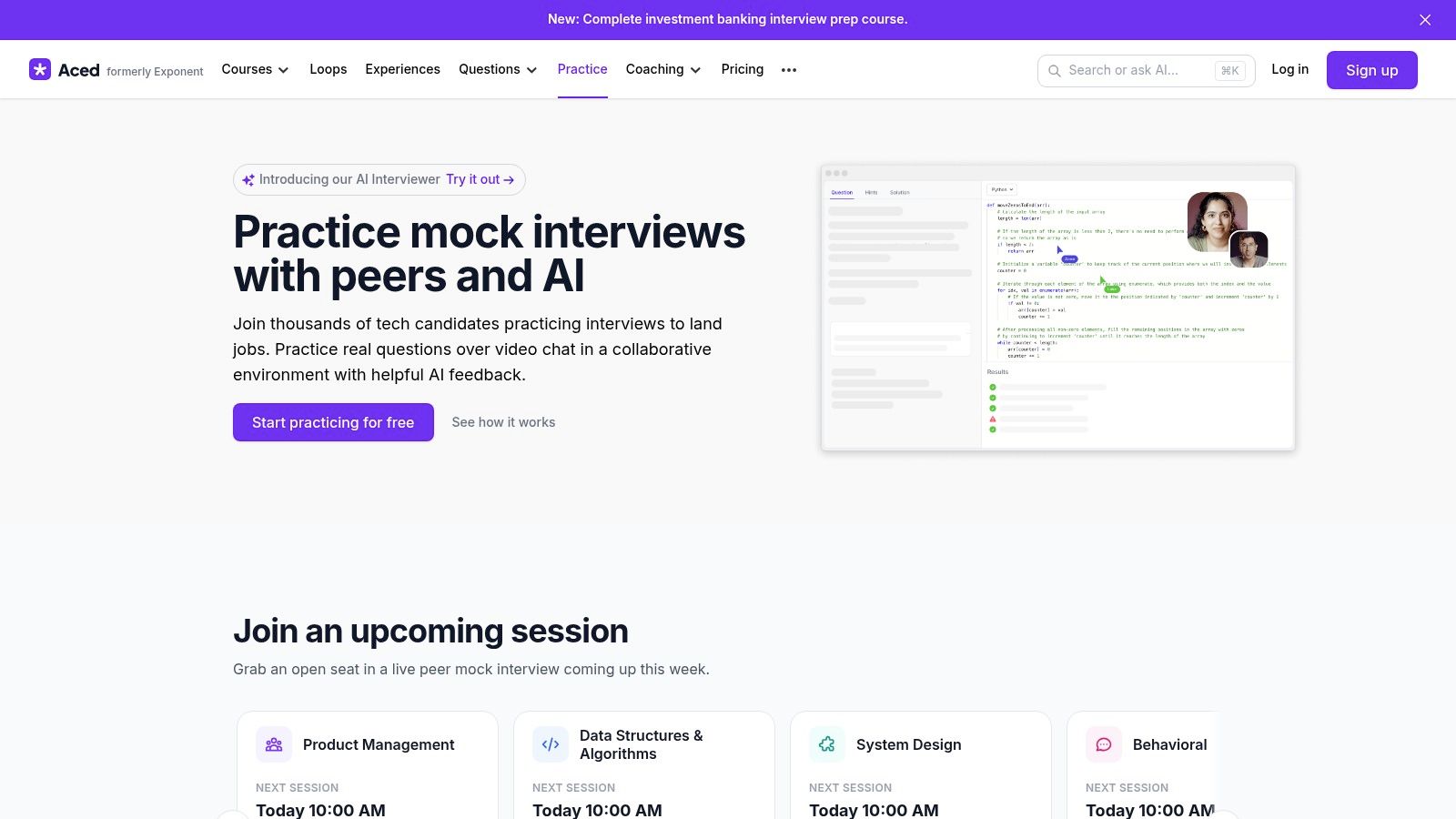
Being watched while thinking is a separate skill. Aced Practice addresses it through peer mock interviews in which participants take turns interviewing and being interviewed.
Coding sessions use a collaborative editor, so you practice explaining decisions to another person rather than only submitting code. Practice also extends to system design, behavioral interviews, SQL, frontend, and other interview types.
Make the Peer Session Worth Scheduling
Arrive with a clear goal, such as improving your initial clarification or explaining complexity without rambling. When you're the interviewer, prepare the prompt, understand its solution, and decide which clarifications you can provide.
Peer feedback works better when it describes observable behavior. Feedback that identifies an unstated assumption or a missing edge case is more actionable than a general confidence rating.
- Strengths: Live interaction, shared coding, and the interviewer role expose communication gaps that solitary work misses.
- Constraints: Session quality depends on the peer match and preparation, and you'll need to schedule or join an available session.
- Access: Free access includes limited monthly credits. Paid membership provides more access, with some AI feedback features reserved for members.
The Tech Interview Handbook describes coding rounds as commonly lasting about 30–45 minutes, with evaluation extending to communication, systematic problem solving, implementation, complexity, and testing.
Use that full workflow in your mock rather than coding continuously until time expires. Leave space for clarification and testing, and ask your partner to challenge an assumption.
Feedback worth requesting: Ask where your reasoning became difficult to follow, not whether you seemed generally prepared.
Aced suits candidates ready for human interaction but not yet looking for paid expert coaching.
7. interviewing.io
interviewing.io is the option I'd reserve for detailed human feedback near the end of preparation. It offers anonymous technical mocks with experienced engineers, including senior engineers and hiring interviewers from major technology companies.
Practice covers coding, algorithms, system design, machine learning, frontend, and behavioral interviews. An AI interviewer and a recorded mock-interview library provide additional preparation options before a human-led session.
- Best fit: Candidates who can solve core problems but need an external assessment of their explanation, pacing, and engineering judgment.
- Main advantage: Detailed post-session human feedback can distinguish a knowledge gap from unclear communication or poor time management.
- Main trade-off: Human-led sessions are considerably more expensive than self-serve practice. Use current booking prices, not previously published comparisons.
Buy Diagnosis, Not Just Another Attempt
Bring a specific uncertainty to the session. Perhaps your code usually works, but you can't tell whether your explanations are too long, your trade-off analysis is superficial, or you depend too heavily on hints.
The anonymous format may make practice feel lower pressure, but it doesn't remove the value of being observed. Treat the session seriously and ask for concrete examples behind each criticism.
Use AI mock interview practice for repeated spoken rehearsal between human sessions, then return to a human interviewer when you need nuanced judgment rather than another repetition.
Don't book expert mocks as a replacement for learning recursion, graph traversal, or basic complexity analysis. Their value is greater when you can act on the feedback immediately.
A productive follow-up is to solve a fresh problem while deliberately changing the behavior identified in the mock. If the same issue persists, you have a clear target for your next session.
How the seven coding interview practice options compare
| Item | Best for | Free option | Practice format | Feedback type |
|---|---|---|---|---|
| ParakeetAI Mock Interview | Spoken and technical interview rehearsal | One free mock interview | AI-led spoken interview with follow-up questions and coding practice | Saved transcripts for review |
| LeetCode | Broad data structures and algorithms preparation | Many problems available free | Coding problems, study plans, and contests | Automated results and community explanations |
| NeetCode | Structured DSA learning | Free roadmaps, videos, and guides | Curated problem sequences with written and video explanations | Worked solutions and learning explanations |
| HackerRank | Coding assessments and timed screening practice | Free practice challenges | Topic-based challenges and timed mock tests | Challenge results and AI-supported feedback in paid plans |
| CodeSignal Learn | Preparing for CodeSignal-style assessments | Free individual access | Assessment-style questions and guided learning paths | Built-in tutor and practice results |
| Aced Practice | Live peer mock interviews | Free access with limited monthly credits | Peer interviews with a collaborative code editor | Peer feedback; some AI feedback requires membership |
| interviewing.io | Realistic interviews with experienced engineers | AI interviewer and recorded mock interviews available | Anonymous human-led mocks, plus AI practice | Detailed feedback from human interviewers |
Match Your Practice to the Gap You Need to Close
The best coding interview practice combines independent problem solving, deliberate sequencing, and spoken explanation. You don't need every platform, and switching tools won't fix a habit you never examine.
Start with a problem bank or roadmap. Choose LeetCode for broad selection, NeetCode for a guided sequence, or HackerRank and CodeSignal Learn when assessment-style practice matches your upcoming process.
Add spoken practice once you can solve core patterns without constant hints. Use AI rehearsal for repeatable conversational practice, peer mocks for live interaction, and paid human sessions when you need detailed diagnosis in the final stretch.
- If you can't choose an approach: Review prerequisites and solve representative problems with a roadmap.
- If you understand explanations but can't reproduce them: Close the solution and implement independently.
- If you freeze under observation: Rehearse aloud and progress to another person watching you work.
- If you finish code but miss bugs: Reserve deliberate testing time and walk through boundary cases.
- If you're preparing for practical tasks: Include repository changes, debugging, tests, and requirement clarification.
Don't let algorithm preparation become your entire definition of engineering. In HackerRank's 2025 Developer Skills Report, 66% of developers preferred practical coding challenges, supporting the value of including realistic tasks alongside algorithm exercises.
For a practical rehearsal, modify unfamiliar code, add a test, explain a failure, and defend your implementation choices. Keep assistance boundaries explicit: practice unaided when you're testing your own ability, and follow the employer's stated rules during assessments.
Review What Changed
After each session, record the underlying mistake rather than only the problem title. Distinguish missing knowledge, incorrect assumptions, implementation errors, weak testing, and unclear explanation.
Credits and free access make it possible to test a tool before committing, but compare what you learned rather than how polished the interface felt. Review recordings where available or saved transcripts, then attempt a fresh problem that tests the same weakness.
Pick the combination that targets your weakest skill this month. Keep it until you can demonstrate improvement independently, then adjust your preparation around the next gap.
Our mock interview tool offers spoken practice with an AI interviewer that follows up on your answers, plus transcripts you can review afterward. Visit ParakeetAI to try your free mock interview and practice explaining a coding approach, testing its assumptions, and responding to follow-up questions.