
Good Job Interview Questions: 35% Higher Success with STAR

Preparing for interviews often feels overwhelming when you’re unsure which questions will actually showcase your strengths. Many candidates waste time memorizing answers to outdated questions while employers now prioritize behavioral insights and cultural alignment over purely technical skills. Understanding how to select strategic questions and craft compelling answers can dramatically improve your interview outcomes. AI-powered interview assistants are revolutionizing how candidates prepare and perform in real time.
Table of Contents
- Selection Criteria For Good Job Interview Questions
- Top Interview Questions And Their Strategic Uses
- Answering Behavioral And Situational Questions Effectively
- Questions To Ask Employers During Interviews
- Summary Comparison Of Interview Question Types
- Situational Recommendations For Job Seekers
- Enhance Your Interview Success With Parakeet AI
- Frequently Asked Questions About Good Job Interview Questions
Key Takeaways
| Point | Details |
|---|---|
| Question Balance | Effective preparation combines behavioral, situational, technical, and cultural fit questions tailored to your role. |
| STAR Method Impact | Using the STAR method boosts interview success rates by 35% through structured storytelling. |
| Asking Questions Matters | Candidates who ask 3+ thoughtful questions improve their hiring chances by 15%. |
| Quantifiable Results | Incorporating measurable achievements in answers increases evaluation scores by 25%. |
| AI Assistance Edge | Real-time AI tools enhance preparation adaptability and confidence during interviews. |
Selection Criteria for Good Job Interview Questions
Choosing the right questions to prepare for starts with understanding what employers truly want to learn about you. Your question selection should directly align with the specific role, industry expectations, and company culture you’re targeting.
Consider these essential factors when building your preparation strategy:
- Role relevance: Technical roles demand different questions than creative or management positions
- Interview stage: Early screenings focus on basics while final rounds explore deeper fit and leadership
- Seniority level: Entry positions emphasize potential and learning attitude, senior roles require proven results
- Company culture: Startups value adaptability differently than established corporations
- Question type balance: Mix behavioral (past experiences), situational (hypothetical scenarios), technical (skills verification), and cultural fit questions
Research shows that balancing question types significantly improves your ability to demonstrate well-rounded capabilities. Employers increasingly seek candidates who can prove past performance while showing future potential through various question formats.
Pro Tip: Create a question inventory organized by category before your interview. Prepare 2-3 strong examples for each behavioral area like teamwork, conflict resolution, and achievement. This framework lets you adapt quickly when interviewers explore unexpected angles.
Modern candidates gain an edge by using AI for interview preparation, which helps identify blind spots in question coverage and practice adaptive responses. The technology analyzes your answers in real time, suggesting improvements that strengthen your presentation during actual interviews.
Top Interview Questions and Their Strategic Uses
Understanding which questions appear most frequently helps you prioritize preparation time effectively. In 2025, behavioral questions dominate interview formats, comprising over 60% of commonly asked questions as employers shift focus toward evaluating real-world problem-solving abilities.
The question “Tell me about yourself” remains the universal interview opener. This deceptively simple prompt sets the tone for everything that follows. Your answer should deliver a concise professional narrative connecting your background to the role’s requirements in under two minutes.
Behavioral questions form the interview backbone because they reveal how you’ve actually performed in past situations:
- “Describe a time you faced a significant challenge at work”
- “Give an example of when you demonstrated leadership”
- “Tell me about a conflict with a colleague and how you resolved it”
- “Share a situation where you failed and what you learned”
- “Explain how you handled competing priorities under tight deadlines”
Technical questions vary dramatically by industry. Software developers face coding challenges, healthcare professionals encounter clinical scenarios, and marketers discuss campaign strategies. Regardless of field, technical questions verify you possess the hard skills the role demands.
Motivation and cultural fit questions have gained prominence as companies recognize that skills can be taught but alignment with values cannot:
- “Why do you want to work here?”
- “Where do you see yourself in five years?”
- “What motivates you professionally?”
- “How do you define success?”
- “Describe your ideal work environment”
The most effective candidates support every answer with measurable achievements. Rather than saying you “improved team efficiency,” specify you “reduced project completion time by 30% over six months.” These concrete details make your capabilities tangible and memorable.

Staying current with evolving job interview questions ensures your preparation reflects what employers actually ask today, not outdated formats from years past.
Answering Behavioral and Situational Questions Effectively
Mastering the STAR method transforms rambling stories into powerful, structured responses that interviewers can easily evaluate. This framework guides you through four critical components: Situation, Task, Action, and Result.
Here’s how to build compelling STAR answers:
- Situation: Set context with 1-2 sentences describing the relevant background and challenge
- Task: Clarify your specific responsibility or goal in that scenario
- Action: Detail the concrete steps you took, emphasizing your individual contributions
- Result: Share measurable outcomes and lessons learned from the experience
Research demonstrates that using the STAR method improves interview success rates by 35% because it creates clear, memorable narratives. Interviewers can quickly assess your capabilities when information follows a logical structure.
Quantifiable achievements matter enormously. Candidates who highlight measurable results achieve 25% higher evaluation scores than those offering vague descriptions. Transform “I improved sales” into “I increased quarterly sales by $150,000, representing 22% growth.”
“The difference between a good answer and a great answer is specificity. Numbers, percentages, and concrete outcomes make your experience real and verifiable to interviewers.”
Cultural alignment amplifies answer effectiveness. Studies show 75% of hiring managers prioritize cultural fit when evaluating responses. Research company values beforehand and weave relevant themes into your stories naturally.
Pro Tip: Record yourself answering practice questions using STAR. Watch for filler words, unclear timelines, or missing results. This self-audit reveals presentation weaknesses you can correct before the actual interview.
Learn more about structuring strong interview answers to refine your delivery and maximize impact during high-pressure conversations.
Questions to Ask Employers During Interviews
Asking thoughtful questions demonstrates genuine interest while helping you evaluate whether the opportunity truly fits your goals. This reciprocal exchange shifts you from passive candidate to active evaluator, a dynamic that impresses interviewers.
Prepare at least three substantive questions covering different aspects of the role and organization. Candidates who ask 3+ thoughtful questions increase their hiring likelihood by 15% because they signal serious engagement and strategic thinking.
Effective questions to consider:
- “How do you measure success for this position in the first 90 days?”
- “What does a typical career path look like for someone in this role?”
- “Can you describe the team culture and collaboration style?”
- “What are the biggest challenges facing your department currently?”
- “How does the company support professional development and continued learning?”
- “What excited you most about joining this organization?”
Tailor questions based on pre-interview research. Reference recent company news, product launches, or industry positioning to show you’ve invested time understanding their business. Generic questions suggest superficial interest.
Avoid questions about salary, benefits, or vacation time during initial interviews unless the interviewer raises compensation first. Save these practical matters for later stages when mutual interest is established.
Your questions also clarify role expectations and organizational fit. If work-life balance matters to you, ask about typical hours and remote work policies. If growth drives you, explore promotion timelines and skill development support.
Close strategically by asking about next steps and timeline. This reinforces your enthusiasm while providing clarity on the hiring process. Discover more strategies for preparing questions to ask interviewers that showcase your analytical thinking.
Summary Comparison of Interview Question Types
Understanding the distinct purposes and characteristics of each question type helps you allocate preparation time strategically and recognize what interviewers seek from specific prompts.
| Question Type | Primary Purpose | Best Interview Stage | Key Strength | Main Limitation | AI Preparation Value |
|---|---|---|---|---|---|
| Behavioral | Evaluate past performance and decision-making patterns | All stages, especially mid rounds | Provides concrete evidence of capabilities through real examples | Past behavior may not predict future performance in different contexts | High - AI can help identify story gaps and strengthen STAR structure |
| Situational | Assess problem-solving approach and hypothetical judgment | Early to mid stages | Tests thinking process and adaptability to new scenarios | Theoretical responses may not match actual behavior under pressure | Very High - AI offers real-time scenario analysis and response frameworks |
| Technical | Verify specific hard skills and knowledge required for role | Mid to final rounds, varies by industry | Directly measures job-critical competencies | May overlook soft skills and cultural alignment equally important for success | Medium - Better for general concepts than specific technical depth |
| Cultural Fit | Determine alignment with company values and work environment | Final rounds, sometimes early screening | Predicts long-term retention and team harmony | Subjective evaluation can introduce bias | Medium - AI helps articulate values but genuine alignment must be authentic |
Entry-level candidates should emphasize behavioral and cultural fit questions since they often lack extensive technical experience. Seasoned professionals benefit from showcasing technical mastery alongside leadership behavioral examples that demonstrate measurable impact.
Industry context matters significantly. Tech companies weight technical questions heavily in early stages. Creative agencies prioritize portfolio discussions and situational creativity tests. Consulting firms rely on case study situational questions to assess analytical thinking.
Explore how different question types work together in the comparison of question types to build comprehensive interview readiness across all evaluation dimensions.
Situational Recommendations for Job Seekers
Your preparation strategy should reflect your unique circumstances, experience level, target industry, and available tools. One-size-fits-all approaches waste time on irrelevant preparation while leaving critical gaps.
Entry-level candidates face a distinct challenge: limited professional experience. Focus your preparation on:
- Academic projects, internships, volunteer work, and extracurricular leadership as experience sources
- Behavioral questions emphasizing learning agility, teamwork, and motivation
- Demonstrating potential through enthusiasm and cultural alignment
- Preparing thoughtful questions that show research and genuine interest
Experienced professionals must demonstrate proven value through:
- Leadership behavioral examples with quantified team and business impact
- Technical depth appropriate to senior role requirements
- Strategic thinking evidenced through situational question responses
- Industry-specific knowledge and market awareness
Industry-specific preparation requires targeted focus:
- Technology roles demand coding challenges, system design questions, and technical problem-solving scenarios
- Healthcare positions explore clinical judgment, patient interaction examples, and regulatory knowledge
- Sales careers emphasize negotiation stories, revenue achievement metrics, and relationship-building examples
- Creative fields showcase portfolio work through situational discussions about creative process and collaboration
Candidates using AI tools gain significant advantages in preparation depth and interview adaptability. AI assistants analyze your response patterns, identify improvement areas, and provide real-time coaching during practice sessions. This technology proves especially valuable for handling unexpected questions that fall outside standard preparation.
Remote and hybrid interview formats introduce additional considerations. Test technology beforehand, ensure proper lighting and background, and prepare for screen-sharing technical demonstrations. Virtual settings can feel less personal, so amplify your enthusiasm and engagement through vocal energy and direct camera eye contact.
The role of AI assistants in interviews continues expanding as candidates recognize how real-time support builds confidence and improves response quality across diverse interview scenarios and formats.
Enhance Your Interview Success with Parakeet AI
Transforming interview preparation from theoretical knowledge into confident performance requires practice, feedback, and adaptability. Parakeet AI delivers real-time coaching that helps you perfect answers during actual interviews, not just practice sessions.
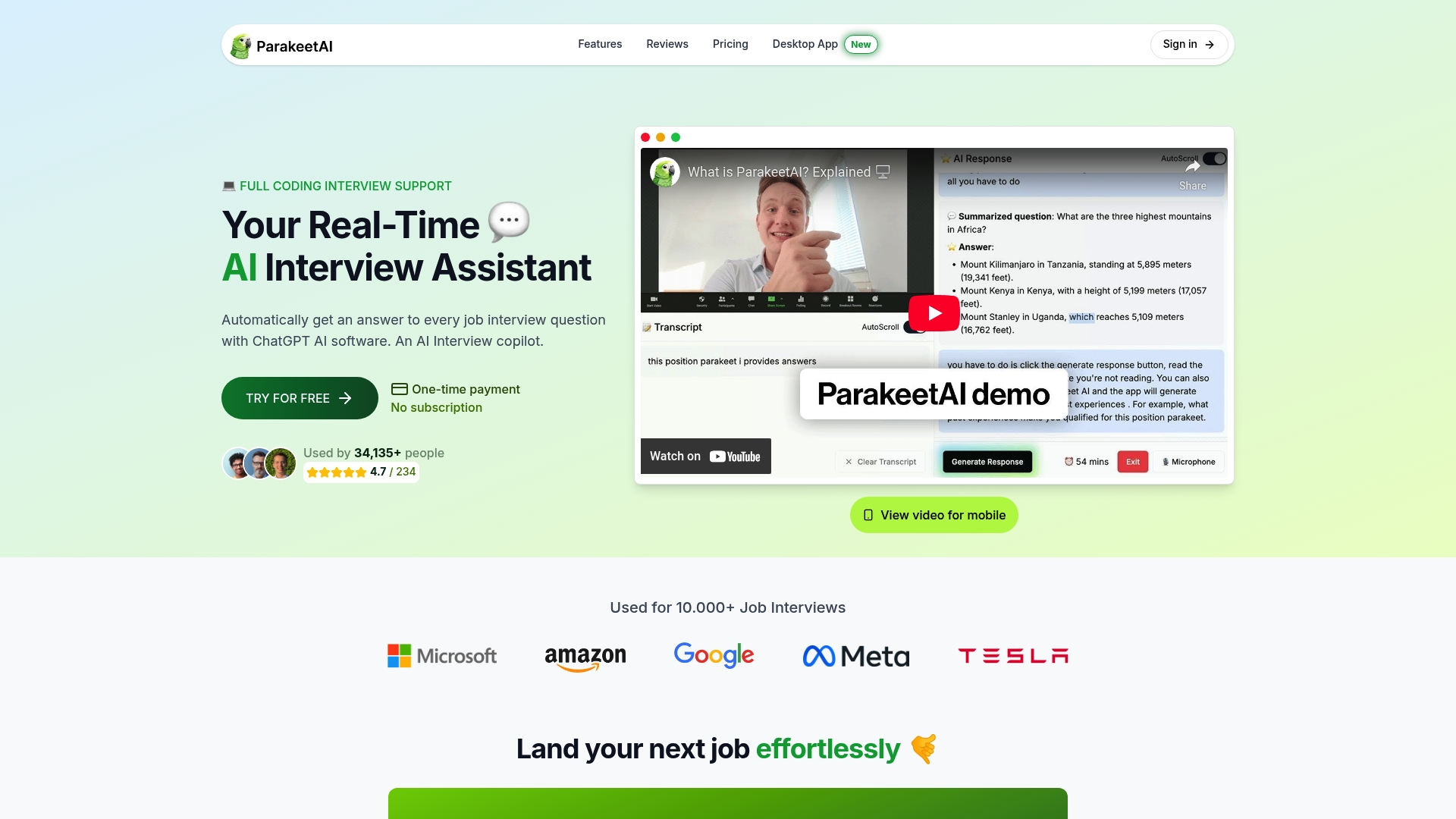
Our AI assistant listens to interview questions and instantly provides structured guidance for behavioral, technical, and situational responses. You gain confidence knowing expert support is available for unexpected questions that catch you off guard.
Strategic preparation with AI means identifying your specific weaknesses and receiving personalized improvement suggestions. The technology adapts to your industry, experience level, and target role, delivering relevant coaching that matches your unique situation.
Discover why AI-powered interview assistance has become essential for 2025 job seekers who refuse to leave success to chance. Explore the role of AI assistants in interviews and see how technology bridges the gap between preparation and performance. Visit ParakeetAI to transform your interview outcomes starting today.
Frequently Asked Questions About Good Job Interview Questions
What are the most effective types of interview questions to prepare for?
Behavioral questions deserve primary focus since they comprise over 60% of interview content and reveal how you’ve actually performed in past situations. Balance this with situational questions testing problem-solving, technical questions verifying hard skills, and cultural fit questions demonstrating alignment with company values. Industry and role determine exact emphasis.
How does the STAR method improve interview answers?
The STAR framework (Situation, Task, Action, Result) structures your responses into clear narratives that interviewers can easily evaluate and remember. This method improves success rates by 35% because it eliminates rambling while ensuring you cover all critical components: context, your role, specific actions taken, and measurable outcomes achieved.
How many questions should I ask the interviewer?
Prepare at least three thoughtful questions covering role expectations, company culture, and growth opportunities. Asking 3+ substantive questions increases hiring chances by 15% and signals genuine engagement. Tailor questions based on prior research rather than asking generic prompts that suggest superficial interest.
Can AI assistants really help me perform better in interviews?
Yes, AI interview assistants provide real-time coaching during actual interviews, not just practice sessions. They help structure STAR responses, handle unexpected questions, and suggest improvements based on your specific industry and experience level. This technology builds confidence and adaptability, especially valuable when facing questions outside your standard preparation scope.
What’s the best way to tailor my questions for different interviewers?
Research each interviewer’s role, background, and tenure at the company beforehand using LinkedIn and company websites. Ask technical leads about project challenges, HR representatives about culture and development, and executives about strategic direction and vision. This customization shows respect for their expertise while gathering diverse perspectives on the opportunity.
Recommended
- 7 Essential Job Interview Tips for Success in 2025
- Common Situational Interview Questions: Strategies That Win Jobs
- 7 Essential Tips to Answer Interview Questions Confidently
- Master the Best Interview Answers for Success
- Setting Smart Financial Goals: Achieve Financial Success - Finblog
- Match a CV with a Job Offer – AI-Powered CV Analysis